
Strelitzia nicolai
-
- 985. 2017/03/07. Pretoria NBG. Photo: David Becking.
General Info – summary
Banana-like Tree and ringed woody unbranched stem and fan-shaped crown to 12m high. Simple Leaves are distichous to (1,8 x 0,6m). Big compound inflorescence has bisexual & irregular Flowers in a spathe. Each flower has 3 (1 short) white protruding sepals and 2 of 3 blue petals form an arrowhead. Tri-locular, inferior ovary has 3 stigmas. Dehiscent Fruit is a woody capsule. Orange aril is on each black seed.
Description
Previous Names: Strelitzia augusta, Strelitzia quensonii.
SA Tree No. 34.
Common names: (Afr) Kuswildepiesang, Natalse Valspiesang, Natalse Wilde-piesang, Natalse wildepiesang, Witpiesang. (Eng) Coastal Strelitzia, Natal Mock Banana, Natal Strelitzia, Natal Wild Banana, Wild Banana, Giant bird of paradise, White bird of paradise. (isiXhosa) Ikhamanga, Isigceba, Isigude. (isiZulu) Igceba, inkamanga, Isigceba. (Xitsonga) Angude.
Family: Strelitziaceae (Strelitzia or Crane flower family). The large Leaves, in 2 opposite vertical rows, are sheathing at the base. These banana-like plants with true stems may be low growing or tree-like. The impressive and showy, zygomorphic Flowers arise from a maroon; boat shaped spathe (the bract or leaf surrounding a flower cluster or spadix. It may be coloured). The 2 lowest of the 3 cream to white or orange petal-like Sepals are erect. Two of the 3 Petals touch to make an arrow-head shape. The third upper petal is much smaller. These petals may be blue or white. Petals surround the 5 long, thin Stamens and the Style. The Fruit is a hard woody capsule with 3 lobes. The large Seeds have an orange aril (an appendage or outer covering of a seed and may appear as a pulpy covering which develops from a stalk, the funiculus, connecting an ovule or a seed with the placenta).
Name derivation: Strelitzia – given to honour Queen Charlotte von Mecklenburg-Strelitz (1744-1818), the wife of King George III of Britain. nicolai is possibly in honour of the Russian Grand duke Nikolai Nikolaevich (1831- 1891). He was the royal sponsor of the Russian Horticultural Society of St. Petersburg. The Species list: Strelitzia includes the following: Strelitzia alba, Strelitzia caudata, Strelitzia juncea, Strelitzia nicola, Strelitzia regina subsp. mzimvubuensis, Strelitzia regina subsp. regina.
Conservation: National Status: L C (least concern). Assessed: 2005 (W. Foden and L. Potter).
Tree
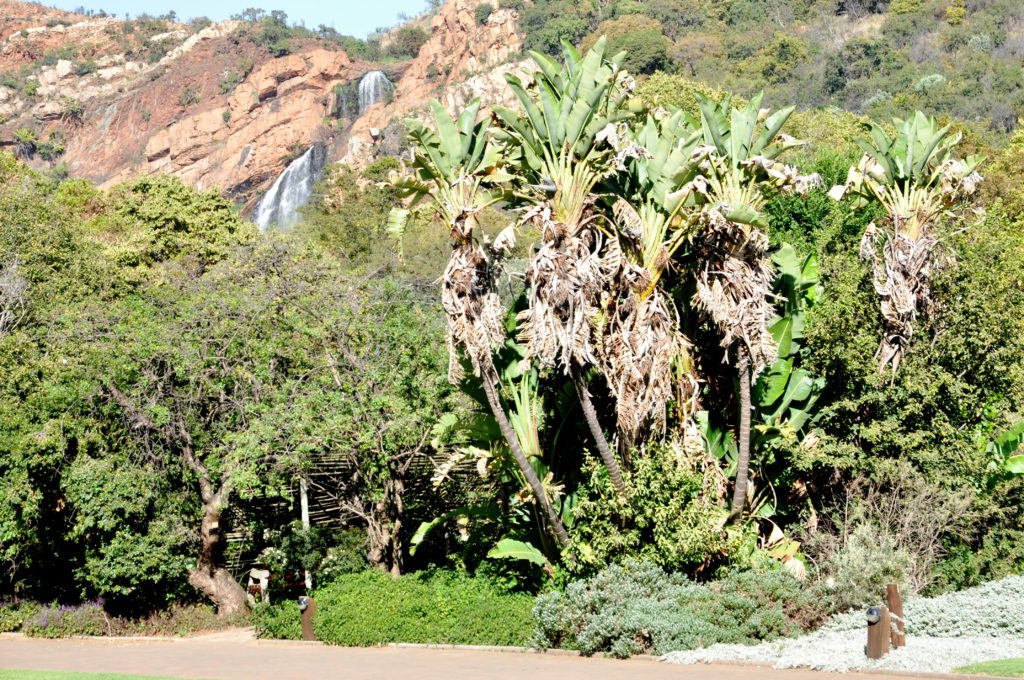
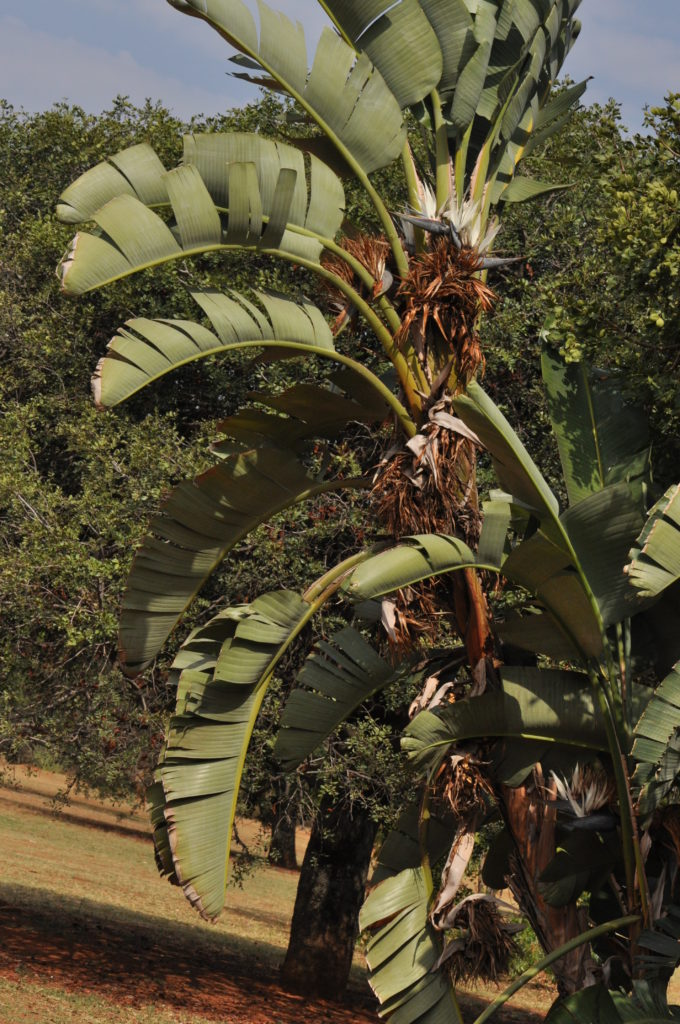
This relatively smooth, grey, woody stem/trunk – (main axis of the plant, the leaf and flower bearing as distinguished from the root-bearing axis) and canopy grows up to 12m x 5m. It suckers from the base (photo 104). This tree (photo 60) is a banana-tree-like plant but unlike the wild banana (Ensete ventricosum), Strelitzia nicolai has true woody stems (photo 43). This relatively smooth, grey, woody stem is marked with past leaf scars (photo 43). Strelitzia nicolai also has a characteristic fan-shaped Crown (photo 104). This species often forms dense clumps of plants.
-
- 104. 2015/05/05. Walter Sisulu NBG. Photo: David Becking.
-
- 60. 2016/10/18. Pretoria NBG. Photo: David Becking.
-
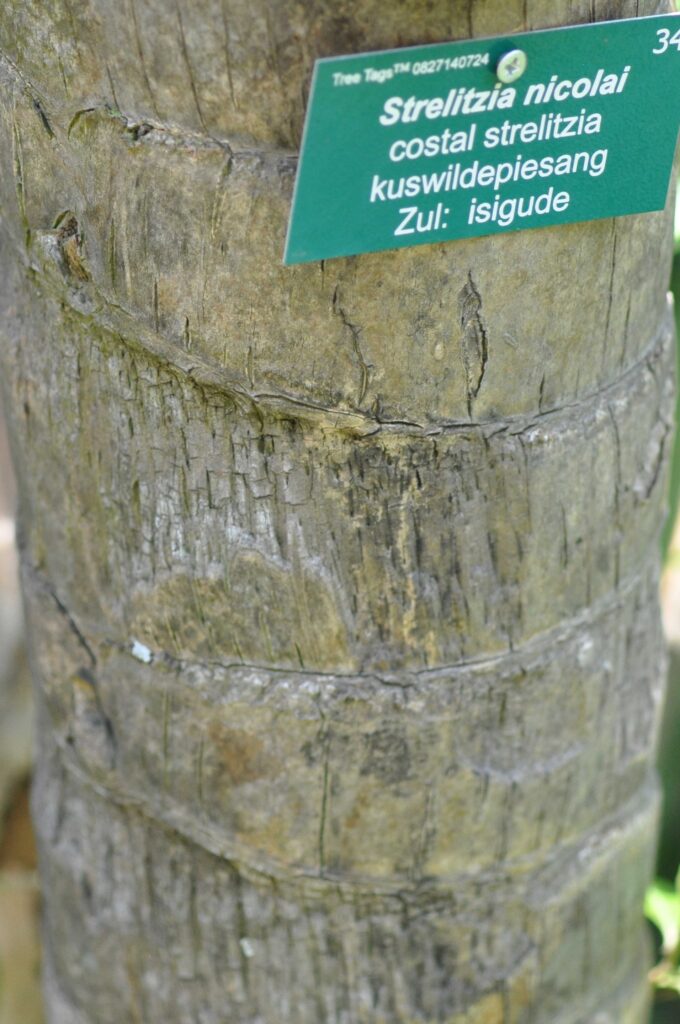
- 43. 2014/09/23. Walter Sisulu NBG. Photo: David Becking.
Leaves
The glossy grey-green magnificent Leaves are distichous (leaves – in this case, as well as leaflets or flowers). Here they are arranged in 2 opposite vertical ranks). Leaves are large: up to 1,9 x 0,6m (photos 236 below & 60 above) and almost palm-like. The leaf in channelled along the lower side including the midrib (photo 236) and petiole (leaf stalk). In older leaves, the wind often tears the leaves along the lines of smaller lateral veins (photo 883). The sound of the wind through the flapping torn (photo 883) leaves is distinctive. The channelled Petiole (leaf stalk) is sheathed at the base. Old colourless, torn leaves tend to become untidy and hang down (photo 104 under Tree).
-
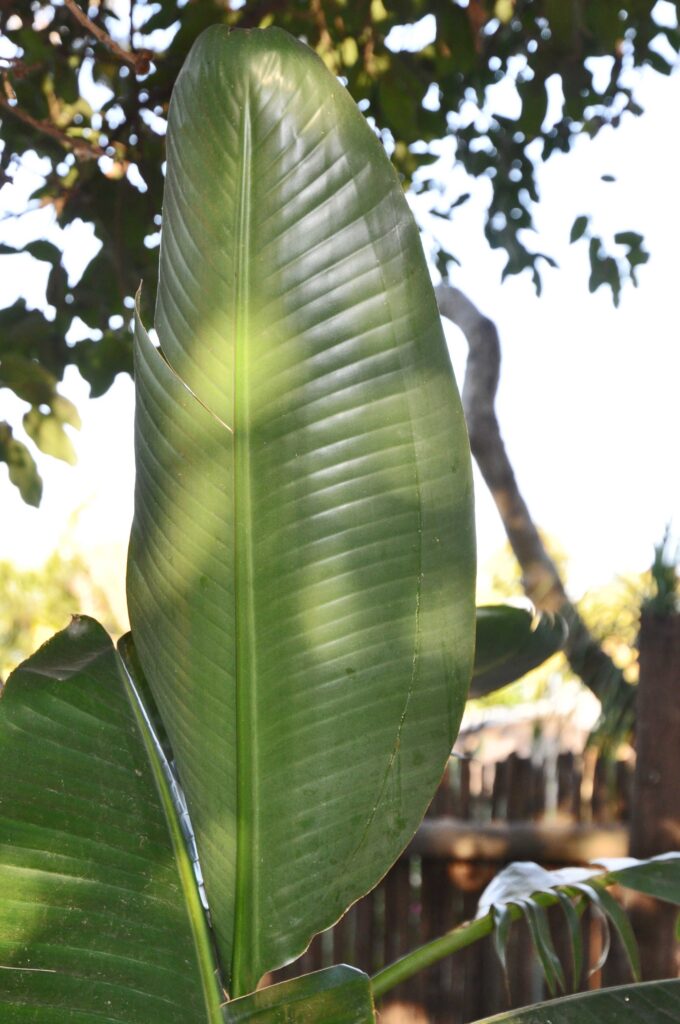
- 236. 2014/09/06. Modjadjiskloof (Duiwelskloof). Photo: David Becking.
-
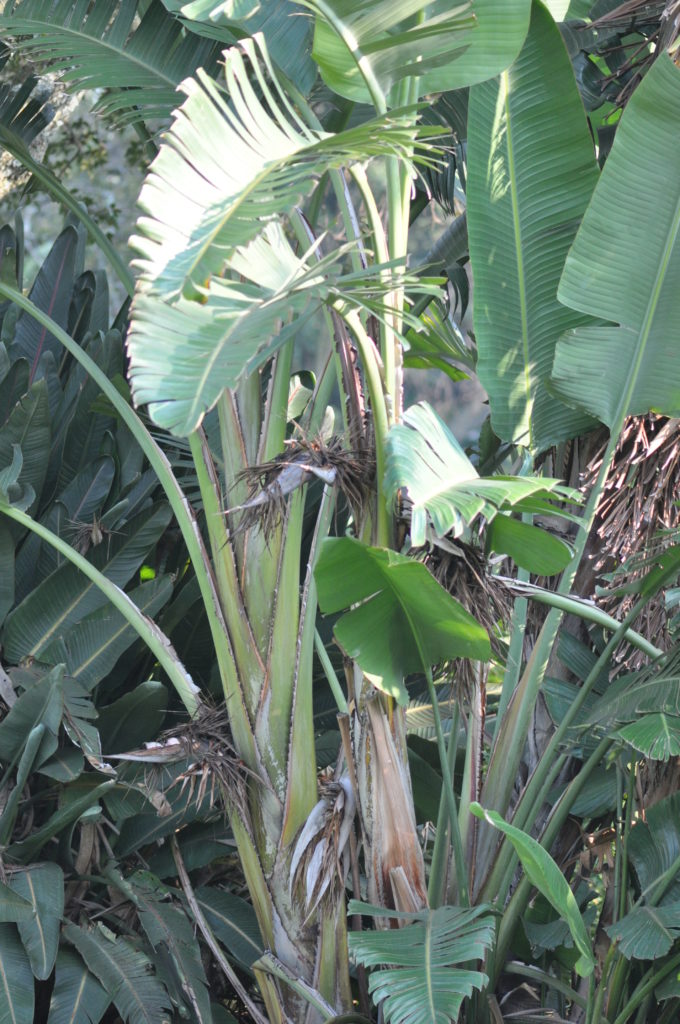
- 883. 2017/03/01. Modjadjiskloof (Duiwelskloof) Photo: David Becking.
Flowers
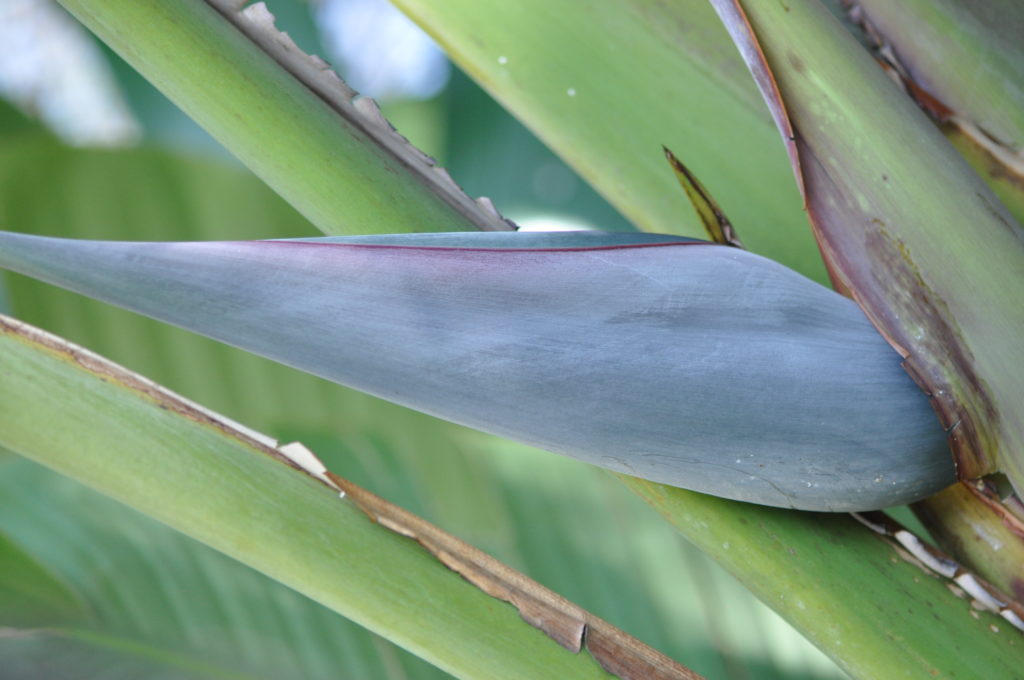
The multiple structure of the compound inflorescences of Strelitzia nicolai is unique and makes identification easier. Here the 5 spathes (spathe – one bracts or leaf enclosing each flower in an inflorescence – photo 232). Each spathe arises from the preceding one. In the process, they turn through approximately 90 degrees from the preceding one (photo 232). To aid this turning process each spathe produces a slimy mucilage. These spathes are initially contained within a single, much larger boat shaped spathe that is up to 45cm long (photo 44).
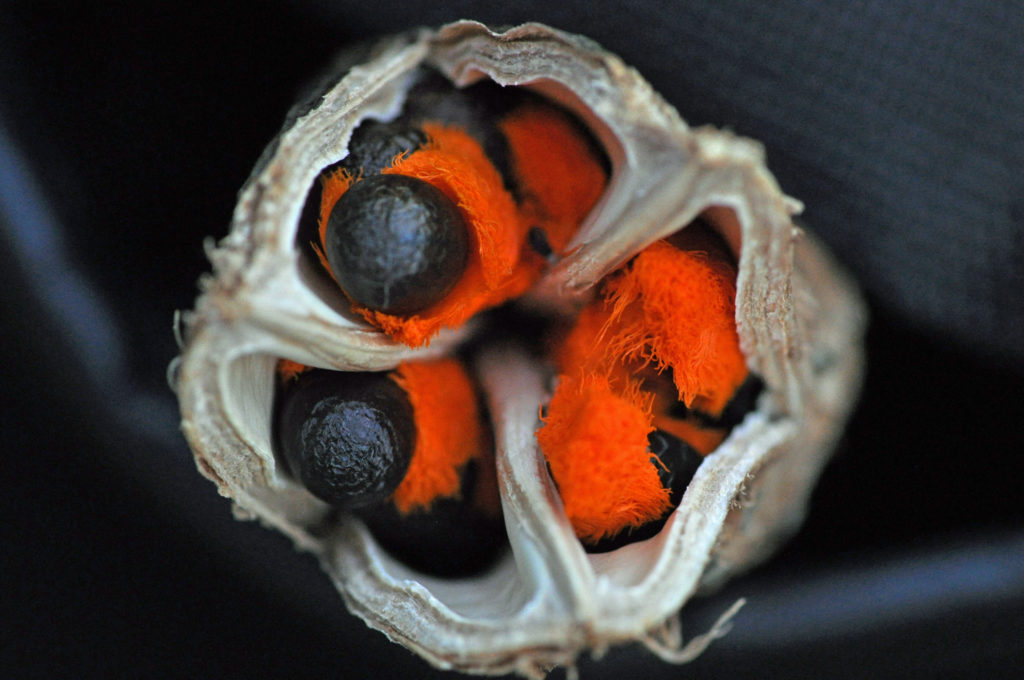
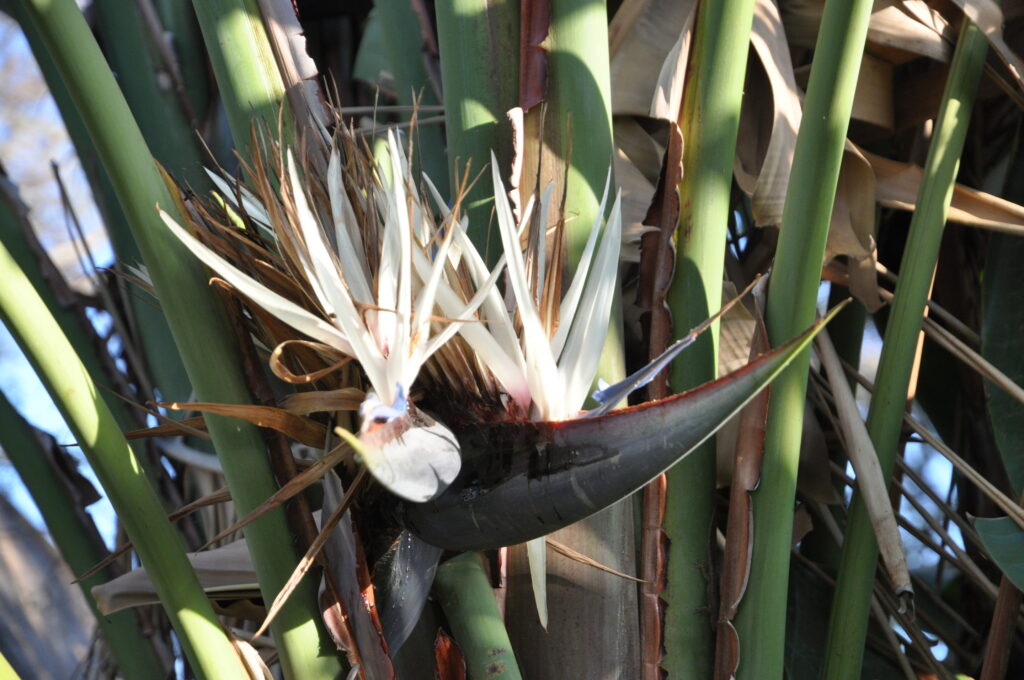
The individual, bisexual Flowers are up to 18 x 45cm and zygomorphic (irregular flower with the corolla that is divisible into 2 equal halves in one plane only). The colour of the large sheathing spathe around the individual flowers is ruby-red to dark blue photo 232). This opens above to allow the 3 cream or white petaloid Sepals (photo 235) to stand up – like the crest of a bird. The lowermost 2 of the 3 blue or mauve Petals touch and form a unique arrowhead structure – somewhat resembling a beak (photo 232 & 235). The third petal is much smaller and contains a long-acting nectary at its base. Within the centre of this channel, the trilocular Ovary (now fully developed in photo 985 under Fruit) and the 5 Stamens with longitudinally dehiscent Anthers (containing 2 parallel theca – pollen sacs) and very long Filaments (the slender stalk that supports the anther) develop. The Style (more or less elongated part of the pistil situated between the ovary and the stigma) has 3 branches, each starting in a Locule (chamber within an ovary – in this case the locule is trilocular (with 3 locules – photo 985 under Fruit). Each style ends with a Stigma (the part of the pistil that receives the pollen). The base of the style and the inferior ovary are enclosed in the Receptacle (that expanded tip of the flower stalk from which the floral parts develop). (Sep–Feb++).
-
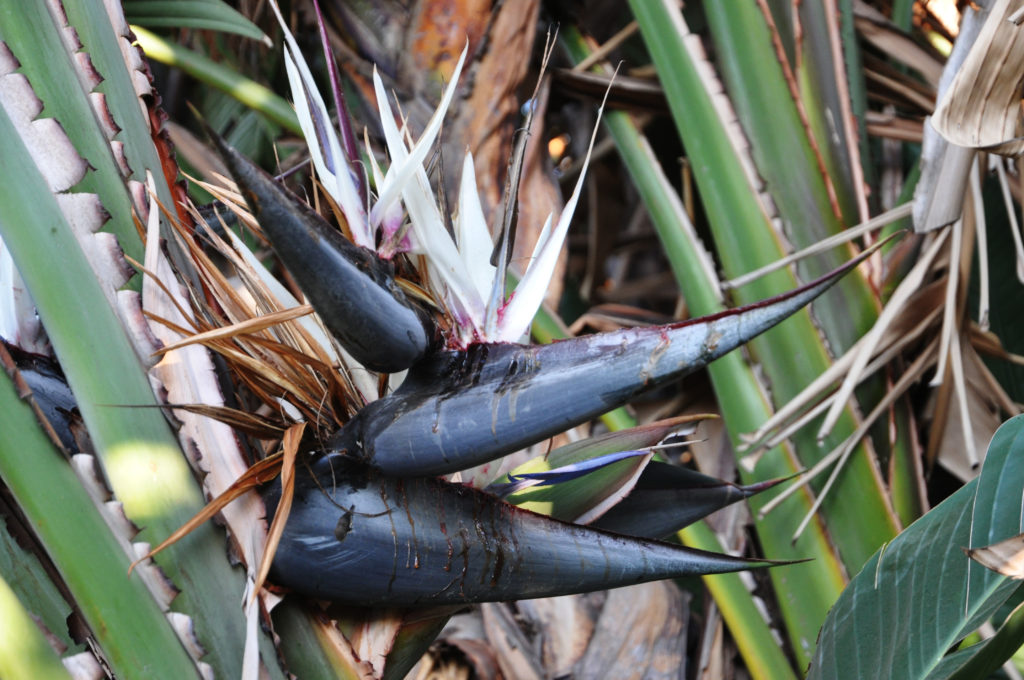
- 232. 2014/09/06. Near Kruger. Photo: David Becking.
-
- 44. 2014/09/23. Walter Sisulu NBG. Photo: David Becking.
-
- 235. Modjadjiskloof (Duiwelskloof). Photo: David Becking.
Fruit
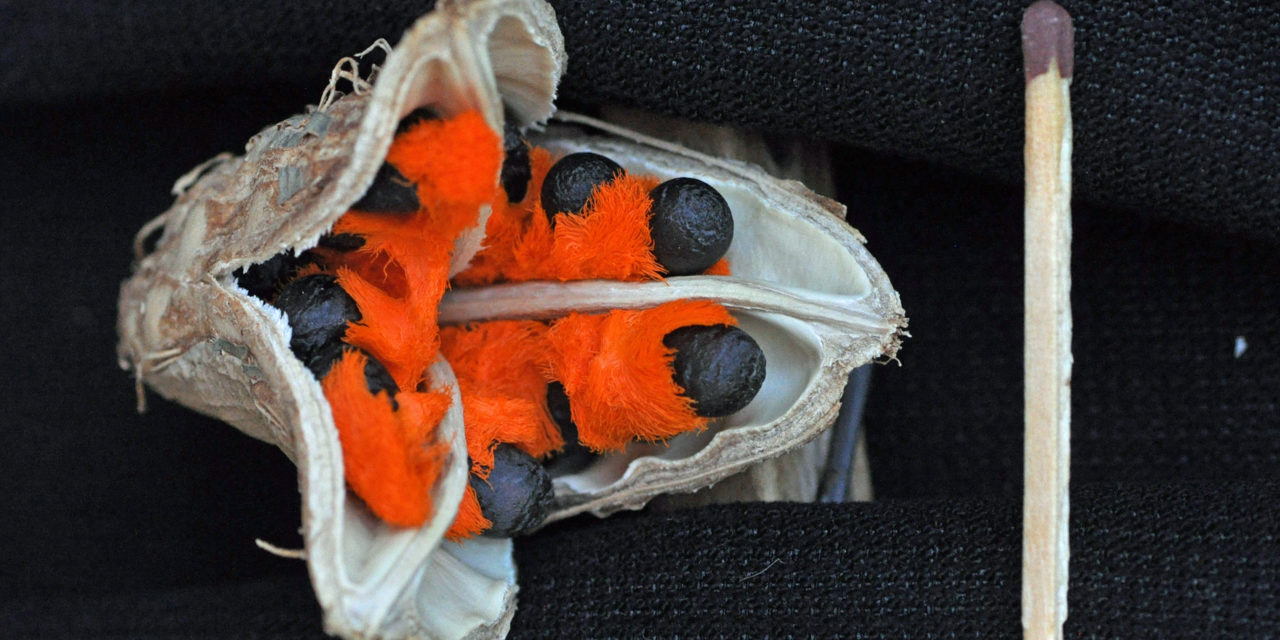
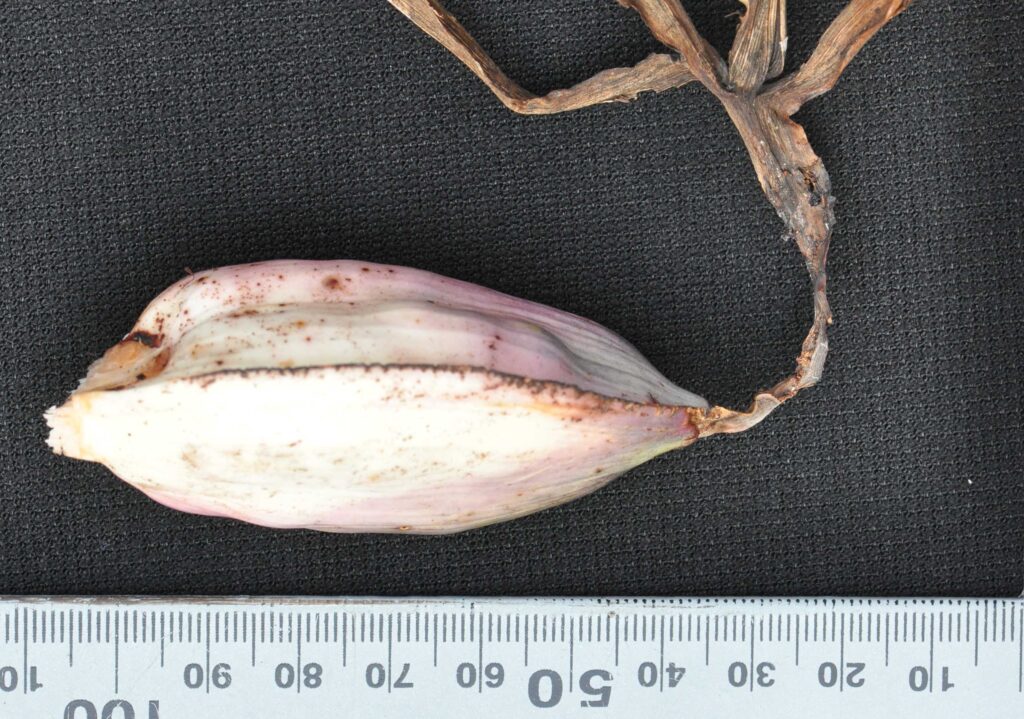
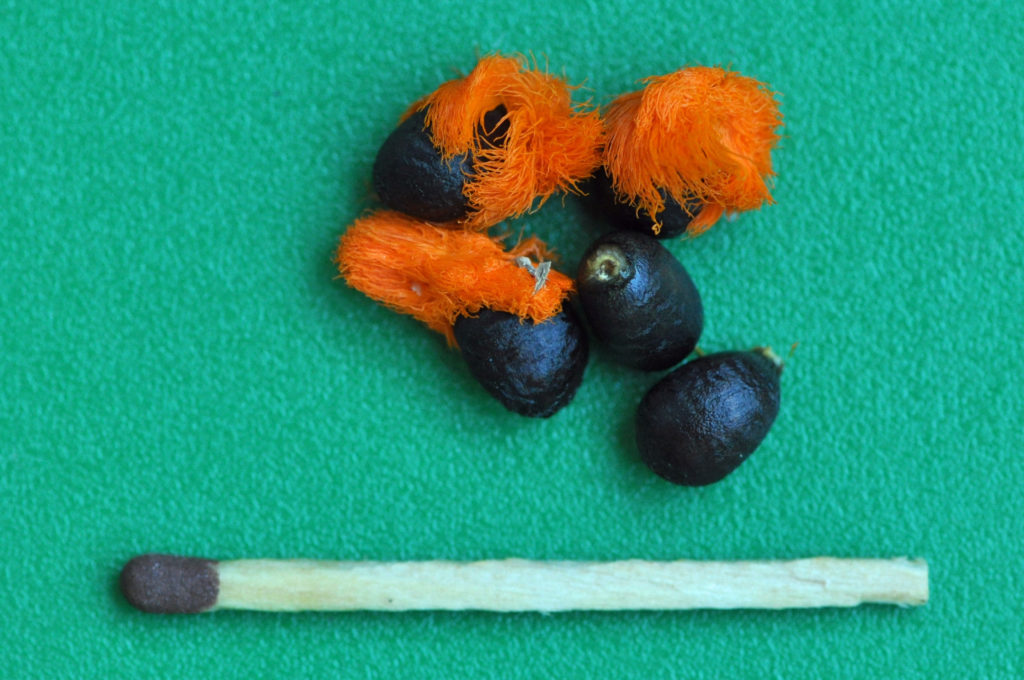
The hard woody, 3-lobed (photo 985) Fruit is a dehiscent Capsule (photo 885) up to 7cm long. These 3 lobes (photo 985) contain hard black Seeds. Each seed has a bright orange woolly Aril (an appendage or outer covering of a seed – photo 01. It develops from a stalk, the funiculus, connecting an ovule or a seed with the placenta – photo 01). (Mar–Jul).
-
- 985. 2017/03/07. Pretoria NBG. Photo: David Becking.
-
- 885. 2017/03/01. Pretoria NBG. Photo: David Becking.
-
- 01. 2017/03/23. Pretoria NBG. Photo: David Becking.
Distribution & Ecology
This tree is common in evergreen forests and dune bush near the coast. It grows in cool moist sites, rich in leaf mould and in rocky places like cliff faces, bordering the sea. Trees are naturally Located below 600m in the Eastern Cape – close to East London and eastwards then northwards through KwaZulu-Natal including Richards Bay. Beyond South Africa, they occur in Eswatini (Swaziland), the extreme southern Mozambique. Botswana and Zimbabwe. These plants are thus Endemic (restricted to a particular geographic location) in Southern Africa. The usually wind torn older leaves create an audible sound in the wind. Tree frogs hibernate at the base of the big Leaf stalks. The Butterfly larvae of the Strelitzia Nightfighter (Moltena fiara) feed on the Leaves. The first larva development stage of this butterfly is bright red with a black head. They use silk to form a shelter by sticking leaves together. Monkeys, birds and the blue duiker feed on parts of the Flowers. Nectar is gathered by 2 regular visitors – the collared sunbird (Hedydipna collaris) and olive sunbird (Cyanomitra olivacea), which effect Pollination in the process. The Tree also affords protection for birds. Green and red-billed wood hoopoe are among the birds that eat the Fruit. Birds and monkeys eat the orange Arils (photo 985 – above) that are attached to the seeds. Tiny Banana Bats (Neoromicia nanus) reside in the curled up leaves. Including the tail, these bats are only up to 7cm long. These bats also frequent banana trees and thatched rooves. They feed on tiny insects, not on leaves.
Ethnobotany
This frost sensitive plant will grow from seeds or suckers and develop best in moist soil and full sun. This tree has invasive roots. Do not plant them near buildings or paving. They can withstand strong, salt laden winds. Strelitzia nicolai is among the rare plants which contain bilirubin (usually a waste product of animal metabolism colouring the faeces and urine and is the cause of discoloration in bruises). Leaves serve as binding agents for building huts, and fish kraals e.g. at Kosi Bay. Spathes (the bracts or leaves surrounding a flower cluster) are used for clothing. Dry Seeds with their Arils are ground and the flour produced is baked after water has been added. Immature pleasant tasting seeds are edible. These plants may be toxic to dogs, cats and horses.
References
Boon, R. 2010. Pooley’s Trees of eastern South Africa. Flora and Fauna Publications Trust, Durban.
Burrows, J.E., Burrows, S.M., Lotter, M.C. & Schmidt, E. 2018. Trees and Shrubs Mozambique. Publishing Print Matters (Pty) Ltd. Noordhoek, Cape Town.
Coates Palgrave, M. 2002. Keith Coates Palgrave Trees of Southern Africa, edn 3. Struik, Cape Town.
Foden, W. & Potter, L. 2005. Strelitzia nicolai Regel & Körn. National Assessment: Red List of South African Plants version . Accessed on 2025/06/26.
Lawrence, G. H. M, 1951. Taxonomy of Vascular Plants. The Macmillan Company, New York. Tenth Printing 1965.
Palmer, E. & Pitman, N. 1972. Trees of southern Africa. Balkema, Amsterdam, Cape Town.
van Wyk, B. & van Wyk, P. 1997 Field guide to Trees of Southern Africa. Struik, Cape Town.
https://en.wikipedia.org/wiki/Strelitzia_nicolai
http://www.biodiversityexplorer.org/plants/strelitziaceae/strelitzia_nicolai.htm
http://www.plantzafrica.com/plantqrs/strelitznichol.htm
http://redlist.sanbi.org/species.php?species=3968-4
http://posa.sanbi.org/flora/browse.php?src=SP
https://en.wikipedia.org/wiki/Nicholas_I_of_Russia


Nikolai Aleksandrovich was Emperor of Russian from 1825-1855. Grand duke Nikolai Nikolaevich the elder (1831–1891), his third son, was never emperor but was the royal sponsor of the Russian Horticultural Society of St. Petersburg.
Greetings David
Many thanks for your correction. Fortunately, my work is on the web and not in a textbook and is easy to change.
Take care
David Becking
Species definitely named after Grand Duke Nicholas Nikolaevich (1831–1891), Russian royalty, son of Tsar Nicholas I of Russia and Alexandra Feodorovna. He was the royal sponsor of the Russian Horticultural Society of St. Petersburg. The following translation from the original 1858 description of the species (in Gartenflora. Monatsschrift für deutsche und schweizerische Garten- und Blumenkunde = Gartenflora. Monatsschrift für deutsche und schweizerische Garten- und Blumenkunde):
“Als eine der wenigen Pflanzen, welche mit dem hohen palmenähnlichen Wuchse und prächtigen grossen Blättern auch noch grosse schöne Blumen vereinen,die sich in reicher Fülle zwei Monate lang ununterbrochen aus den grossen Scheiden entwickeln, achteten wir diese Pflanze würdig, den Namen Sr. Kaiserlichen Hoheit, des Grossfüräten Nicolai Nicolajewitsch, des hohen Pro-tectors des Russischen Gartenbau – Vereins in St. Petersburg, zu tragen, dem wir dieselbe hiemit in tiefster Ehrfurcht widmen.”
= “As one of the few plants that, with the tall palm-like growth and magnificent large leaves, also combine large, beautiful flowers that develop in abundance from the large sheaths for two months without interruption, we respected this plant worthy of the name of His Imperial Highness, the Grand Duke Nikolas Nikolaevich the Elder, the high protector of the Russian Horticultural Association in St. Petersburg, to whom we hereby dedicate it with deepest reverence.” -Regel & Körnicke (1858)
Thank you for the effort you put into informing me about this impressive tree – much appreciated.
Greetings Elliott.
Apology for the late reply. Thankyou for your detailed information – including translation. It is a really impressive tree.
Take care and stay safe.
David Becking.