Sterculia rogersii
General Info – summary
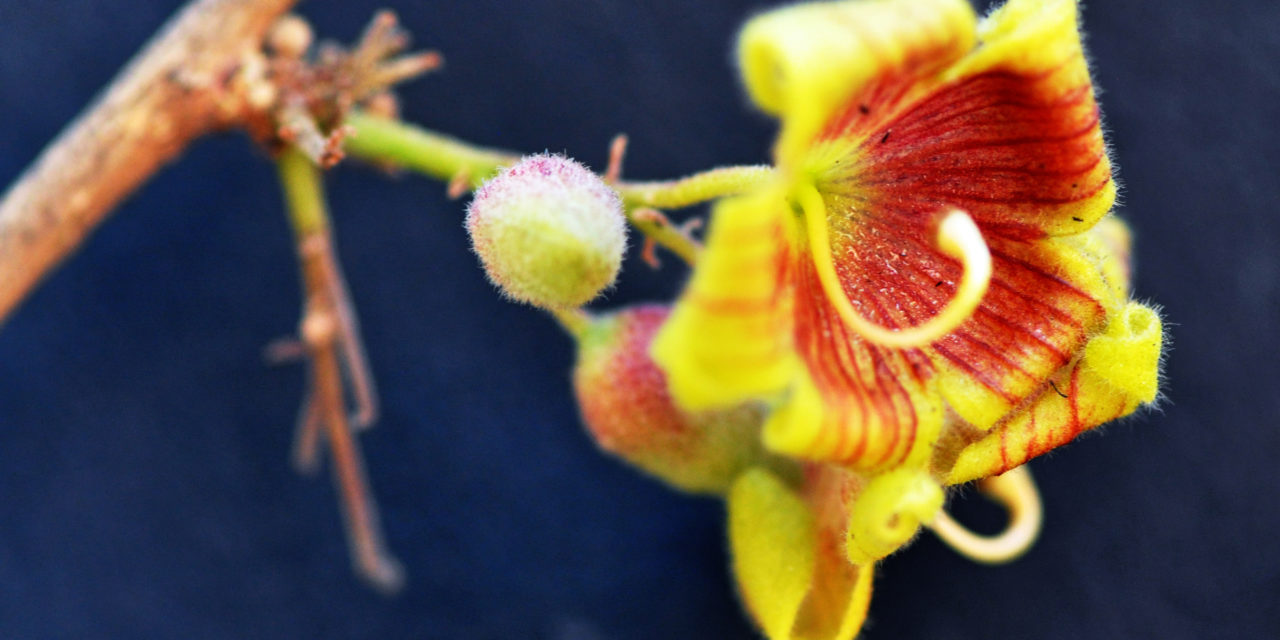
This squat, deciduous and monoecious Tree has a sparse crown, flaking bark & is up to 8m high. Simple Leaves are 3-5 lobed with a cordate base. Flowers. Sepals are petaloid with distinctive red streaks. Petals are absent. Male: staminal tube + many stamens. Female: Superior ovary with carpels & a question mark style. Leathery Fruit: 3-5 large, hairy dehiscent follicles + slightly elongated seeds – each with a white aril.
Description
SA Tree No. 477.
Common names: (Afr) Gewona Sterkastaiing, Sterkastaiing. (Eng) Common Star-chestnut, Small-leaved star-chestnut, Star-chestnut, Squat Star Chestnut. (isiZulu) Ulumbu. (Northern Sotho) Mokgwakgwatha. (siSwati) Sibhosa. (Tshivenda) Mukakate. (Xitsonga) Samani.
Family: Malvaceae. (Wild Pear, Gossypium – cotton, baobab and Hibiscus family). This family has 240+ genera and 4 200+ species. Most species are herbaceous but a few are trees. Indigenous genera that have trees on this website includes Adansonia (baobab), Cola, Dombeya, Grewia, Hibiscus, Sparrmannia and Sterculia. Stems contain mucous canals. The usually alternate, often compound or palmately veined Leaves of all possess stipules and apart from Adansonia, remain simple. Flowers are regular, bisexual or unisexual and have 5 petals (Sparrmannia africana has 4) with regularly arranged overlapping edges. Petals are absent in Cola and Sterculia. There are 5 to many stamens with filaments often united into a staminal tube. This surrounds the superior Ovary with axile placentation and its simple Style and capitate or lobed Stigma. Fruits are usually nuts, schizocarps or loculicidal capsules.
Name derivation: Sterculia – named after Sterculius – the Roman god of manure. In some species, the leaves stink (not this one). rogersii – discovered by Archdeacon Frederick Arundel Rogers (1876-1944) who was a British missionary and prolific plant collector who also collected in South Africa, Mozambique, Swaziland and Zimbabwe from 1903-1933. His total collection numbered more than 24 000 specimens. There are 6 species of the genus Sterculia in southern Africa and 3 in South Africa. These 3 are Sterculia alexandri, Sterculia murex and this one Sterculia rogersii.
Conservation: National Status: L C (least concern). Assessed: 2005/06/30. (W. Foden & L. Potter).
Tree
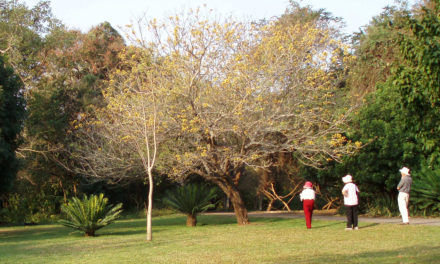
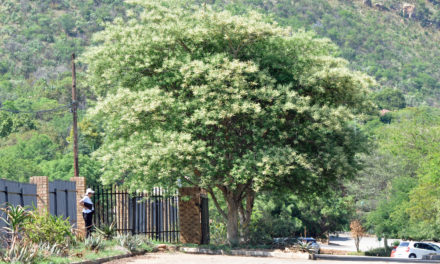
This short, stout Tree has a sparse crown and grows up to 8m high – usually less. The trunk and main branches are stout short and very thick. They divide abruptly into very thin branchlets and twigs that emerge low down (photo 620 somewhat like a young Baobab). The shiny Bark peals revealing the papery thin flakes (photo 619). They leave behind patches that become creamy yellow, pink or mauve (photo 620). Young thin branches have distinctive warty white Lenticels (usually raised corky oval or elongated areas on the plant that allows the uncontrolled interchange of gases with the environment – photo 622 under Leaves).
-
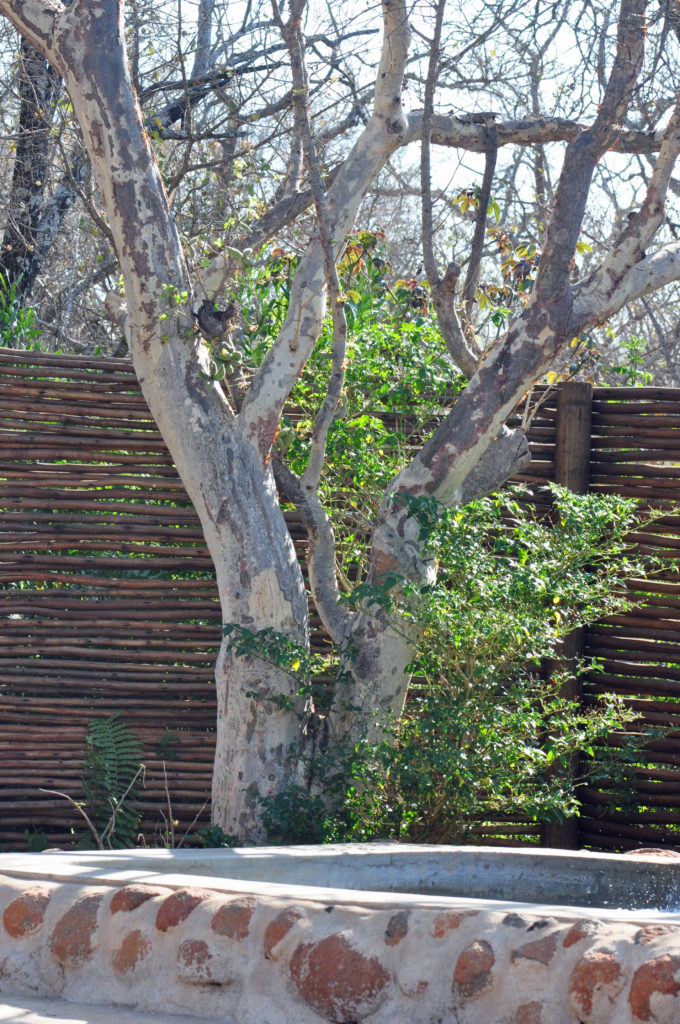
- 620. 2014/09/11. Marloth Park. Photo: David Becking.
-
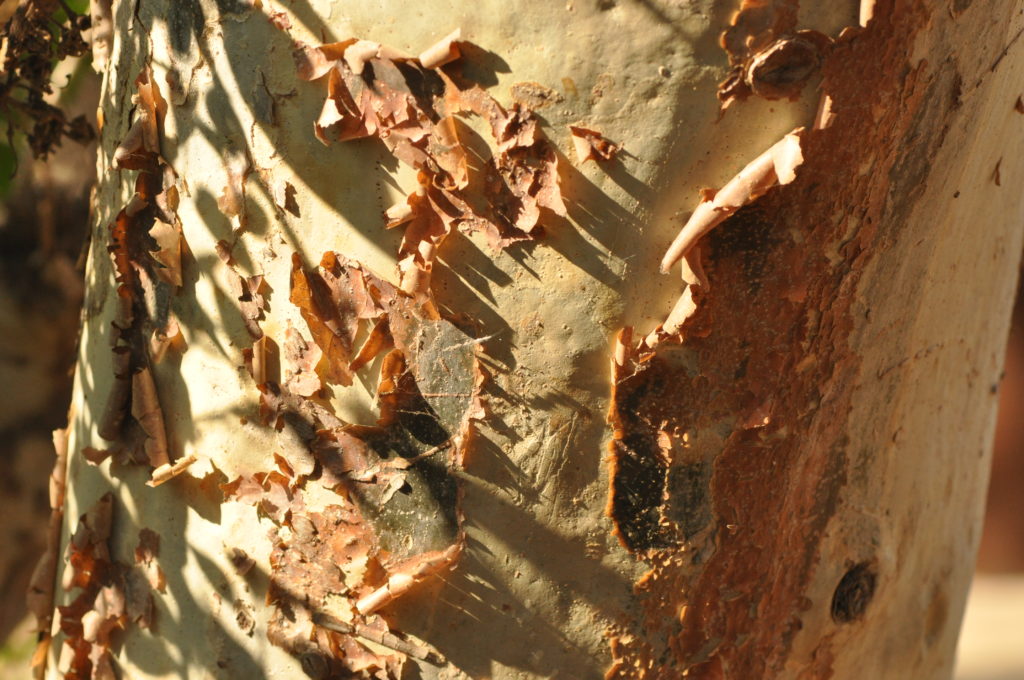
- 619. 2014/09/11. Marloth Park. Photo: David Becking.
Leaves
The small (up to 6 x 5cm – usually smaller), ovate (egg-shaped) to rounded and often lobed Leaves (photo 622) are soft, thin and have entire margins (with a smooth edge and no teeth or notches). Leaves appear late in the season. The Leaf may be lobed and is simple (have a single blade which may have incisions that are not deep enough to divide the leaf into leaflets). The 3-5 lobed and velvety leaves are alternate or clustered on short side twigs (photo 621). The Apex is broadly tapering, and the Base is broadly cordate (heart shaped – photo 622) and has 5-7 veins arising from it (photo 621). The hairy Blade is shiny yellowish green above (photo 621), and lighter grey-green below (photo 622). The thin hairy Petiole (leaf stalk) is slender and usually up to 3cm long. Stipules (basal appendage of the petiole) are present but fugacious (falling or withering away very early). The tree is early deciduous.
-
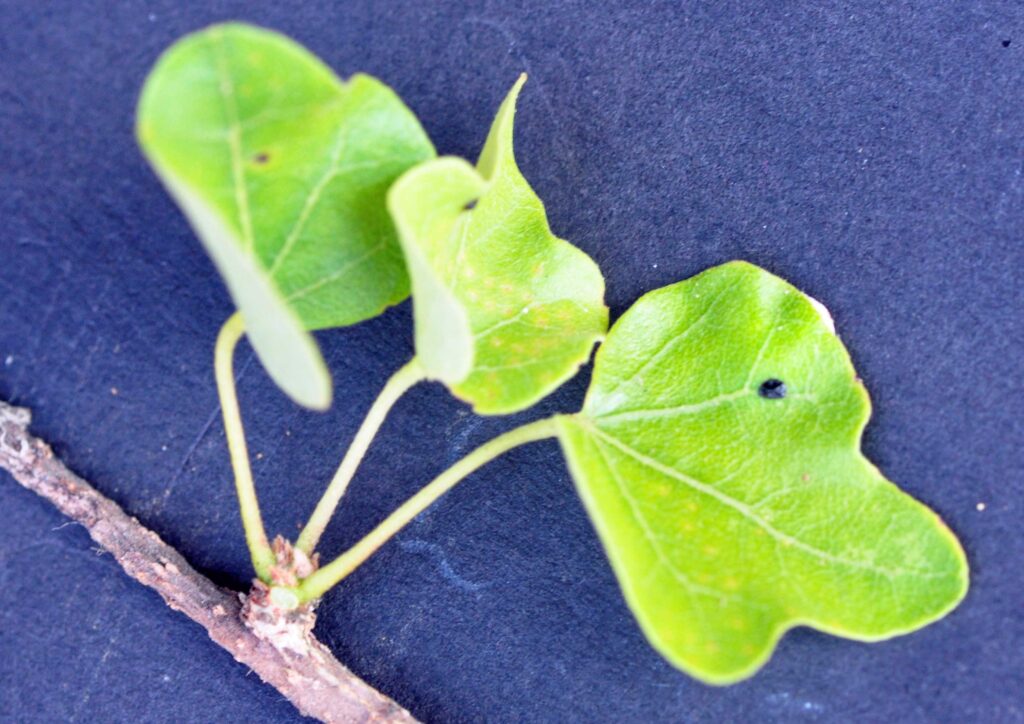
- 621. 2014/09/11. Marloth Park. Photo: David Becking.
-
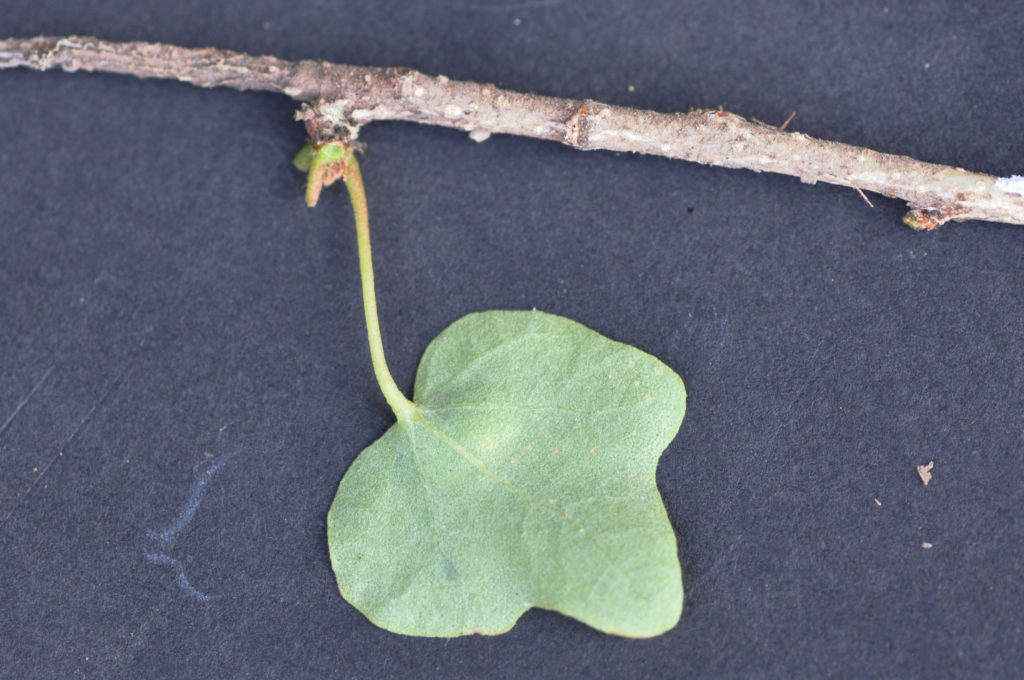
- 622. 2014/09/11. Marloth Park. Photo: David Becking.
Flowers
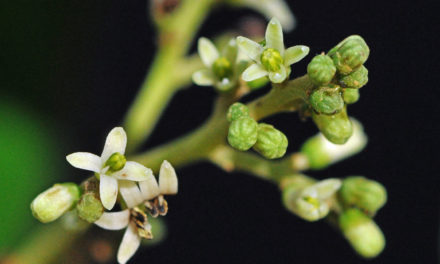
The functionally unisexual Flowers are greenish yellow and up to 2cm in diameter. They are impressive, long flowering and usually appear before the leaves. They occur singly or are clustered on short side shoots (photo 624). Flowers appear on mature wood or on side shoots. Hairy Pedicels (stalks of single flowers) are up to 5mm long (photo 615). The persistent Calyx is campanulate (shaped like a bell) and has 5 hairy petal-like Sepals (photo 616). From the cone-shaped base, the lance-shaped sepal lobes taper to a point and become recurved (photos 615 & 624). On the greenish yellow interior, there are attractive and distinctive pink and dark red streaks that radiate outwards (photo 616). Petals are absent.
In Male Flowers, the Anthers have 2 outwardly facing Theca (pollen sacs – microsporangia of an anther. They produce microspores – pollen grains in seed plants). Usually, an anther has 2 thecae which dehisce, through longitudinal slits. The many Stamens have short, fused Filaments, which form a staminal column surrounding the ovary. Here the Ovary is rudimentary. In the Female Flowers, there is a single Pistil (a unit of the Gynoecium, the female element of the flower, composed of the Ovary, Style and Stigma). Here the superior Ovary has 3-5 united Carpels (foliar units of a compound pistil or ovary). The distinctive Style (more or less elongated part of the pistil situated between the ovary and the stigma) curls like a question mark and ends in a swollen Stigma (the part of the pistil that receives the pollen – photo 616). (Jun-Jan).
-
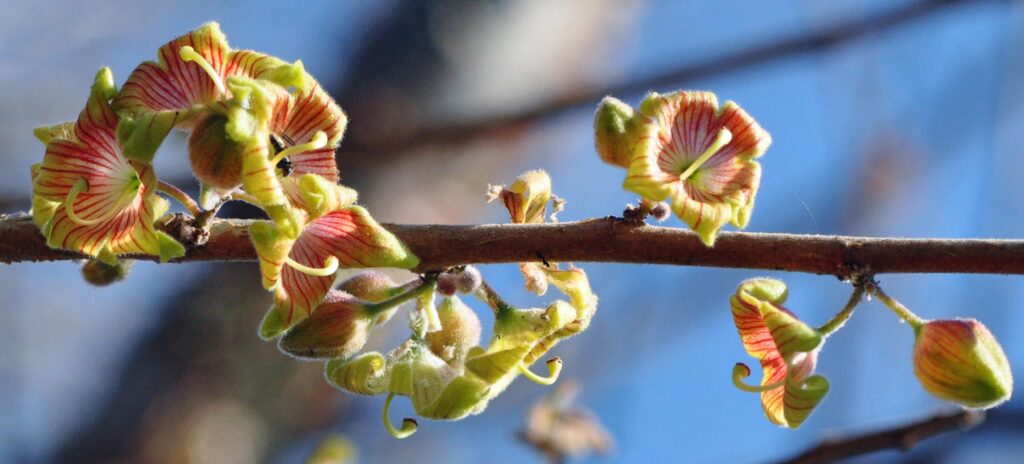
- 624. 2014/09/11. Marloth Park. Photo: David Becking.
-
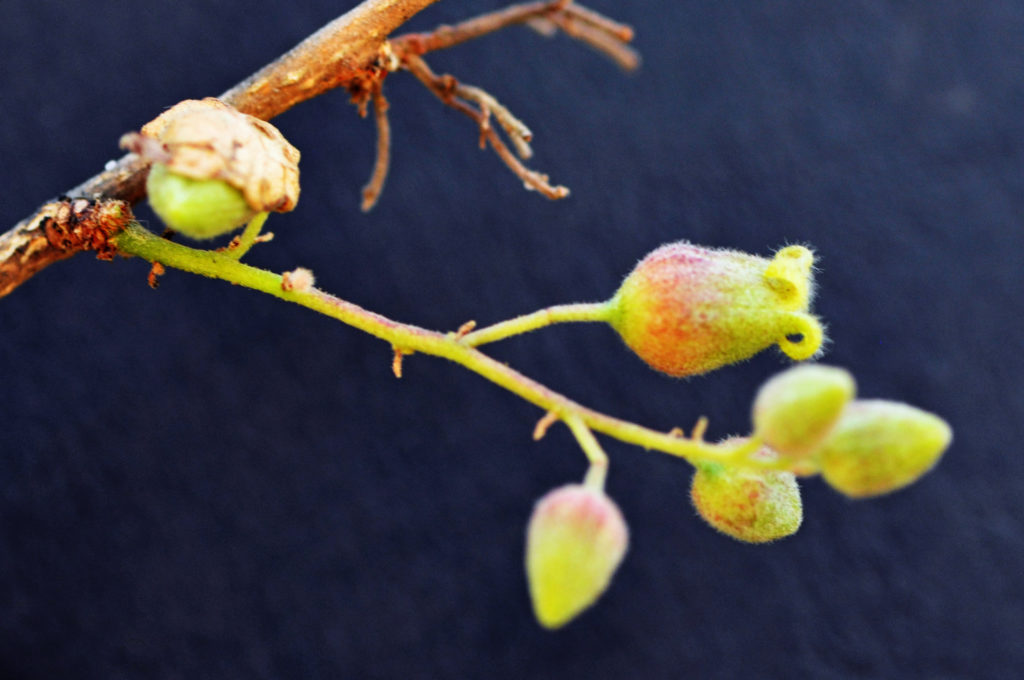
- 615. 2014/09/11. Marloth Park. Photo: David Becking.
-
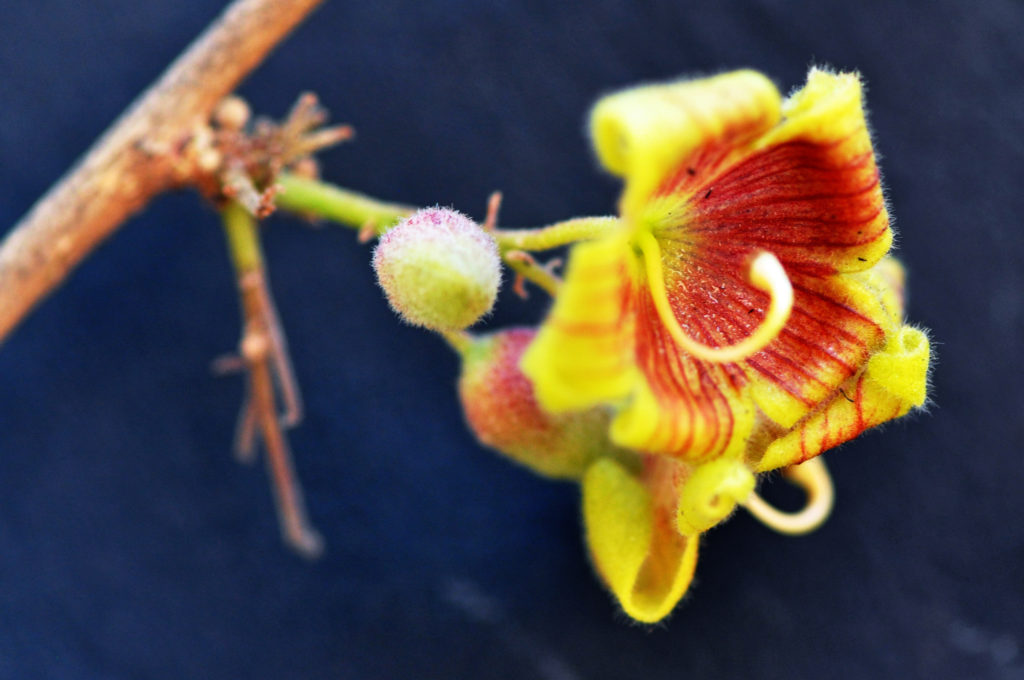
- 616. 2014/09/11. Marloth Park. Photo: David Becking.
Fruit
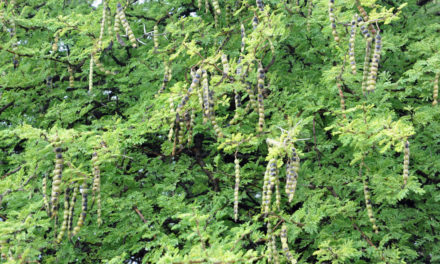
The leathery, star-shaped Fruit (photo 618) consists of 3-5 large Follicles (each follicle is a dry dehiscent fruit that is almost cylindrical, pod-like, opens only on the front suture, and is the product of a single pistil). Each follicle lacks a stalk. Follicles have united bases radiating from a single point (photo 613). They are up to 7,5cm long and have a tapering, upward and outward facing distinct tip (photo 613). They have short golden or creamy hairs. The initially green soft fruit matures to greyish pink and become hard. It may remain on the tree for months even after the new flowers appear (photo 618). Each ripe fruit splits open to reveal 2 rows of about 10 smooth, dark grey Seeds (each up to 1,3 x 0,7cm) surrounded by hairs which are irritating to the skin. (Sep-Mar). Follicles start appearing from September and ripen towards March.
-
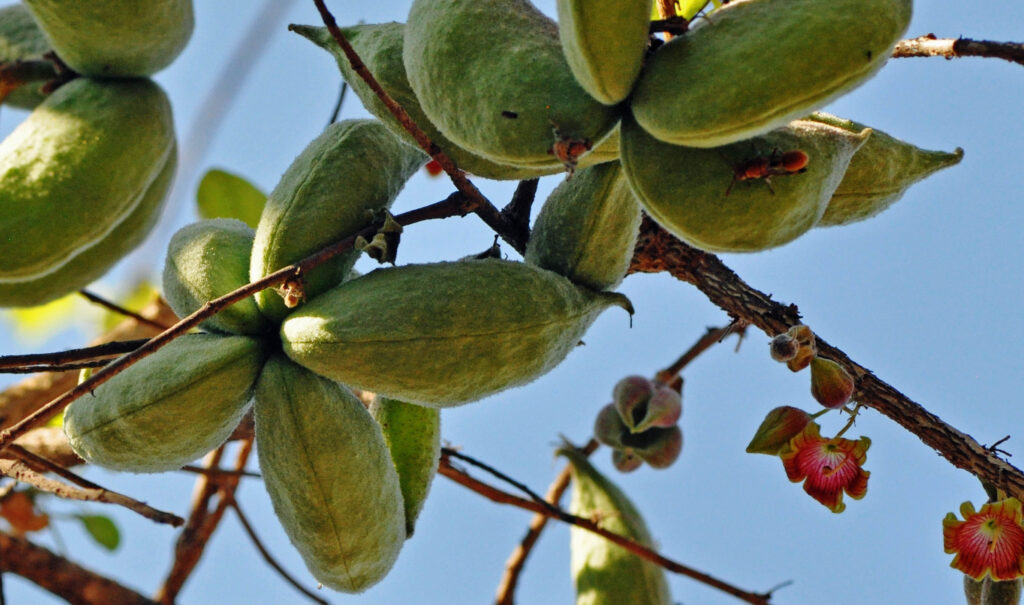
- 618. 2014/09/11. Marloth Park. Photo: David Becking.
-
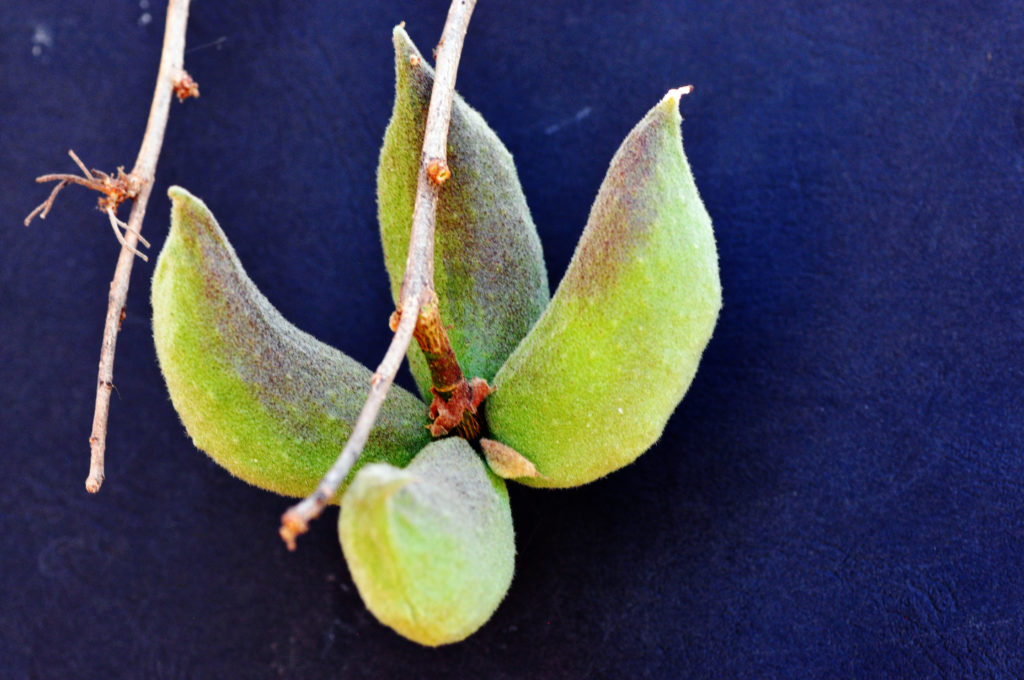
- 613. 2014/09/11. Marloth Park. Photo: David Becking.
Distribution & Ecology
This Tree is a southern African Endemic (restricted to a particular geographic location). Trees occur in low altitude, dry bushveld, or rocky outcrops. They do not tolerate cold areas and are common in alluvial floodplains. In South Africa, Provincial distribution includes Northern KwaZulu-Natal lowveld e.g. Ndumo Game reserve – close to Mozambique boarder, Mpumalanga and Limpopo. In South Africa, trees are common in the arid bush and rocky outcrops between the Soutpansberg Mountains and the Limpopo River. They also occur in Eswatini (Swaziland), southern Mozambique, Botswana and eastern Zimbabwe. Elephants consume Leaves and young Shoots. A variety of animals – including birds game and stock consumes the Seeds. Populations of this tree are decreasing in the Kruger National Park.
Ethnobotany
The light, soft, creamy-white, low-density Wood is brittle and of little use. However good quality Fibre is extractable from the Bark. It is used to make cord, which is then used in hut building, for weaving and repairing of fishing nets, to tie roofing thatch and for making grain baskets. It is also used to sew sleeping mats. People, game, as well as goats and cattle consume the Seeds. The hairy covering of the open suture is irritating to the skin. Domestic animals browse the Leaves and young stems. In times of need, the Pith of trees may be eaten. Propagation is from seeds soaked in hot water overnight, or cuttings. Young plants require a warm, frost free, relatively dry environment. This tree can be grown in a pot, and it is used for bonsai.
References
Boon, R. 2010. Pooley’s Trees of eastern South Africa. Flora and Fauna Publications Trust, Durban.
Burrows, J.E., Burrows, S.M., Lotter, M.C. & Schmidt, E. 2018. Trees and Shrubs Mozambique. Publishing Print Matters (Pty) Ltd. Noordhoek, Cape Town.
Coates Palgrave, M. 2002. Keith Coates Palgrave Trees of Southern Africa, edn 3. Struik, Cape Town.
Foden, W. & Potter, L. 2005. Sterculia rogersii N.E.Br. National Assessment: Red List of South African Plants version . Accessed on 2025/06/27.
Lawrence, G. H. M, 1951. Taxonomy of Vascular Plants. The Macmillan Company, New York. Tenth Printing 1965.
Palmer, E. & Pitman, N. 1972. Trees of southern Africa. Balkema, Amsterdam, Cape Town.
Schmidt, S. Lotter, M. & McCleland, W. 2002. Trees and Shrubs of Mpumalanga and the Kruger National Park. Jacana, Johannesburg.
van Wyk, B. & van Wyk, P. 1997 Field guide to Trees of Southern Africa. Struik, Cape Town.
http://www.plantzafrica.com/plantqrs/sterculiarog.htm
http://www.zimbabweflora.co.zw/speciesdata/species.php?species_id=140080
http://repository.up.ac.za/handle/2263/23730
http://posa.sanbi.org/flora/browse.php?src=SP
http://plants.jstor.org/stable/10.5555/al.ap.person.bm000049358
http://www.worldfloraonline.org