Ficus lutea
General Info – summary
This Tree has grey-brown bark, is up to 25m high & may be a strangler. The crown is up to 25m wide. The trunk may be buttressed. The large, simple and entire Leaves may not be 3-veined at the base. The tiny unisexual Flowers lack petals and develop in a syconium. Ovules are specific wasp pollinated. Fruit is a stalkless fig, which attracts frugivorous animals. Non-toxic milky latex emerges from all damaged parts.
Description
Previous Names: Ficus nekbudu, Ficus quibeba, Ficus subcalcarata, Ficus utilis, Ficus vogelii.
SA Tree No. 61.
Common names: (Afr) Reuseblaarvy. (Eng) Giant Leaf Fig, Giant-leaved Fig, Strangler fig. (isiZulu) Omkhulu, Umthombethombe, Umtombetombe, Umvubu, Umvubu-Omkhulu. (siSwati) Inkhokhokho.
Family: Moraceae (fig or mulberry family). Trees are evergreen and have milky or watery latex present. The simple Leaves are alternate or opposite and 3-veined from near the possibly lobed base. Margins are usually entire, and all leaves have stipules. Plants are monoecious or dioecious and flowers are unisexual. The Perianth of indigenous species contains sepals but no petals. Male flowers have up to 6 stamens. Female flowers are inconspicuous and lack staminodes. The superior or inferior Ovary has 1 locule with 1 ovule and 2 styles are often present. The compound usually fleshy Fruit contains various Seeds. The family has 37 genera and about 1 100 species.
Name derivation: Ficus – Latin for fig. lutea – yellow – may refer to the yellow colour of the leaves in autumn or the colour of the lateral veins. The genus Ficus has 36+ species in southern Africa and 25 in South Africa.
Conservation Status: L C. (Least Concern). Assessment: National Status: Date: 2005/07/12. (J.E. Burrows and J.E. Victor).
Tree
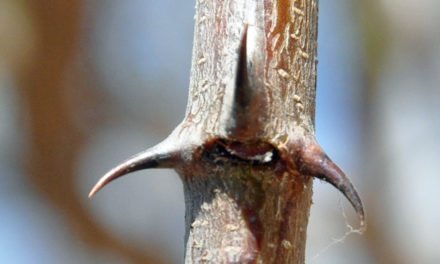
This large Tree may initially be epiphytic (the seeds germinate on another tree). If so, the roots may grow down into the ground, and the plant grows around the host tree – eventually killing it – hence the term strangler fig. Arial roots may also be present on branches. The adult tree may reach a height of 25m. It has a wide, spreading crown of up to 40m wide– especially when not surrounded by other trees (photo 832). In larger trees, the bole is the stem and main wooden axis of a tree, which is an important feature in tree identification. It excludes the root axis. The Trunk may be buttressed (woody extensions from the tree base that radiate outwards in large trees – photo 831). The Bark is dark grey-brown and relatively smooth (photo 826). Young stems may be hairy. After the leaves have fallen, the shiny bronze bud-sheaths (stipules – basal appendage of the petiole) cover the stem buds. Young stems have lenticels (a usually raised, corky, oval or elongated area on the plant that allows the uncontrolled interchange of gases with the environment). Leaf scars are visible on young stems (photo 830). Non-toxic milky Latex emerges from all damaged or cut parts.
-
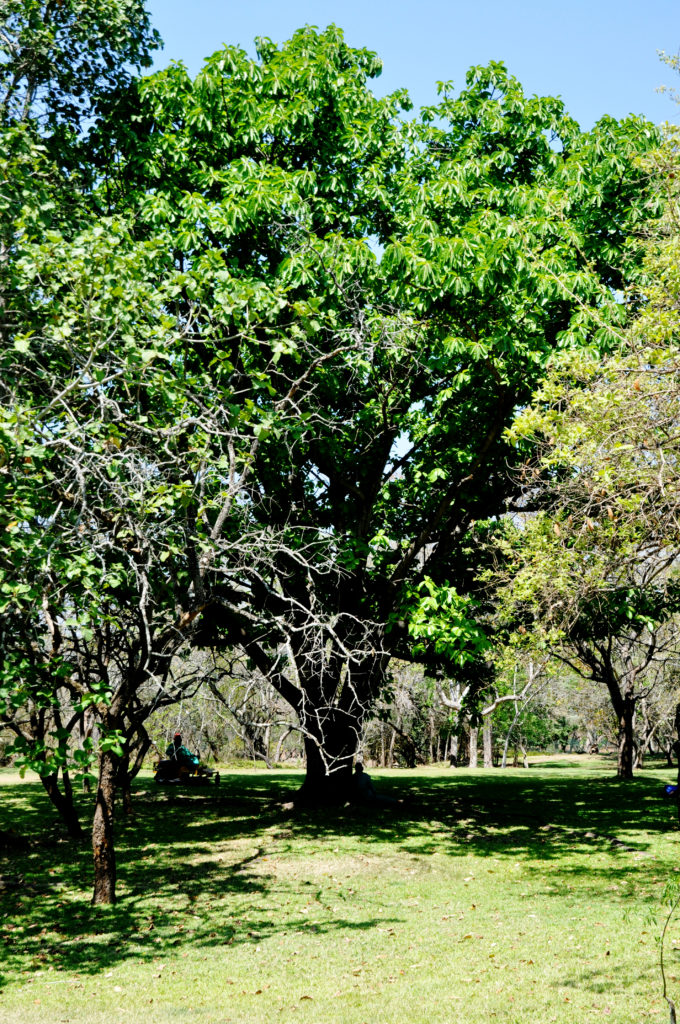
- 832. 2014/09/16. Lowveld NBG. Photo: David Becking.
-
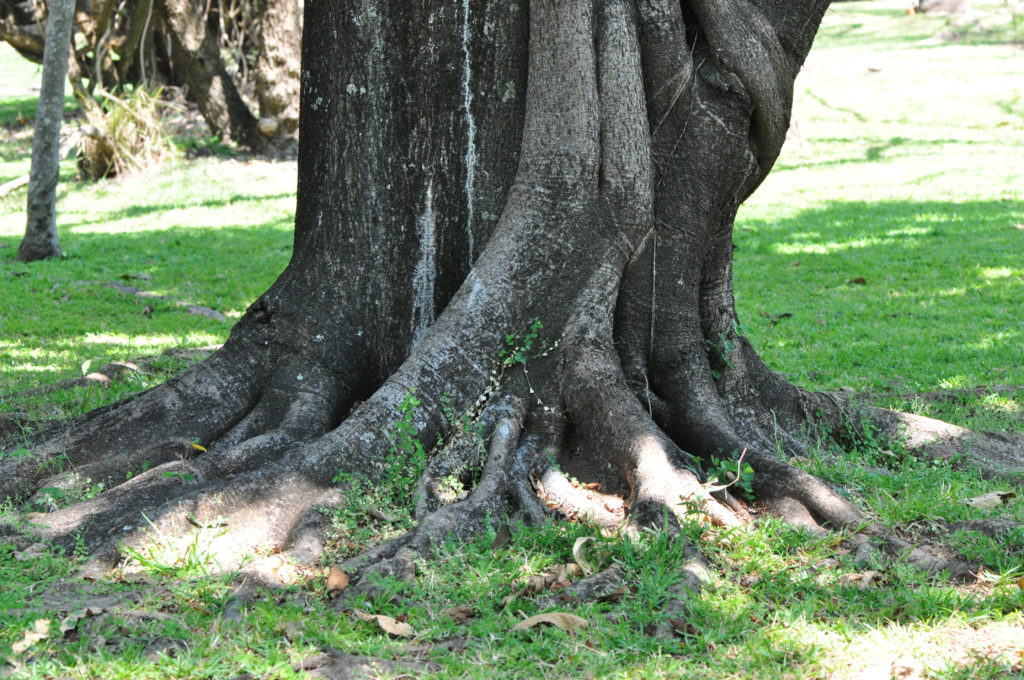
- 831. 2014/09/16. Lowveld NBG. Photo: David Becking.
-
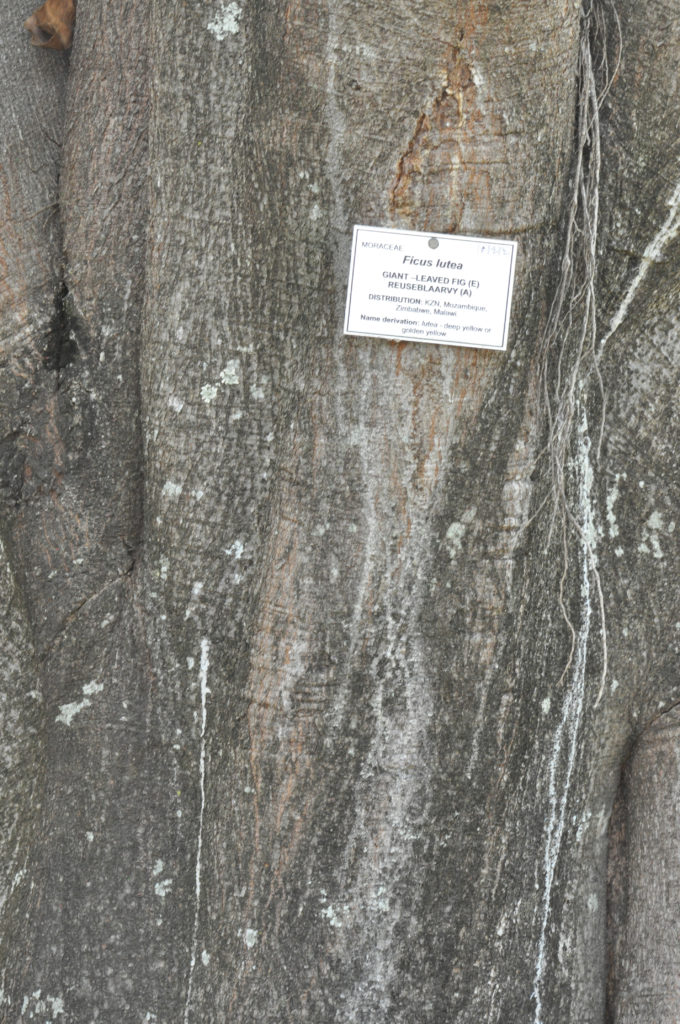
- 826. 2014/09/16. Lowveld NBG. Photo: David Becking.
-
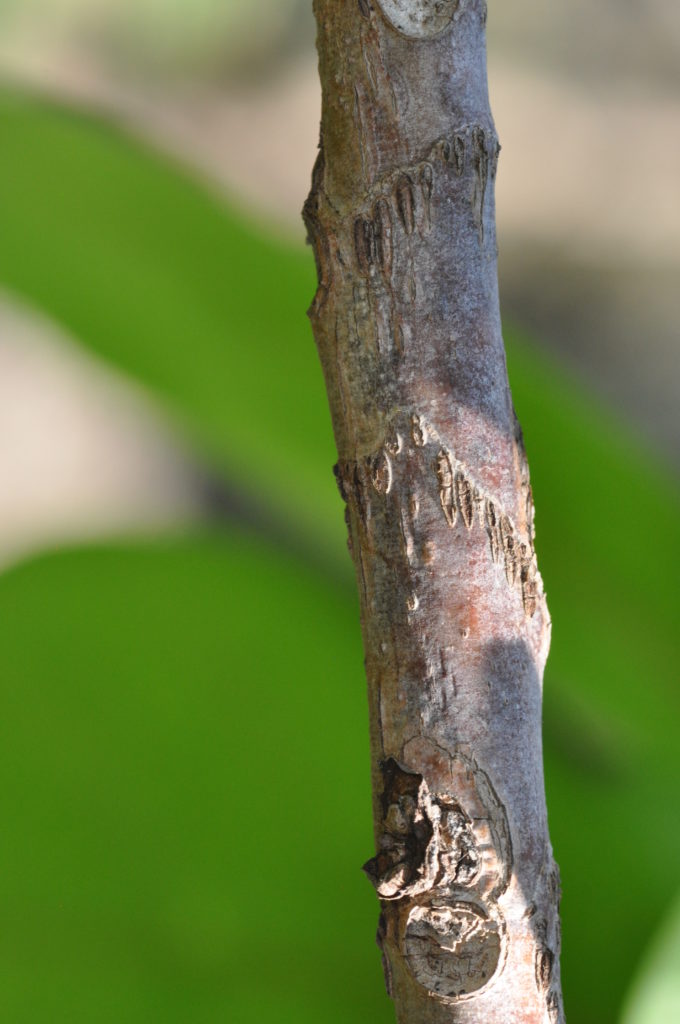
- 830. 2014/09/16. Lowveld NBG. Photo: David Becking.
Leaves
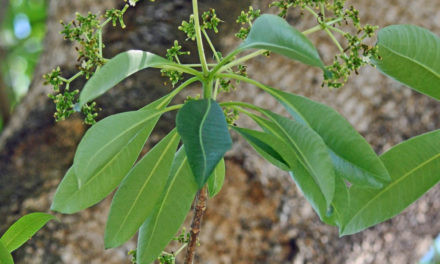
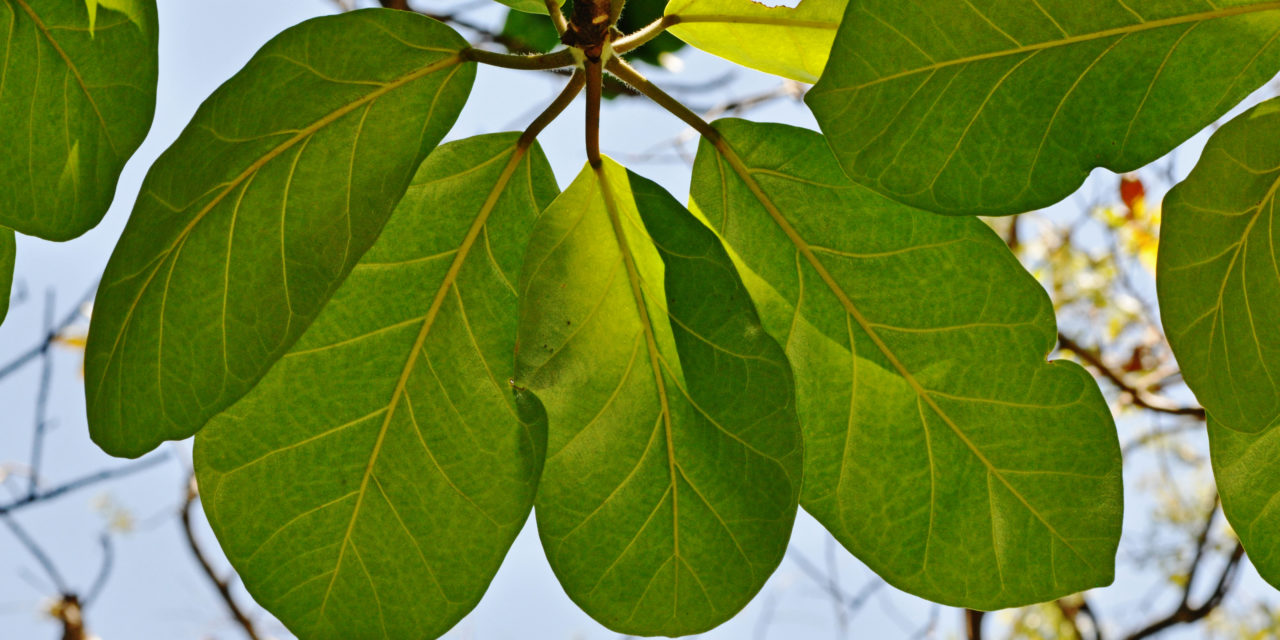
On this deciduous tree, the attractive, stiff and relatively thick Leaves are simple (have a single blade, which may have incisions that are not deep enough to divide the leaf into leaflets). They are downward facing, shiny, alternate are exceedingly large and conspicuous – up to 43 x 20cm (photo 827). They tend to be positioned, almost horizontally, at the ends of wide spreading branches (photo 827 taken from below). Young impressive bright green leaves tend to be hairy and emerge from shiny bronze bud sheaths. Leaves are elliptic, obovate (egg-shaped – with the narrower end at the base) or ovate (egg shaped). The Margin is entire (with a continuous margin, not in any way indented). The Apex is rounded or broadly tapering and may end with an abrupt point (photo 827). The Base is usually rounded or lobed. The prominent Midrib and 6-8 side veins are whitish to yellowish. They are clearly visible and somewhat raised below (photo 829) and not always a pair. The lowermost pair start at the base – making the leaves 3-veined from the base. However, they are not always a pair. Just before reaching the margin, the lateral veins connect with each other via loops that run close to the margin (photo 829). The thick, stout Petiole (leaf stalk – photo 827) may be hairy, and up to 14cm long. Shiny Stipules (basal appendages of the petiole) are present and bronze in colour. These stipules initially cover the stem buds and serve as apical bud sheaths. They are distinctively visible just before the new leaves appear. Stipules that envelope the terminal buds are caducous (an organ or part, which is easily detached and shed early).
-
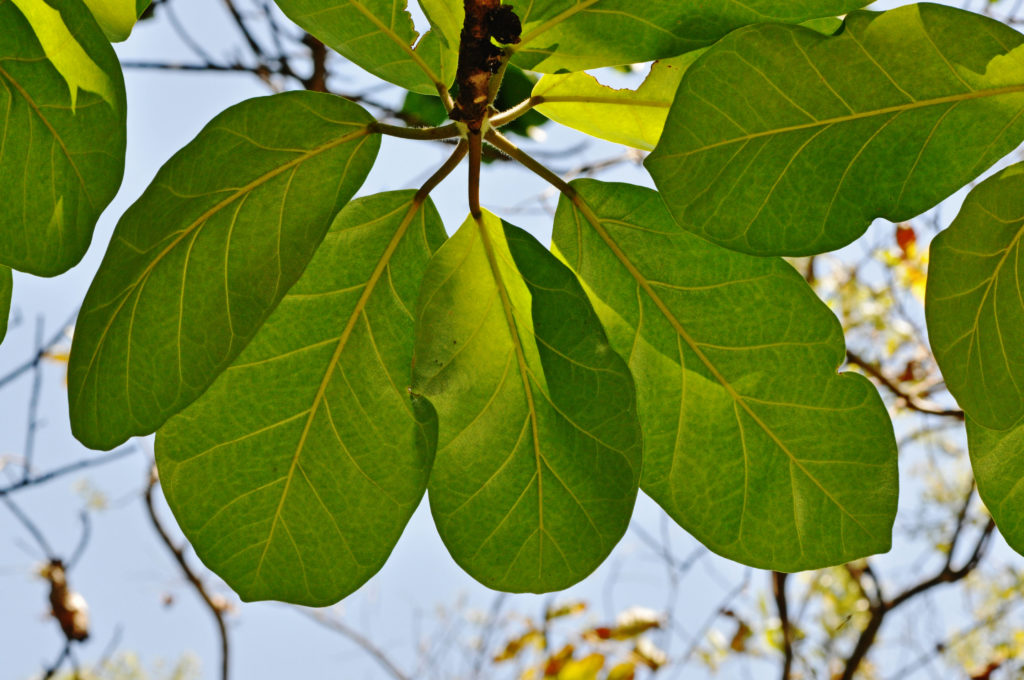
- 827. 2014/09/16. Lowveld NBG. Photo: David Becking.
-
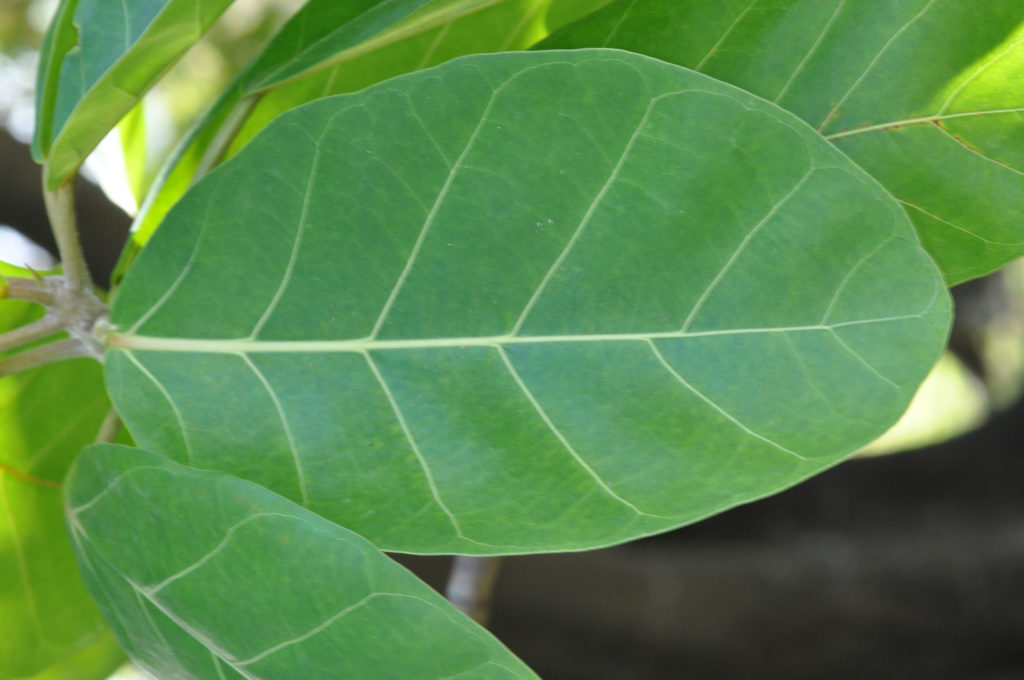
- 829. 2014/09/16 Lowveld NBG. Photo: David Becking.
Flowers
These plants are monoecious (having both male and female reproductive organs on the same plant) but each individual flower is unisexual. Figs possess an amazingly arranged inflorescence called a Syconium. Essentially this consists of a receptacle (is that expanded tip of the flower stalk from which the floral parts develop) whose perimeter substantially increases in size and folds over forming the fig shape. Figs occur singly or in pairs, at the tips of branches or just below the leaves. They are initially hairy but become smooth with time. The hollow fig ends with a tiny opening called an Ostiole that is covered with scales making exit impossible for wasps and entrance difficult. Only the Female pollinating wasp (specific for each species – in this case Allotriozoon heterandromorphum) attempts to do so. She usually injures herself in the process. Around the inner boundary of the hollow receptacle of the fig, a large collection of extremely small flowers is located. The tiny individual flowers are either male or female.
In the Male flowers, up to 6 overlapping perianth (a collective term for the calyx and corolla) lobes and one or 2 anthers are present. The ovary is absent or vestigial (imperfectly developed, non-functional relic from the past). In each Female flower, there are no stamens and usually fewer perianth lobes. The free Ovary has 1 or 2 styles, and the Stigma is usually oblong. The Female wasp enters the fig with her pollen sacks laden with pollen and pollinates those female fig flowers with longish styles that prevent the wasp from laying eggs in those flowers. The wasp targets the flowers with short styles. These they can reach and lay a single egg in each separate ovary. These female flowers react producing a gall, which nourishes the developing larvae that eventually pupate and become adults. The robust Male wasps develop first, fertilize the young Female wasps and then escape by burrowing through the wall of the fig (not the ostiole). This new hole allows oxygen in. The female wasps then, unintentionally load with pollen from the male flowers, escape from the fig and make their way to another fig of the same species. This continues the life cycle. This is an excellent example of a Mutualistic relationship (a beneficial relationship between 2 different species in which both benefit) between the fig tree and the wasp.
Fruit (fig)
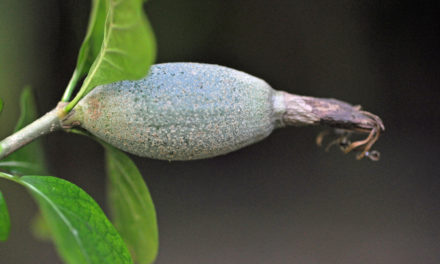
The sessile, plumb shaped and stalkless Fruit is a syconium (a multiple fleshy fig fruit in which the flowers develop within a hollow receptacle) that is from 1,5 to 3cm in diameter and is borne on bare twigs below the leaves or in leaf axils. The initially furry and later smooth figs occur singly or in pairs and more than 1 crop of figs may be produced each year. The fruit is formed by an enlarged, fleshy, hollow receptacle with multiple ovaries on the inside surface. The escaping wasps leave a hole that allows oxygen to enter – resulting in oxygen induced Ethylene production. Ethylene (C2H4) is a small hydrocarbon gas that is odourless and tasteless. This gas is involved in the ripening of the fruit including causing the fruit to change colour and texture and soften. Nearly a week after the wasps have left, the figs with their fertilized seeds, ripen to a yellow, brown or red colour. Hairs are lost in the process. Ethylene is used commercially to ripen fruits like tomatoes, bananas and pears. (Jun-Oct).
Distribution & Ecology
This Tree often grows on rocky slopes and is usually restricted to frost-free areas. It can withstand salt spray and windy conditions and grows well at the coast, in evergreen forests, close to water and from sea level to 1 000m+. Young trees may initially be epiphytic (the seeds germinate on another tree) These fig- trees eventually kill their host and becoming terrestrial. Trees occur naturally from southern KwaZulu-Natal, Mozambique, Eswatini (Swaziland) and northwards into tropical Africa. The Island groups that contain this tree include Madagascar, Comoros and the Seychelles. In Mpumalanga, the tree is becoming naturalized (of a plant or animal: having become established and living wild in a region where it is not indigenous). The tree attracts many frugivorous (fruit-eating) animals, including insects. These insects attract insectivorous Birds. Birds that eat the fruit may deposit the seeds on other tree branches or elsewhere and so start the cycle over again. Monkeys, baboons, bats, duiker, and other Mammals eat the figs and play their part in seed dispersal.
Ethnobotany
This is a most impressive Tree that is widely cultivated in the warmer, moister eastern parts of South Africa. Propagation is by seeds (spring) and truncheons (stem cutting from a selected plant – used to produce genetically identical new plants). The plant is fast growing in a frost-free area and moist environment and may cover 6m wide ground in 2 years. Trees occur near the sea but are not common. The large leaf size makes identification easier. The Latex has been used for birdlime. In Mozambique, the fibre-rich Bark has been used to made good cloth. At the University of Pretoria, extracts from F. lutea have shown to have anti-diabetic activity.
References
Boon, R. 2010. Pooley’s Trees of eastern South Africa. Flora and Fauna Publications Trust, Durban.
Burrows, J.E. & Victor, J.E. 2005. Ficus lutea Vahl. National Assessment: Red List of South African Plants version 2024.1. Accessed on 2026/04/27.
Burrows, J.E., Burrows, S.M., Lotter, M.C. & Schmidt, E. Trees and Shrubs Mozambique. Publishing Print Matters (Pty) Ltd. Noordhoek, Cape Town.
Coates Palgrave, M. 2002. Keith Coates Palgrave Trees of Southern Africa, edn 3. Struik, Cape Town.
Lawrence, G. H. M, 1951. Taxonomy of Vascular Plants, The Macmillan Company, New York. Tenth Printing 1965.
Palmer, E. & Pitman, N. 1972. Trees of southern Africa, Balkema, Amsterdam, Cape Town.
Schmidt, S. Lotter, M. & McCleland, W. 2002. Trees and Shrubs of Mpumalanga and the Kruger National Park.
van Wyk, B. & van Wyk, P. 1997 Field guide to Trees of Southern Africa, Struik, Cape Town.
http://repository.up.ac.za/dspace/handle/2263/25061?show=full
http://www.zimbabweflora.co.zw/speciesdata/species.php?species_id=120320
http://natureswow2.blogspot.co.za/2013/08/giant-leaved-fig-ficus-lutea.html
http://pza.sanbi.org/ficus-lutea
http://plantzafrica.com/plantefg/ficuslutea.htm
http://posa.sanbi.org/flora/browse.php?src=SP