Ficus ingens
General Info – Summary
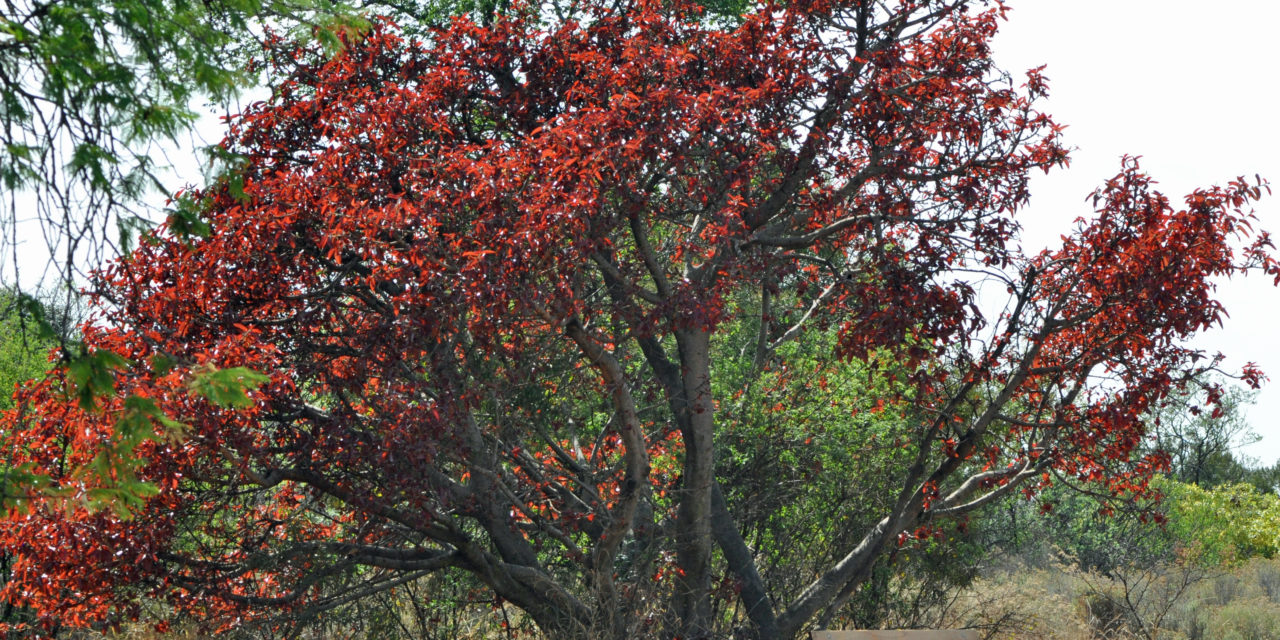
This monoecious Tree may reach 13+m high + a crown diameter of 36m. It may be a rock-splitter. A non-toxic milky sap is present. Leaves are simple with spectacular red new leaves. Each leaf has a distinctly 3-veined base. Small unisexual, specific wasp-pollinated Flowers are in a syconium. The male has 2 stamens. The female has an ovary with 2 styles and oblong stigmas. Fruit is a small fig on a short stalk.
Description
Previous names: Ficus caffra, Ficus pondoensis, Ficus schimperiana, Urostigma caffrum, Urostigma ingens.
SA Tree No. 55.
Common names: (Afr) Rooiblaarrotsvy, Rooiblaarvy. (Eng) Red-leaved Fig, Red-leaved Rock Fig, Red-leaf wild fig, Wild Fig. (isiZulu) Umdende, Umgonswane. (Northern Sotho) Mohlatsa, Monokana, Moumo. (Setswana) Motlhatsa, Moumo. (Tshivenda) Tshikululu.
Family: Moraceae (fig, or mulberry family). Trees are evergreen and have milky or watery latex present. The simple Leaves are alternate or opposite and 3-veined from near the base. Margins are usually entire, and all leaves have stipules. Plants are monoecious or dioecious and flowers are unisexual. The Perianth of indigenous species contains sepals but no petals. Male flowers have up to 6 stamens. Female flowers are inconspicuous and lack staminodes. The superior or inferior Ovary has 1 locule with 1 ovule, and 2 styles are often present. The compound usually fleshy Fruit contains various Seeds. The family has 37 genera and about 1 100 species.
Name derivation: Ficus – Latin for fig. ingens very large or something that goes beyond what is natural for its kind. Most of these trees are not very large. An error? The genus Ficus has 36+ species in southern Africa and 25 in South Africa.
Conservation: National Status: L C. (Least Concern). Assessment Date: 2005/07/12. Burrows, J.E. & Victor, J.E.
Tree
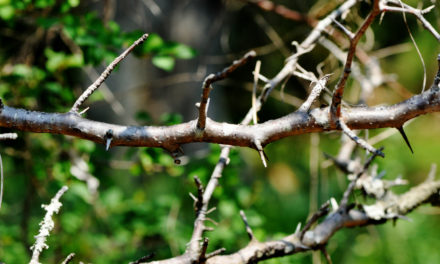
Growing in the open, this small to medium sized Tree may occasionally reach 18m high with a crown up to 30m in diameter. Isolated trees have a near rounded crown (photo 44). When growing on rocks, the tree may be a rock-splitter (photo 316) and flat growing. In colder areas they often grow flat against north-facing rocks (photo 316). Damaged parts yield a non-toxic milky Sap. The Trunk can be ribbed, straight, twisted and broad. The pitted, smoothish Bark (photo 367) is silvery or yellowish grey to grey-brown, becoming darker and cracked with age. Branchlets are smooth – with or without short hairs. Here scars left by fallen leaves (photo 131). Both spines and aerial roots are absent.
-
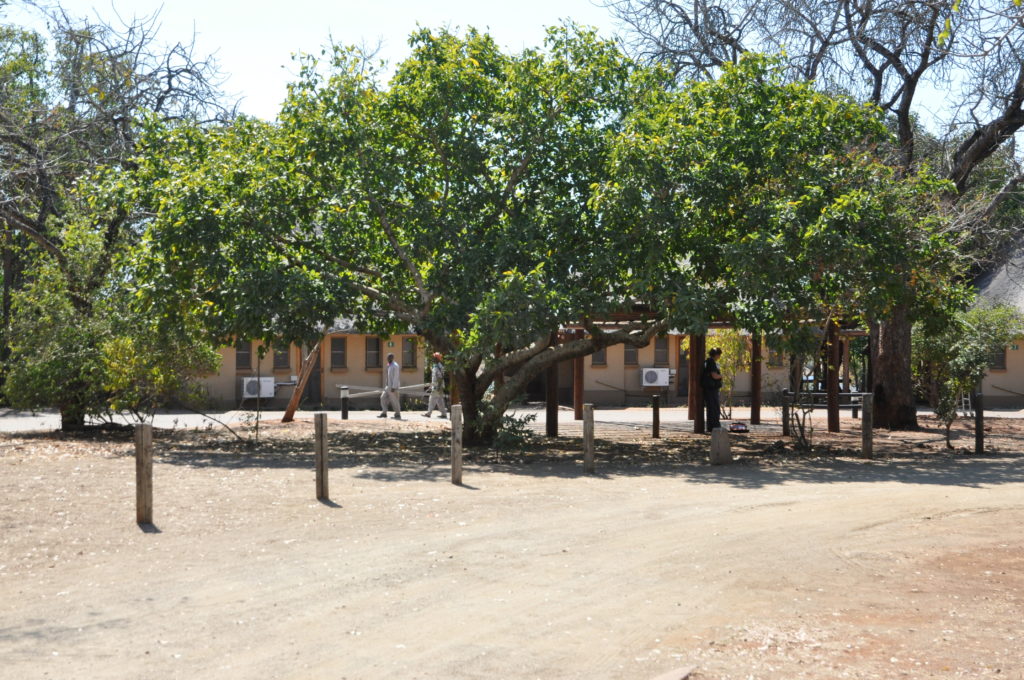
- 503. 2014/09/08. Lower Sabi KNP. Photo: David Becking.
-
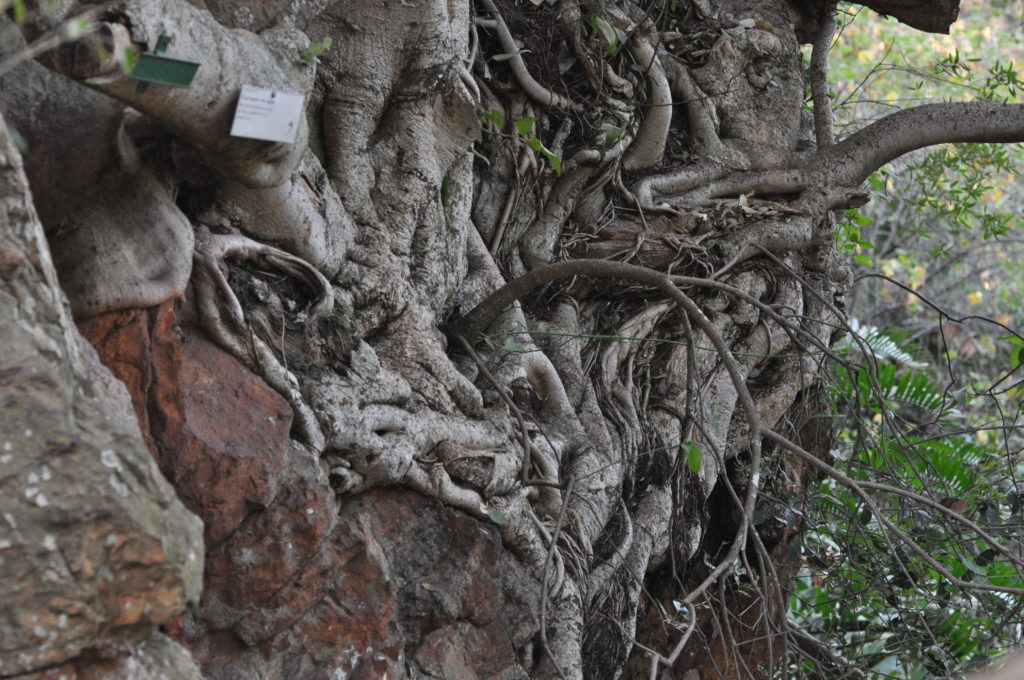
- 316. 2017/08/03. Pretoria NBG. Photo: David Becking.
-
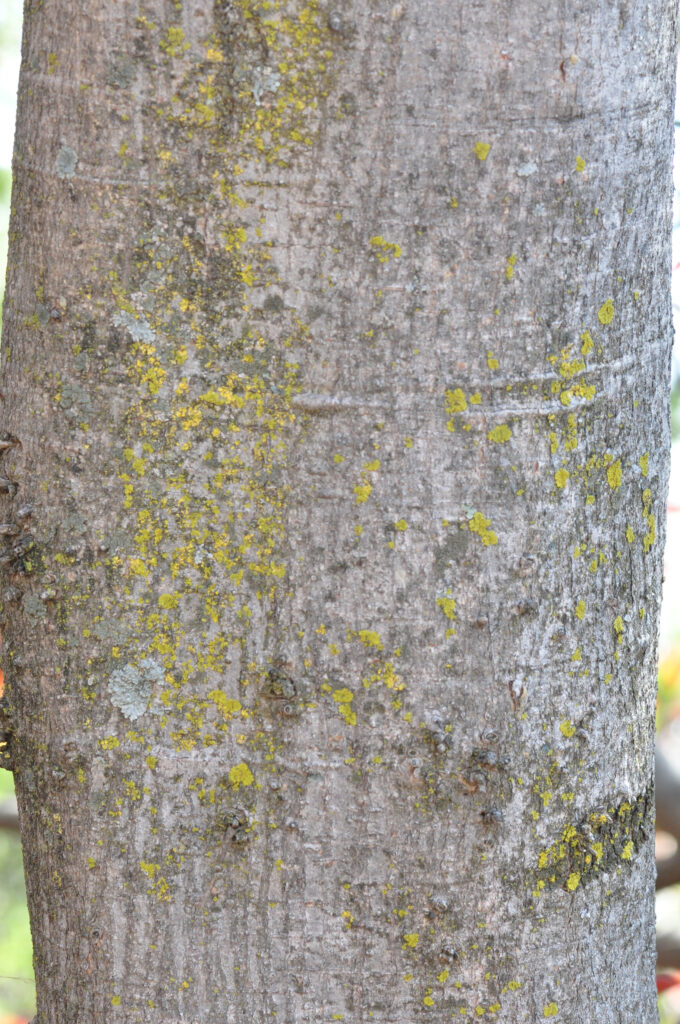
- 367. 2017/10/02. Pretoria NBG. Photo: David Becking.
-
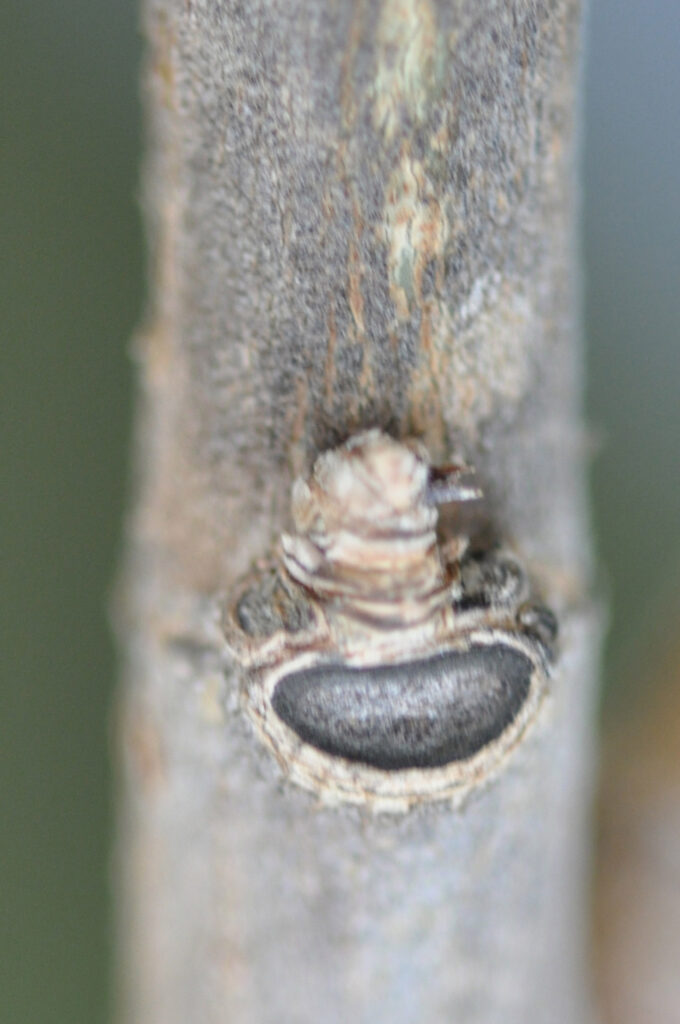
- 131. 2017/12/26. Pretoria NBG. Photo: David Becking.
Leaves
During spring, in the morning sun, the shiny new Leaves display their spectacular pink, red and copper colours (Intro photo. photo & photo 371). Young leaves arise from the stem Nodes. The distance between 2 nodes is the internode (photo 378). Leaves are smooth, become olive green as they mature and are up to 16 x 9cm (photo 309). These leaves are alternate, simple (have a single blade, which may have incisions that are not deep enough to divide the leaf into leaflets), hairless and coriaceous (leathery). The upper surface is slightly glossy and is usually darker than the lower surface. The tree is deciduous for a short period, and the fallen leaves leave a scar (photo 131 under Tree). Lateral veins are visible and slightly more prominent below (photo 309). 5-8 lateral veins occur on each side of the midrib. Each leaf is distinctly 3-veined from the base. These basal veins do not run parallel to the remaining side veins and may have branches going into the lobes (lower leaf photo 23 under flowers). The remaining parallel veins link by means of loops close to the wavy Margin (photo 309). The margin is entire (with a smooth unbroken edge and no teeth or notches). Waxy spots occur in the basal axils of secondary veins, or at base of the midrib on lower surface. The stiff, varied leaf shapes may be ovate, oblong-lanceolate or oblong. The narrow Apex is broadly tapering, somewhat concave, to almost rounded. Leaves are often widest at the Base which is square or rounded to cordate (heart-shaped base) – (photo 309). The Petiole (leaf stalk) is up to 4cm long. Stipules (basal appendages of the petiole) are yellow, soft, velvety, and covered with densely matted woolly hairs. They are not spinescent (lack spines), surround the terminal bud and are caducous (an organ or part that is easily detached and shed early).
-
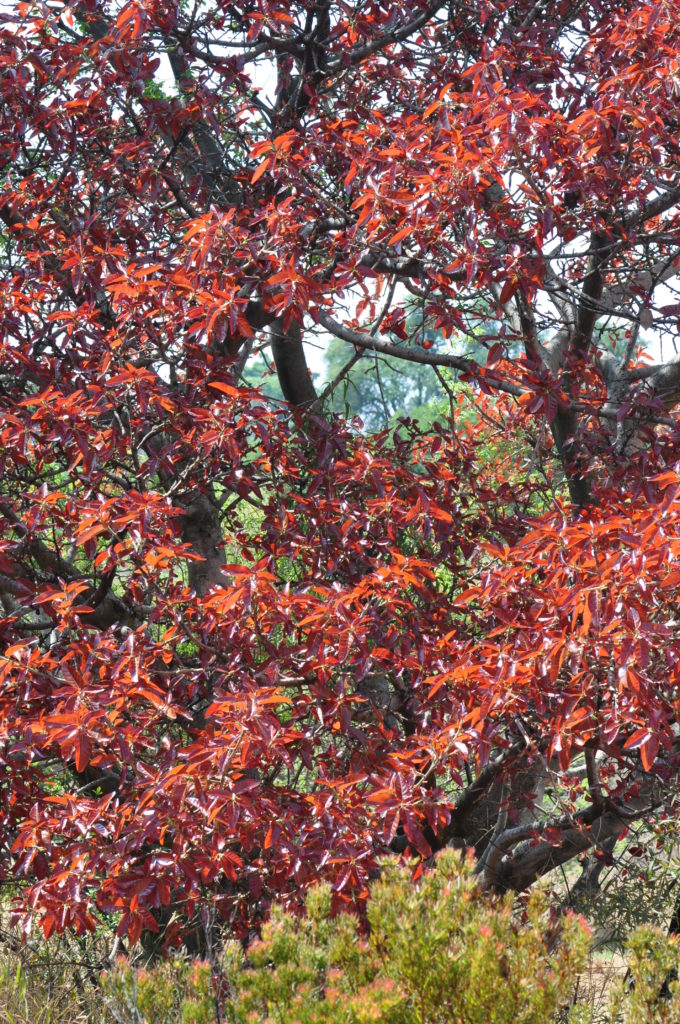
- 371. 2017/10/02. Pretoria NBG. Photo: David Becking.
-
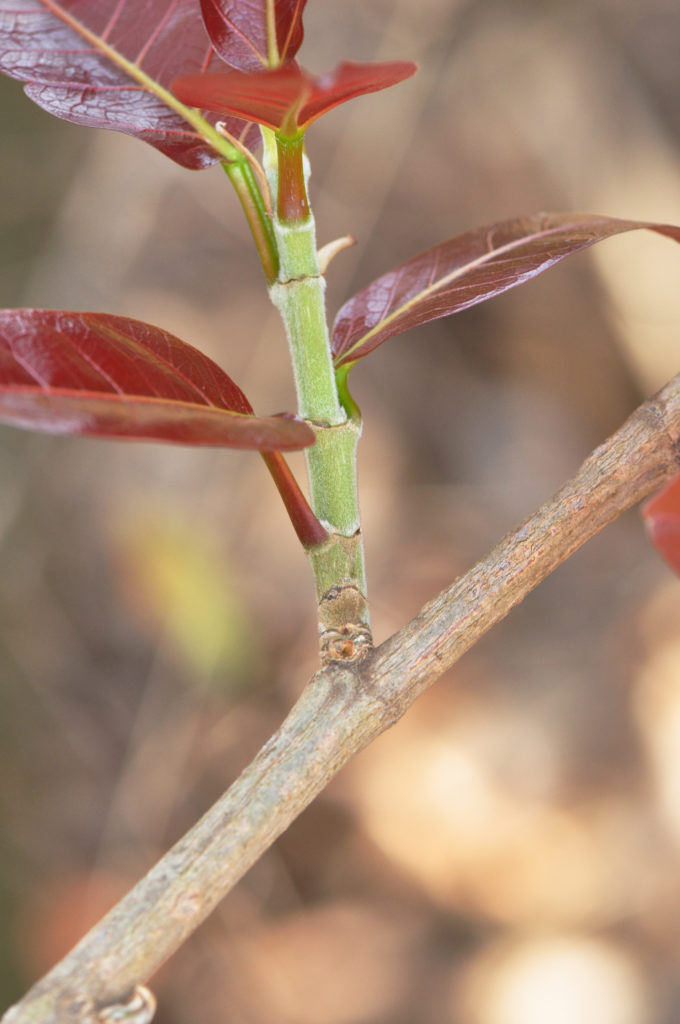
- 378. 2017/10/02. Pretoria NBG. Photo: David Becking.
-
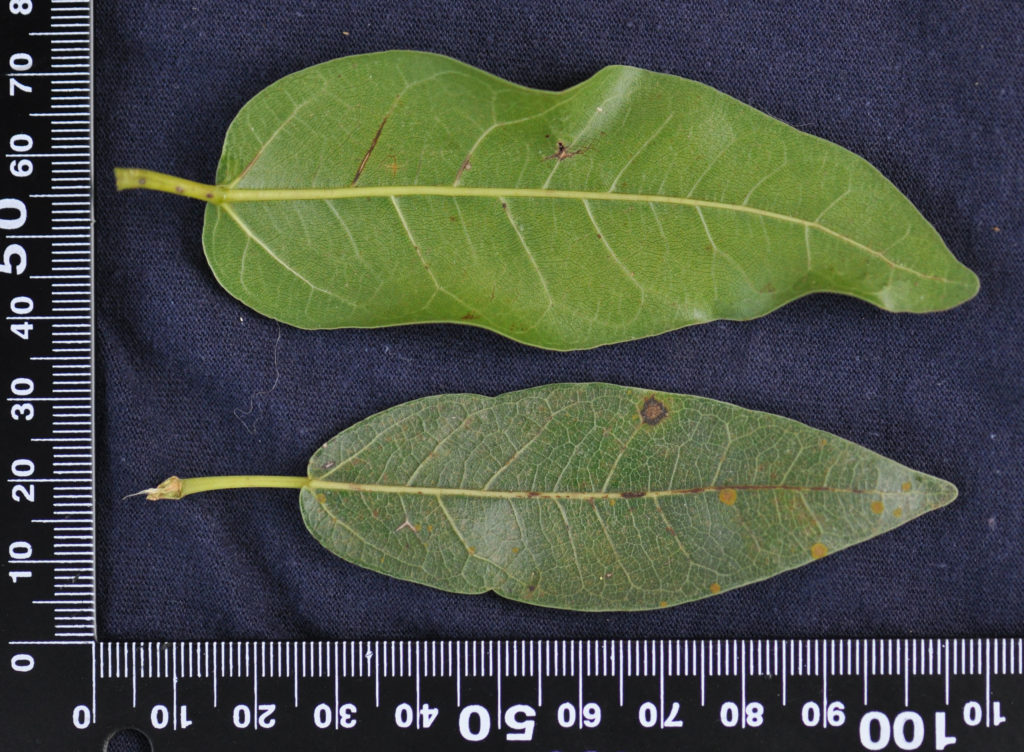
- 309. 2017/08/03. Pretoria NBG. Photo: David Becking.
Flowers
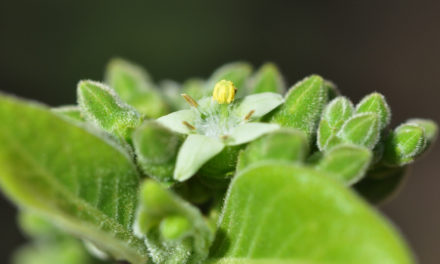
These plants are monoecious (having both male and female reproductive organs on the same plant). The figs are bisexual, but the tiny individual flowers may be male or female or have both sexes present. Figs possess an amazingly arranged flower head called a Syconium. Essentially this consists of a Receptacle (is that expanded tip of the flower stalk from which the floral parts develop). This is greatly expanded in the Genus Ficus and the family Asteraceae (this family includes the sunflower and ass daisies). The perimeter of the receptacle substantially increases in size, folding over and forming the fig shape. As the mature fig dries, its size decreases slightly. In this plant, the figs develop just below a leaf or in terminal leaf clusters and not on small, leafless branches. The Syconium is the type of inflorescence found in figs. The hollow fig ends with a tiny opening called an Ostiole (photo 376 – under Fruit), which is covered with scales that do not overlap (in Ficus ingens these scales do overlap and are not folded in to make a pore) making exit for wasps impossible and entrance difficult. Only the female pollinating wasp (specific for each species, in this case is Platyscapa soraria), attempts to do so and usually injures herself in the process. A large collection of extremely small flowers is located round the inner boundary of the hollow fig receptacle. In the Male Flowers, up to 6 overlapping perianth (the 2 floral envelopes considered together; a collective term for the calyx and corolla) lobes and one or 2 Stamens are present. The ovary is absent or vestigial (imperfectly developed, non-functional. When present it is usually smaller). In the Female flowers, there are no stamens and usually fewer perianth lobes. The Ovary is free and usually has 2 Styles each with usually oblong Stigmas.
The Female wasp enters the fig with her pollen sacks laden with microscopic pollen and pollinates those female fig flowers with longish styles. These longish styles prevent the wasp from laying eggs in the ovary. The wasp targets the flowers with short Stigmas and lays a single egg in each ovary. These female flowers react producing a gall, nourishing the developing larvae and these eventually pupate and becomes adults. The robust young Male wasps emerge first, fertilize the young Female wasps and then burrow through the wall of the fig to escape. This hole allows oxygen to inter. The young female wasps, now unintentionally loaded with pollen from the male flowers, escape from the fig and make their way to another fig of the same species, to continue the life cycle. This is an excellent example of a mutualistic relationship between the fig tree and the wasp – where both benefit. In Ficus ingens there is a very short stalk present. (Mainly Nov-Feb).
-
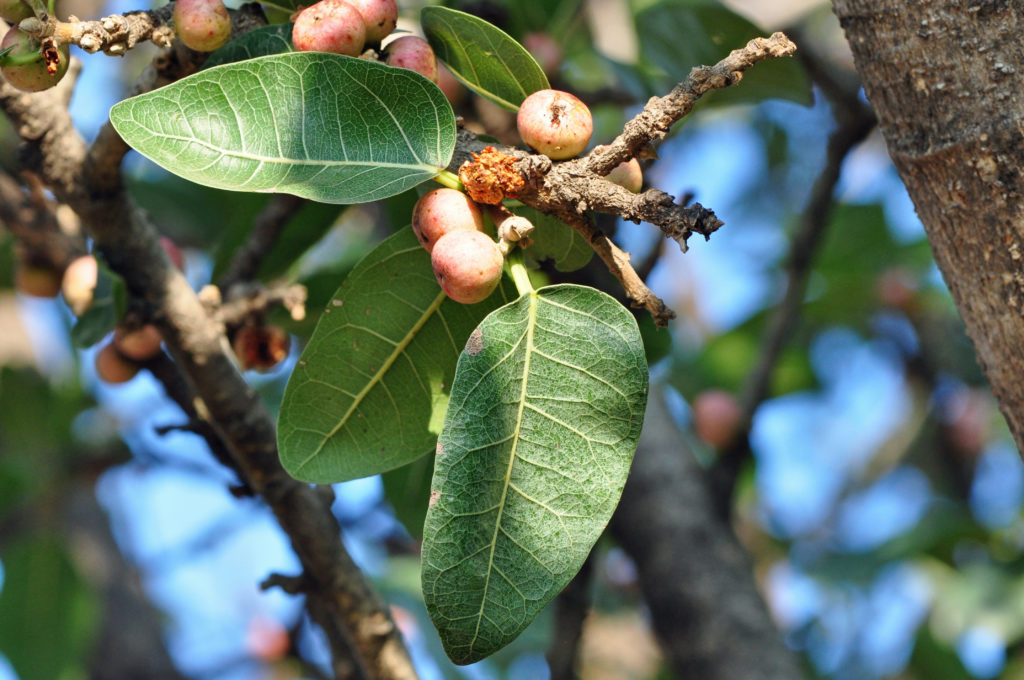
- 23. 2018/03/14. Pretoria NBG. Photo: David Becking.
Fruit
In summer, nearly after the wasps have left, the edible figs with their fertilized seeds, ripen. The small initially pink fig / syconium is up to 1,3cm wide and is on a short stalk – up to 1cm long (photo 376). The mature wrinkled figs may be slightly hairy and change from white to purple. At this stage, small warts may be visible. Figs may appear singly or in pairs (photo 376) in leaf axils or below the leaves on twigs. Oxygen enters through the escaping wasp holes. Ripening is due to the oxygen induced ethylene production. Ethylene is a small hydrocarbon gas that is odourless and tasteless. This gas is involved in the ripening of the fruit and causing the fruit to change colour, texture and soften. It is used commercially to ripen fruits like tomatoes, bananas and pears. (Dec-Feb). In the section through the fig (photo 889), the wasps leaving behind the developing fruit, and have escaped through the visible ostiole are visible. The ruptured ovaries from which the wasps have escaped are clearly visible.
-
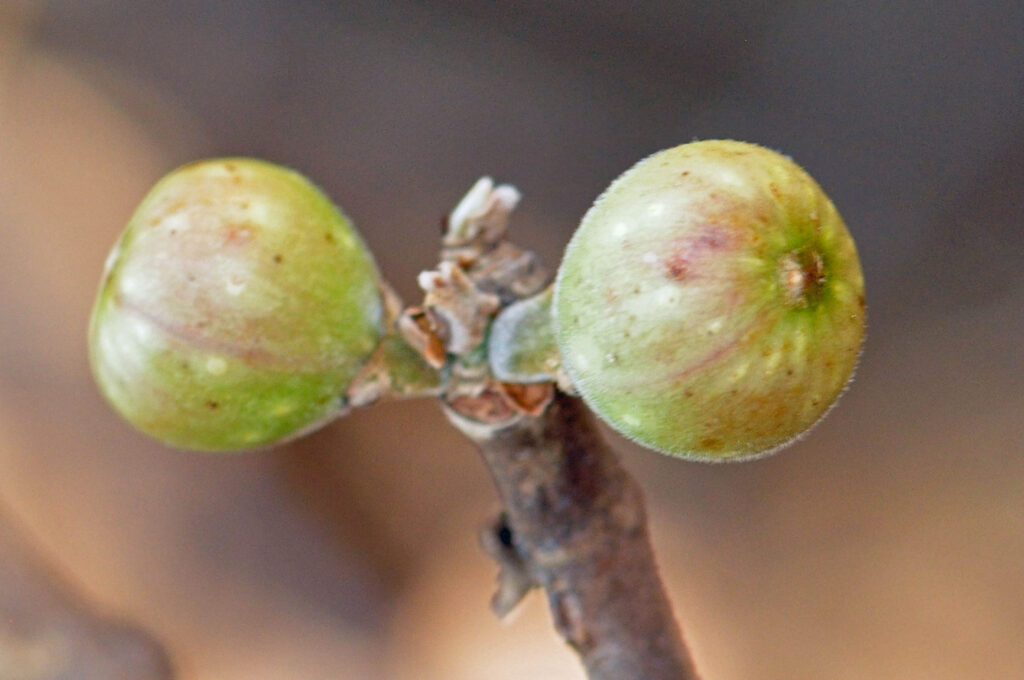
- 376. 2017/10/02. Pretoria NBG. Photo: David Becking
-
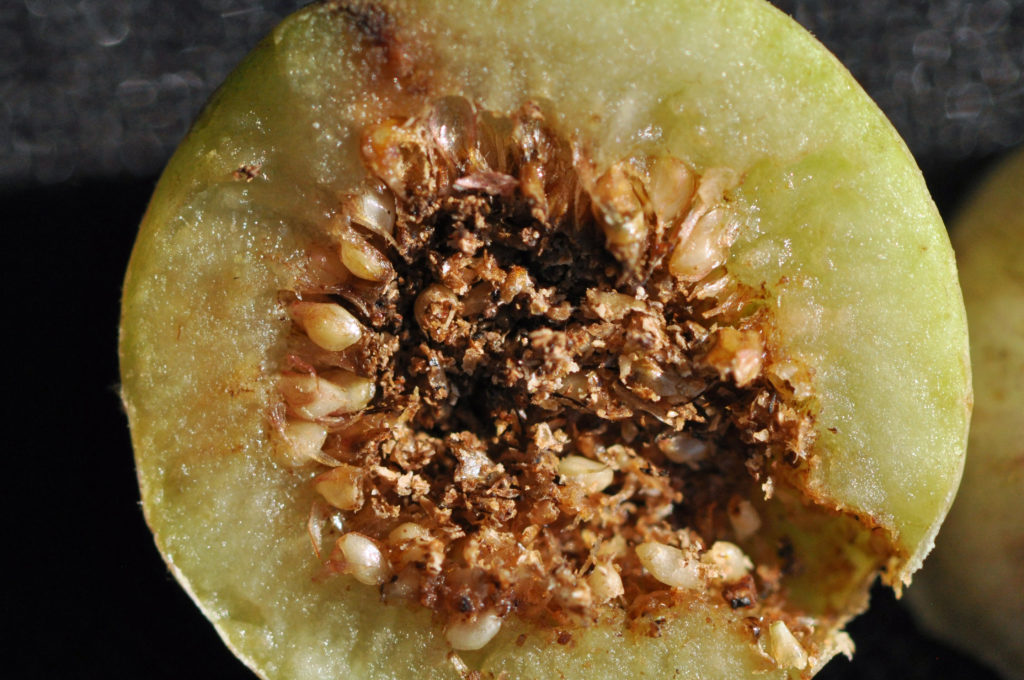
- 889. 2017/11/14. Pretoria NBG. Photo: David Becking.
Distribution & Ecology
These trees may be found from around Pondoland and Grahamstown (NE of Port Elizabeth) in the Eastern Cape, KwaZulu-Natal, Gauteng (usually against the rocks of north facing slopes – e.g. Melville Koppies), Mpumalanga e.g. on the dolomites of the Pilgrim’s Rest area, Limpopo, North West, Eswatini (Swaziland), Botswana, Mozambique, Zimbabwe, and northwards into tropical Africa- including Senegal, Ethiopia and Saudi Arabia. This is a tree of the savannah (a rolling grassland scattered with shrubs and isolated trees, which can be found between a tropical rainforest and desert biome). This plant can also be found in mixed woodland, riverine forests and in moderate frost sites including grassland and rocky hillsides. In cooler areas, trees often occur on north facing slopes. The tree may occasionally be a strangler (seeds may grow on other species and eventually kill them). This tree can withstand some cold weather. It is important ecologically for its food, shade and shelter. Many Birds – including bulbuls seek the Fruit. Monkeys, baboons and other animals also feed on the fruit. Leaves supply food for the butterfly larvae of the Common Fig-tree Blue (Myrina silenus ficedula). This attractive butterfly – blue and orange, has a wingspan of about 3cm that is slightly larger in females.
Ethnobotany
This plant can be Grown from seeds or truncheons (stem cutting from a selected plant – used to produce genetically identically new plants). The Figs are edible, but leaves are very toxic to livestock. The Root system is aggressive – thus usually not for the small garden and not near buildings. However, it makes a good shade and bird-attracting tree. It also makes a good bonsai. Wood is light to grey-brown. Ficin/Ficain is a protease enzyme (an enzyme that breaks down proteins and peptides) extracted from the milky sap of fig trees. Currently it is being studied for its effects on cancer and diabetes. Local people use it as a substitute for a disinfectant such as iodine.
References
Boon, R. 2010. Pooley’s Trees of eastern South Africa. Flora and Fauna Publications Trust, Durban.
Burrows, J.E. & Victor, J.E. 2005. Ficus ingens (Miq.) Miq. National Assessment: Red List of South African Plants version 2024.1. Accessed on 2026/05/03.
Coates Palgrave, M. 2002. Keith Coates Palgrave Trees of Southern Africa, edn 3. Struik, Cape Town.
Lawrence, G. H. M, 1951. Taxonomy of Vascular Plants, The Macmillan Company, New York. Tenth Printing 1965.
Palmer, E. & Pitman, N. 1972. Trees of southern Africa, Balkema, Amsterdam, Cape Town.
Schmidt, S. Lotter, M. & McCleland, W. 2002. Trees and Shrubs of Mpumalanga and the Kruger National Park.
van Wyk, B. & van Wyk, P. 1997 Field guide to Trees of Southern Africa, Struik, Cape Town.
Woodhall, S. 2020. Field Guide to Butterflies of South Africa, edn 2. Donnelley, RR, China.
https://commons.wikimedia.org/wiki/Category:Myrina_silenus
http://plantzafrica.com/plantefg/ficusingens.htm
http://www.prota4u.org/protav8.asp?p=Ficus+ingens
http://posa.sanbi.org/flora/browse.php?src=SP
https://www.bing.com/videos/search?q=Syconium&&view=detail&mid=2E73A68D3B07BE4CE6DF2E73A68D3B07BE4CE6DF&&FORM=VRDGAR&ru=%2Fvideos%2Fsearch%3Fq%3DSyconium%26%26FORM%3DVDVVXX