
Senegalia erubescens
General Info – Summary
This semi-deciduous Tree is up to 10m high. It papery bark with sharp, paired hooked thorns. The small bipinnate Leaves have non-spinescent stipules and just spaced apart leaflets. Bisexual, regular, Flowers are in axillary spikes and appear before the leaves. Exerted filaments provide white flower colour. Late extending style aids cross-pollination. Fruit: straight, dehiscent papery pod produces compressed seeds.
Description
Previous Names: Acacia erubescens, Acacia caffra var. pechuelii, Acacia dulcis, Acacia kwebensis, Acacia longipetiolata.
SA Tree No. 164.
Common names: (Afr) Blouhaak, Blouhaakdoring, Blouhaakdoringboom, Geelhaak, Katnael, Soetdoring, Witdoring, Withaak, Wynruitdoring, Wynruithaakdoring. (Eng) Blue Thorn, Blue-thorn. (Setswana) Moloto. (Tshivenda) Mulondo, Tshihaka-phele. (Xitsonga) Xinaganhutlwa.
Family: Fabaceae, or Leguminosae (Pea, bean or legume family). After the Orchidaceae and the Asteraceae, the Fabaceae is the third largest Angiosperm (flowering plants) family with 700+ genera and close to 20 000 species. Local Tree genera on this website include Acacia (Vauchellia, Senegalia), Albizia, Bauhinia, Bolusanthus, Burkea, Calpurnia, Colophospermum, Cordyla, Cyclopia, Dichrostachys, Erythrina, Erythrophleum, Faidherbia, Indigofera, Mundulea, Peltophorum, Philenoptera, Piliostigma, Schotia and Xanthocercis. The Fabaceae are recognisable by their fruit and their pinnately compound Leaves. Leaves may also be simple – even bilobed and usually have stipules – some of which may be spinescent. Leaflets are usually entire. Flowers are bisexual and bracteate. Regular flowers usually have 4-5 sepals and the same number of petals. Irregular flowers have 4-5 sepals and 5 or less petals. Stamens have anthers that have 2 pollen sacs and there are usually at least twice the number of stamens as petals – often 10. The superior Ovary has 1 locule containing 1 or more ovules. The Stigma and Style are simple. The single carpel develops into the Fruit, which is usually a pod. The mature pods may dehisce or break into segments. Seeds vary.
Name derivation: Species of the genus Vachellia and Senegalia were considered members of the genus Acacia until 2005. New Names. The genus Vachellia was named after George H. Vachell (1789 – 1839), chaplain and plant collector in China. Here the inflorescence is capitate (head like) and spinescent stipules are present. Plants in the genus Senegalia – (from Senegal) usually do not have spinescent stipules and the inflorescence is usually a spike. erubescens: reddening, or blushing and may refer to the young flowers.
Conservation: National Status: L C (Least Concern). Assessed: 2005 (W. Foden and L. Potter).
Tree
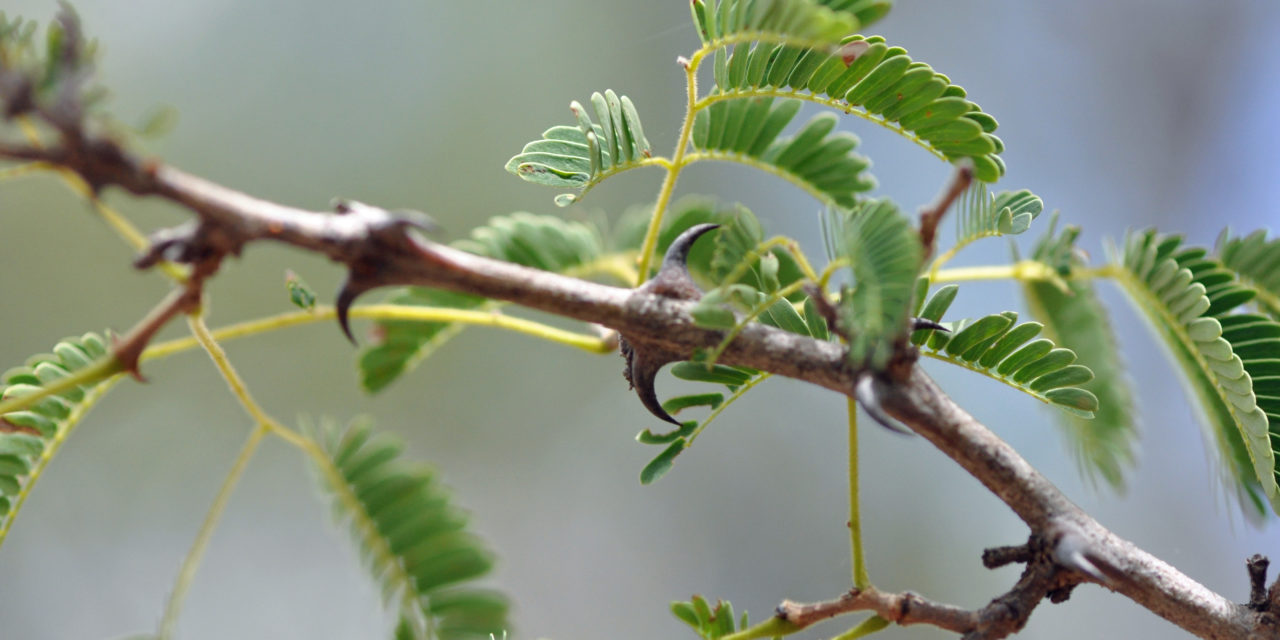
This small Tree may reach 10m high with has a flattened or spreading crown. It often is a shrub with many stems. The frequently papery Bark is pale blue (photo 128), yellow (photo 107) or white. It may be scaly, or corky and peals with pale greyish-yellow papery flakes. Shiny young branches may be hairy, orange tinged or greyish brown. The sharp, stout and recurved paired short Thorns are bluish black tipped and up to 7mm long (photos 112 and 109 under Leaves). These thorns occur just below the nodes. If 3 thorns present, they all point in the same direction.
-
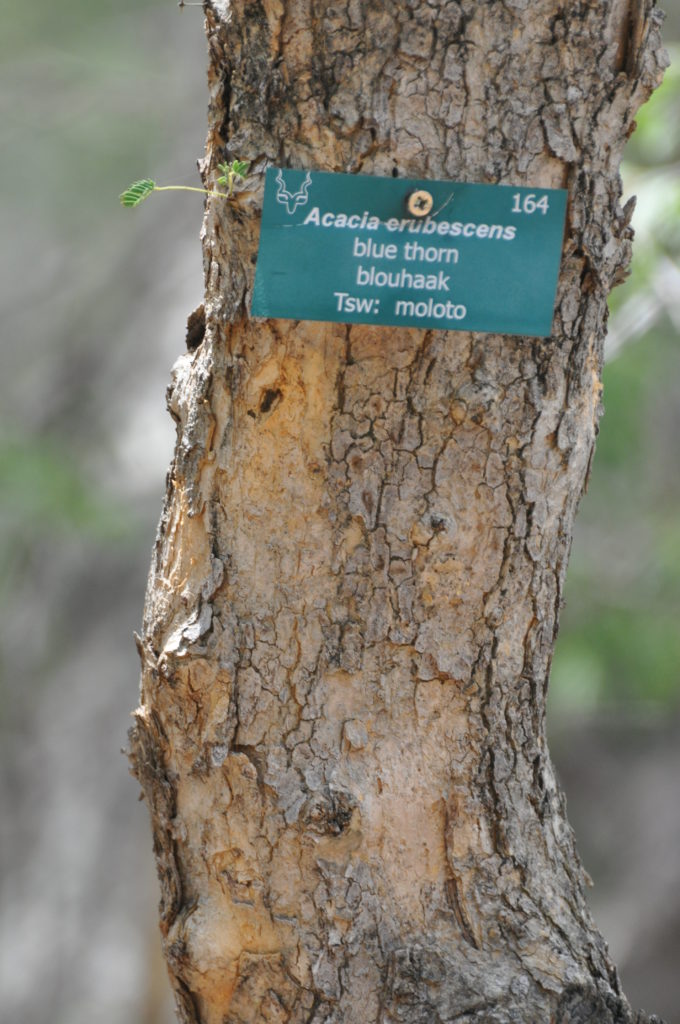
- 107. 2014/02/17. Marakele NP. Photo. D. Becking.
-
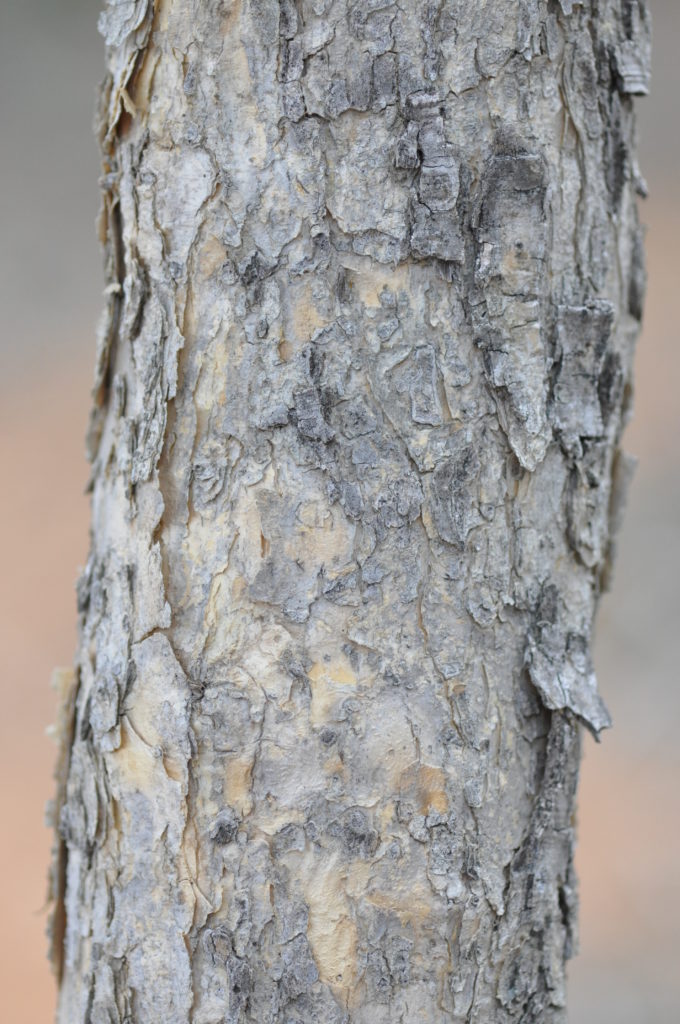
- 128. 2014/02/17. Marakele NP. Photo. D. Becking.
-
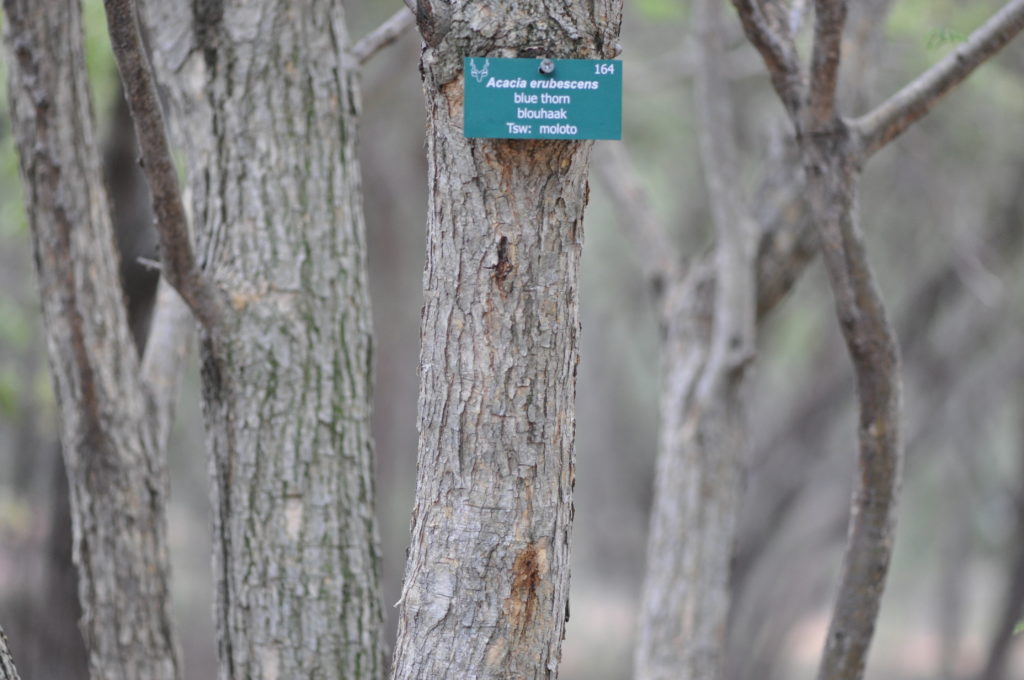
- 348. 2014/02/18. Marakele NP. Photo: David Becking.
-
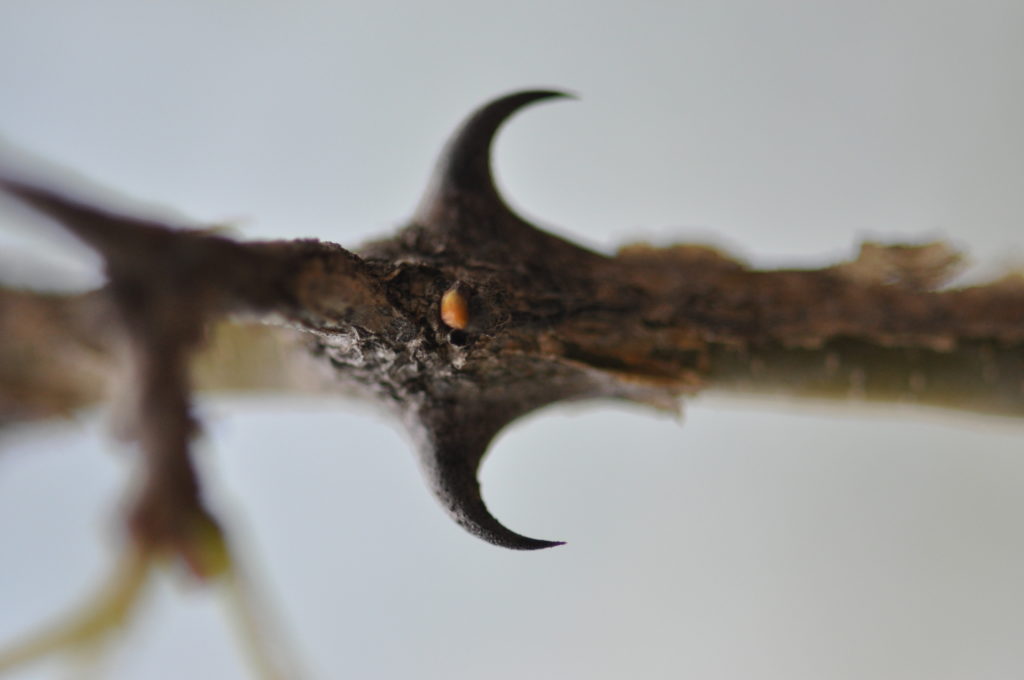
- 112. 2014/02/17. Marakele NP. Photo. D. Becking.
Leaves
This semi-deciduous tree has relatively small Leaves that are up to 6 x 4cm. They are bipinnate (compound: twice-pinnate leaves. The Rachis (main/central axis) has lateral pinnae “branches” not leaflets and the pinnules “leaflets” are on these “side branches”). The hairy rachis (main axis) is up to 3cm long with 3 to 7 pairs of pinnae (Leaflets – photo 110) that curve downwards (photo 109). Each pinna has between 10 and 30 pairs of pinnules – leaflets. Glands may be present between the top pair of pinnae and on the petiole (photo 125). The small blue-green, grey-green or yellowish-green and slightly spaced apart Leaflets (more so than in Senegalia cinerea) are obliquely oblong and up to 7,5 x 2mm. They may be slightly sickle shaped. The Petiole (leaf stalk – photo 109) is usually up to 2,5cm long and often has a raised petiolar gland near the base of the leaflets. The Stipules (basal appendages of the petiole) are not spinescent and are soon lost. Leaflets are larger than in Senegalia cinerea, which also has more pinnae.
-
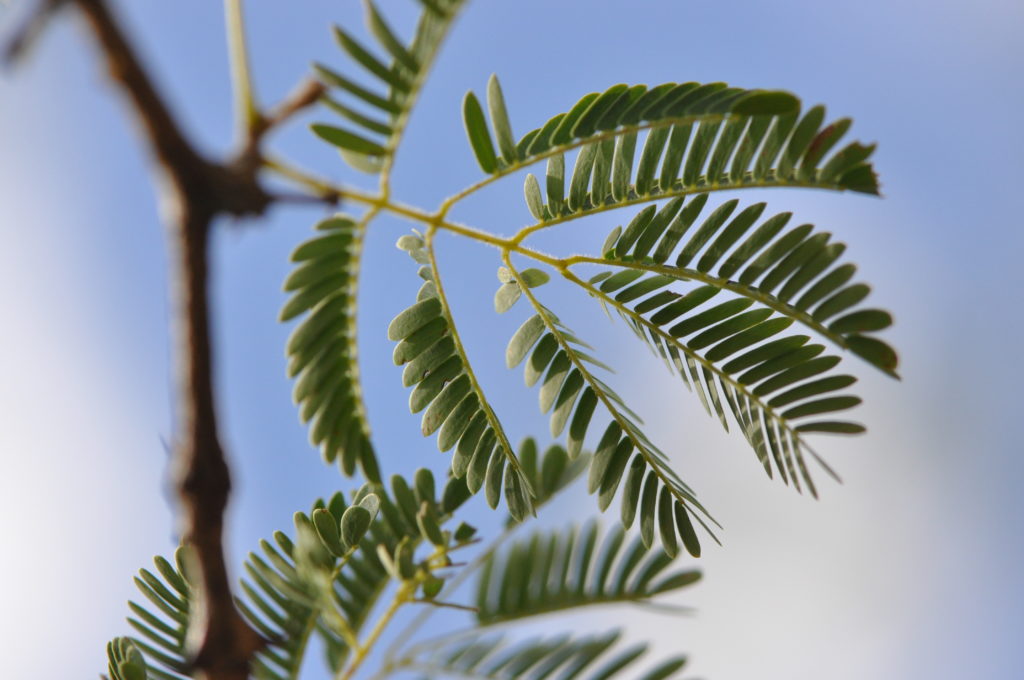
- 110. 2014/02/17. Marakele NP. Photo. D. Becking.
-
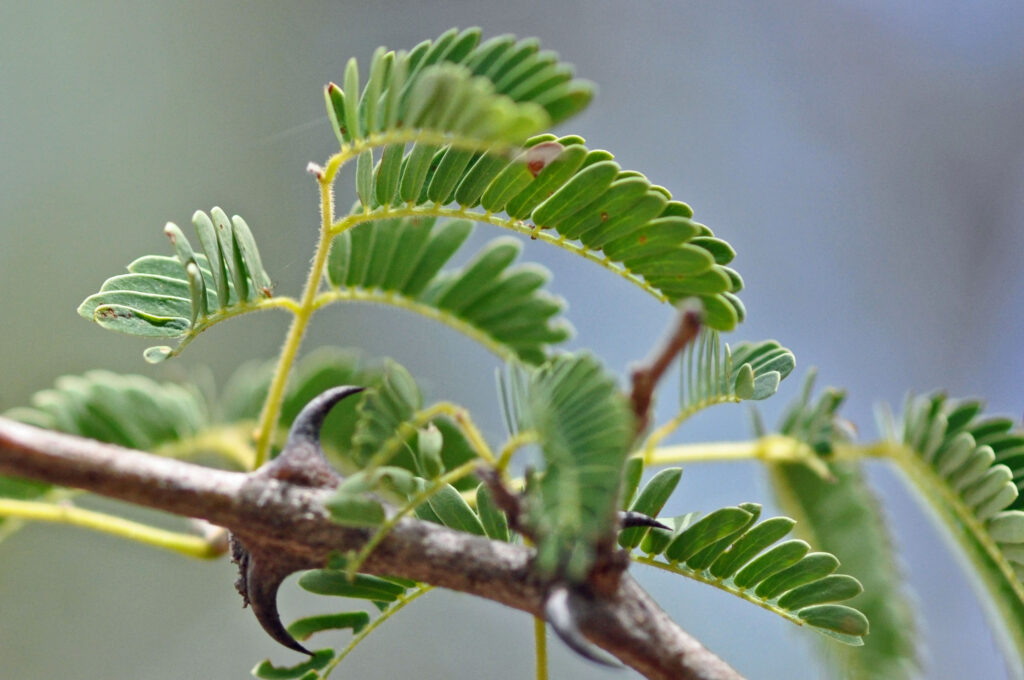
- 109. 2014/02/17. Marakele NP. Photo. D. Becking.
-
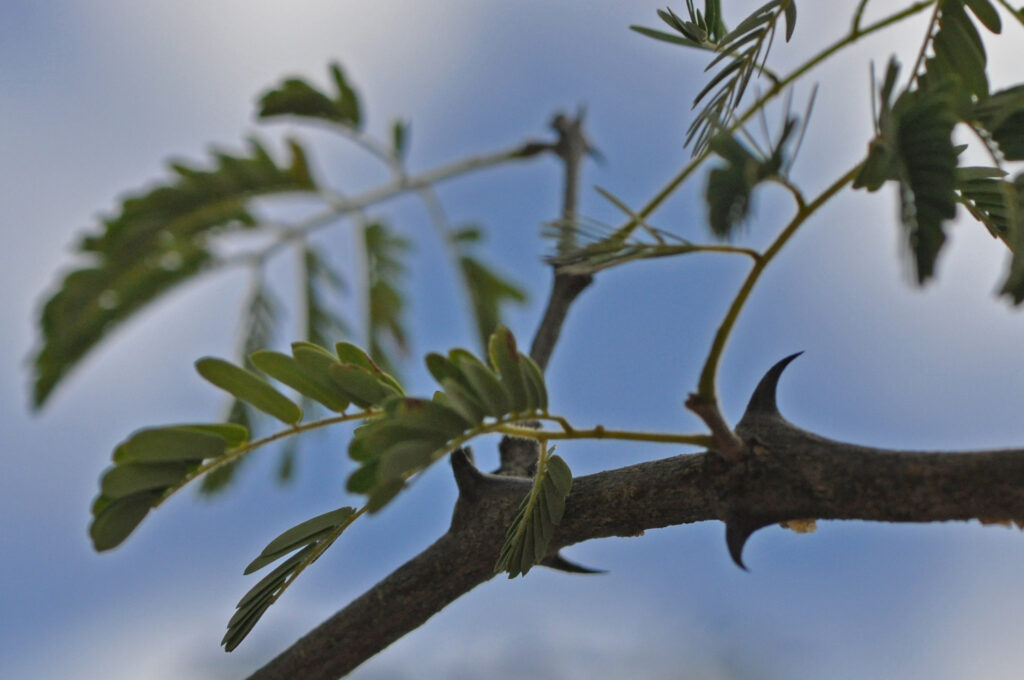
- 125. 2014/02/17. Marakele NP. Photo. D. Becking.
Flowers
The bisexual Flowers appear before the leaves and are actinomorphic (Regular, symmetrical. Flowers are vertically divisible into similar halves by more than 1 plane passing through the axis). The sweet-smelling flowers collectively resemble bottlebrushes. These flowers are in short, white or pale-yellow (occasionally reddish) axillary Spikes (simple indeterminate inflorescence with sessile flowers on a single unbranched axis opening in succession towards the apex) that are up to 4,5cm long. They may be tinged with pink and usually appear before the new leaves. The bell-shaped Calyx is up to 4,5mm long and the Corolla is up to 6,5mm long. The Petals have adpressed hairs (lying closely against the adjacent part). These hairs are most noticeable near the apex of the lobes. The many Stamens have free Filaments that provide the creamy-white flower colour. They are distinctly exserted (sticking out; projecting beyond) and each stamen ends in an Anther (where pollen is produced). There is a single Pistil (a unit of the Gynoecium, the female element of the flower, composed of the Ovary, Style and Stigma) and the superior Ovary has a single locule (compartment). The single Stigma (the part of the pistil that receives the pollen) rests on a small, thread like Style. After pollen dispersal, the style elongates and extends the stigma beyond the declining stamens and becomes receptive to pollen. This helps ensure cross-pollination. (Aug-Oct).
Fruit
The straight, light to reddish brown, leathery Fruit is a flat, dehiscent, straight, papery pod that ends in a point. The pods have many crossing veins visible. Pods produce compressed Seeds that are up to 13 x 2cm. (Sep-Jan).
Distribution & Ecology
These drought resistant Trees are common in hot, dry rocky areas, in mixed deciduous woodlands, on hill slopes, bushveld and banks of dry watercourses below an altitude of 1 000m. They are often located close to Vachellia tortilis and grow well in deep sand and close to pans. Trees develop on rocky outcrops, riverbanks and close to pans. Coppice growth (occurs when stems are cut or burned that causes regrowth from the stump or roots). In South Africa these trees are located in Limpopo, Mpumalanga and North West. Beyond SA they occur in Namibia, Angola, DRC, Botswana Tanzania, Zimbabwe, southwest Mozambique, Malawi, DRC and into tropical Africa. This tree has a symbiotic relationship with nitrogen fixing bacteria forming Nodules on the roots. The nitrogen collected by this relationship benefits this tree and eventually other near-by plant life.
Ethnobotany
An excellent tasting, very sweet yellow Gum (a water-soluble sugary polysaccharide that is exuded to seal wounds and prevent infection by bacteria and fungi) also helps to prevent the trees from freezing. This gum can be harvested from the tree. It is highly regarded and before being eaten, the dried gum may be pounded. Wood is hard, termite resistant and makes good fence posts and an excellent fuel. The Pods are nutritious and sought by animals.
References
Coates Palgrave, M. 2002. Keith Coates Palgrave Trees of Southern Africa, edn 3. Struik, Cape Town.
Foden, W. & Potter, L. 2005. Senegalia erubescens (Welw. ex Oliv.) Kyal. & Boatwr. National Assessment: Red List of South African Plants version 2020.1. Accessed on 2023/12/20.
Lawrence, G. H. M, 1951. Taxonomy of Vascular Plants. The Macmillan Company, New York. Tenth Printing 1965.
Palmer, E. & Pitman, N. 1972. Trees of southern Africa. Balkema, Amsterdam, Cape Town.
Ross, J. H. A conspectus of the African Acacia Species. 1979. Botanical Research Institute.
Schmidt, S. Lotter, M. & McCleland, W. 2002. Trees and Shrubs of Mpumalanga and the Kruger National Park. Jacana, Johannesburg.
van Wyk, B. & van Wyk, P. 1997 Field guide to Trees of Southern Africa. Struik, Cape Town.
http://www.zimbabweflora.co.zw/speciesdata/species.php?species_id=125880
http://www.sagr.co.za/forum/viewtopic.php?f=248&t=306&start=40
http://tropical.theferns.info/viewtropical.php?id=Acacia+erubescens
http://waynesword.palomar.edu/plaug99.htm
http://posa.sanbi.org/flora/browse.php?src=SP



I need Acacia Erubescens Seeds, at least 100000 number of seeds, from where do I can get seeds of this specie? please guide
Dear Shahab
Thank you for your note.
Regrettably I have only come across the one in my website and that was at Marakele National Park – in Limpopo. (Details on the web)
Take care
David.
Hello Mr Ali. did you find the seeds? if so, could you maybe link to where you got them?
Greetings from Johannesburg.
Please repeat your question. Apologies I am not sure how to answer your question.
“In reply to Shahab Ali. Hello Mr Ali. did you find the seeds? if so, could you maybe link to where you got them?”
Take care and stay warm.
David Becking.