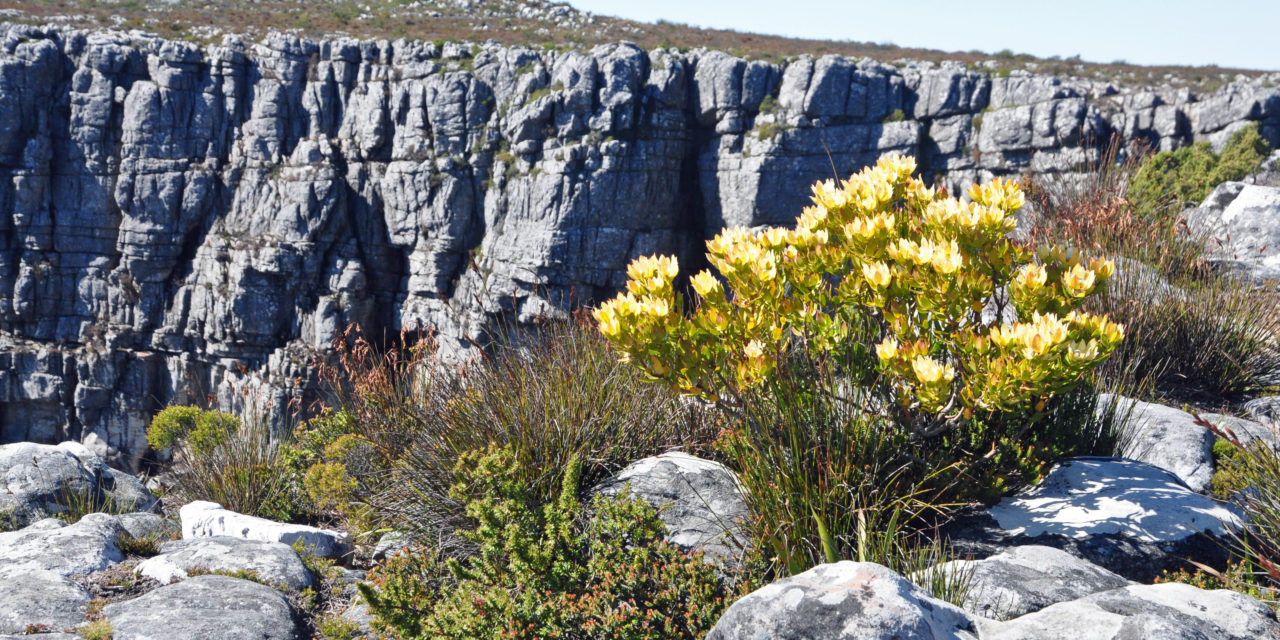
Leucadendron strobilinum
General Info – Summary
This dioecious Tree may reach 3m high but is often a shrub. Stems have ring-like leaf scars. Mature, simple, leathery, elliptic Leaves become hairless & lack a pedicel. The red & recurved involucre does not hide the ovoid Flowerhead. Flowers: male-4 stamens, no filaments. Female: single pistil superior ovary with 1 ovule and pollen presenter. Fruits: in a cone-head with flat post fire wind dispersed winged seeds.
Description
Previous Names: Leucadendron conocolor, Leucadendron squarrosum.
SA Tree No. 78.
Common names: (Afr) Bergroos, Rotstolbos, Rots-tolbos. (Eng) Mountain Rose, Peninsular Conebush, Rock Conebush.
Family Proteaceae (Protea family). Members of this family occur mainly in the southern hemisphere. Universal characteristics are few. All are woody trees or shrubs. Anthers are basifixed and the superior Ovary is sessile. Flowers are contained in a compound inflorescence and 4 Tepals are present. There are about 80 genera and at least 1 600 species including the Australian Macadamia. (South Africa has now become one of the biggest producers of Macadamia nuts). In South Africa, there are 16 genera and 300 species. 6 genera (examples on this website) have species that are trees. These are Brabejum, Faurea, Leucadendron, Leucospermum, Mimetes and Protea. Currently the genus Protea has the most species. Protea gaguedi is the only species found in Namibia. The South African Protea flowers all have a superior Ovary containing a single ovule. The Stigma is a tiny groove resting on the top of the pollen presenter. The Style is long and thin. The silky appearance of the wood is due to the presence of medullary rays (are pith rays used for the radial conduction of water, minerals and organic substances). Leaves are Sclerophyllous (type of drought resisting vegetation adapted to prevent water loss with hard, leathery, evergreen leaves that develop on narrowly spaced nodes). This family has similar Leaves to the Glossopteridales whose fossil leaf remains resemble the modern protea. These fossils were prevalent more than 200 million years ago. This was a time before the breakup of the super continent – Gondwanaland – due to continental drift.
Name derivation: Leucadendron – leukos: (Greek) – white and dendron (Greek) – tree. This colour does not apply to this plant. Strobilinum – Like a cone (Greek) referring to the cones, which resemble pinecones.
Conservation: National Status: (Near Threatened D2). Assessed: 2020/07/22 (A.G. Rebelo, H. Mtshali & L. von Staden). It only occurs naturally in about 8 locations within 154 square km. One of these (all photos below) is on Table Mountain. Problems include invasion by alien pine trees and poor fire management.
Tree
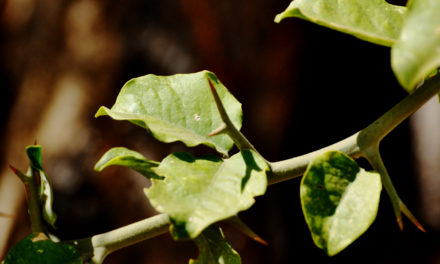
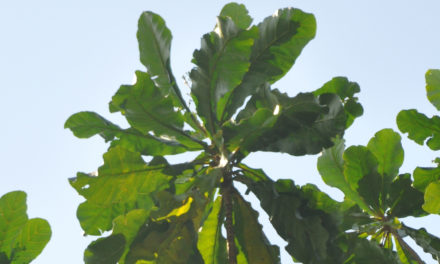
This Tree may reach 3m high but is often a robust shrub (photo 145). Branches with spars hairs occur near the base. Bark is purplish The Stems have flattish ring-like structures marking scars left by previous leaves (photo 138). Below the rings, white raised Lenticels (usually raised corky oval or elongated area on the plant that allows the uncontrolled interchange of gases with the environment) are visible (photo 138). Sparse Hairs may be present.
-
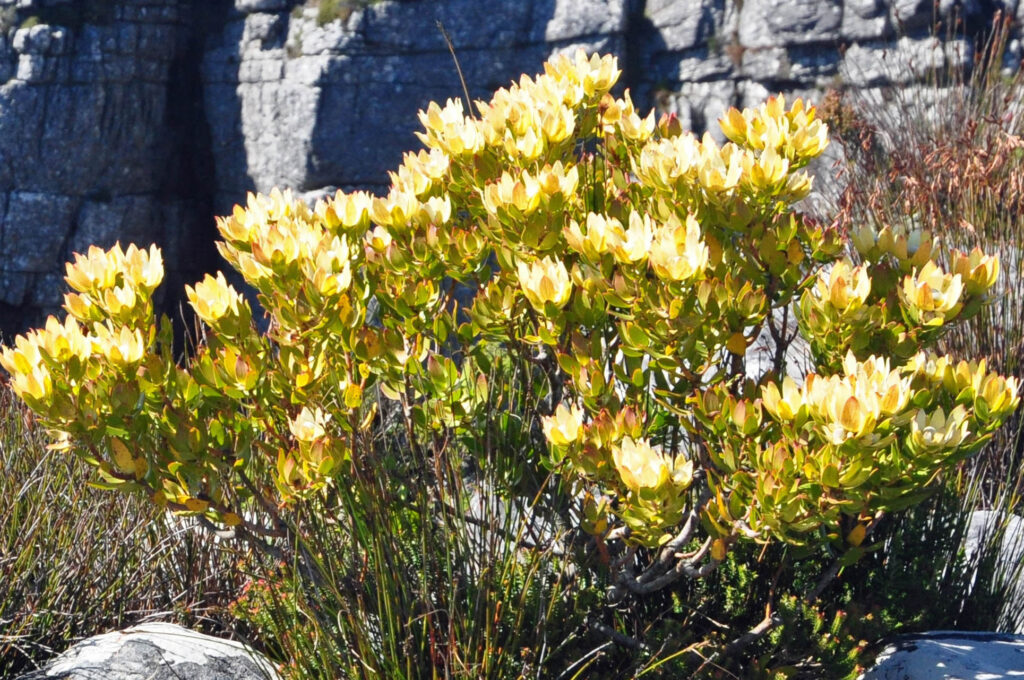
- 145R. 2018/09/10. Table Mountain. Photo: David Becking.
-
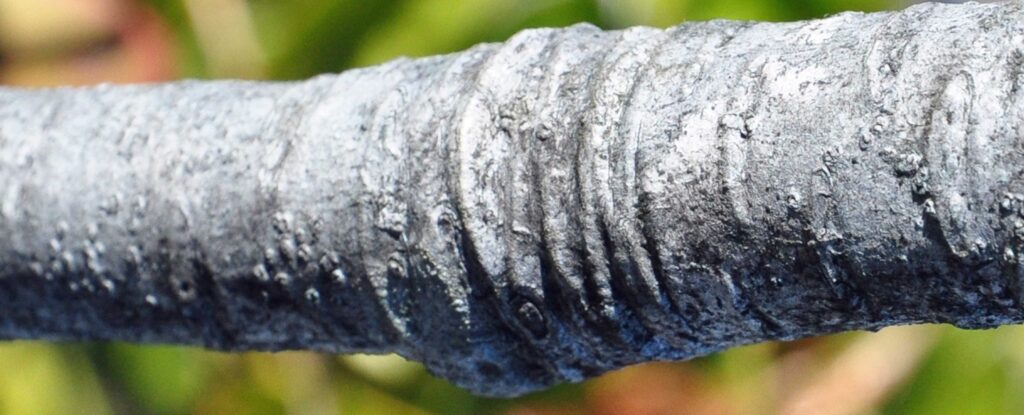
- 138. 2018/09/10. Table Mountain. Photo: David Becking.
Leaves
The light to dark green Leaves are simple (have a single blade, which may have incisions that are not deep enough to divide the leaf into leaflets), alternatively arranged, leathery and elliptic (photo 139). They are up to 8 x 2,4cm (slightly smaller in male plants). Away from the base, the smooth, initially hairy Margins are curved backwards and become hairless as they mature. Here the initially soft leaves become leathery. The Apex is very broadly tapering to rounded and a soft recurved reddish Bristle occurs at the reddish apex. This turns backwards and ends in a point (photo 136). The Base tapers when young and lacks a Petiole (leaf stalk – photo 139). Neither the relatively few leaves nor the larger Involucel (one or more whorls of bracts situated below and close to a flower) hide the inflorescence. They may be larger and more distinctive than the leaves and are cream-coloured or white.
-
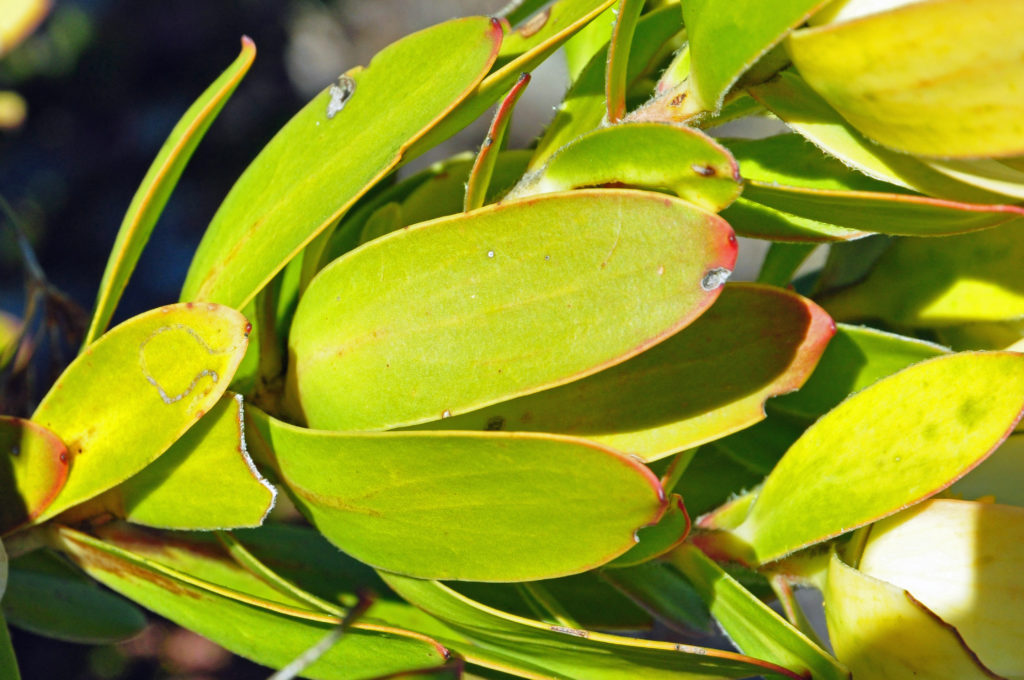
- 136. 2018/09/10. Table Mountain. Photo: David Becking.
-
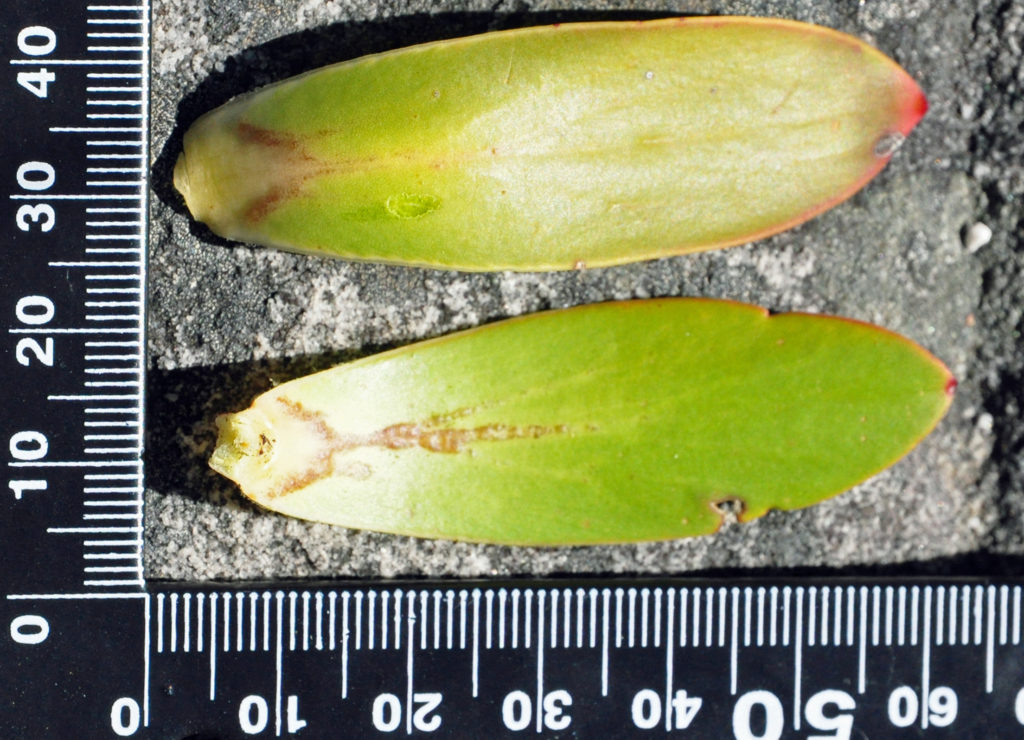
- 139. 2018/09/10. Table Mountain. Photo: David Becking.
Flowers
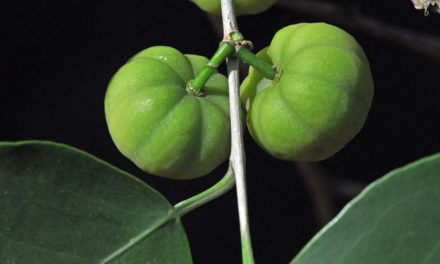
Here cream/yellow Involucral bracts (involucre: one or more whorls of bracts situated below and close to a flower, flowerhead, or fruit) are not numerous and do not conceal the flowerhead. This plant is dioecious (unisexual floral structures with male and female parts on separate plants). What may appear to be a single Flower is actually an inflorescence containing many small either male or female flowers. These flowerheads occur singly (photo 134). The small, individual flowers are 4-merous and smell of yeast. The Perianth (a collective term for the calyx and corolla) is cylindrical. In the Male Plants, the flowerhead is up to 2,5 x 3,5cm and here the bracts are very small. In individual male flowers, the ovary is usually small and vestigial (imperfectly developed). The 4 stamens lack filaments. In the Female Plants, the flowerhead matures into a narrowly ovoid (egg-shaped) cone up to 7 x 4cm. The individual, small female flowers have a single Pistil (a unit of the gynoecium composed of the stigma, style – when present – and ovary). A pollen presenter is present. (This is an area on the tip of the style in flowers of the Proteaceae). Here the anthers release their pollen prior to anthesis (the period or act of expansion in flowers, especially the maturing of the stamens. This occurs while the stigma is still covered and this function is to promote cross-fertilization). Here the superior Ovary has a single locule (chamber within an ovary) and the stamens are vestigial (imperfectly developed, non-functional relic from the past. It is usually smaller These yeast-smelling, female flowers collectively mature into the Cone Head (hence the common name: Conebush), which is up to 6,5 x 4cm. Here conspicuous woody Bracts are present. Small beetles are responsible for pollination. (Sep-Oct).
-
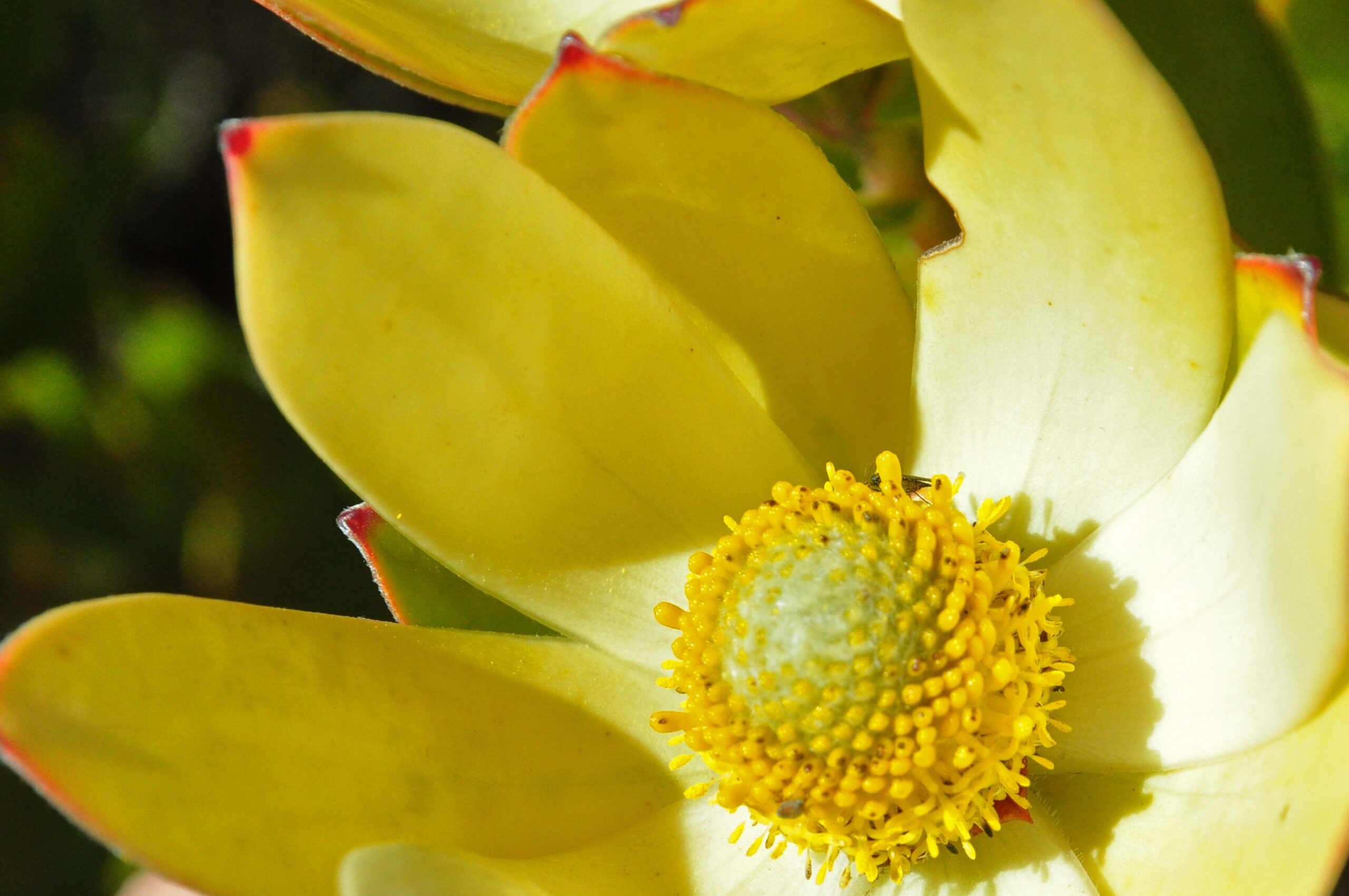
- 134. 2018/09/10. Table Mountain. Photo: David Becking.
-
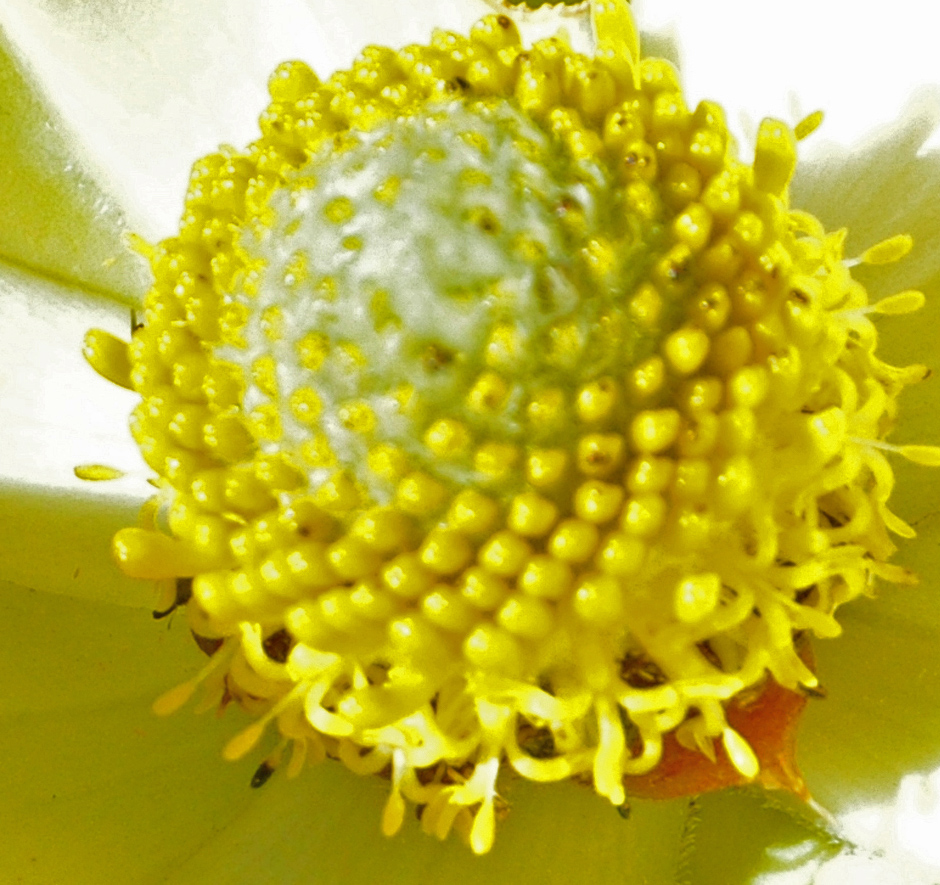
- 135. 2018/09/10. Table Mountain. Photo: David Becking.
Fruit
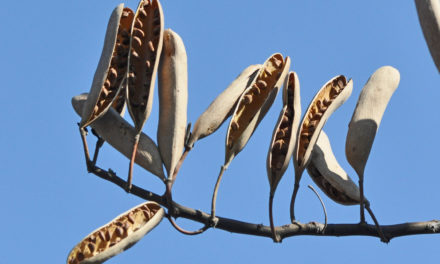
In the female plant, the seeds are stored in a large, strong cone (photo 137). Within the cone, the small, greyish brown, smooth Fruits (each from a separate flower) are small dry Nuts (indehiscent, 1-seeded hard bony fruit). They are usually about 8 x 6mm. (Nov-Jan). Dispersal of the flat winged seeds by wind only occurs when the parent pant dies – often after a fire. The cone protects the enclosed seeds from fire damage.
-
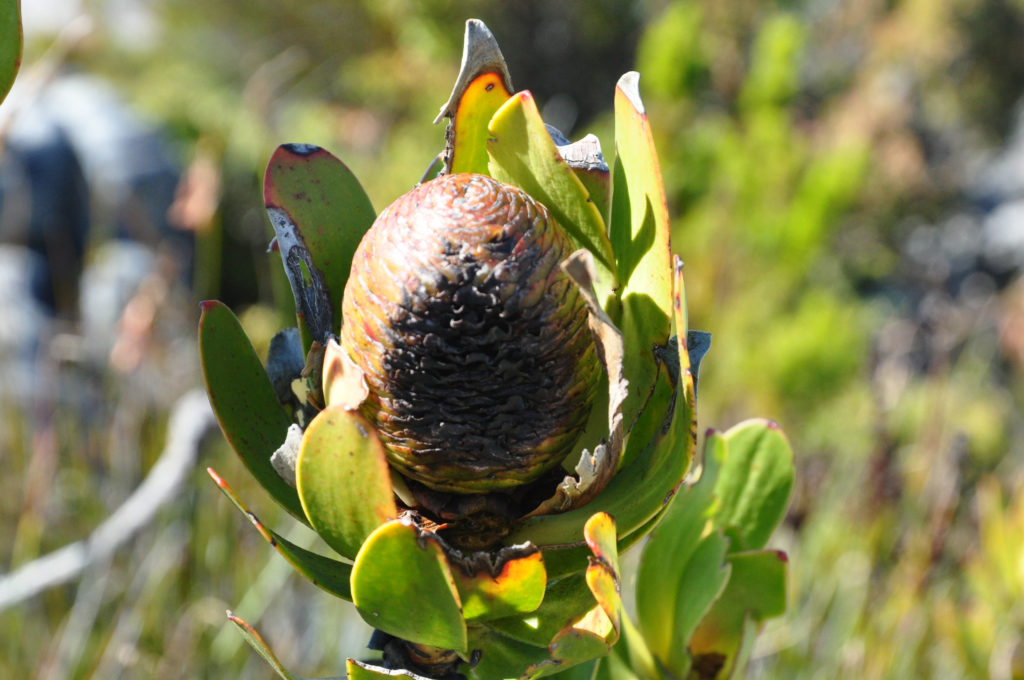
- 137. 2018/09/10. Table Mountain. Photo: David Becking.
Distribution & Ecology
This plant is slow growing, slow maturing, and usually occurs on south-facing rocky slopes, where the soil is damp and fires infrequent. It is Endemic (restricted to a particular geographic location) in the Western Cape of South Africa. The plant supplies food for pollinators. It is most common in the altitude range: 500-1 100m, in forests and fynbos (a belt of natural shrubland or heathland in the winter rainfall area within the distinctive vegetation of the Western Cape). Fire usually kills the plant, but the cone-stored seeds may remain viable – a survival strategy of a Pyrophyte (plant which has adapted to tolerate fire). These plants also survive hot, dry summers in poor soils. Shiny leaves help reduce water loss.
Ethnobotany
This attractive garden plant is for a fynbos garden. Plant seeds in autumn – in full sun. Water in winter. Plants can also be grown from cuttings. If seeds are wanted, use cuttings from both male and female plants. Apply a rooting hormone – after removing the lowermost leaves. Refrain from moving the established plant. Urbanisation and farming have reduced the relatively small survival area.
References
Coates Palgrave, M. 2002. Keith Coates Palgrave Trees of Southern Africa, edn 3. Struik, Cape Town.
Rebelo, A.G., Mtshali, H. & von Staden, L. 2020. Leucadendron strobilinum (L.) Druce. National Assessment: Red List of South African Plants version 2024.1. Accessed on 2025/12/10.
Olivia Tyambetyu. Kirstenbosch National Botanical Garden. January 2012
http://pza.sanbi.org/leucadendron-strobilinum
https://finebushpeople.com/content/leucadendron-strobilinum
http://posa.sanbi.org/flora/browse.php?src=SP
Leucadendron strobilinum – Wikipedia
Peninsula Conebush (Leucadendron strobilinum) – Botanical Realm
https://www.semanticscholar.org/