Kirkia acuminata
General Info – Summary
This candelabra shaped and attractive monoecious Tree, with its straight trunk and blunt ending, flexible upward pointing branches, is up to 19m high and a diameter to 0,8m. The imparipinnate acuminate and deciduous Leaves are spectacular in autumn. Small 4-merous unisexual Flowers are yellowish or cream. Male: 4 stamens with a reduced ovary. Female: superior ovary + staminodes. Fruit is a 4-angled capsule.
Description
Previous Names: Kirkia pubescens, Kirkia acuminata var. pubescens.
SA Tree No. 267.
Common names: (Afr) Witsering. (Eng) Common Kirkia, White seringa, White syringe, White Kirkia.
(Northern Sotho) Modumela. (Setswana) Modumela, Mvumayila. (Tshivenda) Mubvumela.
Family: Kirkiaceae. This family has 1 genus and 3 species in southern Africa and 1 genus in Madagascar. Leaves are often near branch ends and all lack stipules. Individual leaves are usually opposite, compound and imparipinnate with many pairs of opposite Leaflets. The trees are unarmed. Flowers occur in paniculate, bracteate cymes. Individual flowers are regular and usually unisexual. Although the tree is monoecious (having both male and female reproductive organs on the same plant), only 1 sex appears at a time. The Calyx has 4, more or less free Sepals. There are 4 free imbricate Petals and usually 4 Stamens in Male Flowers and these are reduced to staminodes in Female Flowers. Here the superior ovary (reduced in male flowers) has 4 locules, each with 1 ovule. 4 fused styles end in a capitate stigma. The woody Fruit is clearly 4-angled, dry and splits longitudinally. Seeds are triangular in cross section and have little or no endosperm (the starch and oil-containing tissue of many seeds; often referred to as the albumen).
Name derivation: Kirkia – after an explorer who also visited the southern Africa – the Scotsman Captain (Sir) John Kirk (1832-1922). He was highly regarded as a botanist and was a valued member of David Livingstone’s Zambesi expedition of 1858-1863. acuminata – acuminate – said of an acute apex whose sides are somewhat concave and taper to a protracted point. This refers to the leaves.
Conservation Status: L C. Least Concern. 2009 (Raimondo, D., von Staden, L., Foden, W., Victor, J.E., Helme, N.A., Turner, R.C., Kamundi, D.A. and Manyama).
Tree
This Tree with its spreading rounded crown (photo 109) usually has a single straight, grey trunk that may be smooth or rough. It may reach 19m high with a trunk diameter up to 0,8m. The grey Bark varies from smooth when young too rough with deep grooves. It may become flaky with age, even vertically streaked (photo 110RR). Pale grey branching may occur near the base. Young flexible branches have many clearly visible circular or oval leaf scars (photo 117R). Smooth Branches tend to grow upwards (photo 109) and may have a number of dark corky knobs (photo 110). Branches are blunt tipped (photo 117R). Older grey stems may have a corky flaking bark with grooves more than 2cm deep.
-
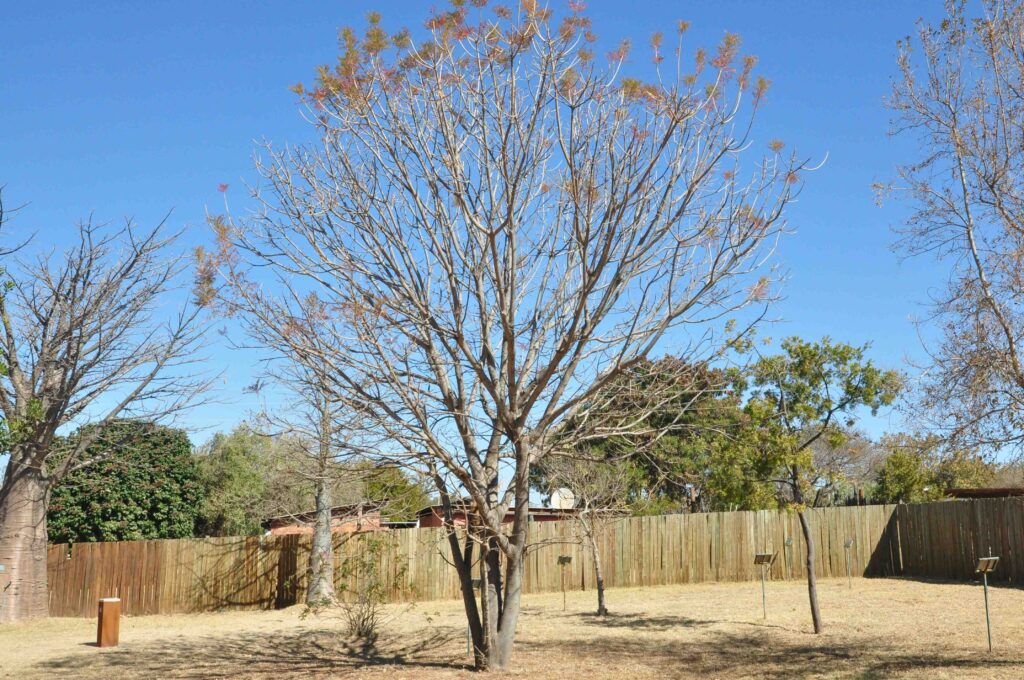
- 109. 2021/07/17. Bella Bella. Photo: John Becking.
-
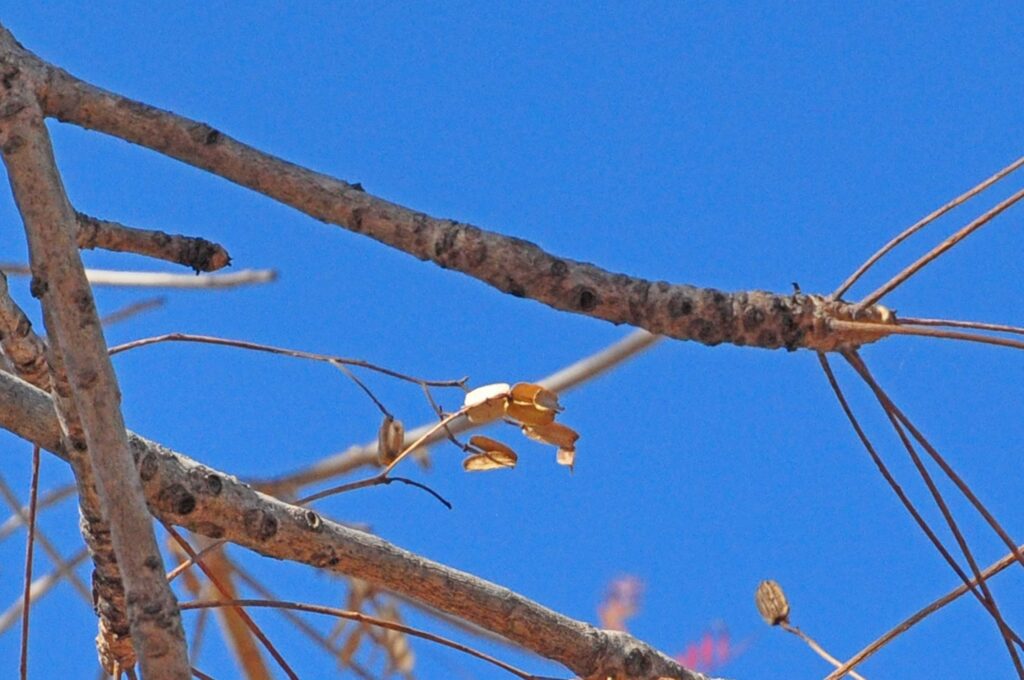
- 117R. 2021/07/19. Bella Bella. Photo: John Becking.
-
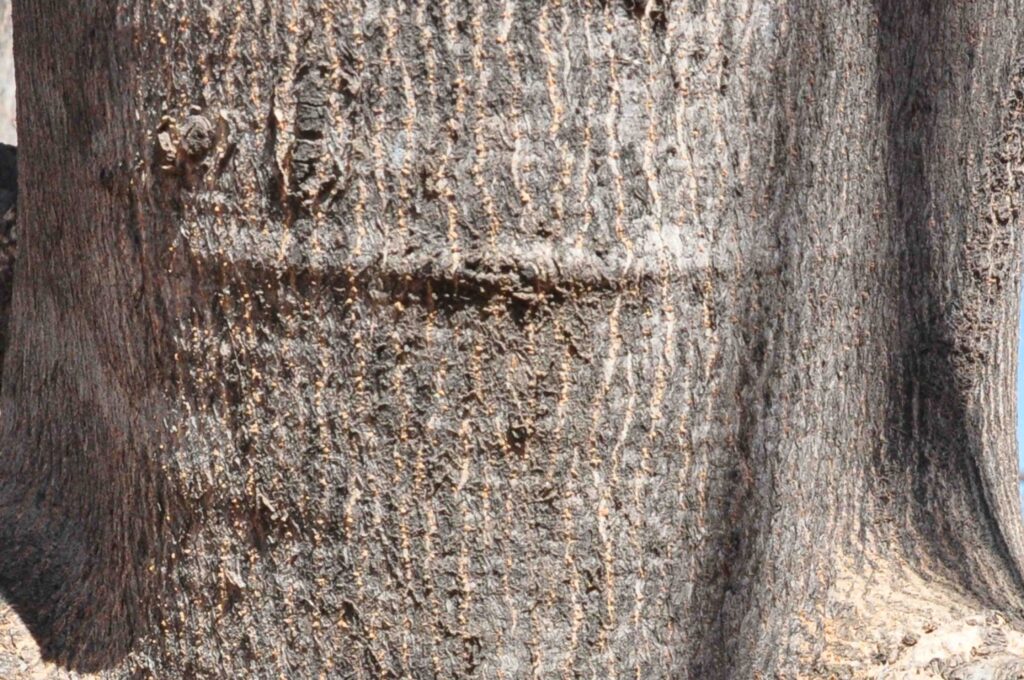
- 110RR. 2021/07/17. Bella Bella. Photo: John Becking.
-
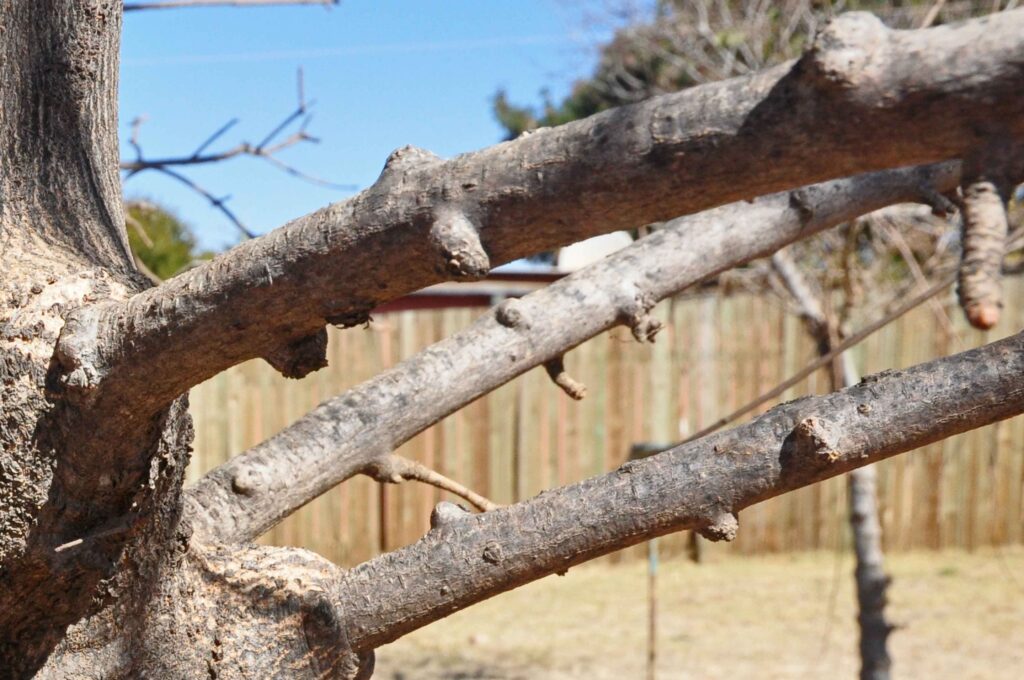
- 110E. 2021/07/17. Bella Bella. Photo: John Becking.
Leaves
Initially the young Leaves may be sticky. They develop late in spring and fall early in autumn. In summer the pale green pinnate (once divided leaf blades with leaflets arranged on both sides of the rachis) leaves are up to 45cm long (photo 120RR) and imparipinnate (pinnately compound leaf ending in a single leaflet – photo 120X). They develop towards the ends of bluntly tipped branches (photo 117R – under Tree). On this early deciduous tree, the leaves turn a spectacular red to golden colour in autumn (photo 120RR). Leaves lack Stipules (basal appendage of the petiole – leaf stalk). Each leaf has 6 to 10 pairs of narrowly ovate (shape of an egg with the widest point closest to the petiole) leaflets. These leaflets may be opposite, nearly so, (photo 120RR) or alternate. Leaves end in a single terminal leaflet (photo 120X). Each leaflet is up to 8 x 2,5cm and has a long sturdy central vein. In this compound leaf, the Midrib (the main rib of a leaf or leaf-like part is a continuation of but excludes the petiole) is branched into different leaflets and is connected by a single petiole. Here each leaflet Apex is acuminate (said of an acute apex whose sides are somewhat concave and taper to a protracted point – photo 120X). The asymmetric Base (not equal to the opposite side) is tapering to rounded. Margins are scalloped to finely serrated. Each leaflet is up to 8 x 2,5cm and has long sturdy midrib which is a rich plumb colour on the upper side. The leaflet Apex is acuminate (said of an acute apex whose sides are somewhat concave and taper to a protracted point). The Petiole (leaf stalk) is often reddish and up to 10cm long. Petiolules (leaflet stalks – photo 120X) are very short or absent.
-
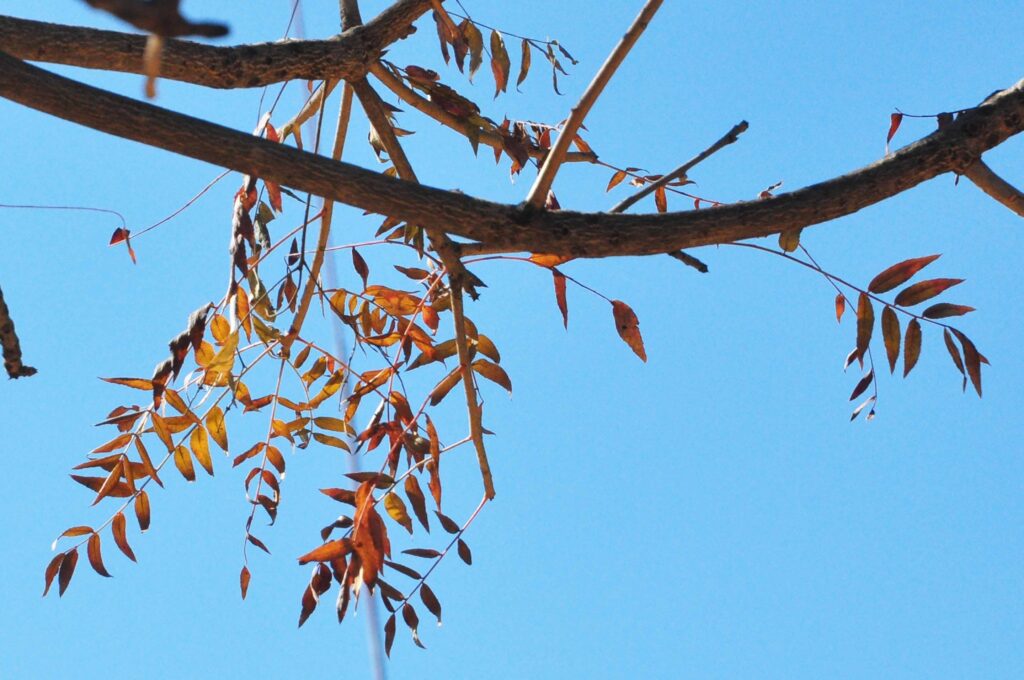
- 120RR. 2021/07/17. Bella Bella. Photo: John Becking.
-
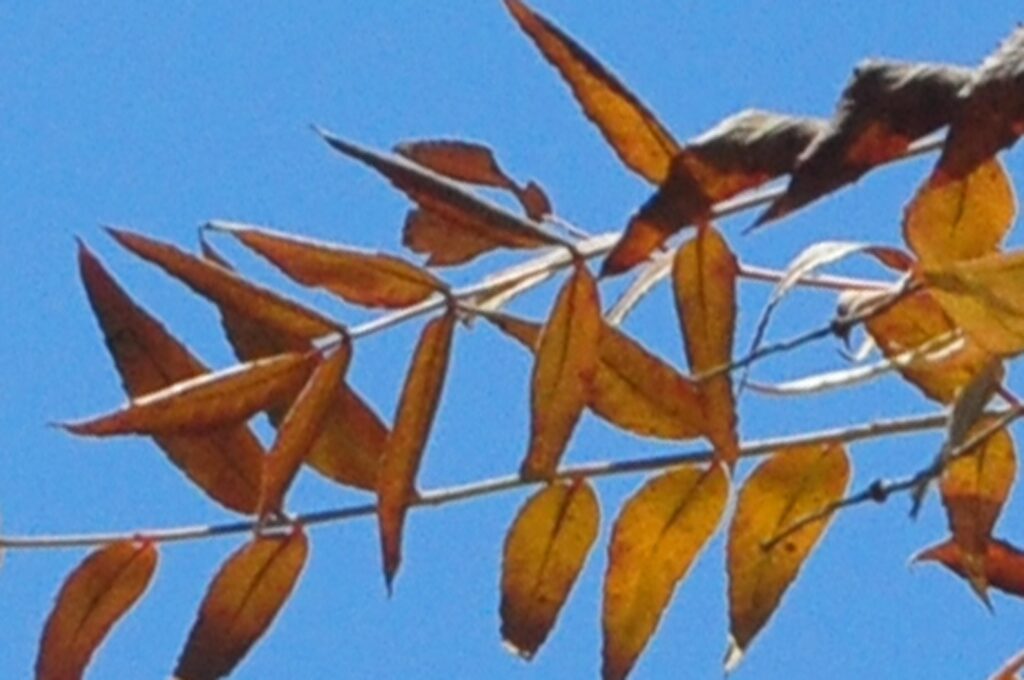
- 120X. Bella Bella. Photo: John Becking.
Flowers
This tree is monoecious (having both male and female reproductive organs on the same plant). Individual whitish Flowers are small – about 7mm in diameter and appear with the new leaves in leaf axils (axil – the upper angle between a lateral organ, such as a leaf, and the stem that bears it). Each flower has a noticeably long Pedicel (stalk of a single flower). The usually separate male and female flowers occur collectively in cymes (a broad, more or less flat-topped, determinate flower cluster – with central flowers opening first). The Calyx has 4 Sepals, and the Corolla has 4 free, cream or greenish, lanceolate Petals that are imbricate (having regularly arranged, overlapping edges, as roof tiles). In Male Flowers, the ovary is reduced and the style is absent. Alternating with the petals are 4 Stamens (male reproductive part of a flower. Stamens produce pollen in the terminal anther, which is usually supported by the filament, which arise on the outside of the disc (a more or less fleshy or elevated development of the receptacle). The Anthers are free from both the Corolla and other anthers. Present in the Female Flowers are Staminodes (sterile stamens). Here the superior Ovary is 4 locular, 4 lobed and is partly immersed in the annular or swollen disc. The slim Style (more or less elongated part of the pistil situated between the ovary and the stigma) ends in a capitate (formed like a head) Stigma (the part of the pistil that receives the pollen). (Each of the 4 locules (cavities within an organ) has a single Ovule. (Oct-Dec).
Fruit
The light brown, thinly woody, sharply 4 angled persistent Fruit (photo 117) is a Capsule (a dry fruit resulting from the maturing of a compound ovary which usually opens at maturity by one or more lines of dehiscence). This one is up to 2 x 1cm, and on dehiscence, splits into 4 parts but remain joined at the apex by a strip of tissue at the top of a central column. One single, triangular in cross section Seed is contained in each part. Capsules may remain on the tree for a year. (Jan-May).
-
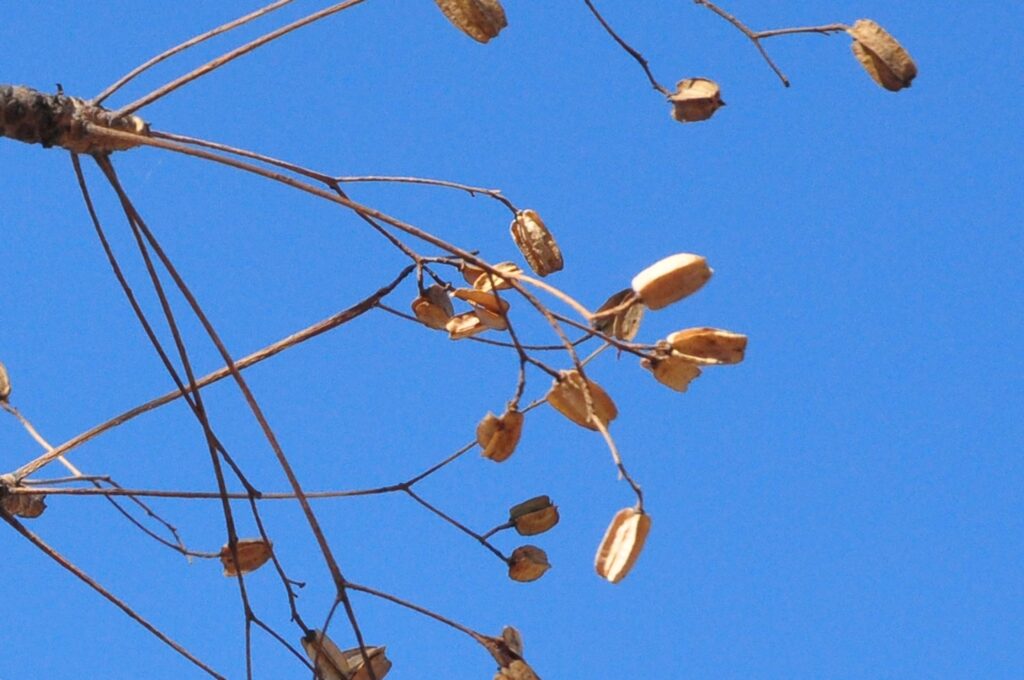
- 117. 2021/07/17. Bella Bella. Photo John Becking.
Distribution & Ecology
This medium to low altitude plant is a tree of the bushveld and lowveld. It may be seen on rocky hills, in deep sandy soil – especially the red sandy soil. These trees tend to tower over the surrounding bush. In South Africa, the best sightings are on north facing slopes and occur north of the Soutpansberg range. (This mountain range runs for about 100km roughly east to west in Northern Limpopo Province). The tree is often co-resident with mopane trees. In South Africa, it also occurs in Mpumalanga. Outside South Africa the trees also grow in Mozambique, Northern Botswana, Zimbabwe e.g., Namibia e.g., close to Etosha National Park, Tanzania, Southern Angola, Zaire, and into tropical Africa. It also is found in Madagascar.
Ethnobotany
This Tree may be planted as a live fence, and it would make an attractive street tree. The, not very durable Wood, has a relatively low density – from 580 – 720kg per cubic metre at a 12% water content. It has a narrow heartwood that is dark coppery or greenish brown with dark wavy margins. The sapwood is whitish to light grey. Due to its high silica content, the wood is difficult to cut, however attractive furniture can be made from it. It planes and turns well. It can also be used for parquet flooring and for making spoons, dishes, bowls, cups and hoops. The wood is also used for fuel and for making charcoal. The swollen Roots store thirst quenching liquid that can be used by people and animals e.g. impala, in times of a water shortage. Here animals and people may dig for them. Roots may also damage pavements, pools and buildings. Stock may browse the Leaves and the nutritious Seeds. The leaves are impressive in spring and autumn. The young tree should be protected from frost. These drought resistant trees are fast growing from both seeds and truncheons. The fine, rounded leafy crown makes this an attractive tree that provides deep shade in summer. Protect young trees from frost. In parts of Zimbabwe this tree is regarded as sacred.
References
Coates Palgrave, M. 2002. Keith Coates Palgrave Trees of Southern Africa, edn 3. Struik, Cape Town.
Burrows, J.E., Burrows, S.M., Lotter, M.C. & Schmidt, E. 2018. Trees and Shrubs Mozambique. Publishing Print Matters (Pty) Ltd. Noordhoek, Cape Town.
Foden, W. & Potter, L. 2005. Kirkia acuminata Oliv. National Assessment: Red List of South African Plants version 2020.1. Accessed on 2021/08/22.
Palmer, E. & Pitman, N. 1972. Trees of southern Africa, Balkema, Amsterdam, Cape Town.
Schmidt, S. Lotter, M. & McCleland, W. 2002. Trees and Shrubs of Mpumalanga and the Kruger National Park.
van Wyk, B. & van Wyk, P. 1997 Field guide to Trees of Southern Africa, Struik, Cape Town.
http://redlist.sanbi.org/species.php?species=3970-1
http://posa.sanbi.org/flora/browse.php?src=SP
http://pza.sanbi.org/kirkia-acuminata
https://www.zimbabweflora.co.zw/speciesdata/species.php?species_id=133250
http://tropical.theferns.info/viewtropical.php?id=Kirkia+acuminata
https://www.prota4u.org/database/protav8.asp?g=pe&p=Kirkia+acuminata+Oliv.