
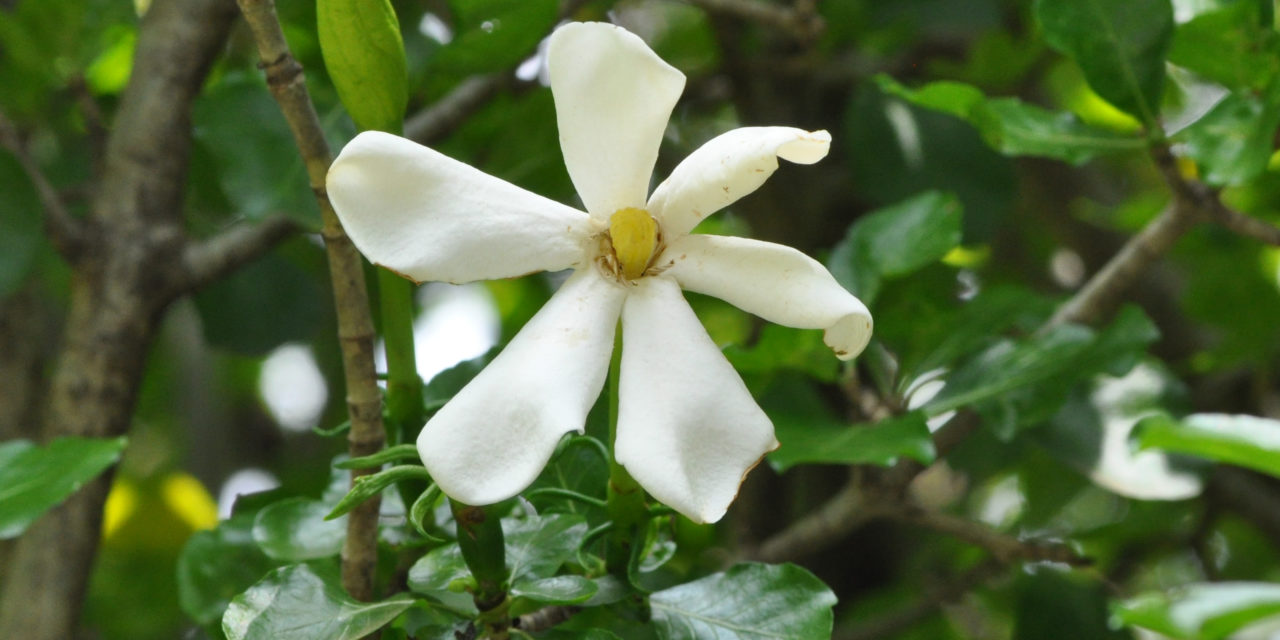
Gardenia cornuta
General Info – Summary
This impressive Tree is up to 5m high with a greenish trunk and 3 whorled, abruptly ending branches. Obovate simple, glabrous Leaves with entire margins are in 3 whorls at branch ends. Large, white, sweet scented, regular Flowers are bisexual. Calyx has lanceolate twisting lobes. Six emerging stamens, a single pistil + inferior ovary are present. Large yellow Fruit has a persistent calyx and many flattish seeds.
Description
Previous names: Nil.
SA Tree No. 690.1
Common names: (Afr) Tongakatjiepiering, Tonga Katjiepiering, Natalkatjiepiering, Wilde-appel. (Eng) Horned gardenia, Natal Gardenia, Spurred Gardenia, Tonga Gardenia. (isiZulu), Umhlahle, Unomphumela, Umvalasangweni. Uvalasangwane. (siSwati) Umvalasangweni, Semanzini.
Family: Rubiaceae (Coffee/Gardenia family). This family of dicotyledonous plants has in excess of 600 genera and about 13 000 species and members include trees, shrubs and herbs. The plants are terrestrial and predominantly woody and sometimes Scandent (climbing without the aid of tendrils). Local genera with trees on this website include Afrocanthium, Canthium, Coddia, Gardenia, Pavetta, Rothmannia and Vangueria. Leaves are simple, opposite or whorled and have interpetiolar stipules. The 4 or 5 merous, usually regular Flowers are bisexual or unisexual. The Calyx has Sepals that are at least partly united. In the Corolla, the Petals are joined – at least at the base. Stamens are usually as many as corolla lobes and alternating with them. The Ovary is inferior. Fruit is a drupe, berry or capsule.
Name derivation: Gardenia – named after Alexander Garden a Scottish doctor, physician and plant collector (1730- 1791). cornuta – horned: possibly referring to the persistent loose twining lobes of the calyx at the end of the fruit (photo 303 – under Fruit).
Conservation: National Status: L C. (Least Concern). Assessment Date: 2005/06/30 (W. Foden and L. Potter).
Tree
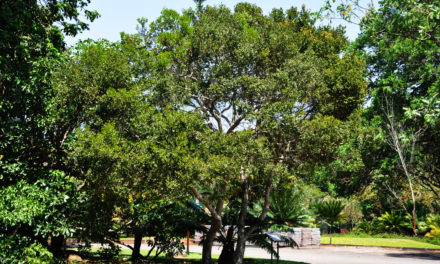
This small Tree (photo 315) has some direct erect branches and is usually up to 5m in heigh. It may also be a large woody, multi-stemmed shrub. The erect, rigid and 3-whorled main Branches (photo 745) occur low down (photo 315). The grey branchlets are stiff, rigid or smooth, and usually end with an abruptly curved tip (photo 785). The Bark is cream to pale greenish grey (photo 316), mottled (covered with areas of different colours that do not form a regular pattern, having blotches of two or more colours). It may be smooth and occasionally thinly flaking – leaving shiny depressions. The crown may be twiggy.
-
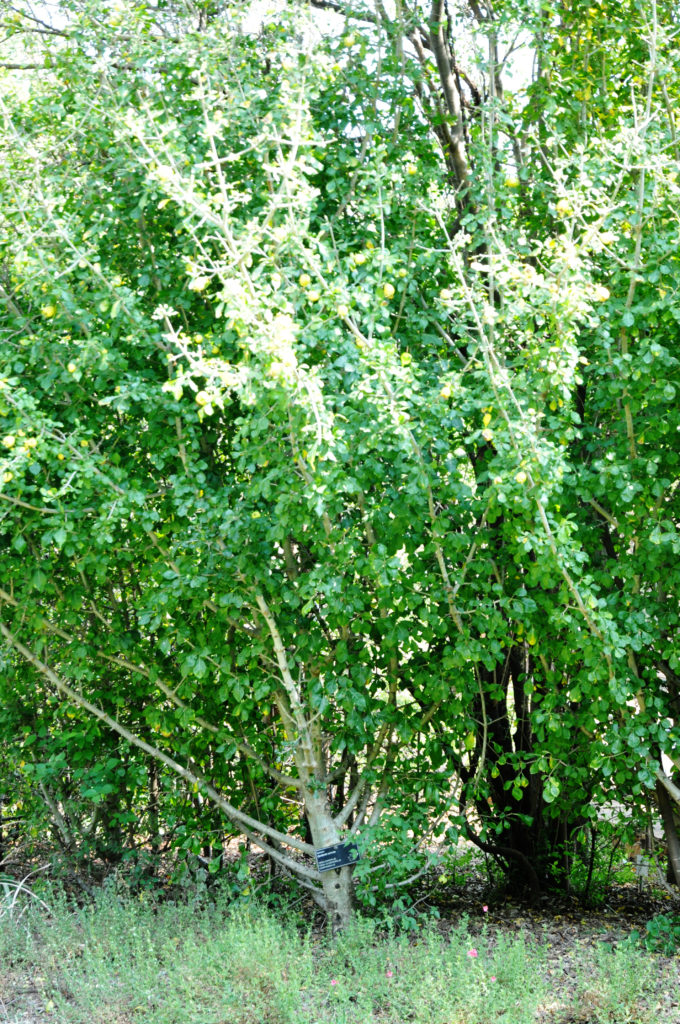
- 315. 2015/10/13. Walter Sisulu NBG. Photo: David Becking.
-
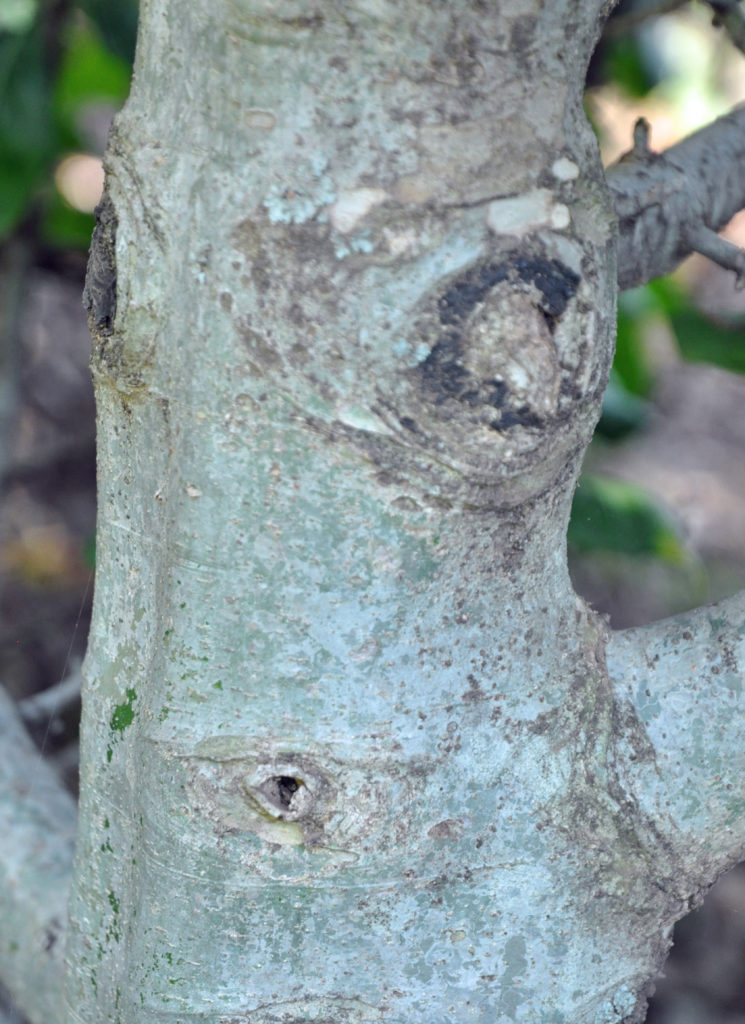
- 316. 2015/10/13. Walter Sisulu NBG. Photo: David Becking.
-
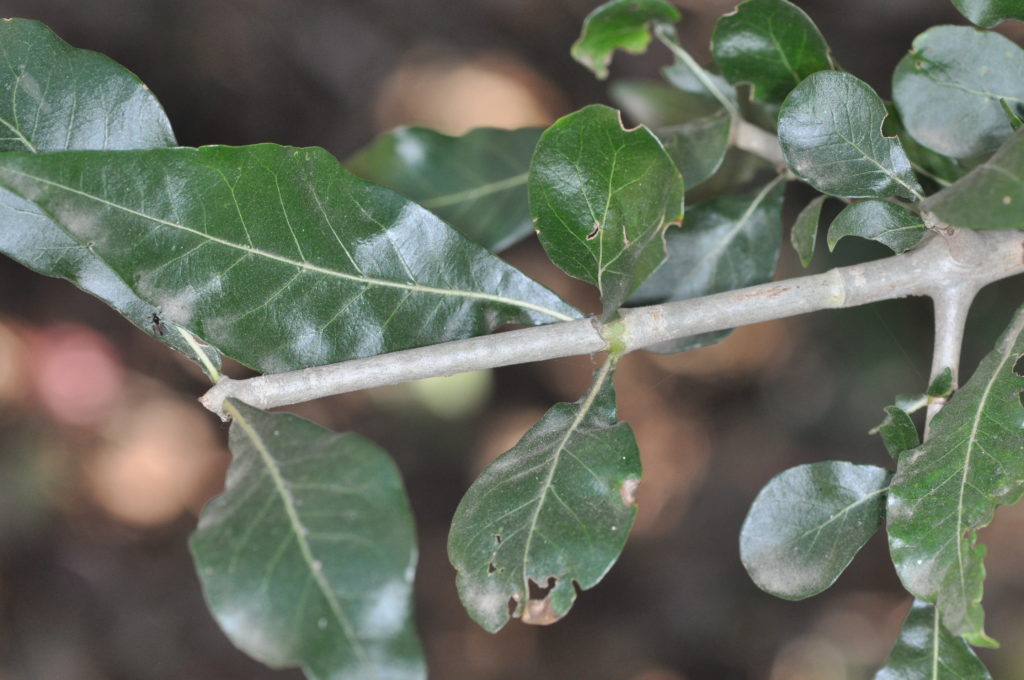
- 785. 2016/08/30. Walter Sisulu NBG. Photo: David Becking.
-
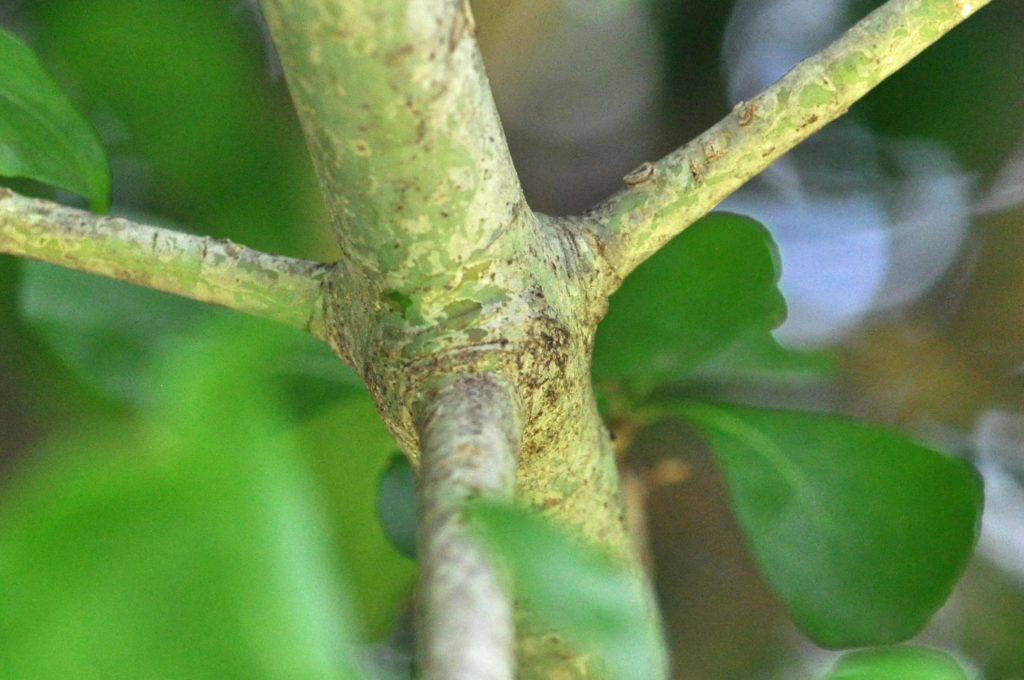
- 745. 2020/01/20. Walter Sisulu NBG. Photo: David Becking.
Leaves
The simple Leaves are usually in whorls of 3 and crowded towards the ends of the short rigid branchlets (photo 548). Each leaf is broadly obovate (reverse of ovate, the terminal half is broader than the basal) and up to 11 x 6cm (photo 305). In this photo the smooth shiny Blade is bright green above and lighter green below. Veins are more visible when the leaf is examined against a strong light (photo 307). The leaves are glabrous (hairless) apart from occasionally slightly hairy midrib and around Domatia that occur in axils of principal side veins. To the naked eye (photo 309), the domatia appear as small bumps. They are more clearly visible in when enlarged (photo 307). Domatia are intended to be used by organisms that have a symbiotic relationship with the plant and are developed by plants to form a shelter for insects, fungi or mites for this purpose. The main lateral veins do not quite reach the margin (photo 309). The Apex is very broadly tapering to rounded (photo 305). The Base is narrowly tapering. The somewhat wavy Margin (photo 308) is entire (with a continuous margin, not in any way indented). The short Petiole (leaf stalk) is 1-3mm long or absent. The Stipules (basal appendages of the petiole) form a sheath or ring around node (photo 418).
-
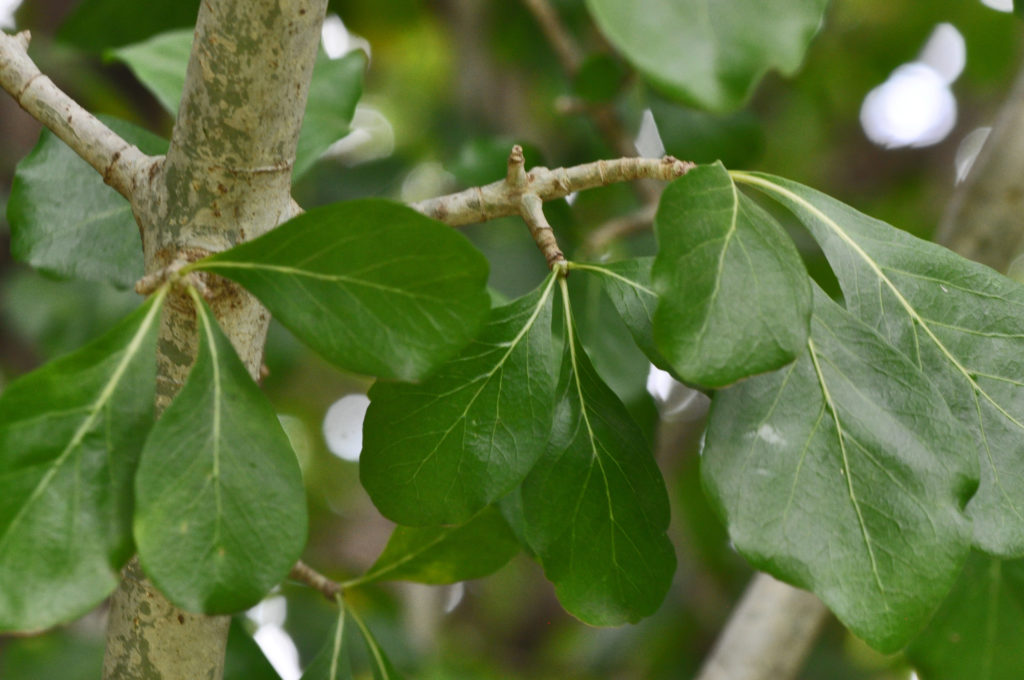
- 548. 2015/10/20. Walter Sisulu NBG. Photo: David Becking.
-
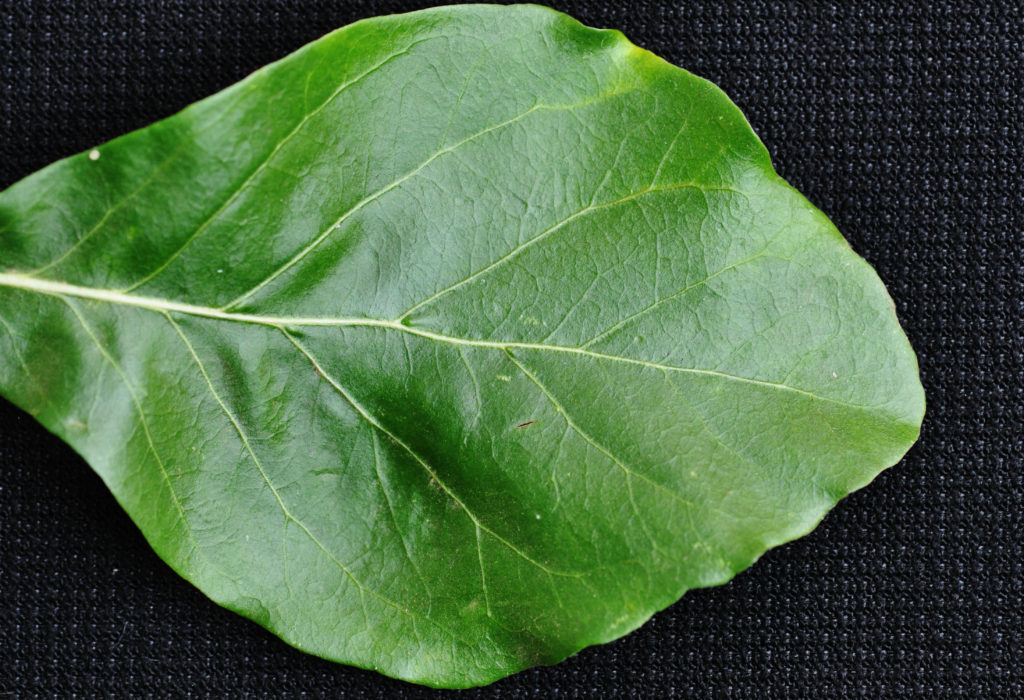
- 308. 2015/10/13. Walter Sisulu NBG. Photo: David Becking.
-
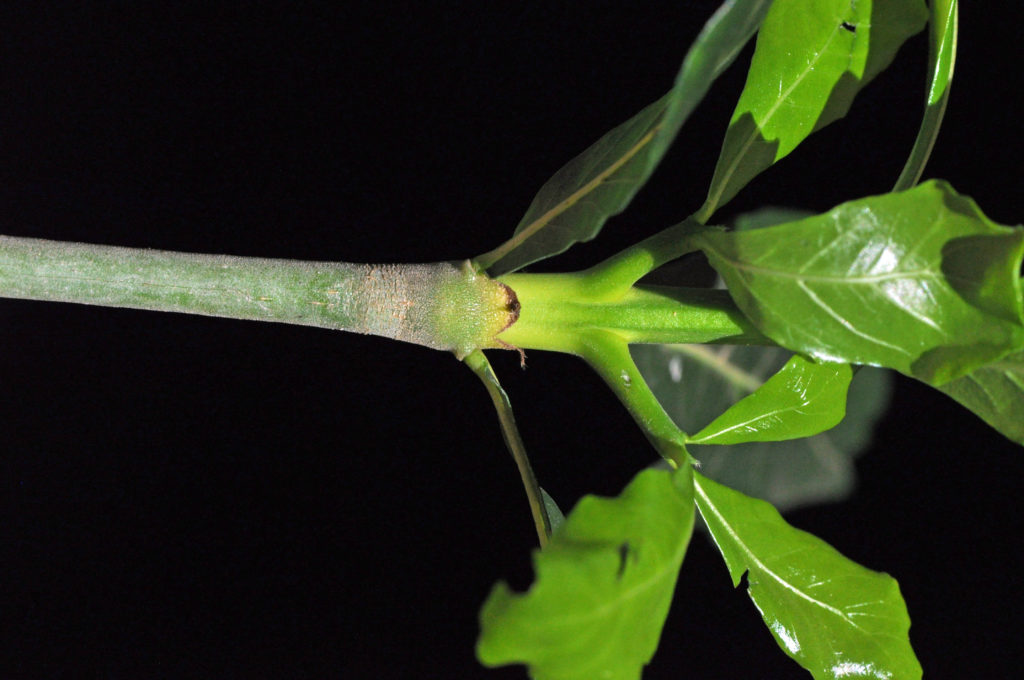
- 418. 2017/10/10. Walter Sisulu NBG. Photo: David Becking.
-
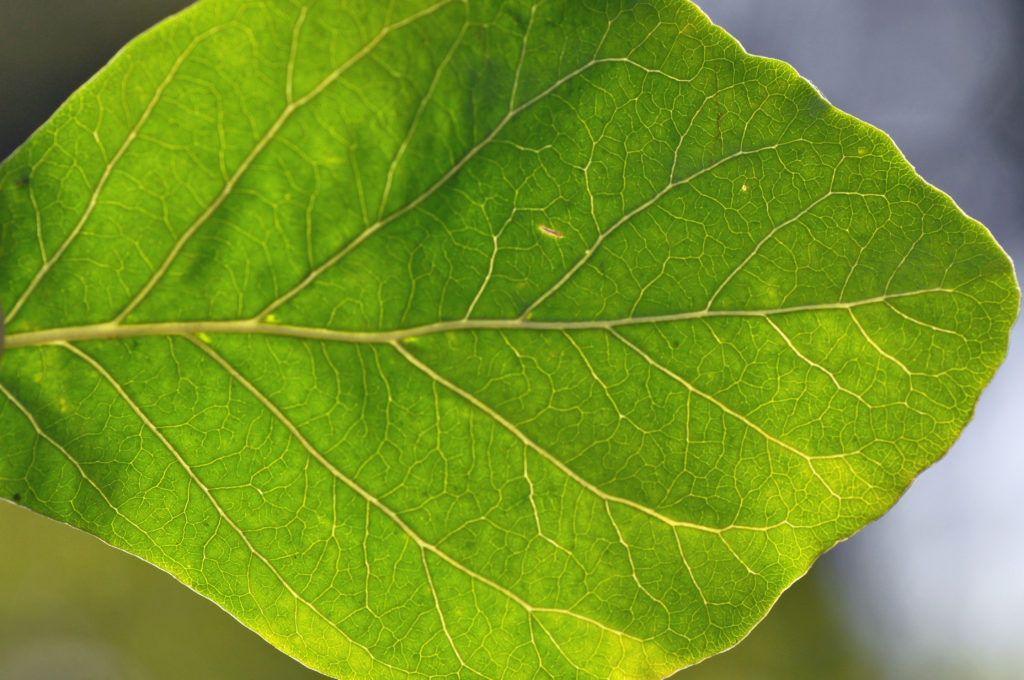
- 309. 2015/10/13. Walter Sisulu NBG. Photo: David Becking.
-
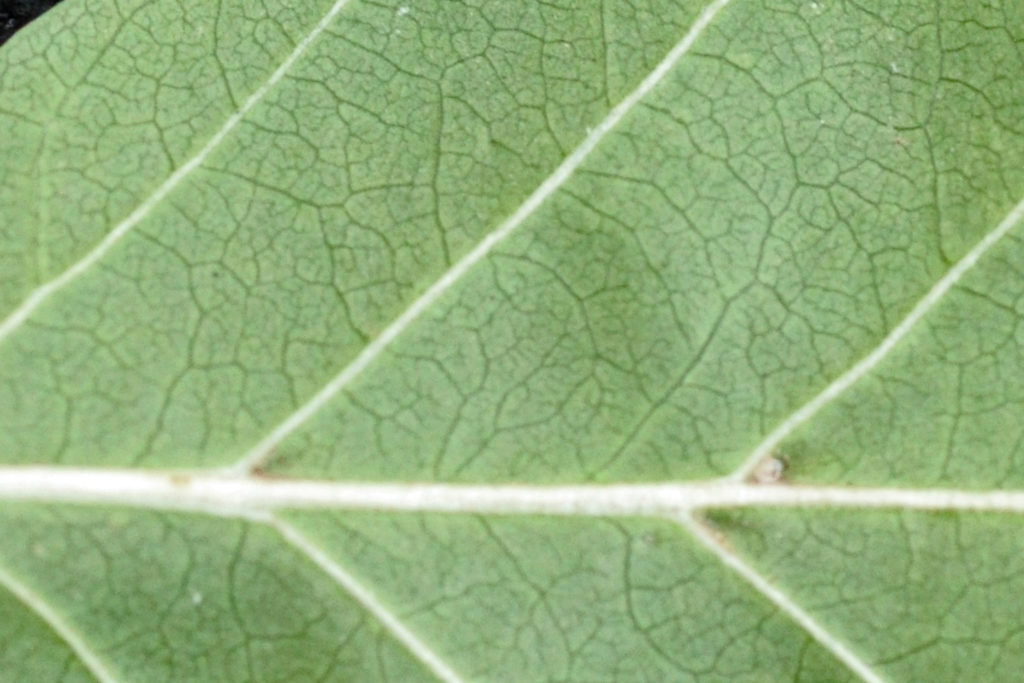
- 307. 2015/10/13. Walter Sisulu NBG. Photo: David Becking.
-
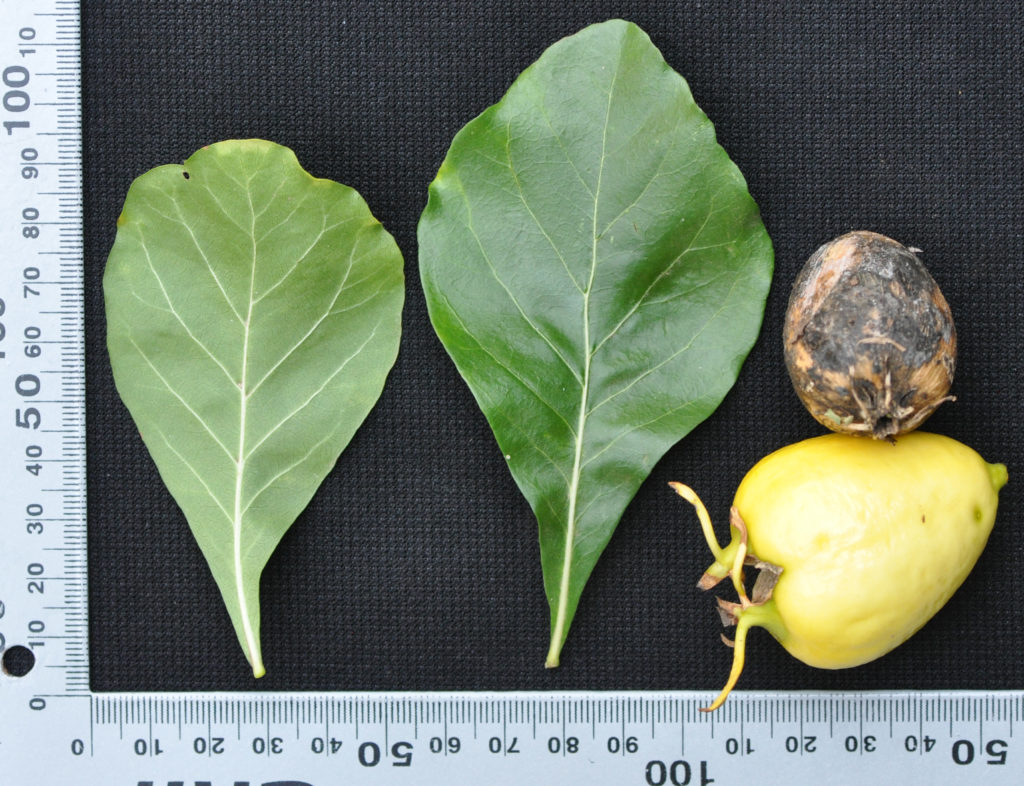
- 305. 2015.10/13. Walter Sisulu NBG. Photo: David Becking.
Flowers
The impressive single Flowers have a sweet, heavy scent. They develop towards the ends of rigid branches. Flowers are solitary, bisexual and actinomorphic (Regular, symmetrical. Flowers are vertically divisible into similar halves by more than 1 plane passing through the axis). The green Calyx usually has 6 long, thin, loose, twisting and lanceolate almost centrally attached Sepal lobes (1,5cm) protruding out from about half the length of the calyx (photo 135E). The base of the Corolla starts with a long greenish tube (photo 267) up to 7cm long. In summer this ends with the 5 spreading white petal lobes, each about 3cm long. These lobes age to a yellow colour when ripe. The Stamens (male reproductive pats of a flower) arises from the petals within the throat of the corolla (photo 135En) Stamens alternate with the corolla lobes (photo 267). The sessile, longitudinally dehiscent linear Anthers (photo 135En) are visible – partly protruding out slightly between the petal lobes (photo 267). A single Pistil (a unit of the Gynoecium, the female element of the flower, composed of the Ovary, Style and Stigma) is present. The inferior, 2-locular Ovary contains many ovules. The single Style – the part of the pistil situated between the ovary and the stigma (Photo 135E) ends with a yellow swollen Stigma (photo 135En). (Nov-Mar – and beyond.)
-
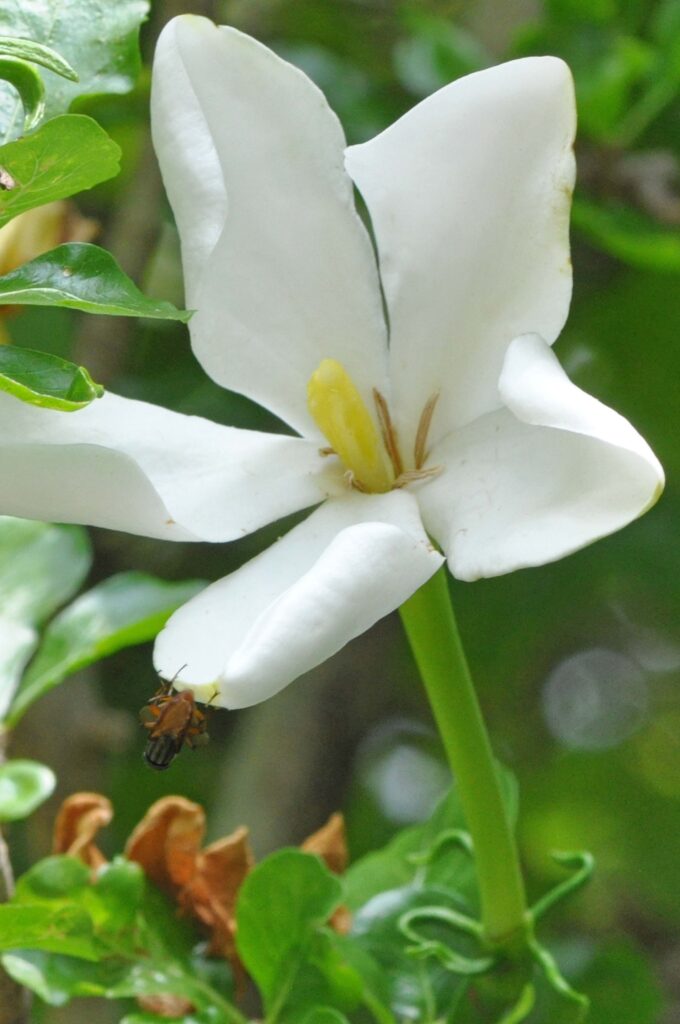
- 267. 2015/12/15. Walter Sisulu NBG. Photo: David Becking.
-
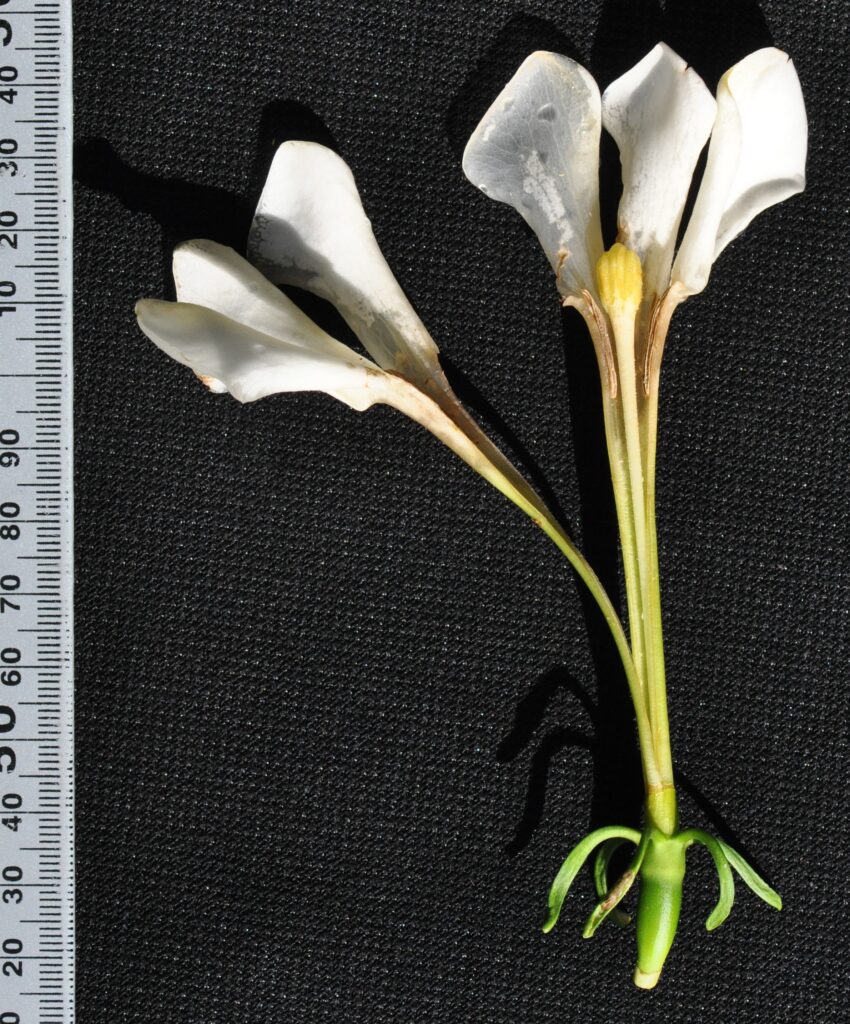
- 135N. 2016/12/13. Walter Sisulu NBG. Photo: David Becking.
-
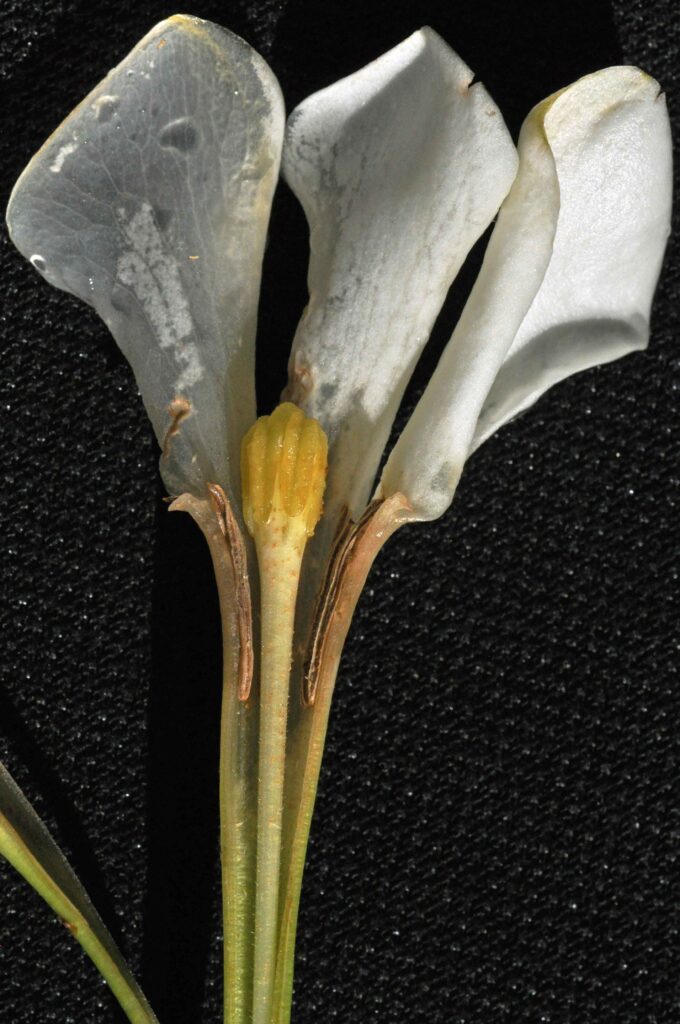
- 135En. 2016/12/13. Walter Sisulu NBG. Photo: David Becking.
Fruit
Many impressive single Fruits may be seen all year round (photo 317). The ripe, ovoid (egg-shaped) or pear shaped, fruit are not ribbed and fruit may be slightly wider towards the end, and may reach 5 x 3,5cm. The fruit is hard, heavy, smooth, thin skinned, thick walled and initially green (photo 508). It matures to a bright yellow or golden colour (photo 303). The fruit is up to 6cm long and has the persistent, distinctive remains of the Calyx at its apex (photo 303). When fruit occur in large numbers, they can weigh down the branches. The flattish Seeds are contained within a very hard woody covering (photo 305 under leaves) that occurs below the yellow coating (Feb–Aug). Many round or oblong, hard and flattish seeds are produced that are embedded in a pulpy placental tissue, forming a relatively solid mass. (Feb-Aug). (Apr-May P&P)
-
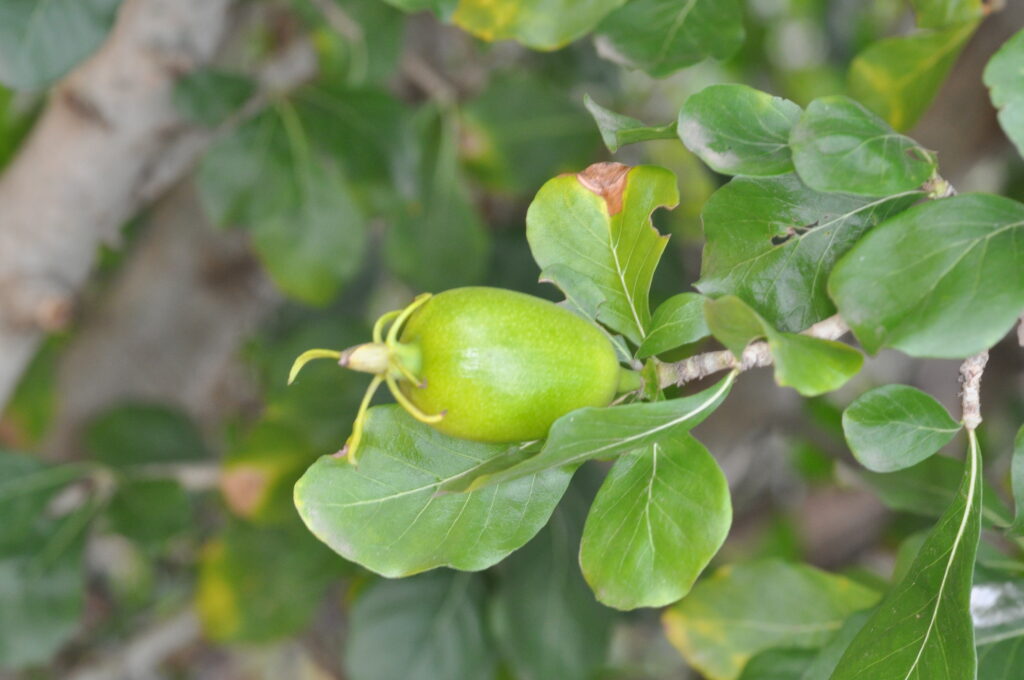
- 508. 2015/12/08. Walter Sisulu NBG. Photo: David Becking.
-
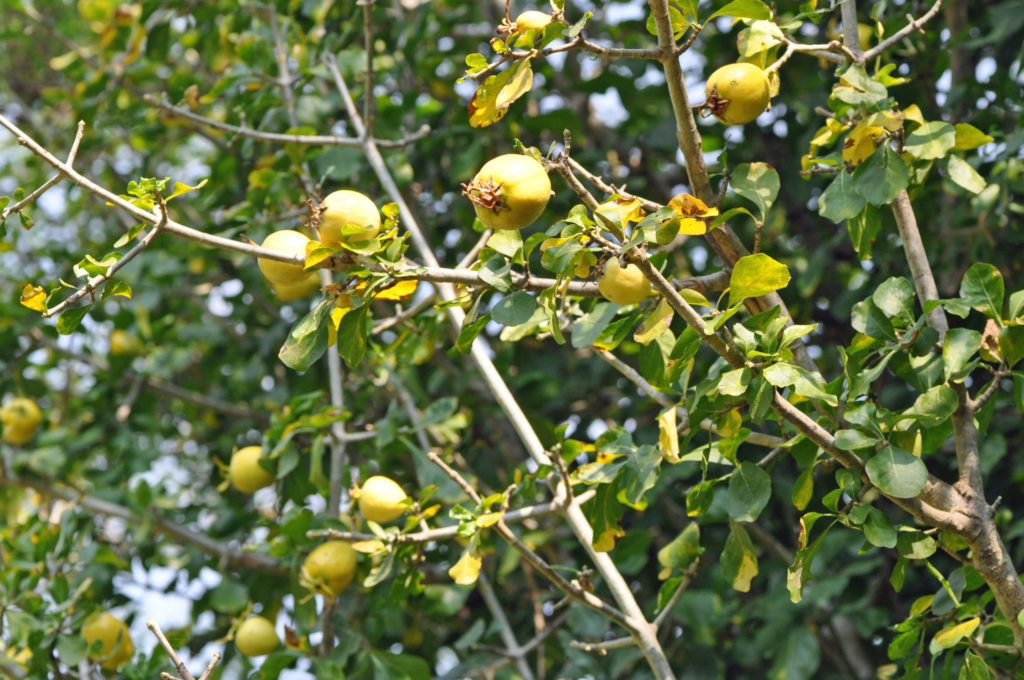
- 317. 2015/10/13. Walter Sisulu NBG. Photo: David Becking.
-
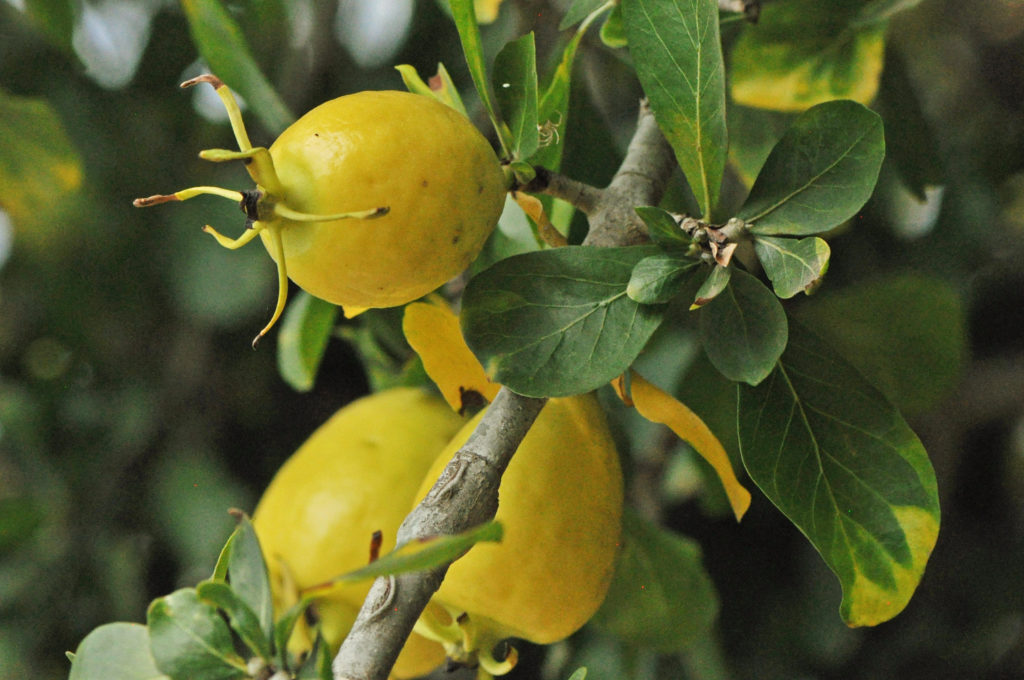
- 303. 2015/10/13. Walter Sisulu NBG. Photo: David Becking.
Distribution & Ecology
This relatively small tree is Endemic in southern Africa (Endemism is the ecological state of a species being unique to a defined geographic location). These trees are common in the Western Cape e.g., False Bay, NE KwaZulu-Natal – Northeast – Ndumu, Gauteng, Limpopo, and marginal in south-eastern Mpumalanga. They are also found in Eswatini (Swaziland) and southern Mozambique and along the Lebombo Mountains (800km long running N-S from Punda Maria in Limpopo province to Hluhluwe in KZN, including parts of SW Mozambique. Trees occur on grassy plains, bushveld (a mixed woodland region (900-1 500m altitude) in the hot, dry north-east of South Africa and adjoining countries, thickets, woodland and on sandy or alluvial flats at a lowish altitude. Monkeys, Baboons and Nyala eat the young Fruit and herbivores browse the Leaves.
Ethnobotany
Goats browse the Leaves. Wood is used for fencing poles, sticks and fuel. Propagation is most effective from seeds. Local medicine makes use of the fruit and roots. This is a good garden tree. For the best flowering results, plant this tree on its own, in low frost risk area. A variegated form is now available.
References
Boon, R. 2010. Pooley’s Trees of eastern South Africa. Flora and Fauna Publications Trust, Durban.
Burrows, J.E., Burrows, S.M., Lotter, M.C. & Schmidt, E. 2018. Trees and Shrubs Mozambique. Publishing Print Matters (Pty) Ltd. Noordhoek, Cape Town.
Coates Palgrave, M. 2002. Keith Coates Palgrave Trees of Southern Africa, edn 3. Struik, Cape Town.
Foden, W. & Potter, L. 2005. Gardenia cornuta Hemsl. National Assessment: Red List of South African Plants version 2024.1. Accessed on 2026/04/06
Palmer, E. & Pitman, N. 1972. Trees of southern Africa, Balkema, Amsterdam, Cape Town.
Schmidt, S. Lotter, M. & McCleland, W. 2002. Trees and Shrubs of Mpumalanga and the Kruger National Park.
van Wyk, B. & van Wyk, P. 1997 Field guide to Trees of Southern Africa, Struik, Cape Town.
http://www.plantzafrica.com/plantefg/gardencorn.htm
http://www.operationwildflower.org.za/index.php/albums/trees/gardenia-cornuta-flower-jw-1453
http://plantlust.com/plants/gardenia-cornuta-variegata/
https://en.wikipedia.org/wiki/Rubiaceae


I’m truly enjoying the design and layout of your blog.
It’s a very easy oon the eyes which makes it much more pleasant forr me to come
here aand visit more often. Did you hire out a designer
too create your theme? Great work!
my web-site: casinoonlinevavada.Onepage.website
Thank you for your comments. I did hire a designer for the website.
Take care.
David Becking.