
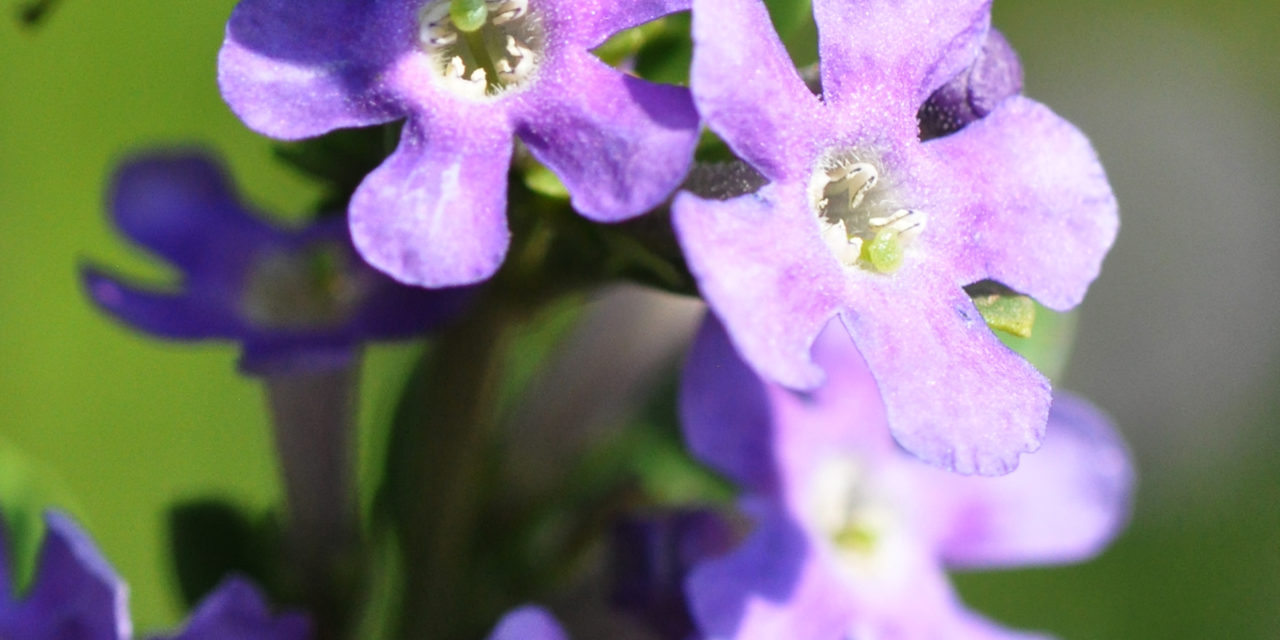
Freylinia tropica
General Info – Summary
This small attractive Tree may reach 7m high but is often a shrub up to 3m. Spreading branches are loose. The hairless, shiny and glabrous Leaves are simple with a lightly serrated the upper margin. Small, regular, bisexual Flowers with a 5 lobed perianth, didynamous stamens, a superior ovary, + many ovules, a thick style and enlarged stigma. The small Fruit is a dehiscent capsule with membranous winged seeds.
Description
SA Tree No. 670.3.
Common names: (Afr) Blouheuningklokkies, Blouheuningklokkiesbos. (Eng) Blue Honey-bells, Blue Freylinia, Waterberg bell-bush, Inyanga (Zulu – healer or doctor) hedge plant.
Family: Scrophulariaceae (figwort family). The simple mature Leaves are usually opposite and/or alternate. The bisexual Flowers are usually zygomorphic (irregular flower: when corolla is divisible into 2 equal halves in one plane only). The calyx is 4-5 lobed and there are tubular corollas with 2 lips. Usually, 4 stamens are present and are usually didynamous (2 long and 2 short). The superior ovary is usually bilocular and contains many ovules. The style is terminal, simple and the stigma is entire or has 2-3 lobes. The Fruit is usually a capsule. There are usually 1 to many Seeds per locule. In this family, there are about 65 genera and more than 1 600 species. In southern Africa, the genera with trees included on this website are Buddleja, Dermatobotrys and Freylinia.
Name derivation: Freylinia – named after an Italian Count Lorenzo de Freylino – owner of an impressive garden near Turin in Northern Italy in the 19th century. tropica – of the tropics. There are 8 species of the genus Freylinia in southern Africa. Most are confined to the Western and Eastern Cape.
Conservation: National Status: Rare but not threatened. Assessment Date: 2018 (E.J. van Jaarsveld, D. Raimondo & L. von Staden). It is now more widespread due to cultivation.
Tree
This attractive shrub (photo 606) with its spread of about 2,5m, may become a Tree and reach up to 7m high. The more common shrub is usually up to 3,5m high and has long, slender and upright branches that often have slightly 4-angled Branches that are loosely spreading. They may be twisted and sticky when young. The smooth to rather rough Bark (photos 801 & 315) is pale grey, greenish to dark grey or even light brown. It may peal in thin strips. Raised Lenticels (a usually raised corky oval or elongated area on the plant that allows the uncontrolled interchange of gases with the environment) are visible (photo 801). In these enlarged photos, the branches appear rougher.
-
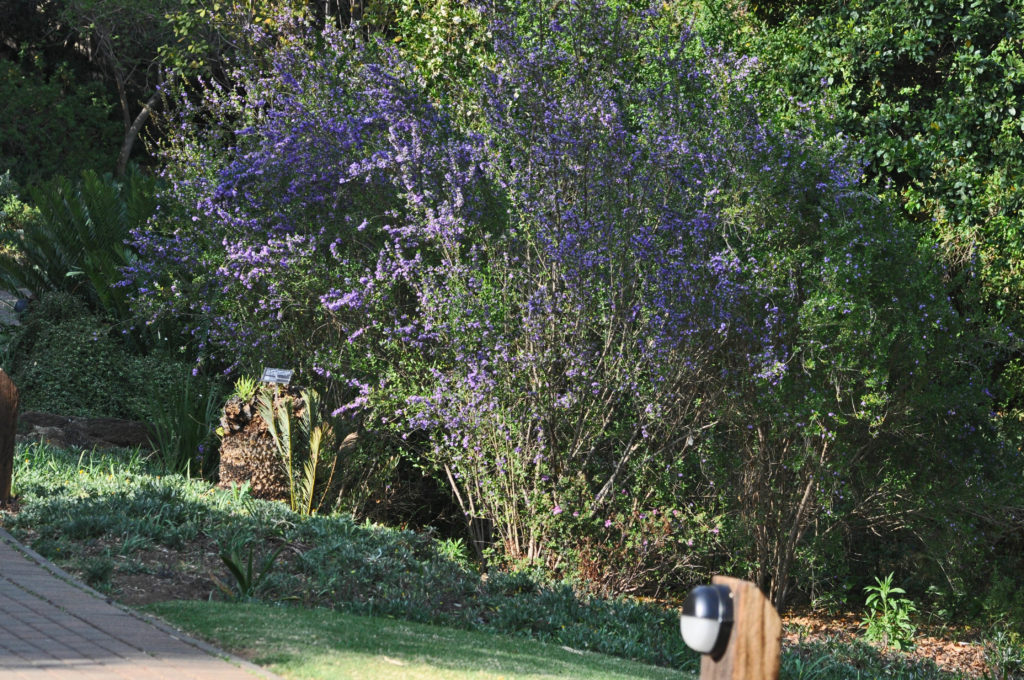
- 606. 2019/09/18. Walter Sisulu NBG. Photo: David Becking.
-
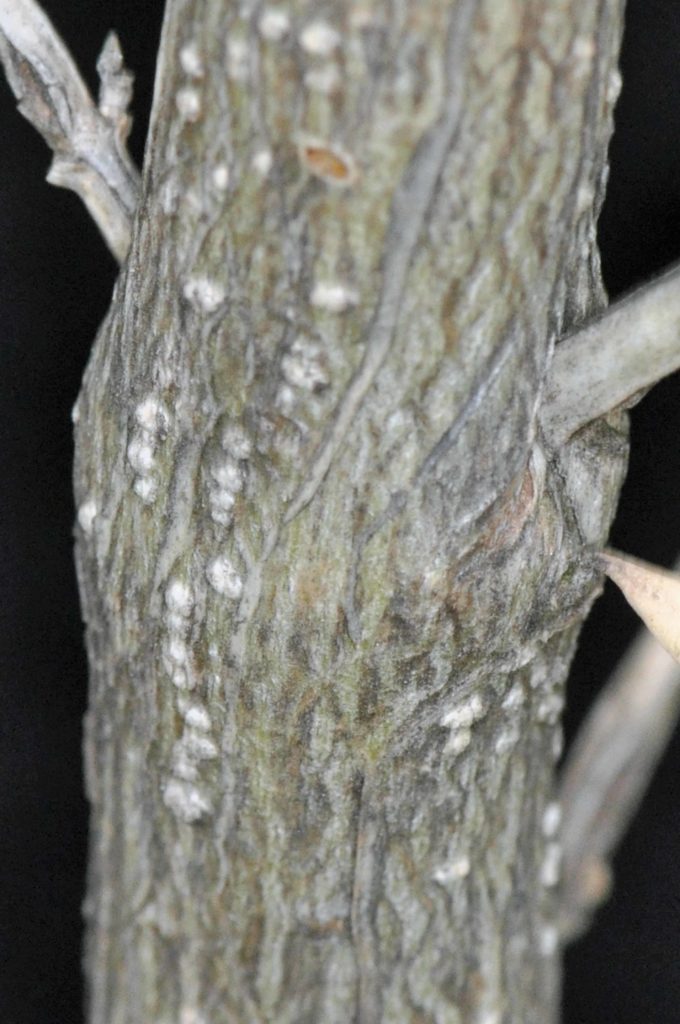
- 801. 2015/08/11. Walter Sisulu NBG. Photo: David Becking.
-
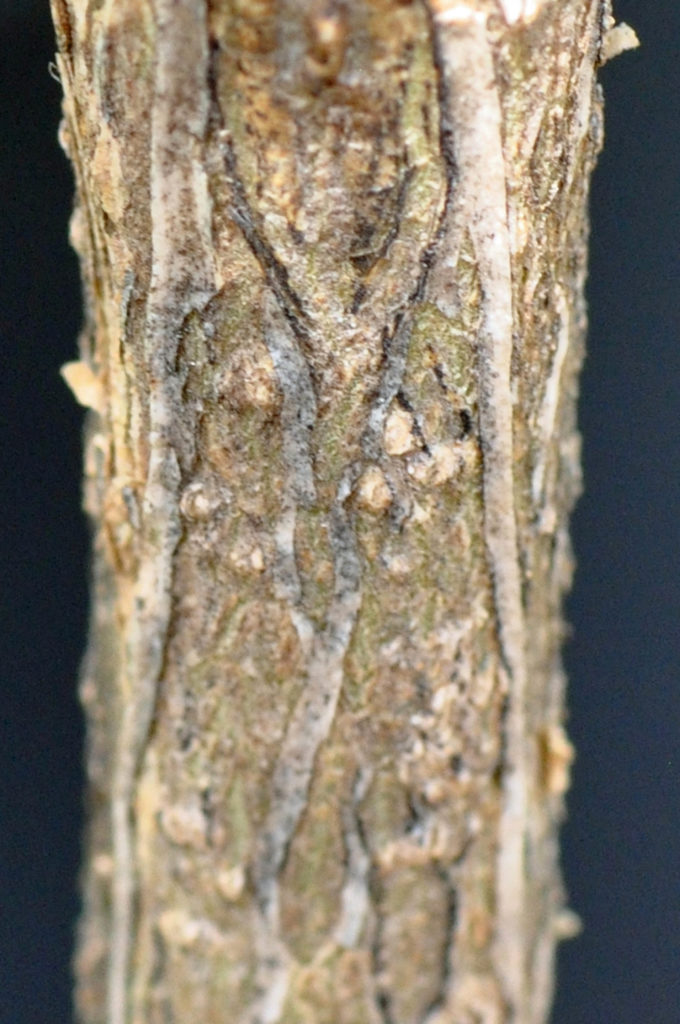
- 315. 2014/12/04. Lifestyle Nursery Photo: David Becking.
Leaves
The small, light green, shiny Leaves are usually decussate (opposite pairs of leaves have successive pairs at right angles to each other i.e., rotated 90 degrees along the stem when viewed from above (photos 314 & 504). They may also be in whorls of 3 or 4. Each glabrous (hairless) leaf is up to 4 x 1cm (photo 501) and is simple (have a single blade that may have incisions that are not deep enough to divide the leaf into leaflets). They are narrowly obovate (upside down egg shaped) or oblanceolate (the reverse of lanceolate, the leaf is broader at the apical third than at the middle – photo 501). The Margin may be lightly serrate in the upper half (photo 314). The Apex tapers to a point and Base tapers less broadly. Young leaves may be scalloped. The Midrib is raised and more visible below, but side veins are not easy to see. The lower surface of the blade is slightly lighter (photo 501). The Petiole (leaf stalk) is absent or up to 5mm long.
-
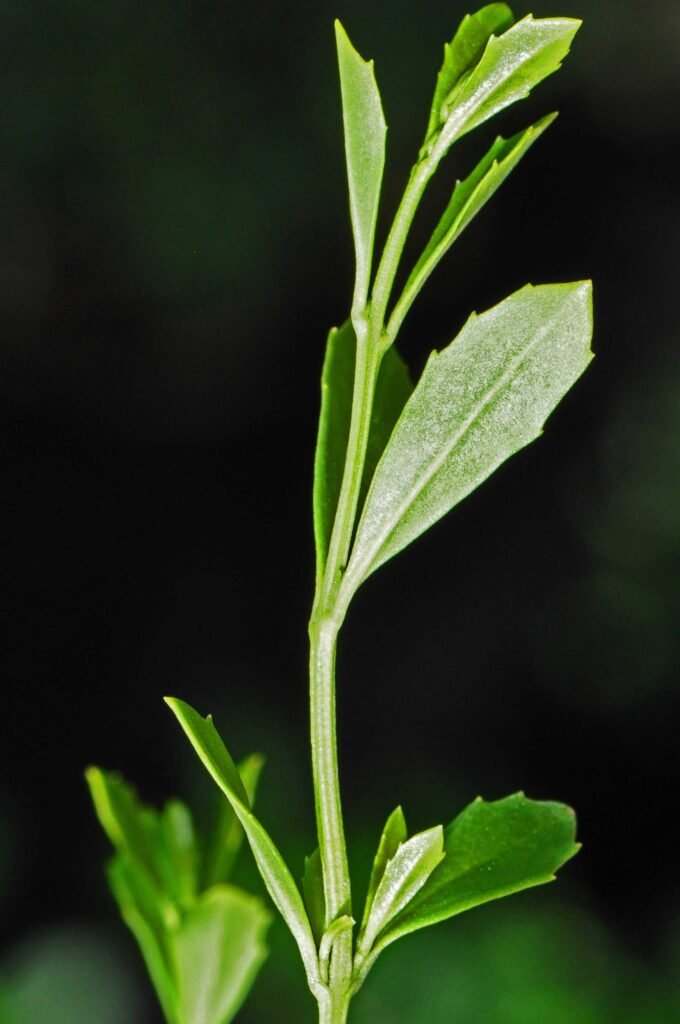
- 314. 2014/12/04. Lifestyle nursery. Photo: David Becking.
-
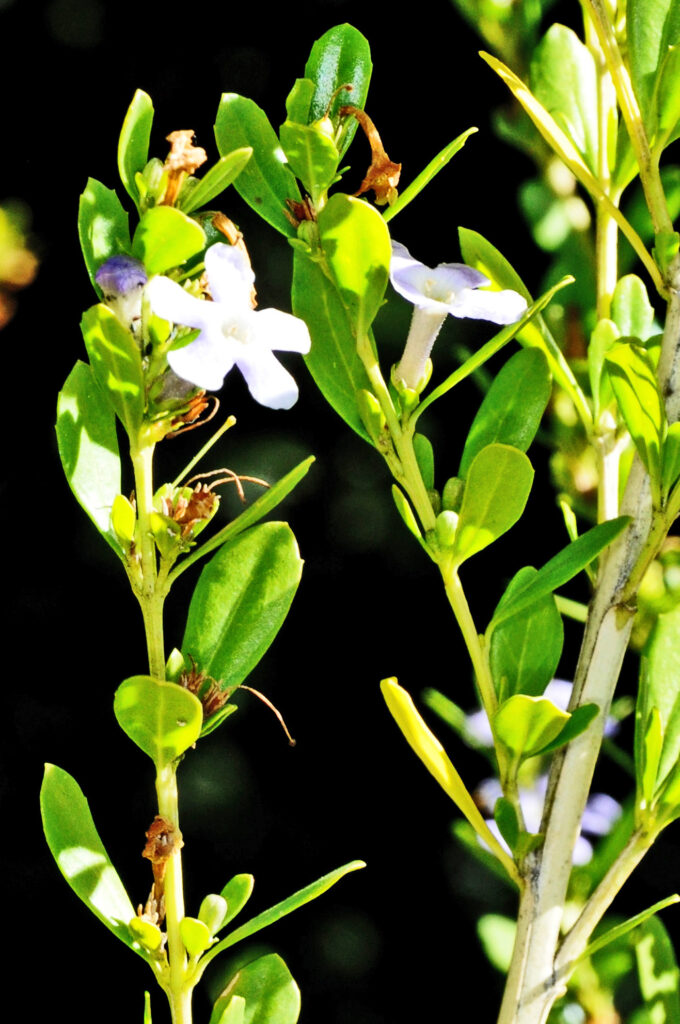
- 504. 2015/07/28. Walter Sisulu NBG. Photo: David Becking.
-
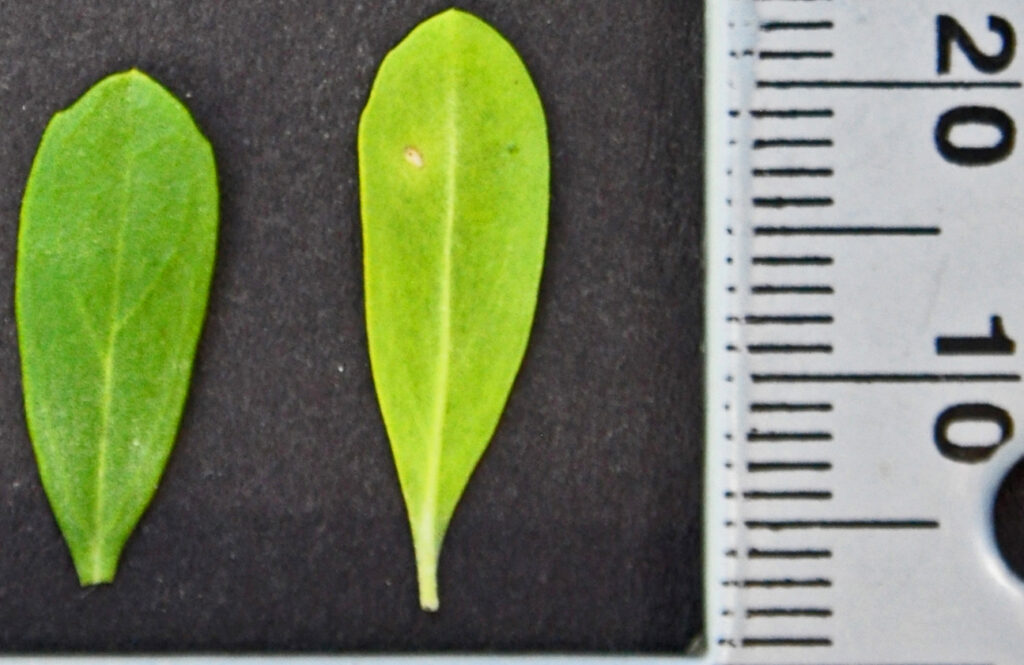
- 501. 2015/07/28. Walter Sisulu NBG. Photo: David Becking.
-
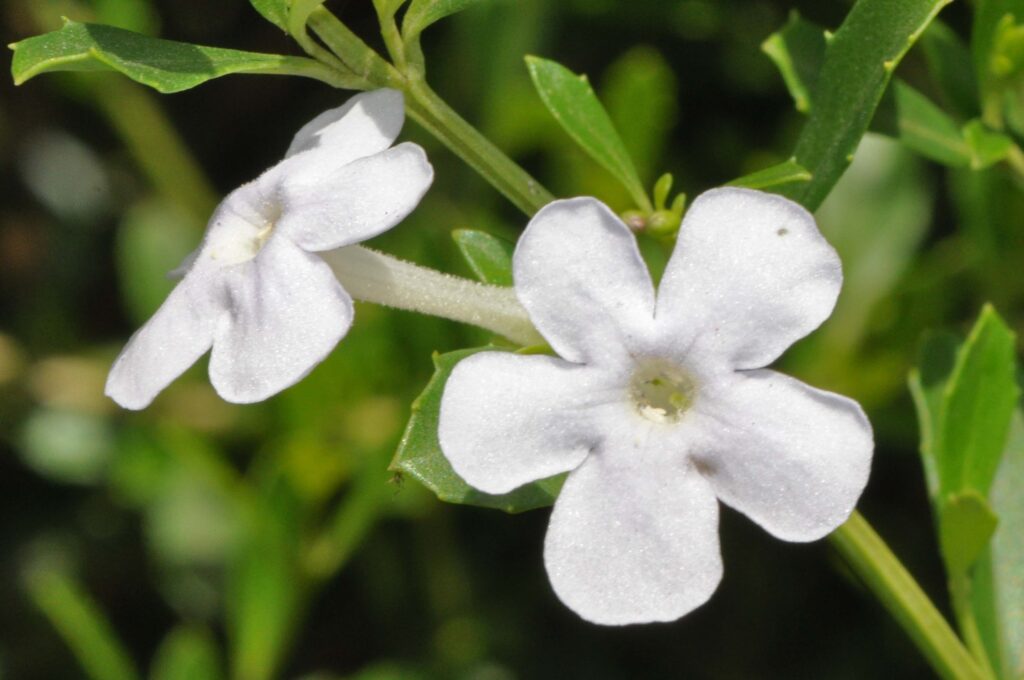
- 309. 2014./12/04. Lifestyle nursery. Photo: David Becking.
Flowers
The smallish, attractive white (photo 309 – under Leaves), mauve or lilac Flowers (photo 500) are bisexual and actinomorphic (usually regular, symmetrical. The Perianth (calyx and corolla) are divisible into 3 or more identical sectors or mirror images). Up to 5 flowers are situated towards the ends of branches in axillary (growing between stem and leaf) clusters. The Perianth (the 2 floral envelopes considered together; a collective term for the calyx and corolla), is divisible into 3 or more identical sectors – photos 206 & 500). The Calyx is deeply 5-lobed and campanulate (bell-shaped). The lobes are elliptic (photo 500). The hairy Corolla tube (photo 500) is funnel-shaped, up to 1cm long and ends with 5 lobed Petals, each of which is rounded and up to 6mm long (photo 206). The lobes spread horizontally and each apex is wider than base (photo 309). The lobes are shorter than the tube. Both sides of the corolla are hairy (photo 500 & 457). Stamens are didynamous (having 4 stamens disposed in 2 pairs of 2 different lengths). They arise from the extreme base of the corolla tube and seldom extend much beyond the mouth of the tube (photo 457). The Anthers have 2 erect and not quite parallel theca (pollen sacs – photo 457). A Staminode may be present. The single Pistil (a unit of the Gynoecium, the female element of the flower, composed of the Ovary, Style and Stigma) has a superior Ovary, which is bilocular (with 2 locules). It contains several Ovules. The single, thick Style ends in an almost spherical initially green Stigma (photo 206). Sporadic flowering may occur through the year (mainly Sep-Feb).
-
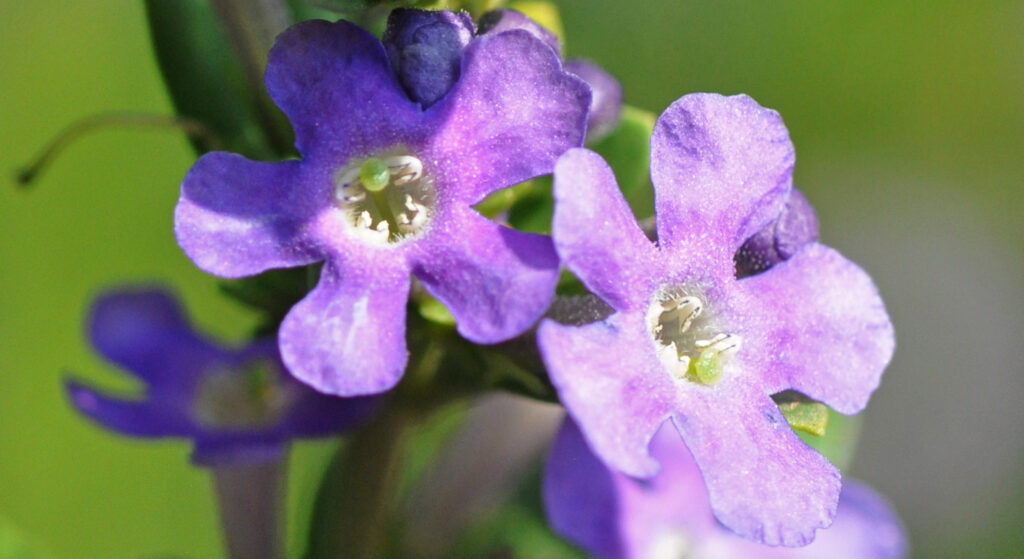
- 206. 2015/08/25. Walter Sisulu NBG. Photo: David Becking.
-
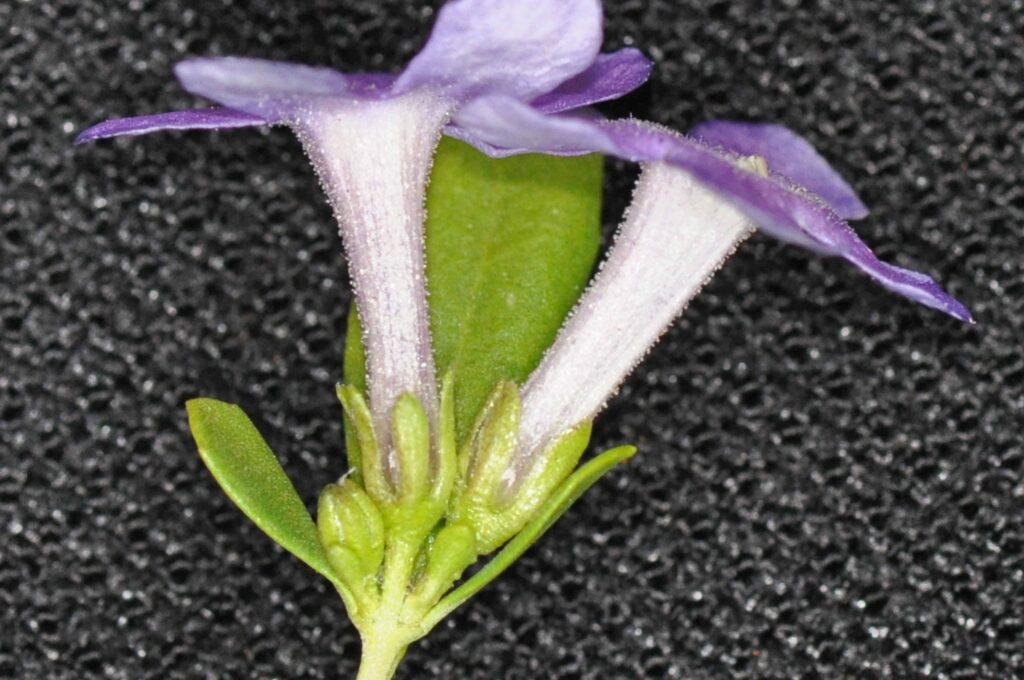
- 500. 2016/08/16. Walter Sisulu NBG. Photo: David Becking.
-
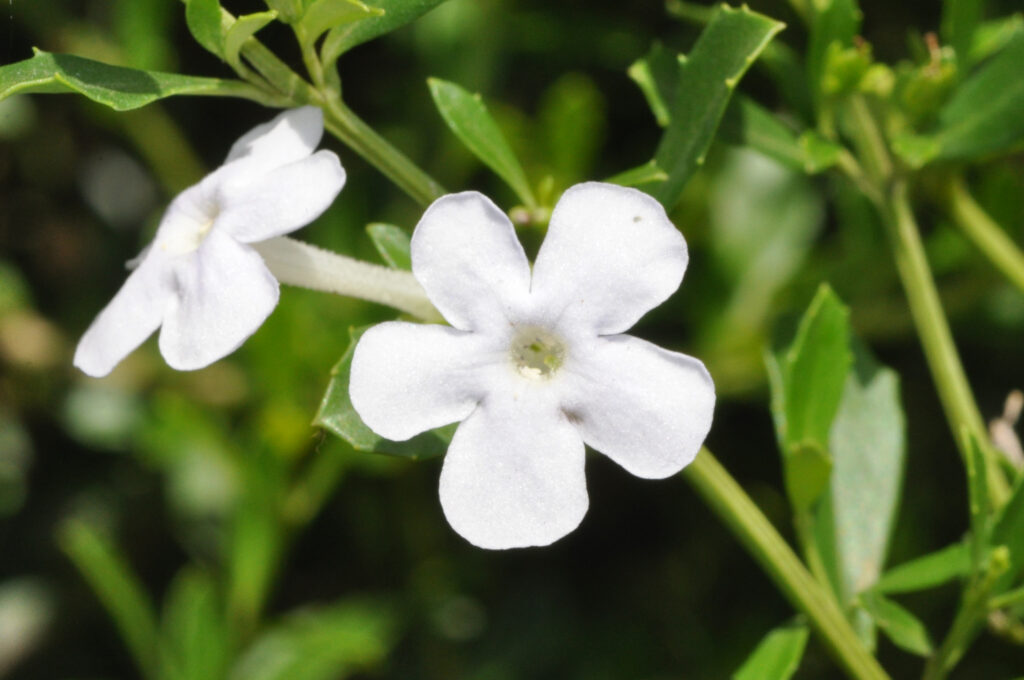
- 309. 2014/12/04. Lifestyle nursery. Photo: David Becking.
-
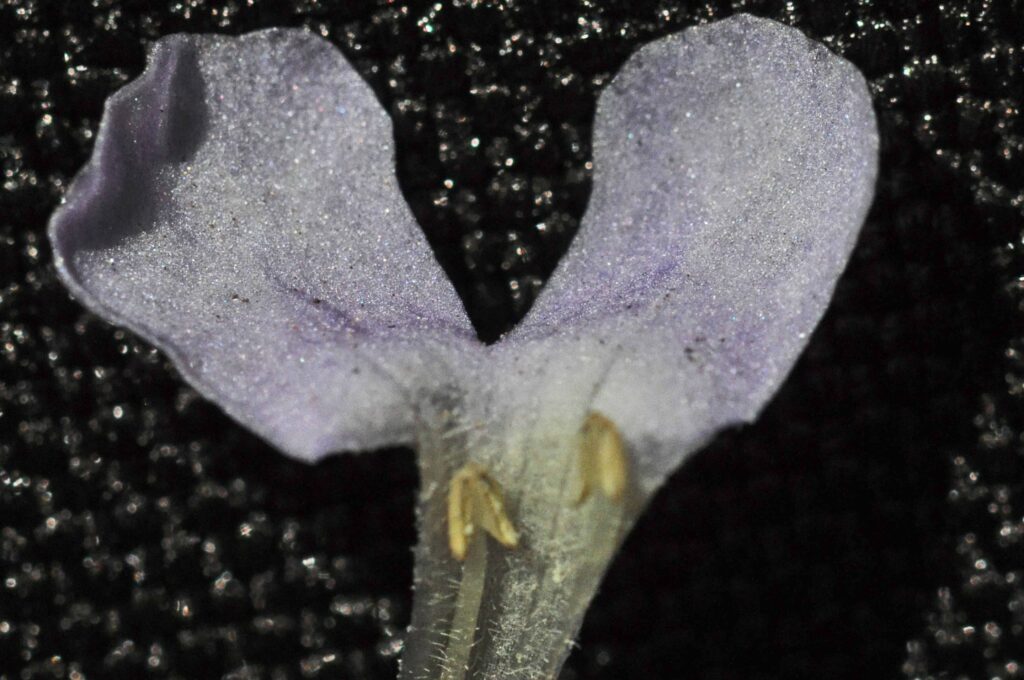
- 457. 2018/07/25. Walter Sisulu NBG. Photo: David Becking.
Fruit
The ovoid-ellipsoid Fruit is a lobed, pointed, pale brown to dull yellow, dehiscent Capsule (a dry fruit resulting from the maturing of a compound ovary with more than 1 carpel) which is up to 5mm long. The now reflexed calyx remains attached to the capsule along with the remains of the persistent style at the apex. The capsule is dull yellow to pale brown and ends with a persistent Style. The tiny discoid (disc shaped) Seeds have a membranous wing. (Oct-Mar).
Distribution & Ecology
Freylinia tropica is Endemic (restricted to a particular geographic location) in southern Africa. In South Africa, these plants occur in the Waterberg, in Limpopo Province. Unlike other members of the genus Freylinia tropica, is also found to the North of South Africa close to the border between Zimbabwe (eastern highlands) and Mozambique (central west). This plant occurs at high altitudes (up to 2 000+m) and at the margins of evergreen forests. It is also found on exposed misty mountain slopes. This plant is often a Pioneer plant (hardy species, which are the first to colonize previously disturbed areas like on disturbed damp ground. It is relatively frost hardy, quick growing, drought resistant and is common on riverbanks and stream edges.
Ethnobotany
Cuttings are the best way to propagate this attractive plant. These young fast-growing plants need early protection from frost and grow best in well-drained soil and in semi-shade. They also are good container plants. The tree attracts insects, including butterflies. It is used to establish an attractive hedge.
References
Burrows, J.E., Burrows, S.M., Lotter, M.C. & Schmidt, E. 2018. Trees and Shrubs Mozambique. Publishing Print Matters (Pty) Ltd. Noordhoek, Cape Town. P 1991?
Coates Palgrave, M. 2002. Keith Coates Palgrave Trees of Southern Africa, edn 3. Struik, Cape Town. 1003
Ebrahim, I., Raimondo, D., von Staden, L. & van Jaarsveld, E.J. 2023. Freylinia tropica S.Moore. National Assessment: Red List of South African Plants version 2024.1. Accessed on 2026/04/12.
http://www.plantzafrica.com/plantefg/freylintropica.htm
http://witkoppenwildflower.co.za/freylinia-tropica/
http://posa.sanbi.org/flora/browse.php?src=SP
https://wildflowernursery.co.za/indigenous-plant-database/freylinia-tropica/
https://www.wildflowers-and-weeds.com/Plant_Families/Scrophulariaceae.htm

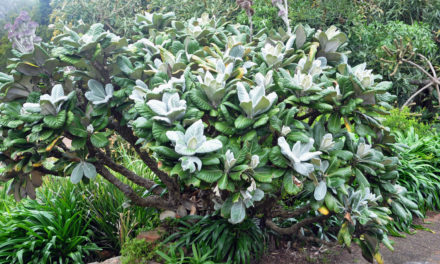
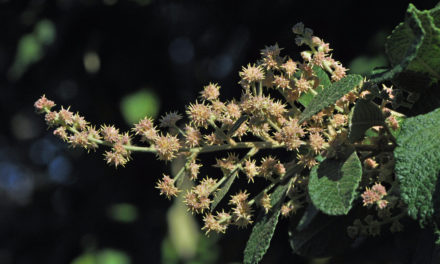
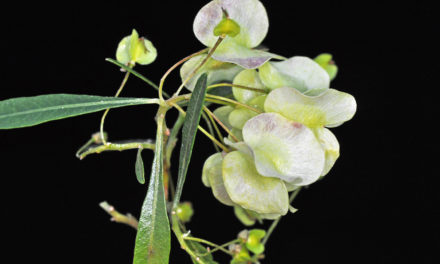
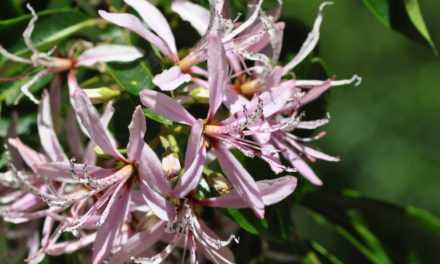

This a fascinating plant species (Freylinia tropica) because of its remarkable tolerance of drought. It was also stunning to observe that this plant was almost not affected by the recent drought and heatwave. Therefore, this raises important questions about the contribution of its morphology, physiology and anatomy to adaptation to hostile environments.
Greetings Molekoane Ranyaoa
Thank you for the comment. We are probably in for dry times ahead and your comment is of critical importance.
Take care
David Becking.