Ficus burkei
General Info – Summary
This symmetrical monoecious Tree is up to 18m high and may grow on its own, be a rock splitter or strangler. Branches extend low down. Non-toxic milky latex is present. Spirally, alternate, glossy Leaves are simple. Minute Flowers in a pollinated syconium that only specific pollen carrying wasps try to enter. The ripened Fruit is a syncarp with a roughish surface, and reddish or yellowish colour.
Description
Previous Names: Ficus thornningii (in part), Ficus natalensis, Ficus phillipsii, Ficus rhodesiaca, Urostigma burkei.
SA Tree No. 48.
Common names: (Afr) Gewone Wildevy, Wurgvy. (Eng) Common Wild Fig, Strangler Fig. (IsiNdebele) Intenjane, Umtende. (isiXhosa) Uluzi, Umthombe. (isiZulu) Umbombe, Umthombe. (Northern Sotho) Moumo. (Setswana) Mmadintana, Moomo, Moumo, Muomo, Xirhomberhome. (siSwati) inkhokhokho. (Tshivenda) Muumo.
Family: Moraceae (fig or mulberry family). Trees are evergreen and have milky or watery latex present. The simple Leaves are alternate or opposite and 3-veined from near the possibly lobed base. Margins are usually entire, and all leaves have stipules. Plants are monoecious or dioecious and flowers are unisexual. The Perianth of indigenous species contain sepals but no petals. Male flowers have up to 6 stamens. Female flowers are inconspicuous and lack staminodes. The superior or inferior Ovary has 1 locule with 1 ovule and 2 styles are often present. The compound usually fleshy Fruit contains various Seeds. The family has 37 genera and about 1 100 species.
Name derivation: Ficus – Latin name for fig. burkei – after Joseph Burke (1812-1873) botanist, plant and animal collector who visited Gauteng in 1841 and went on an amazing trip with many delays. His return trip from Cape Town took more than 2 years. See web reference below. The genus Ficus has 24+ species in southern Africa.
Conservation: National Status: L C (Least Concern). Assessment date: 2005/07/12 (J.E. Burrows and J.E. Victor).
Tree
The noticeably, usually symmetric, medium to large sized Tree is up to 18m high (photo 459). Initially the tree may grow on its own or be a rock splitter or a strangler (growing from a tiny seed left by a bird dropping on the, to be, hosts branches). If Aerial roots are present, they hang down from the branches. Here they can combine and, eventually surround, and strangle the host tree. The dense leafy Crown (photo 459) may be spreading or rounded and up to 35m wide. In older trees, the crooked Trunk may be grooved and buttressed (woody extensions from the tree base that radiate outwards photo 460). The branches may extend from lowdown. Cutting the tree or branches causes them to exude non-toxic milky latex. The usually smoothish trunk Bark (Photo 523) may be light (photo 460) or dark grey brown (photo 523) or khaki (photo 526). On younger branches, Lenticels (a usually raised corky oval or elongated area on the plant that allows the uncontrolled interchange of gases with the environment) may be visible in vertical lines. On older trees, the bark may develop cracks (photo 726).
-
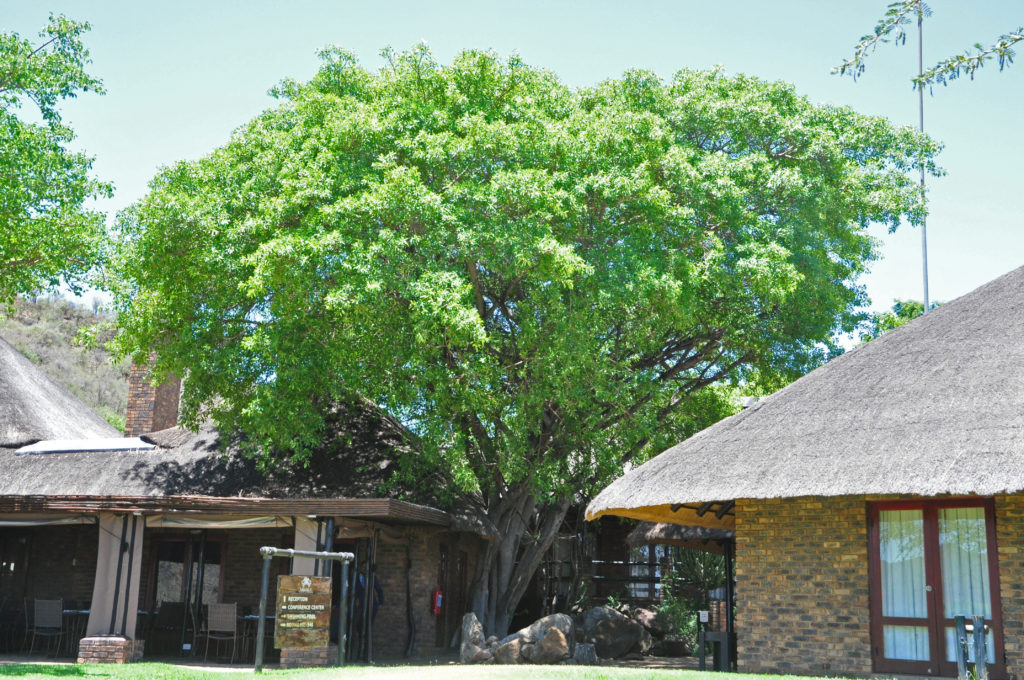
- 459. 2018/11/12. Bakubung. Photo: David Becking.
-
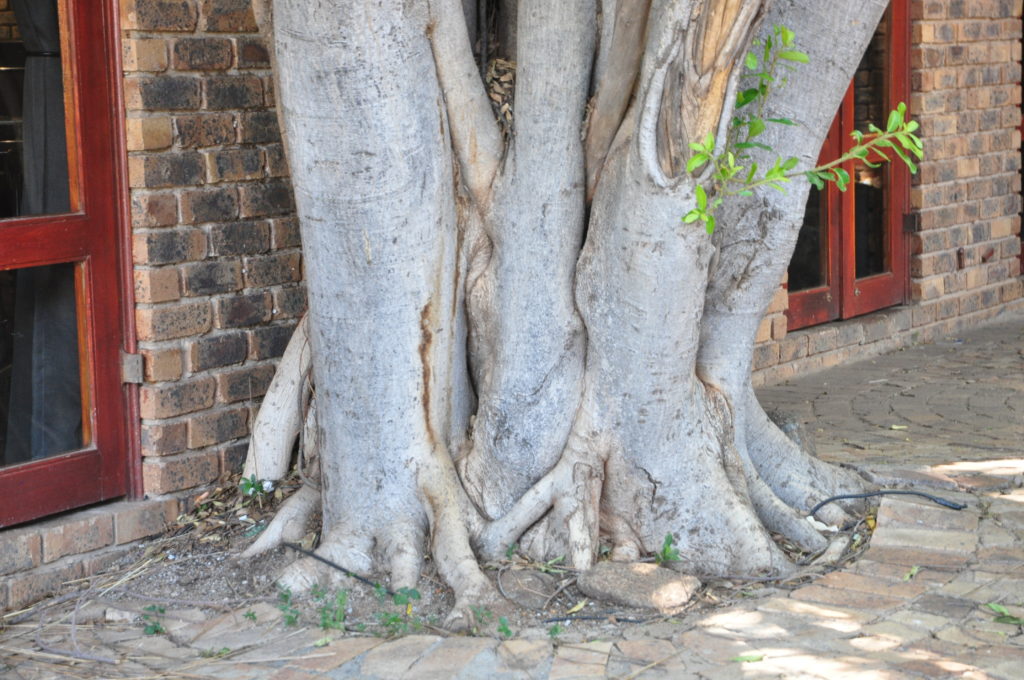
- 460. 2018/11/12. Bakubung. Photo: David Becking.
-
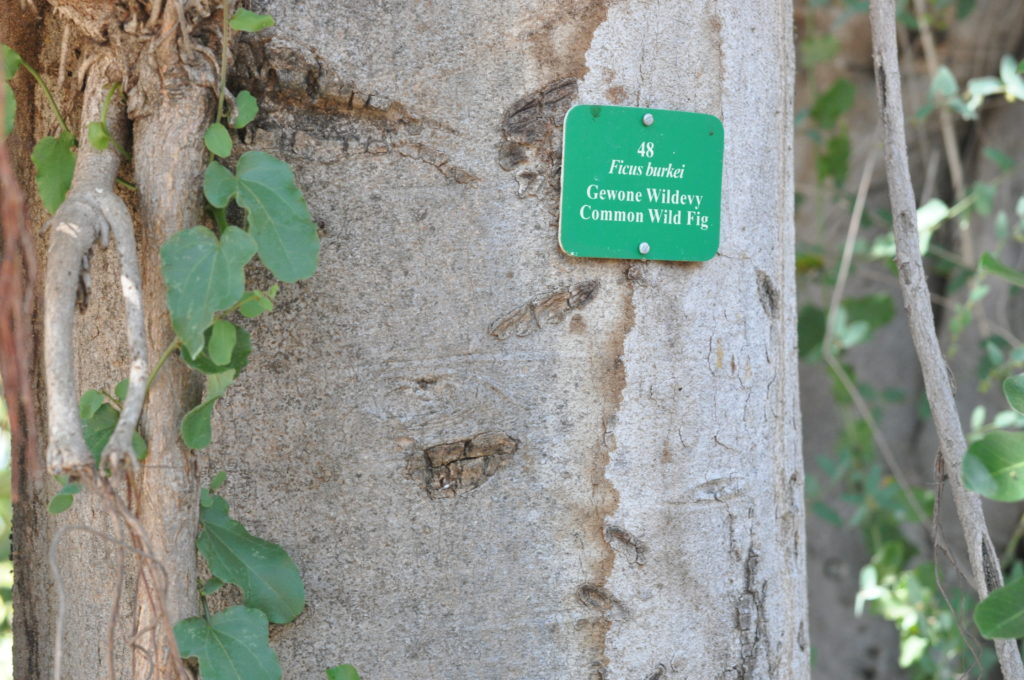
- 523. 2014/09/08. Lower Sabi KNP. Photo: David Becking.
-
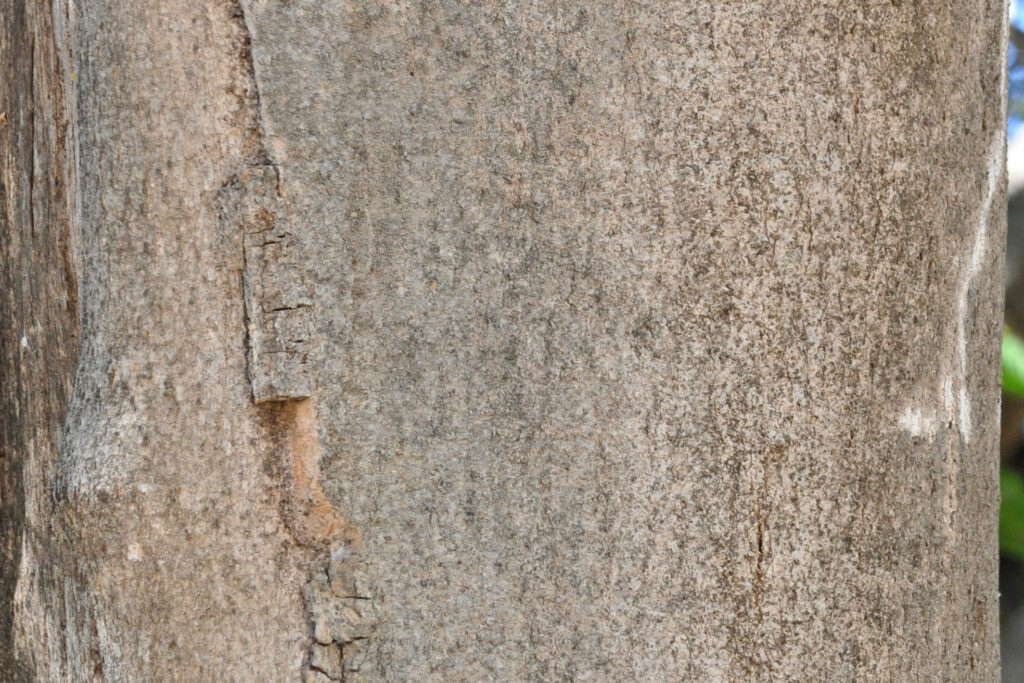
- 526. 2014/09/08. Lower Sabi KNP. Photo: David Becking.
-
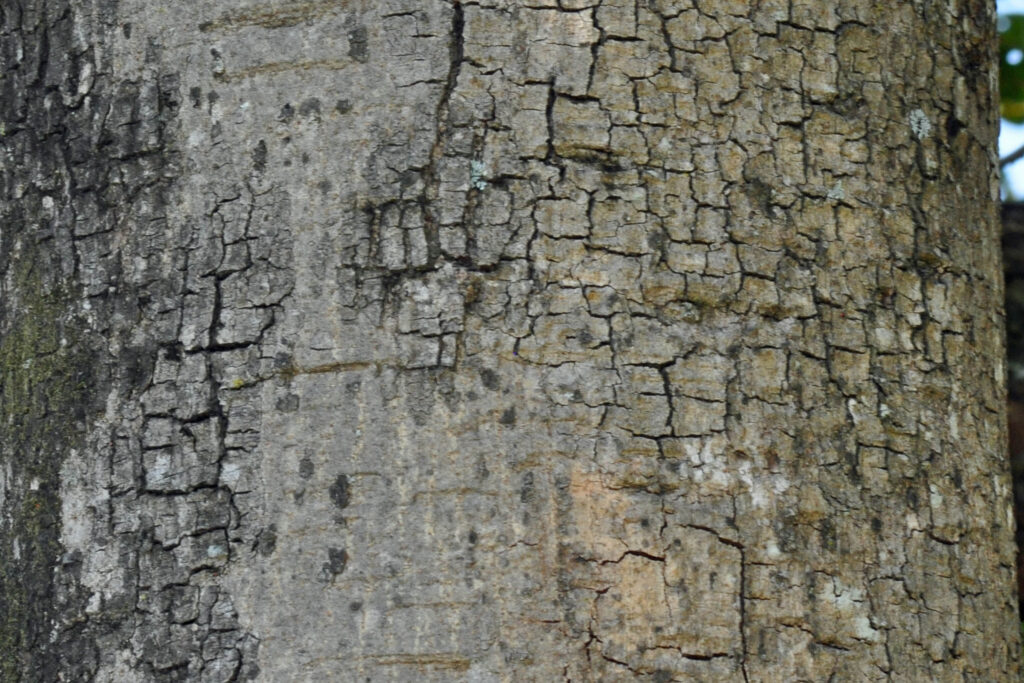
- 726. 2014/09/14. Lowveld BG. Photo: David Becking.
Leaves
Leaf shape is variable. The alternate (photo 527) or whorled and usually hairless, leathery and stiff Leaves are mild to dark green above (photos 525&476) and glossy (photo 527). They are lighter below (photo 476) and the smooth margin is entire (with a continuous margin, not in any way indented). Young leaves are a lighter green (photo 718). Leaves are simple (have a single blade which may have incisions that are not deep enough to divide the blade into leaflets), and smooth – not rough nor sandpaper-like. The tree may be evergreen or briefly deciduous. This is largely weather dependent. Leaves are oblong or elliptic to obovate (like an upside-down egg with the narrower end near the base – photo 476) and up to 12 x 6cm. The midrib protrudes on the Lower paler Surface (photo 527) and may be yellowish. Veins are best viewed when the leaf is held against a strong light (photo 481). Here the Parallel Lateral veins loop and join close to the margin forming a sub-marginal vein. These leaves are not markedly 3-veined from the base. The Apex is rounded or bluntly pointed (527). The Base may be rounded, narrowly tapering square or lobed (photo 476). In this photo the Petiole (leaf stalk) is hairy and indented lengthwise above (photo 476) and usually up to 5cm long. Stipules (basal appendages of the petiole) may be visible.
-
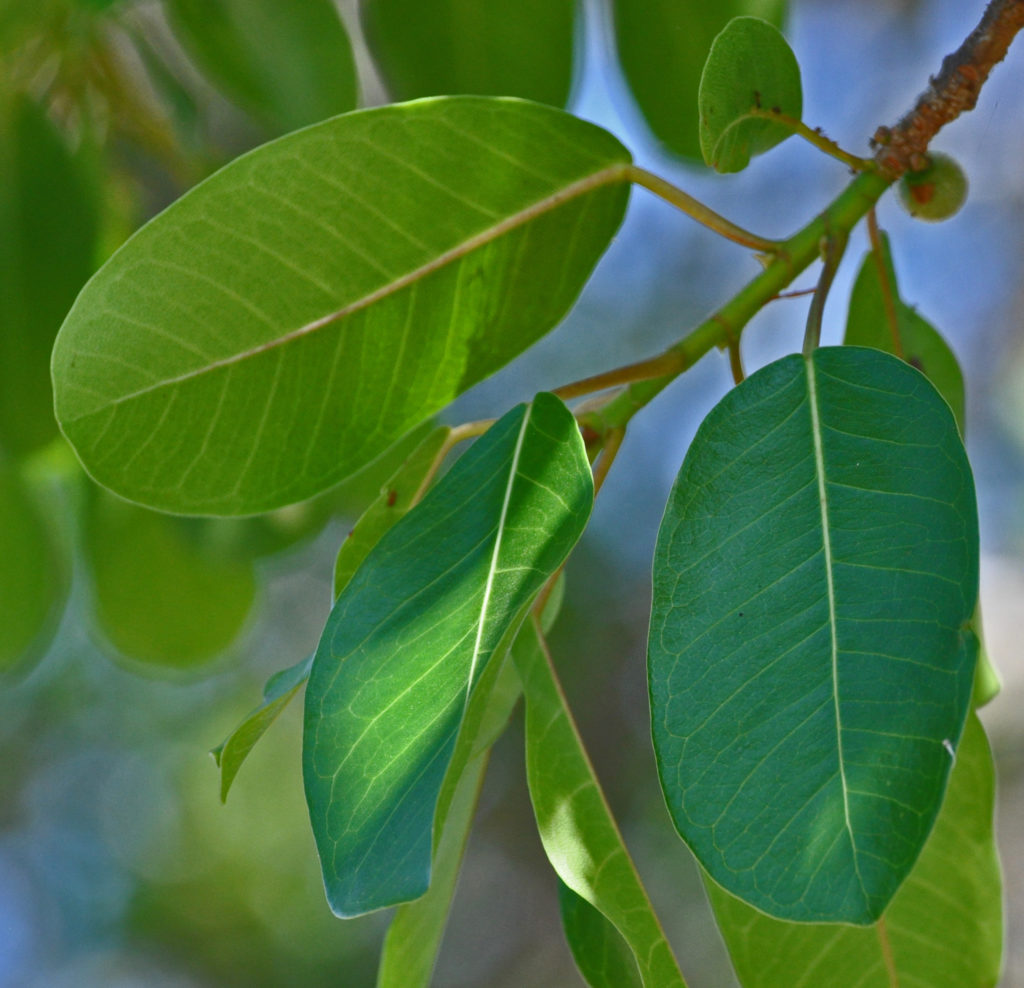
- 527. 2014/09/08. Lower Sabi KNP. Photo: David Becking.
-
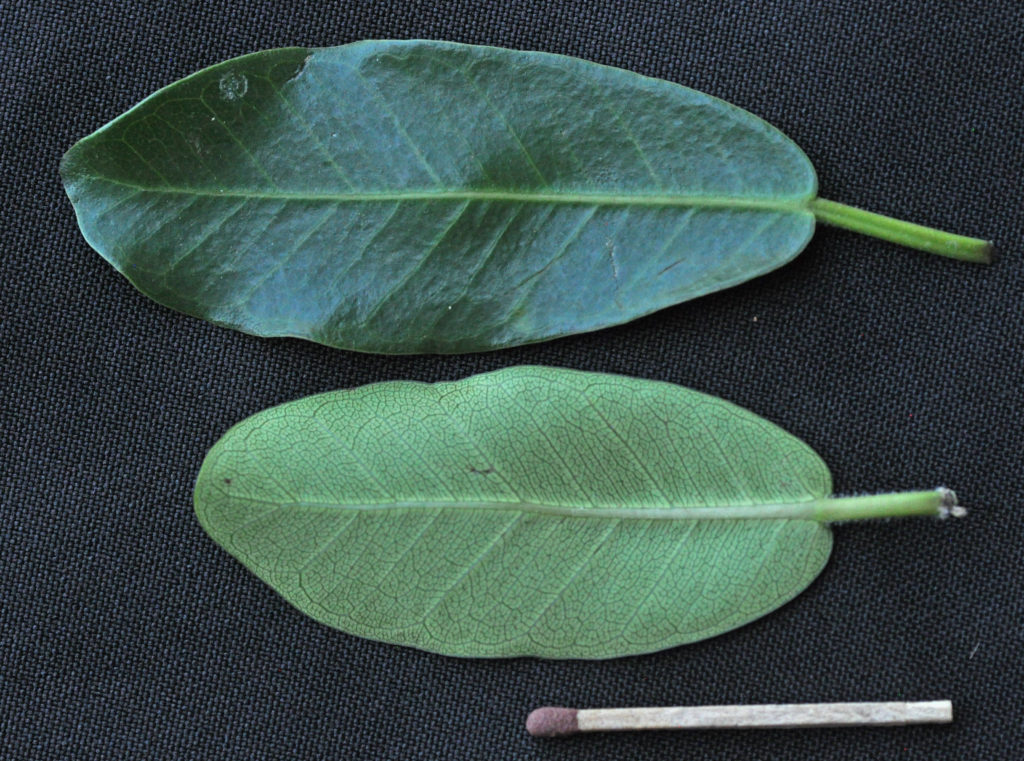
- 476. 2018/11/22. Bakubung. Photo: David Becking.
-
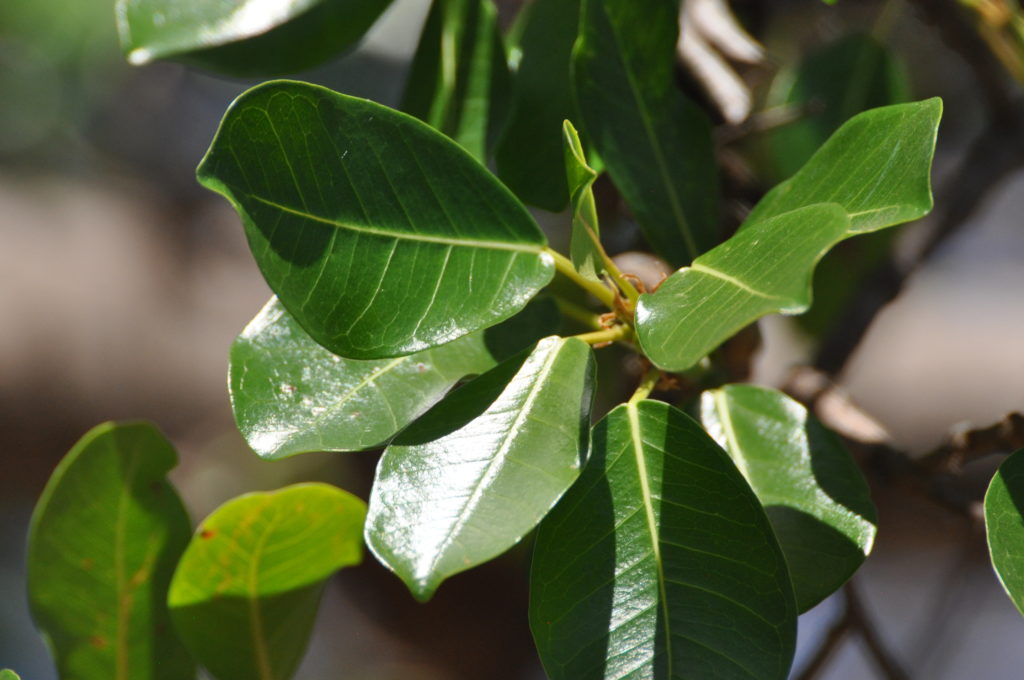
- 525. 2014/09/08. Lower Sabi KNP. Photo: David Becking.
-
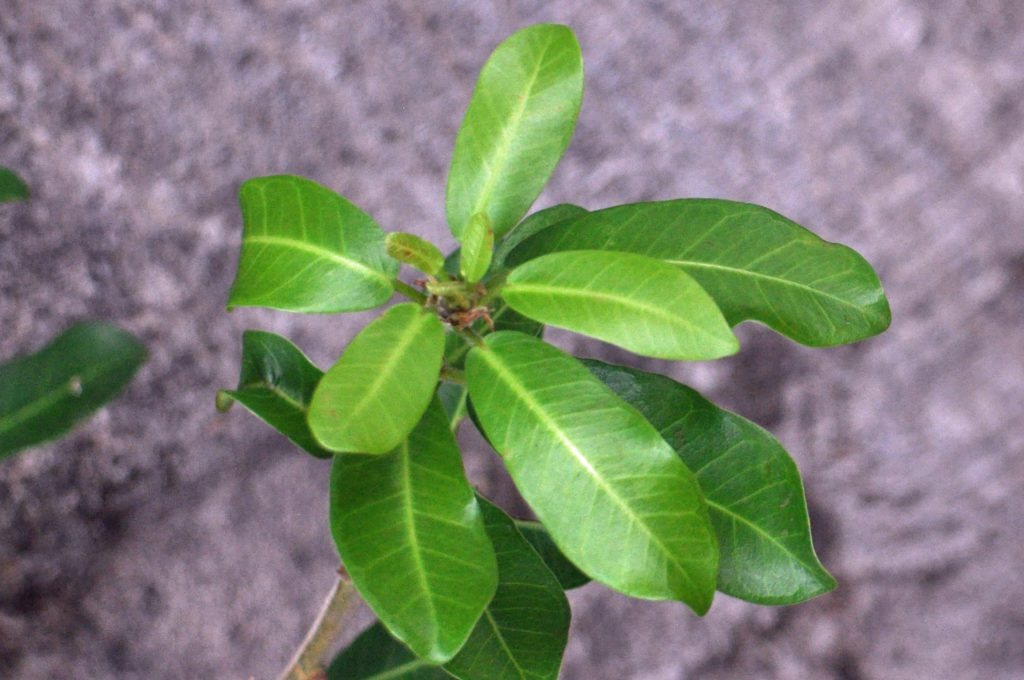
- 718. 2018/11/23. Bakubung. Photo: David Becking.
-
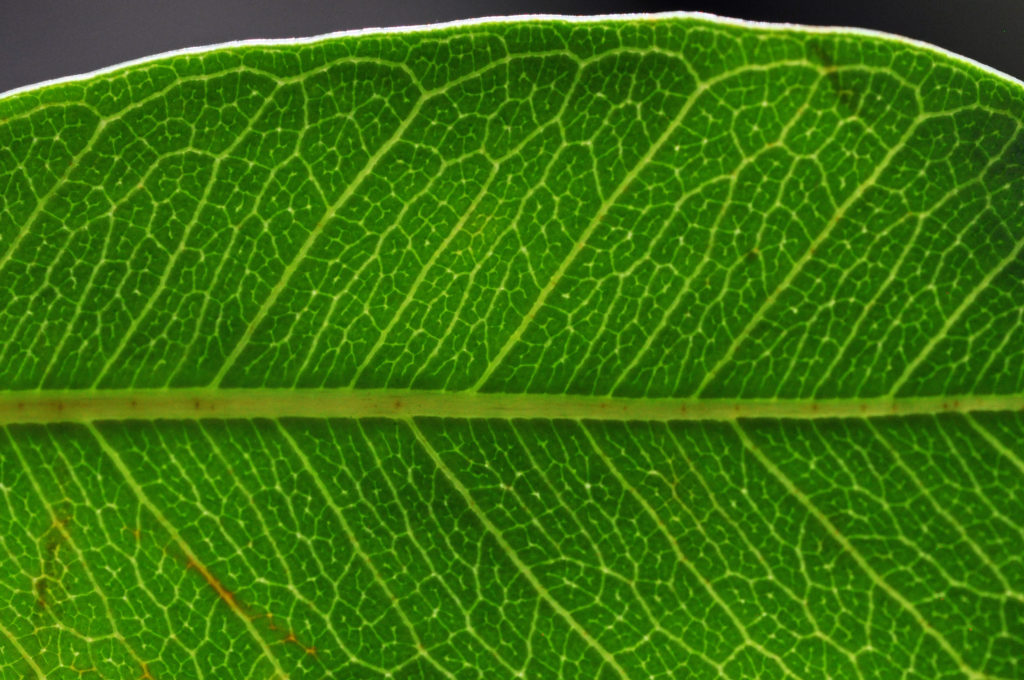
- 481. 2018/11/22. Bakubung. Photo: David Becking.
Flowers
This tree is monoecious (having both male and female reproductive organs on the same plant). The unisexual Flowers are very small. Figs possess an amazingly arranged flower head called a Syconium (the type of inflorescence found in by figs). Here the inflorescence refers to the whole flower head of a plant including pedicels (stalks of each single flower), bracts, and flowers. The syconium is formed by an enlarged, fleshy, hollow receptacle (is that expanded tip of the flower stalk from which the floral parts develop). It initially has multiple ovaries on the inside surface. This receptacle develops into a multiple fruit that is collectively called a Fig. Here the perimeter of the receptacle substantially increases in size and folds over forming the fig shape. The hollow fig ends with a tiny opening called an Ostiole, which is covered with scales making exit for wasps impossible and entrance difficult. Only the female pollinating wasps (here Elisabethiella stuckenbergi, Alfonsiella longiscapa or Elisabethiella socotrensis) attempt to do so and are usually injured in the process. Around the inner boundary of the hollow receptacle of the fig, a large collection of extremely small flowers develops. These flowers are either male or female. In the small Male Flowers, up to 6 overlapping perianth parts (the 2 floral envelopes considered together; a collective term for the calyx and corolla). Each male flower has 1 or 2 stamens (stamen – male reproductive part of a flower. Stamens produce pollen in the terminal anther, which is usually supported by the filament present). The ovary is absent or vestigial (imperfectly developed, non-functional). In Female Flowers, the free Ovary has 1 or 2 Styles. The Stigma (the part of the pistil that receives the pollen) is usually oblong. There are no stamens (male reproductive part of a flower). Stamens produce pollen in the terminal anther, which is usually supported by the filament (the usually long slender stalk that supports the anther.
The Female wasp enters the fig through the ostiole with her pollen sacks laden with pollen and, unintentionally, pollinates those female fig flowers that have longish styles. These longer styles prevent the wasp from laying eggs in the ovary. The wasp thus targets the flowers with short stigmas and lays a single egg in each ovary. The female ovary reacts producing a gall which nourish the developing wasp larvae. Wasps eventually pupate and become adults. The new, robust Male wasps develop first and fertilize the young Female wasps. Male wasps then burrow through the wall of the fig allowing oxygen in. The young female wasps then, unintentionally, load pollen from the male fig flowers, escape from the fig and make their way to another fig of the same species, to continue the life cycle. This is an excellent example of a mutualistic relationship (a beneficial relationship between 2 different species in which both benefit). Here both the fig tree and the wasp benefit. There are usually at least 28 different fig specific species of wasps involved in pollination of different fig trees.
Fruit (figs)
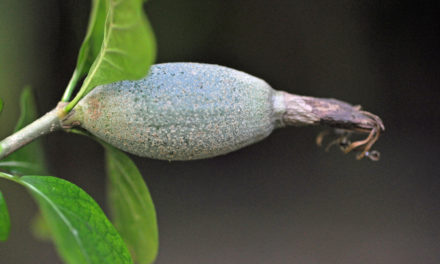
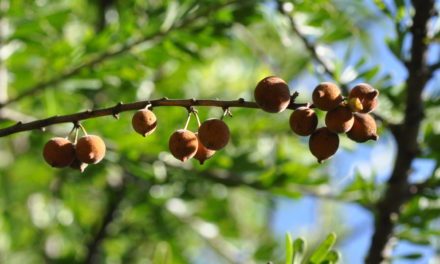
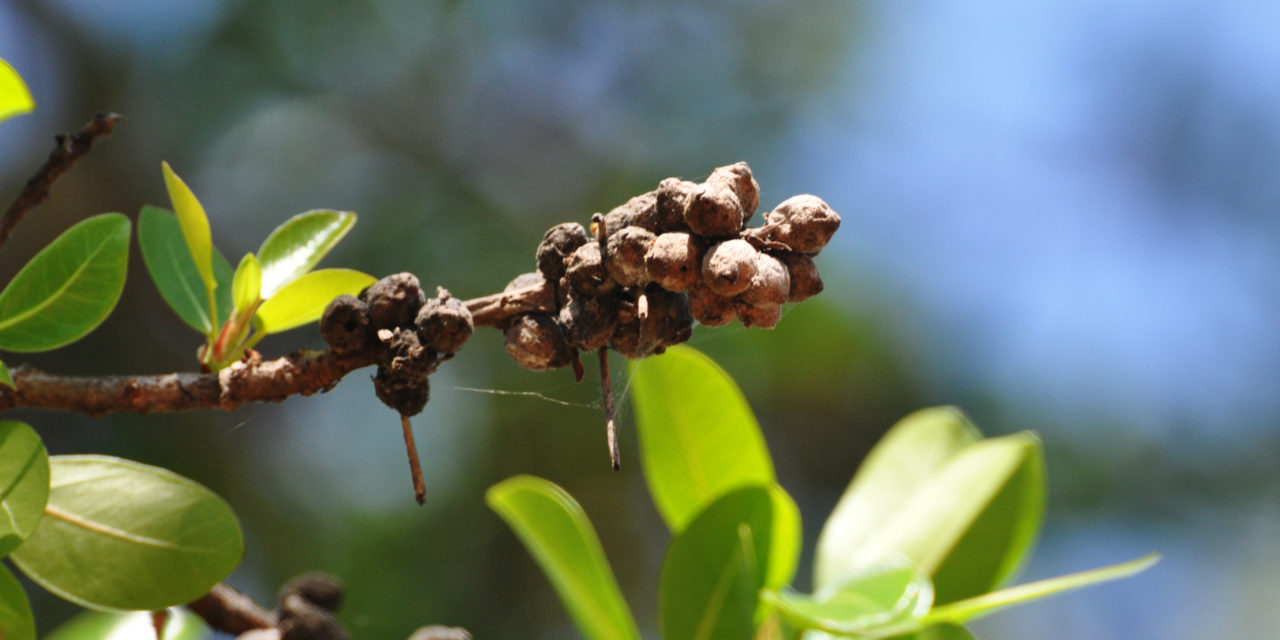
Nearly a week elapses after the wasps escape and leave behind the now fertilized fig eggs. Oxygen enters through the holes created by the exiting wasps, and this induces the production of Ethylene. Ethylene is a small hydrocarbon gas – odourless and tasteless. This gas is involved in the ripening of the fruit – including causing the fruit to change colour, texture and soften. Ethylene is used commercially to ripen fruits like tomatoes, bananas and pears. The small Figs now ripen (becoming up to 2cm wide) and develop into a multiple rosy speckled brown Fruit. They occur just below the leaf or in leaf axils (upper angle between a lateral organ, such as a leaf, and the stem that bears it). The opening is often nipple like, and at maturity, they become a bit rough and a slightly reddish or yellowish colour. The fruit is born singly or are often in pairs and remains on the tree for most of the year (photo 524). The Carpel is the female reproductive organ with an ovary, ovule(s) stigma and usually a style. In the fig it is an almost spherical or pear-shaped Syncarp (having united carpels: applied to an ovary of 2 or more carpels) It is up to 1,5cm wide and is usually sessile (without stalks). When present, the stalks may reach up to 7mm long. The fig Surface is smooth, initially green (Photo 480) and usually densely hairy and attached to a saucer-shaped thickened basal plate.
-
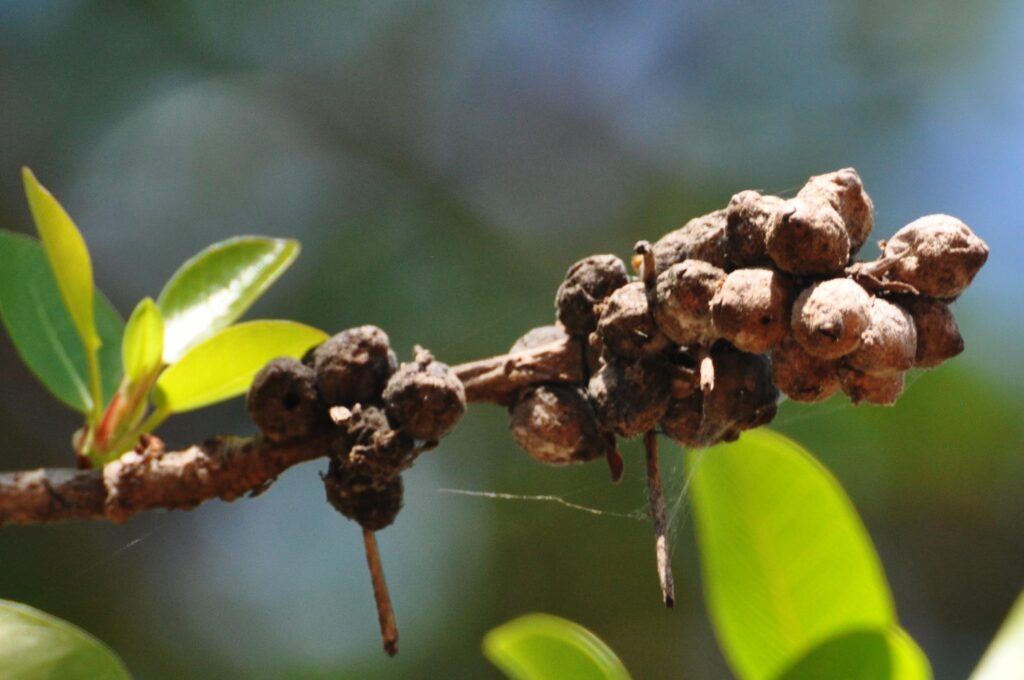
- 524. 2014/09/08. Lower Sabi KNP. Photo: David Becking.
-
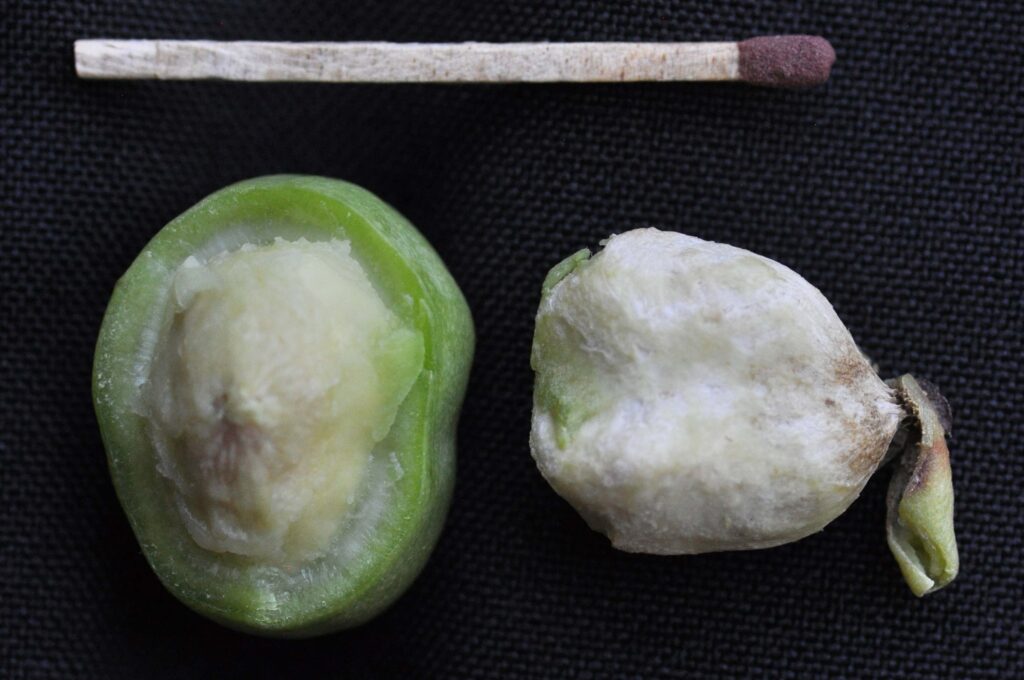
- 480. 2018/11/22. Bakubung. Photo: David Becking.
Distribution & Ecology
These Trees are common in forests and Savanna (is a rolling grassland scattered with shrubs and isolated trees) regions. The tree also develops on termite mounds. Trees usually occur in mid altitudes below 1 800m on rocky hillsides, in woodland forests and semi deciduous forests. In South Africa, these figs occur naturally in Eastern Cape, KwaZulu-Natal, Gauteng, Mpumalanga, Limpopo, and North West. Trees are also found in Mozambique, Zimbabwe, Botswana, Eswatini (Swaziland), Uganda, Kenya, Tanzania, southeastern Democratic Republic of Congo, Zambia and Malawi. This tree may be terrestrial, a strangler or a rock-splitter. Birds, including the African Green Pigeon (Treron calvus, feed on the fruit. The insects feeding on the fruit attract other birds. These include the Black Sunbird, Crested Loerie (Turaco), the Saw-wing Swallow and the Paradise Flycatcher. Mammals, including fruit bats, baboons, bushpigs, monkeys, warthogs, bushbuck, nyala, duiker and klipspringer also feed on the ripe Figs. Larval stages of the Tiger moth caterpillar (Asota speciosa) and butterflies – including the Lesser Fig-tree Blue (Myrina dermaptera), the Common Fig-tree Blue (Myrina silenus) as well as the Lesser Fig-tree Blue butterfly (Myrina dermaptera dermaptera) all have larval leaf feeders. Bird lime can be made from the plant latex.
Ethnobotany
These plants are lithophytes (Plants that adapt to rock surfaces or in rock crevices. Here they adapt to nutrient poor environments). When growing on rocks the white roots growing over rocks other plant stems are distinctive. The tree is slightly frost sensitive/resistant. The Figs are edible. This is a good birders tree and shade provider. The soft Wood has a low density, is whitish, weak and susceptible to borer attack. Bark fibres are used for cordage (making cords and ropes) and mat making. Pounded Root extract is very sticky and used for trapping hares and birds. It is also smeared on grass to trap guineafowl. This shade producing and bird attracting plant grows easily from truncheons (stem cutting from a selected plant – used to produce genetically identical new plants but here requires ample space). Plant well clear of building, including pools.
References
Boon, R. 2010. Pooley’s Trees of eastern South Africa. Flora and Fauna Publications Trust, Durban.
Burrows, J.E. & Victor, J.E. 2005. Ficus burkei (Miq.) Miq. National Assessment: Red List of South African Plants version 2020.1. Accessed on 2023/06/03.
Burrows, J.E., Burrows, S.M., Lotter, M.C. & Schmidt, E. 2018. Trees and Shrubs Mozambique. Publishing Print Matters (Pty) Ltd. Noordhoek, Cape Town.
Coates Palgrave, M. 2002. Keith Coates Palgrave Trees of Southern Africa, edn 3. Struik, Cape Town.
Ginn, P.J. McIlleron, W.G. Milstein, S. 1989. The Complete Book of Southern African Birds. Struik Publishers (PTY) LTD. Third impression 1991.
Palmer, E. & Pitman, N. 1972. Trees of southern Africa, Balkema, Amsterdam, Cape Town.
Schmidt, S. Lotter, M. & McCleland, W. 2002. Trees and Shrubs of Mpumalanga and the Kruger National Park.
van Wyk, B. & van Wyk, P. 1997 Field guide to Trees of Southern Africa, Struik, Cape Town.
http://www.digplanet.com/wiki/Joseph_Burke_(botanist)
http://www.blueplanetbiomes.org/savanna.htm
https://www.biomedcentral.com/content/supplementary/1471-2148-12-1-s5.pdf
http://posa.sanbi.org/flora/browse.php?src=SP