Faurea gapinii updating now
General info
This Tree may reach 10+m high or is shrub like. Bark is grey and smooth to rough. Evergreen simple, leathery, lanceolate, entire Leaves lack stipules. Small bisexual Flowers develop in spikes with bristle-like hairs & long styles. Here 4 anthers, a single pistil with a superior ovary and a long persistent stigma are present. Fruit has a long persistent style and is a small, globose, distinctly hairy one seeded achene.
Description
SA Tree No. 73.
Common names: (Afr) Bosbeukenhout, Bosboekenhout, Bos-boekenhout, Rooiboekenhout, Platorand-boekenhout. (Eng) Bush Beech, Escarpment Beechwood, Forest Beech, Forest Beechwood, Forest Boekenhout. (Northern Sotho) Mohlakô, Monengenenge. (siSwati) Sisefo.
Family Proteaceae (Protea family). Members of this family occur mainly in the southern hemisphere. Universal characteristics are few. All are woody trees or shrubs. Anthers are basifixed and the superior Ovary is sessile. Flowers are contained in a compound inflorescence and 4 Tepals are present. There are about 80 genera and at least 1 600 species including the Australian Macadamia. (South Africa has now become one of the biggest producers of Macadamia nuts). In South Africa, there are 16 genera and 300 species. 6 genera (examples on this website) have species that are trees. These are Brabejum, Faurea, Leucadendron, Leucospermum, Mimetes and Protea. Currently the genus Protea has the most species. Protea gaguedi is the only species found in Namibia. The South African Protea flowers all have a superior Ovary containing a single ovule. The Stigma is a tiny groove resting on the top of the pollen presenter. The Style is long and thin. The silky appearance of the wood is due to the presence of medullary rays (pith rays used for the radial conduction of water, minerals and organic substances). Leaves are Sclerophyllous (type of drought resisting vegetation adapted to prevent water loss with hard, leathery, evergreen leaves that develop on narrowly spaced nodes). This family has similar Leaves to the Glossopteridales whose fossil leaf remains resemble the modern protea. These fossils were prevalent more than 200 million years ago. This was a time before the breakup of the supercontinent – Gondwanaland – due to continental drift. In the family Proteaceae the genera Faurea, together with the Protea, use xylose (a monosaccharide which has 5 carbon atoms not 6 as in glucose) as the main sugar in their nectar. This is unusual.
Name derivation: Faurea – named after William Caldwell Faure (1822-1844) son of a Dutch Reformed minister in Cape Town. He died in an ambush in India after joining the Dutch East India Company. galpinii. Named after E.E. Galpin an amateur plant collector. There are 5 Faurea species in South Africa, including F. galpinii and F. saligna.
Conservation: National Status: L C. (Least Concern). Assessment: 2019/04/12 (A.G. Rebelo, L. von Staden and H. Mtshali). As the exotic pine trees spread, the effect on the Faurea galpinii will take its toll.
Tree
This usually small Tree with its spreading crown (photo 10) is usually up to 10m and occasionally 18m high. On exposed rocks, it may be shrub like (a shrub is woody perennial plant, less than 6m in height, with multiple stems arising from or close to the base. They may may be evergreen or deciduous. The erect Trunk may be much branched. The young twigs are reddish (photo 450 – under Leaves). The Bark is grey and smooth in forests and lower circumferential rings may be present near the base (photo 555). Bark is darker and rough when growing in more exposed situations.
Leaves
On this evergreen tree, the leaves are simple (have a single blade, which may have incisions that are not deep enough to divide the leaf into leaflets), alternate, leathery and lanceolate (lance-shaped). Leaves are up to 11 x 2,5cm (not up to 15cm long as in Faurea saligna). Leaves are initially light green (photo 760) but become dark green above and remain lighter green below (photo 932). The Midrib (the main rib of a leaf or leaf-like part, a continuation of, but excludes the petiole is prominent and often reddish – especially in young leaves that are close to the up to 12mm long – photo 450). The Petiole (leaf stalk – photo 450) may also be reddish (photo 450). In this photo the collection of close together leaf scars, indicates the end of the previous year’s growth. The wavy Margins (photo 932) are entire (with a continuous margin, not in any way indented – (photo 932). Leaves taper to both the Base and the Apex (photo 932). Stipules (basal appendages of the petiole) are absent.
Flowers
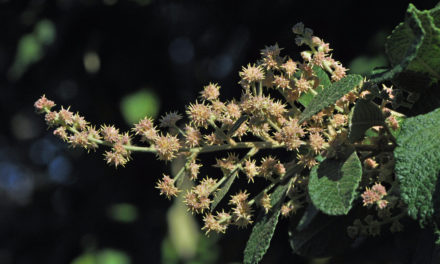
The small, bisexual, whitish, slightly Zygomorphic (irregular flower with the corolla divisible into 2 equal halves in one plane only). Flowers become greenish or light blue and have fine, whitish hairs. They usually develop in lax, upright, terminal and solitary Spikes (are a type of flower arrangement where multiple blooms attach directly to a single unbranched stem, with no individual flower stalks between them (Photo 182 under Fruit). The spikes may become horizontal with only the end portion upright (photo 548). The inflorescence is usually up to 10cm long but may reach 18cm. Each spike has distinctive short Pedicel (flower stalk) that may reach 1cm long (photo 548) which is absent in Faurea saligna. An ovate floral bract subtends each flower. The Perianth (a collective term for the calyx and corolla) has rusty to cream coloured hairs (photo 182) and the upper 3 segments are fused or may be absent.
In this plant the Male reproductive part of a flower develops 4 Stamens which produce pollen in the terminal elliptical Anthers (where the pollen grains are formed). Each anther is usually each supported by a Filament (the usually long slender stalk that supports the anther). Here the linear-elliptic anthers may be sessile or nearly so. This plant has a single Pistil (a unit of the Gynoecium, the Female element of the flower). The pistil is composed of the Ovary, a longish Style and the Stigma (the part of the pistil that receives the pollen). Here the single developing locular Ovary forms a protective sheath within which development and fertilization occur. In this plant the ovary is covered with long, straight trichomes (hairlike surface outgrowths – photo 182 – under Fruit). The ovary rests on a disc (a more or less fleshy or elevated development of the Receptacle (the expanded tip of the flower stalk from which the floral parts develop. This ovary has a single Ovule (a small egg – especially visible in an early stage of growth). There is a single, relatively long, slender, persistent, slightly curved and terete (circular in cross-section) Style (photo 449 under Fruit). This terminates in a single stigma.
Fruit
Each fruit has a long persistent Style present (photo 449 & 182) and whitish hairs cover the Fruit – (photo 182). This fruit is a small globose Achene (a small dry indehiscent one seeded fruit with a tight, thin pericarp – the wall of the ripened ovary). Each achene has a prominent basal attachment scar. (Nov-Apr). The mature fruit/achene rests on a short Pedicel (the stalk of a single flower – photo 182).
Distribution and ecology
This Tree is Endemic (restricted to a particular geographic location) in southern Africa. These plants occur naturally, along the escarpment in KwaZulu-Natal through Eswatini (Swaziland), Mpumalanga e.g., Barberton (where some of the oldest volcanic rocks in the world are located) and Limpopo. Trees commonly grow in a seasonally dry tropical biome (a major community of plants and animals with similar environmental conditions). They occur in fine isolated areas of forests, forest margins and moist rocky outcrops e.g., Soutpansberg Mountains in Northern Limpopo. In the mountains, trees occur along drainage lines and are usually associated with high mist belts from an altitude of 1 000 to 1 800m. Established plants are frost and drought resistant. Flowers produce a lot of nectar and rodents may help with pollination.
References
Boon, R. 2010. Pooley’s Trees of eastern South Africa. Flora and Fauna Publications Trust, Durban.
Coates Palgrave, M. 2002. Keith Coates Palgrave Trees of Southern Africa, edn 3. Struik, Cape Town.
Palmer, E. & Pitman, N. 1972. Trees of southern Africa, Balkema, Amsterdam, Cape Town.
Rebelo, A.G., von Staden, L. & Mtshali, H. 2019. Faurea galpinii E.Phillips. National Assessment: Red List of South African Plants version 2024.1. Accessed on 2026/07/25
Schmidt, S. Lotter, M. & McCleland, W. 2002. Trees and Shrubs of Mpumalanga and the Kruger National Park.
van Wyk, B. & van Wyk, P. 1997 Field guide to Trees of Southern Africa, Struik, Cape Town.
http://pza.sanbi.org/faurea-galpiniihttp://posa.sanbi.org/flora/browse.php?src=SP
https://plants.jstor.org/stable/10.5555/al.ap.person.bm000125780