
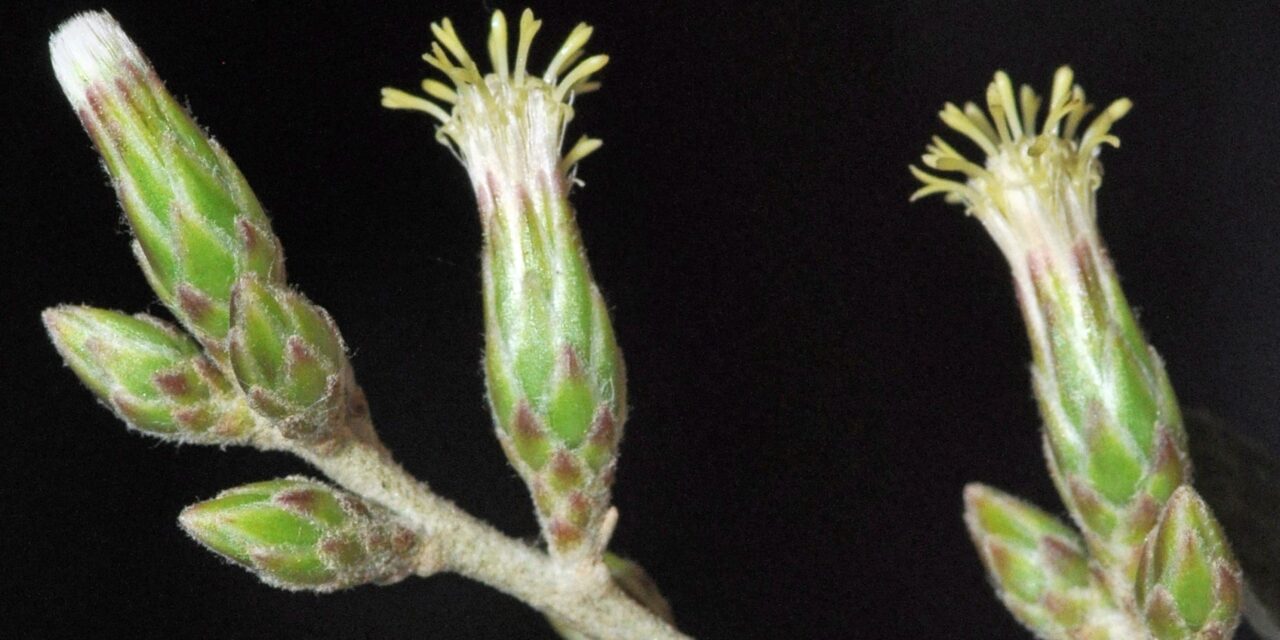
Phyllogeiton discolor
Phyllogeiton discolor, now in the family Rhamnaceae, is considered the correct name for Brachylaena discolor.
General Info – summary
This common dioecious coastal Tree is a southern African endemic. The trunk diameter to 45cm and is occasionally up to 29m high with a vertically fissured bark. It may be a dune shrub. Simple, bitter Leaves are discolorous. Shiny upper surface is hairless & densely velvety below. Tiny unisexual Florets (flowers) are in bracteate capitula. The Fruit is a cypsela. Seeds have a wind-dispersal apical pappus.
Description
Previous Names: Brachylaena discolor, Brachylaena discolor DC. subsp. discolor, Brachylaena discolor DC. subsp. discolor var. discolor, Brachylaena discolor DC. subsp. discolor var. mossambicensis Paiva, Brachylaena natalensis.
SA Tree No. 724.
Common names: (Afr) Bergvaalbos, Bosvaalbos, Kreukelboom, Kusvaalbos, Lepelboom, Vaalbos. (Eng), Bird plumb, Coast Silver Leaf, Coast silver oak, Coastal Silver-oak. (isiXhosa) Isiphaluga, Isiduli, Umpatha. (isiZulu) Iphahla, Isiphahluka, Umduli, Umphahla. (siSwati) umPhahla. (Xitsonga) apahla.
Family: Rhamnaceae. (Buckthorn Family). This family mainly contains trees and shrubs. It has about 58 genera and 900 species. In South Africa, there are 9 genera and 203 species. Trees on this website include Phyllogeiton, Noltea, Rhamnus and Ziziphus. Leaves are simple and usually alternate, and stipules are present – if only for a short time. Flowers are actinomorphic (regular and symmetric) and a prominent hypanthium (the cup-like receptacle usually derived from the fusion of floral envelopes and androecium, and on which are seemly borne calyx, corolla and stamens) is present. Sepals are well developed, and Petals are free and in 4’s or 5’s. The Calyx is tubular, and sepals do not overlap. The free petals arise from the calyx tube or from the outer margin of the disc. The 4-5 Stamens arise with, and opposite to the petals. Anthers have up to 2 pollen sacs and pollen is released through longitudinal slits. The Ovary is usually superior and has 2-5 chambers. Fruit is a drupe, which is partly enclosed by a persistent Calyx.
Name derivation: Phyllogeiton is a small genus of flowering plants in the family Rhamnaceae. discolor is now considered the correct species name.
Conservation: National Status: L C (Least Concern). Assessed: 2018/11/07. (L. von Staden).
Tree
This multi-stemmed shrub or single stemmed Tree is up to 12m high (usually less) and has a Trunk that may reach a diameter of 45cm. The tough, dark grey to reddish brown Bark becomes rough, hairless and vertically fissured (photos 1048, 340 & 347). The many indiscriminately arranged dark grey or reddish-brown untidy Branches (photo 347) may be grooved and may reach down to the ground (photo 360). The young branches are ribbed and white-felted with short-lived woolly white hairs (photo 904). Young branches may have visible pale Lenticels (usually raised corky oval or elongated area on the plant that allows the uncontrolled interchange of gases with the environment).
-
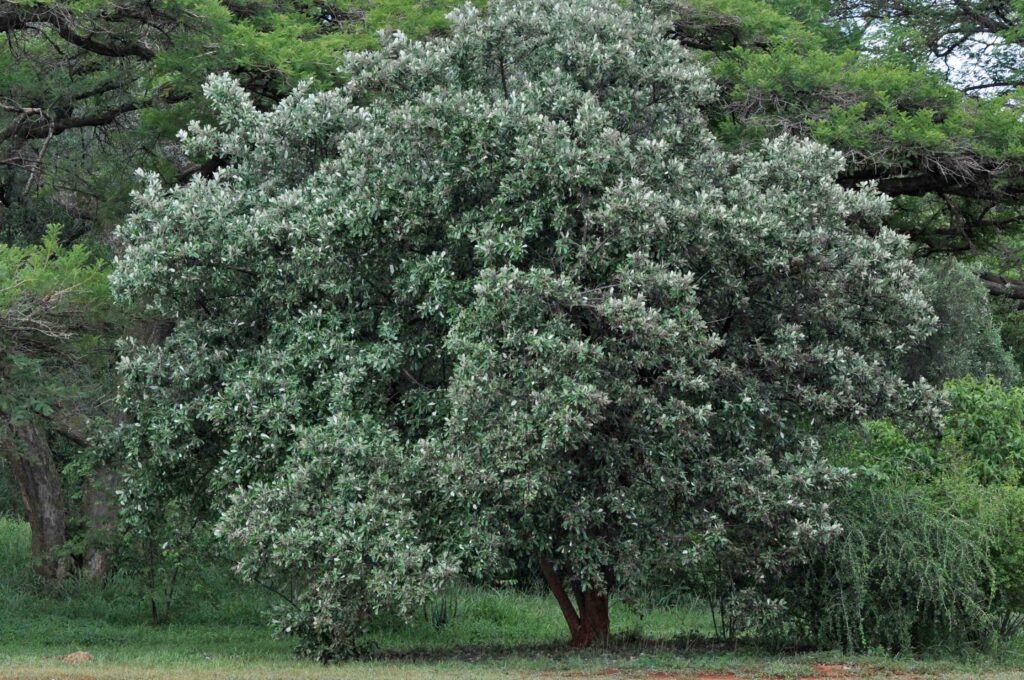
- 360. 2016/01/16. Pretoria NBG. Photo: David Becking.
-
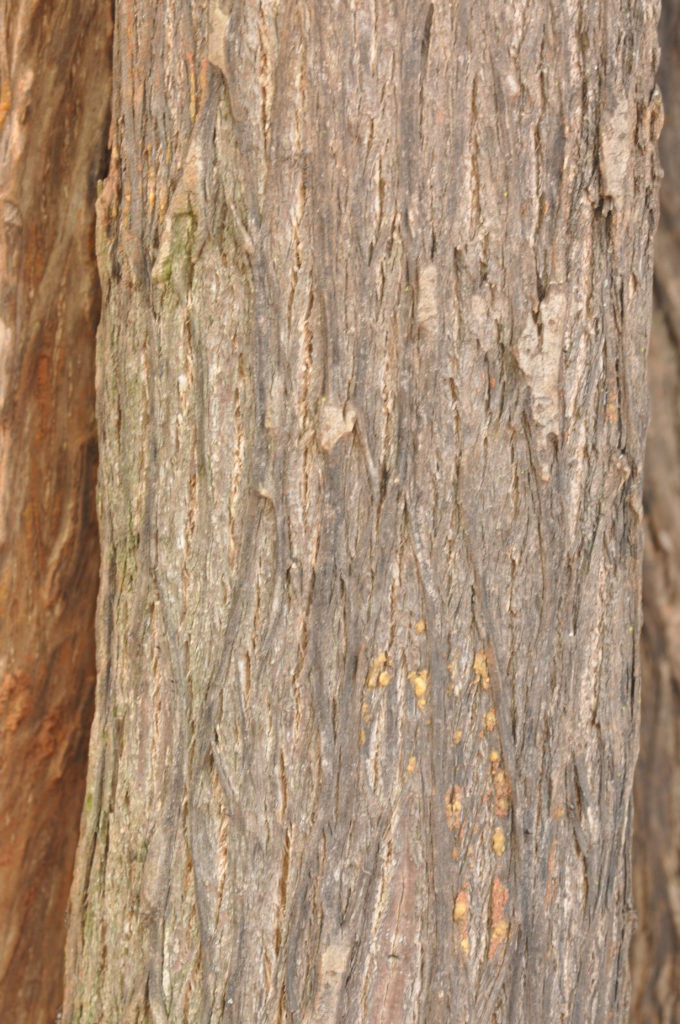
- 1048. 2016/10/18. Pretoria NBG. Photo: David Becking.
-
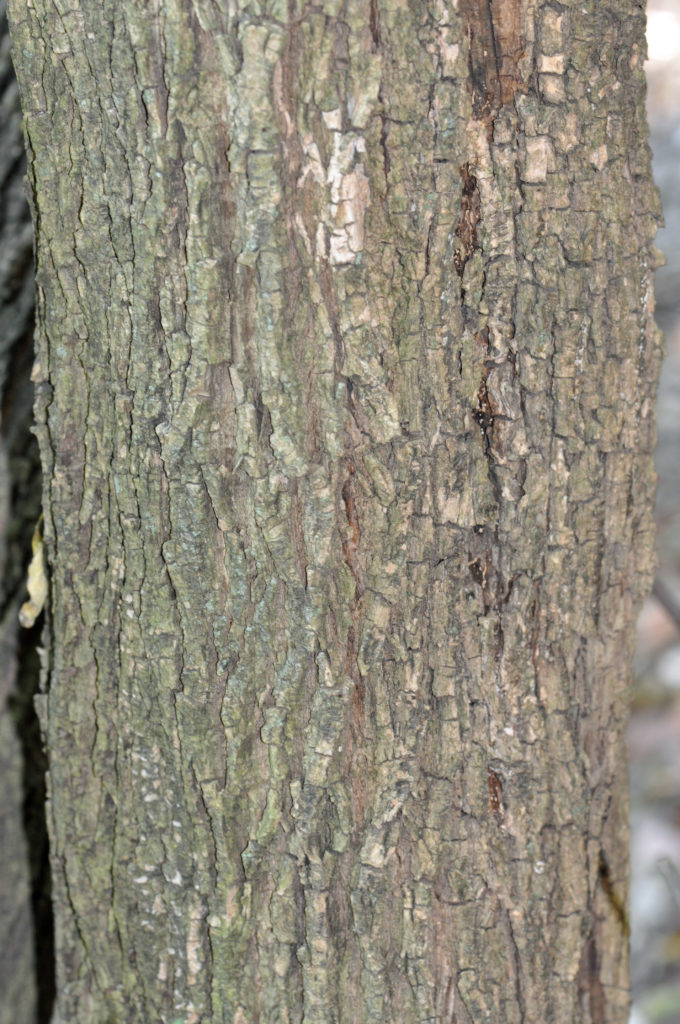
- 340. 2015/10/13. Walter Sisulu NBG. Photo: David Becking.
-
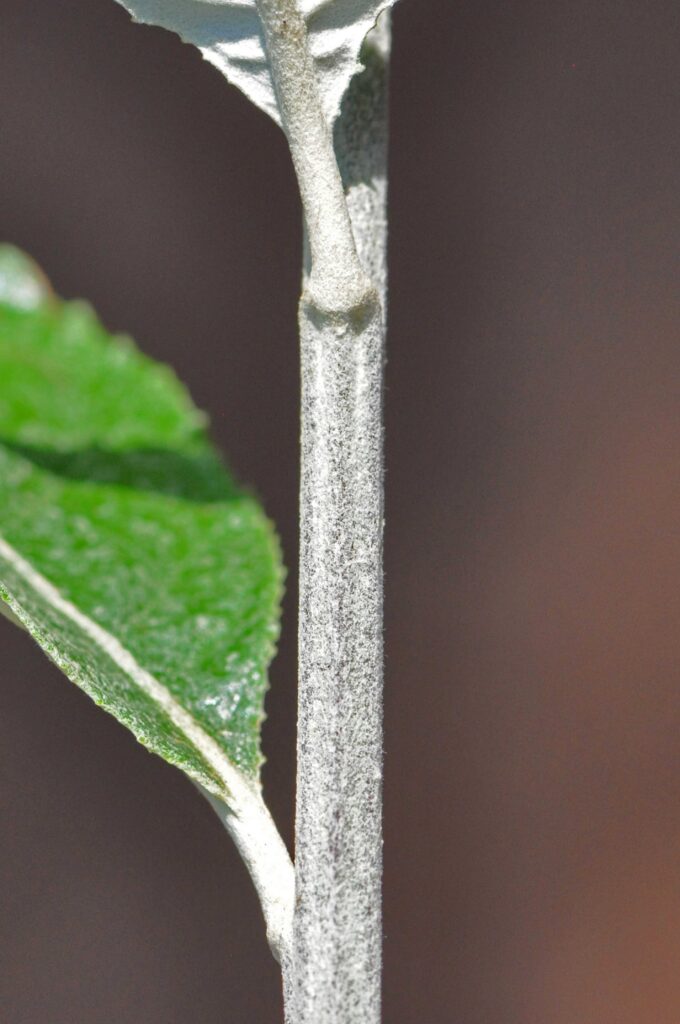
- 904. 2018/03/01. Pretoria NBG. Photo: David Becking.
-
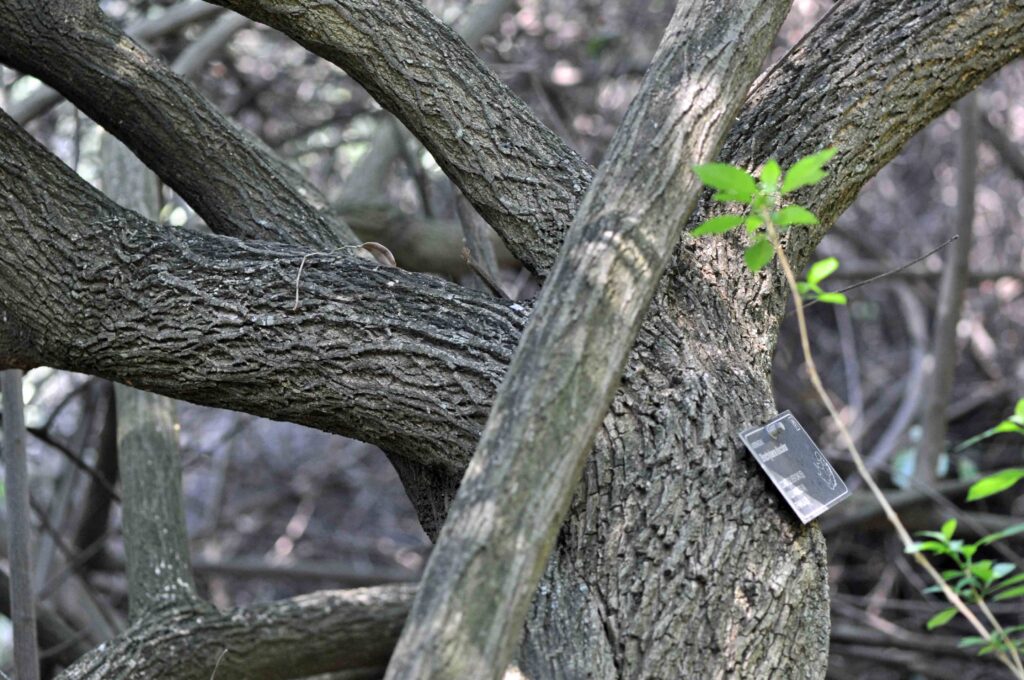
- 347. 2015/10/13. Walter Sisulu NBG. Photo: David Becking.
Leaves
On this evergreen or semi deciduous tree, the simple, alternate or spirally arranged Leaves are usually up to 12 x 6cm (photo 342). Leaves are variable in shape from oblong to lanceolate or elliptic to obovate even oblanceolate (the reverse of lanceolate, the leaf is broader at the apical third than at the middle and tapers towards the base) and occasionally oblong-elliptic. The thinly leathery Blade is discolorous (having upper and lower surfaces of leaves different colours). It is shiny dark green and hairless above (photo 342) and white/silvery with dense velvety hairs below – hence the species name discolor (photo 342). These discolorous leaves are distinctive and individual trees are recognisable from a distance – especially when the wind is blowing (photo 360 under Tree). The Midrib and lateral Veins protrude below (photo 344) and are sunken above (photo 342). The lateral veins often form a V-shape before they reach the margin (photo 344). The Margin may be wavy, almost entire (with a smooth edge and no teeth or notches), or obscurely to irregularly toothed in older leaves, especially closer to the apex (photo 342). The Apex tapers to a point (photo 342) or is almost rounded. The Base tapers narrowly. Here the tapering is slightly decurrent (partly wraps or has wings around the stem or petiole) here slightly down the hairy Petiole (leaf stalk) that is up to 2cm long – photo 344). Stipules (basal appendages of the petiole) are absent (photo 342).
-
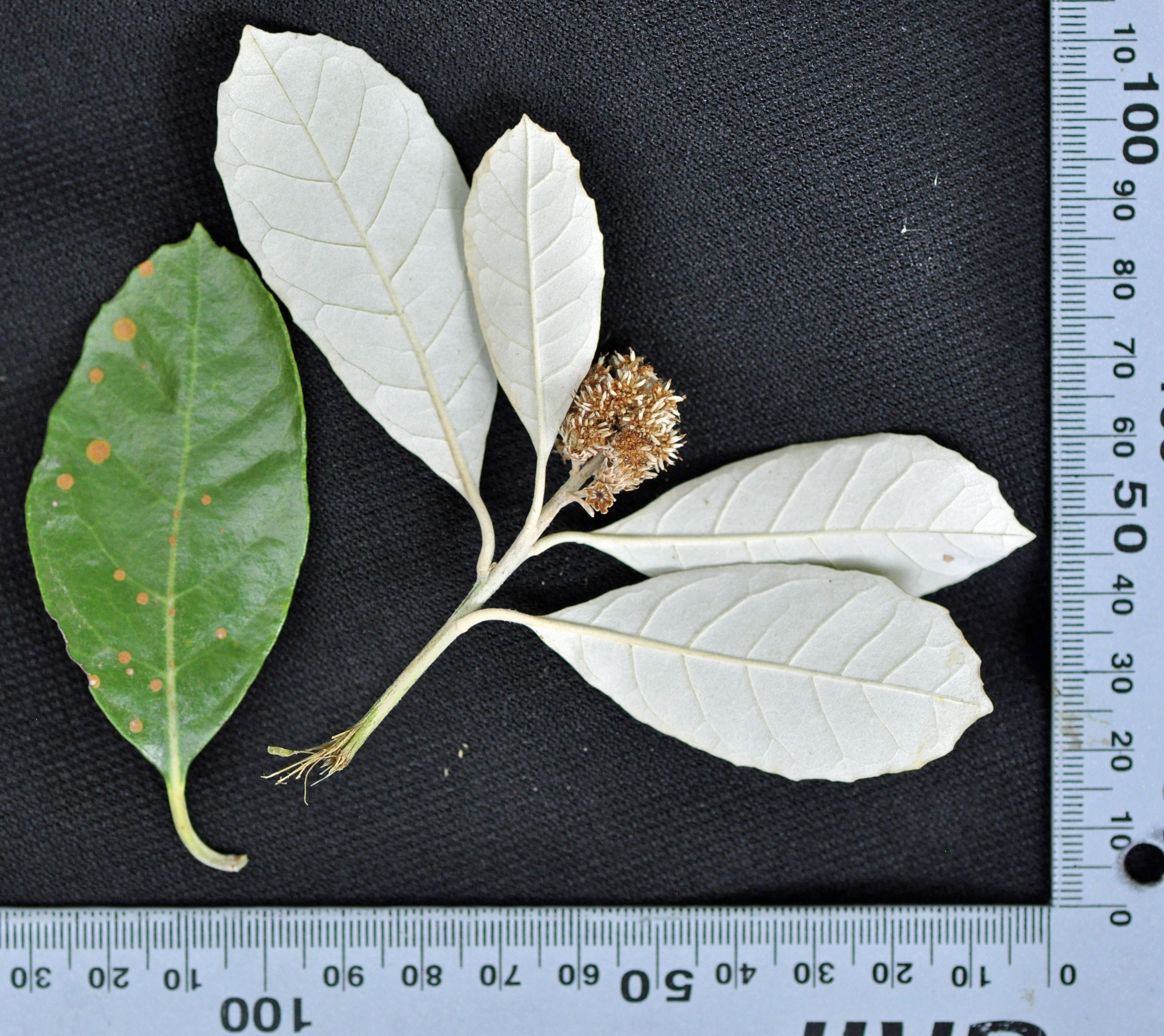
- 342. 2015/10/13. Walter Sisulu NBG. Photo: David Becking.
-
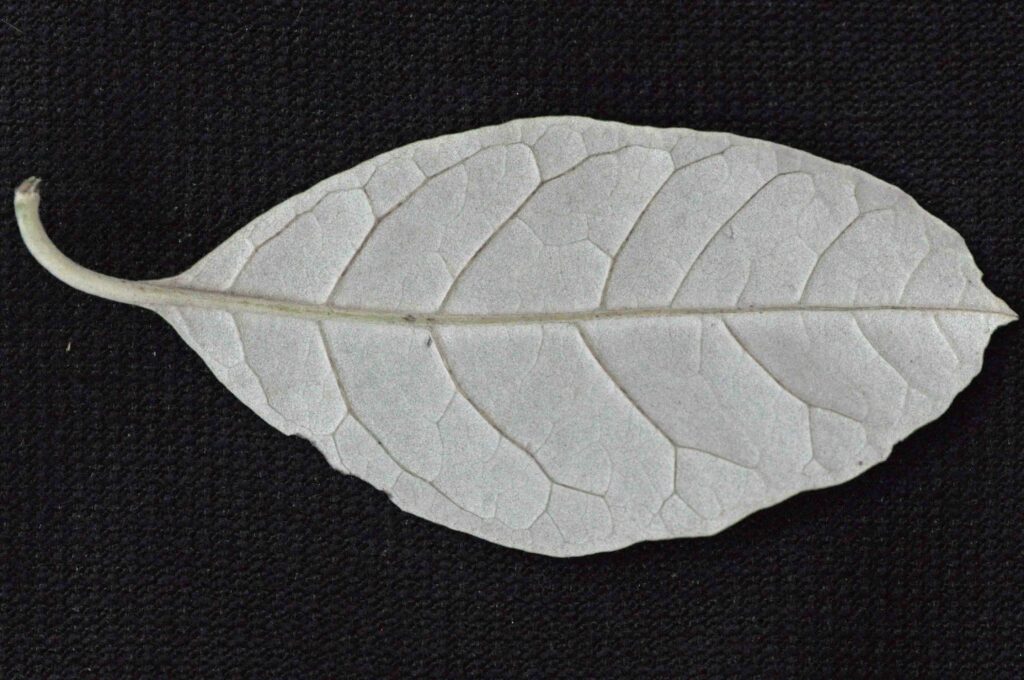
- 344. 2015/10/13. Walter Sisulu NBG. Photo: David Becking.
Flowers/florets
In this tree, each inflorescence is a small Capitulum (a flower head containing a dense cluster of up to 50 small Florets (flowers). Each capitulum (photo 345) is about 11mm long with a distinct Pedicel (stalk of a single floret) up to 5mm long. In photo 367, each capitulum is supported by a short visible Peduncle (stalk of flower cluster). Here the Involucre (whorls of visible green bracts) on each single capitulum is also visible. The Male flowers are round to cup-shaped and in Female flowers, they are funnel or cup shaped at the base. The capitula collectively form in a Panicle (an indeterminately, branched inflorescence – photo 367M) that is up to 40cm long.
These trees are Dioecious (having male and female parts on separate plants) and the very small Florets are thus unisexual. Here the Sepals are replaced by a Pappus (modified Calyx) that is bristle-like. When completely open these somewhat resemble a shaving brush (photo 367). The Corolla has a dull tube ending with 5 tiny recurved, light yellow petal lobes (photo 366). In each Male floret, the 5 Stamens are attached to the style and surround the Stigma. The Anthers are introrse (the line of dehiscence, faces towards the flower centre). The male involucre is relatively large, and round to cup-shaped. Here individual florets / flowers (photo 366) are up to 15 x 8mm and the Ovary is abortive. In the Female capitulum (photo 366), the creamy white 5 lobed, recurved petals of florets are visible. From the centre of each floret, the short exserted Style has 2 lobed branches that are flat to ovate-lanceolate (photo 366). Staminodes (sterile stamens) may be present. The inferior Ovary has a single ovule. (Jul- Sep).
-
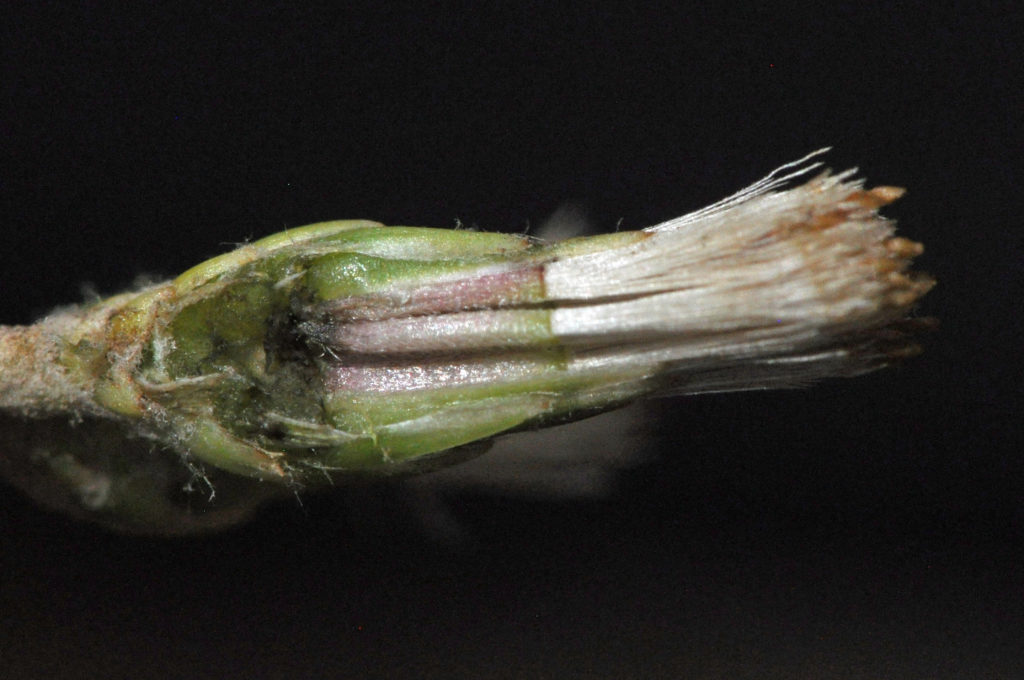
- 108. 2017.09.19. Pretoria NBG. Photo: David Becking. Dissected..
-
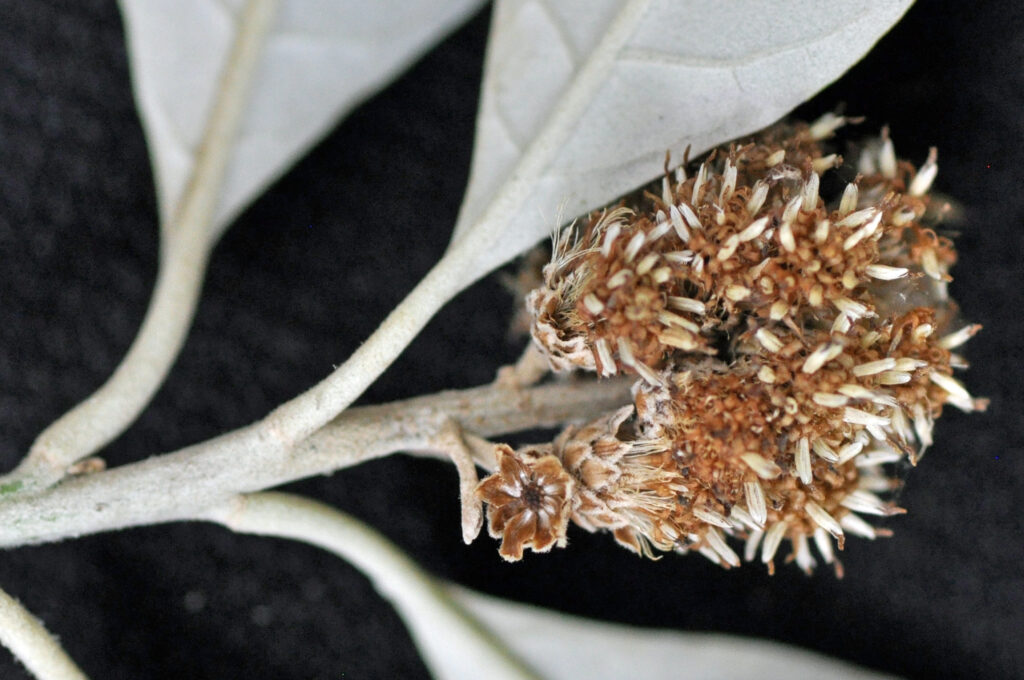
- 152. 2016/10/25. Pretoria NBG. Photo: David Becking.
-
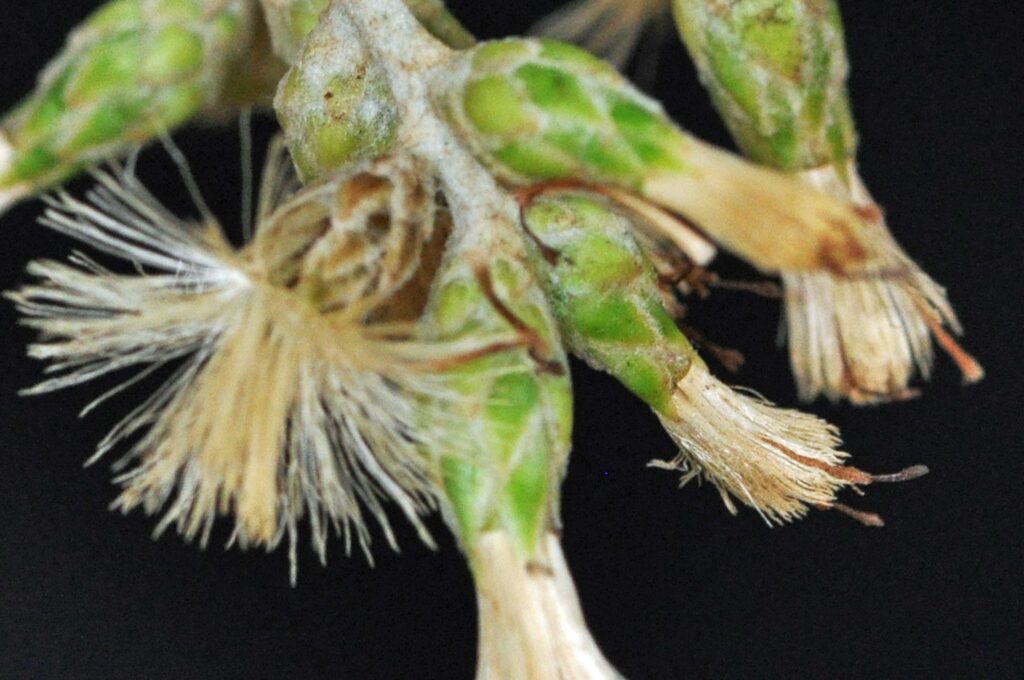
- 367M. 2017/08/03. Pretoria NBG. Photo: David Becking.
-
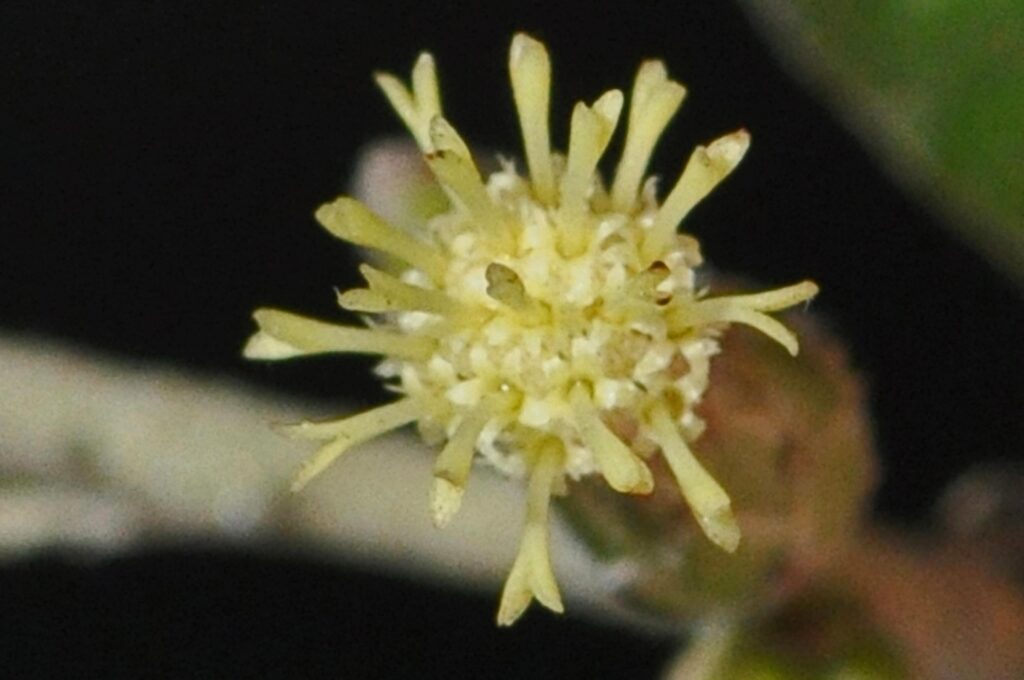
- 366. 2017/08/03. Pretoria NBG. Photo: David Becking.
Fruit
Each capitulum has numerous male or female florets. In photo 152 the capitulum has opened revealing many ripening female florets. The date-like brownish to purplish Fruit is a Cypsela (a dry single-seeded fruit formed from a double ovary of which only one develops into a seed. Here the seed is up to 8mm long (photo 152). It has an apical Pappus (modified outer perianth series of Asteraceae). The pappus has a tuft of rough creamy bristles (photo 152). These bristles enable the seeds to be wind dispersed (photo 152). The tiny brown Seeds lack endosperm (starch and oil containing tissue). (Aug-Nov).
Distribution & Ecology
This drought resistant plant is common in coastal forest, riverine forests and dune bush e.g. near Port Alfred – Southwest of East London). It is also found at the edges of mangroves and northwards along the north-eastern coast of South Africa. Trees are Located in the Eastern Cape, KwaZulu-Natal, and marginally in Mpumalanga. They also occur up to the Lebombo Mountains in Limpopo, in southern Mozambique, Swaziland and Zimbabwe. It is thus a Southern African Endemic (restricted to a particular geographic location). On the dunes, it exists mainly as a shrub. Trees are absent in Namibia. Flowers, which may cover much of the tree, are rich in nectar. This attracts both insect, including bees and flies, as well as birds. Duiker, Bushbuck and Nyala may eat the Leaves. The trees may survive for 30 or more years. The leaves have anti-microbial properties.
Ethnobotany
The yellow, strong, very hard and durable Wood has a relatively low density and is used as floats for fishing nets. Other uses include making fishing spears, fence posts, boat building, hoe, pick and axe handles, hut building and for fuel. Zulu girls use the wood for constructing string bows. Here a gourd is used as a sounding box. The wood ashes are used as an alkali for soap making. The wood is suitable for carving. People and animals consume the vitamin C rich fruit. Young stems are used to make winnowing basket rims (Winnowing – separation – usually by wind) of more dense seed grain from their outer covering. This is a good Honey tree. Propagation is from cuttings and seeds. The plant grows easily and quickly from seeds and makes a good hedge plant and windbreak – especially in coastal areas. If fruit is wanted, both male and female plants are required. Using cuttings from both male and female plants is the best way to achieve this. This plant has non-invasive roots. Together with Mimusops caffra (coast red milkwood), these trees are planted for dune afforestation. The bitter tasting leaves are seldom grazed.
References
Boon, R. 2010. Pooley’s Trees of eastern South Africa. Flora and Fauna Publications Trust, Durban.
Burrows, J.E., Burrows, S.M., Lotter, M.C. & Schmidt, E. 2018. Trees and Shrubs Mozambique. Publishing Print Matters (Pty) Ltd. Noordhoek, Cape Town.
Coates Palgrave, M. 2002. Keith Coates Palgrave Trees of Southern Africa, edn 3. Struik, Cape Town.
Lawrence, G. H. M, 1951. Taxonomy of Vascular Plants. The Macmillan Company, New York. Tenth Printing 1965.
Palmer, E. & Pitman, N. 1972. Trees of southern Africa. Balkema, Amsterdam, Cape Town.
Schmidt, S. Lotter, M. & McCleland, W. 2002. Trees and Shrubs of Mpumalanga and the Kruger National Park. Jacana, Johannesburg.
van Wyk, B. & van Wyk, P. 1997 Field guide to Trees of Southern Africa, Struik, Cape Town.
von Staden, L. 2018. Brachylaena discolor DC. National Assessment: Red List of South African Plants version 2024.1. Accessed on 2026/08/18.
http://www.plantzafrica.com/plantab/brachylaendiscol.htm
https://en.wikipedia.org/wiki/Brachylaena_discolor
Berchemia discolor | Plants of the World Online | Kew Science
http://kumbulanursery.co.za/plants/brachylaena-discolour
http://apps.kew.org/efloras/namedetail.do?taxon=4688&nameid=11353
http://posa.sanbi.org/flora/browse.php?src=SP


I don’t know why but when I searched phyllogieton discolor this page came up and this page is abous Brachylaena discolor not P.discolor. The page is mislabled phyllogeiton discolor.
Greetings Bilaal
Thank you for your comment. However plant renaming has taken place. Your comment has had my plant taken off the web name list.
Regards
David Becking.