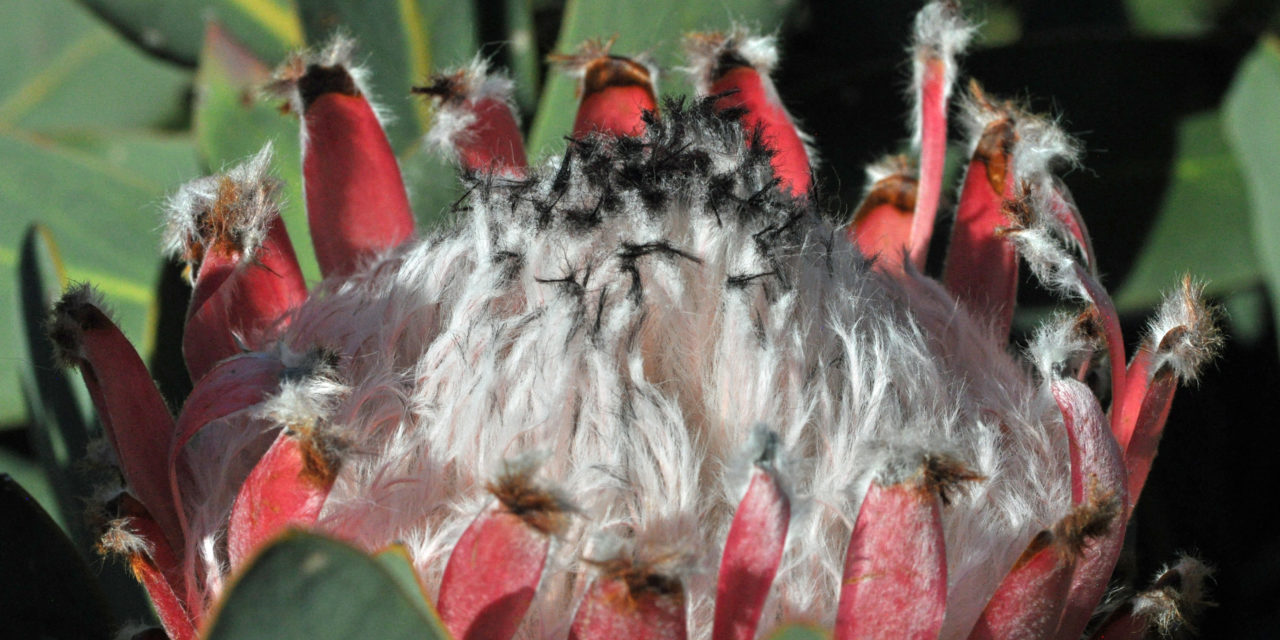
Protea magnifica
General Info – summary
This Tree may reach 3,5m high but is usually a shrub. Entire, leathery Leaves with indistinct petioles are simple and have a prominent midrib. The capitulum with many thin Flowers is broad & up to 20cm wide. Two types of bracts surround the capitulum – the inner bearded bracts with white hairs & the shorter outer bracts. Fruit is a hairy achene, and the single relatively large Seed is only released after the plant dies.
Description
Previous Names: Protea barbigera.
SA Tree No. 86.1
Common names: (Afr) Baardprotea, Baardsuikerbos, Braadsuikerkan, Koninginprotea, Suikerbosprotea, Wolbaardsuikerbos, Wolbaard-suikerbos. (Eng) Bearded protea, Bearded Sugarbush, Laurel-leaved Protea, Queen Protea, Queen Sugarbush, Woolly Beard.
Family: Proteaceae (Protea family). Members of this family occur mainly in the southern hemisphere. Universal characteristics are few. All are woody trees or shrubs. Anthers are basifixed and the superior Ovary is sessile. Flowers are contained in a compound inflorescence and 4 Tepals are present. There are about 80 genera and at least 1 600 species including the Australian Macadamia. (South Africa has now become one of the biggest producers of Macadamia nuts). In South Africa, there are 16 genera and 300 species. 6 genera (examples on this website) have species that are trees. These are Brabejum, Faurea, Leucadendron, Leucospermum, Mimetes and Protea. Currently the genus Protea has the most species. Protea gaguedi is the only species found in Namibia. The South African Protea flowers all have a superior Ovary containing a single ovule. The Stigma is a tiny groove resting on the top of the pollen presenter. The Style is long and thin. The silky appearance of the wood is due to the presence of medullary rays (are pith rays used for the radial conduction of water, minerals and organic substances). Leaves are Sclerophyllous (type of drought resisting vegetation adapted to prevent water loss with hard, leathery, evergreen leaves that that develop on narrowly spaces nodes). This family has similar Leaves to the Glossopteridales whose fossil leaf remains resemble the modern protea. These fossils were prevalent more than 200 million years ago. This was a time before the breakup of the super continent – Gondwanaland – due to continental drift.
The genus Faurea, together with the Protea, use xylose (a monosaccharide which has 5 carbon atoms not 6 as in glucose) as the main sugar in their nectar. This is unusual.
Name derivation: Protea – after the Greek sea god Proteus, who like these plants, had a variable appearance. magnifica – bearded: referring to the fringe of hairs on the floral bracts. There are in excess of 60 species of the genus Protea in South Africa.
Conservation: National Status: L C (Least concern). Assessed: Raimondo et al. (2009). The population trend is stable.
Tree
This plant is usually a low shrub up to 2m high and 4m wide. A sturdy main stem may develop into a Tree up to 3,5m high. Fires may reduce this height. The Bark is grey to dark brown and smooth. As they mature, the young branches lose their hair.
Leaves
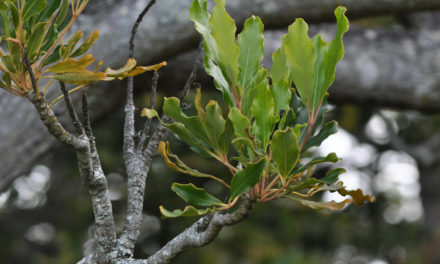
The variable oblong, oval to widely oblanceolate (the reverse of lanceolate, the leaf is broader at the apical third than at the middle) and tapers towards the base Leaves are hairy when young and become heavily leathery and simple (have a single blade, which may have incisions that are not deep enough to divide the leaf into leaflets). The blue-green to grey-green leaves (photo 267) are variable in size – up to 21 x 6cm. Leaves have an asymmetric base (not equal to the opposite sides). When young, leaves are outlined and covered with silky hairs. Maturing leaves become hairless. Both the leaf Apex and Base taper.
The base may also be decurrent (leaf blade that partly wrap or have wings around the stem or petiole – photo 271). The Petiole (leaf stalk) is thus indistinct, whereas the yellowish Midrib is prominent (photo 271). The wavy and thickened Margin is entire (with a continuous margin is not in any way indented) and Cartilaginous (relating to or resembling cartilage). When young leaves are covered with, and outlined with, silky hairs. In mature leaves the margin is yellowish or reddish (photo 267) and slightly hairy. Both the distinctive midrib and lateral veins are slightly visible on both surfaces. The veins details are observable when the leaf is viewed against a strong light (photo 268).
-
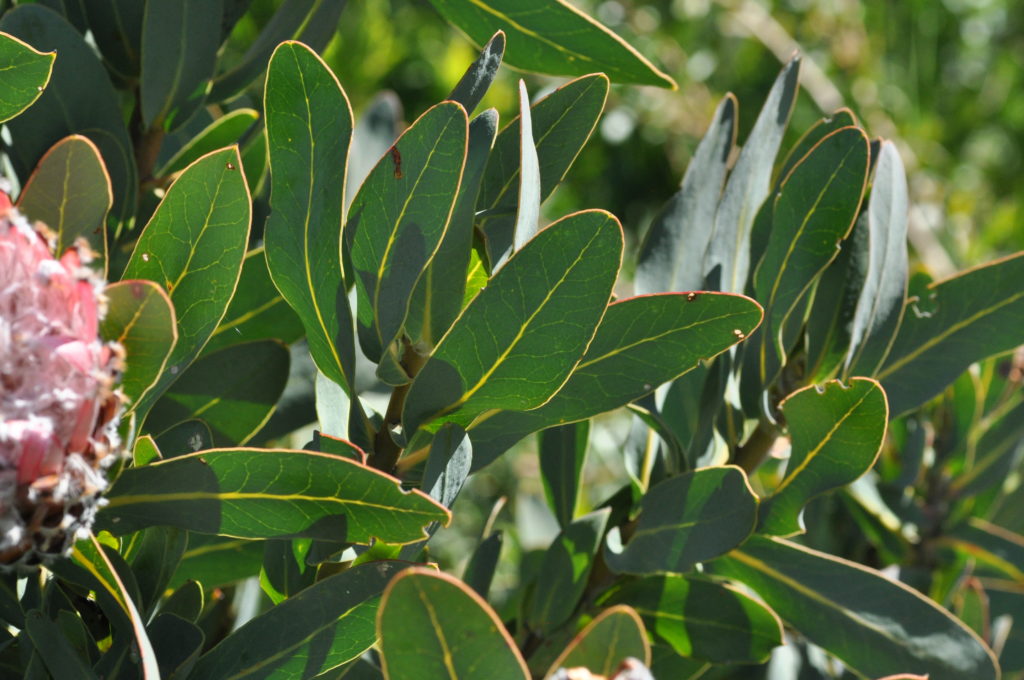
- 267. 2018/09/11. Kirstenbosch NBG. Photo David Becking.
-
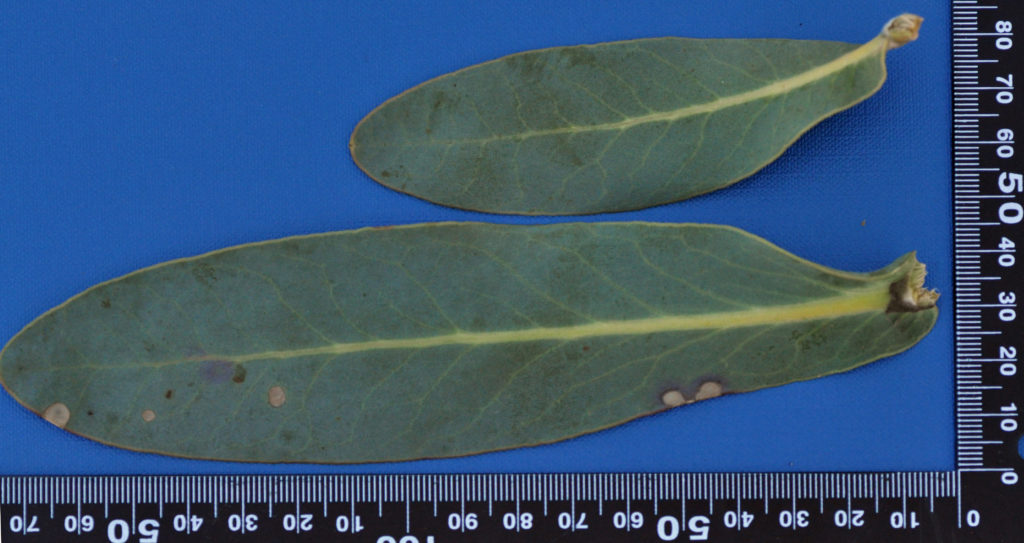
- 271. 2018/09/11. Kirstenbosch NBG. Photo David Becking.
-
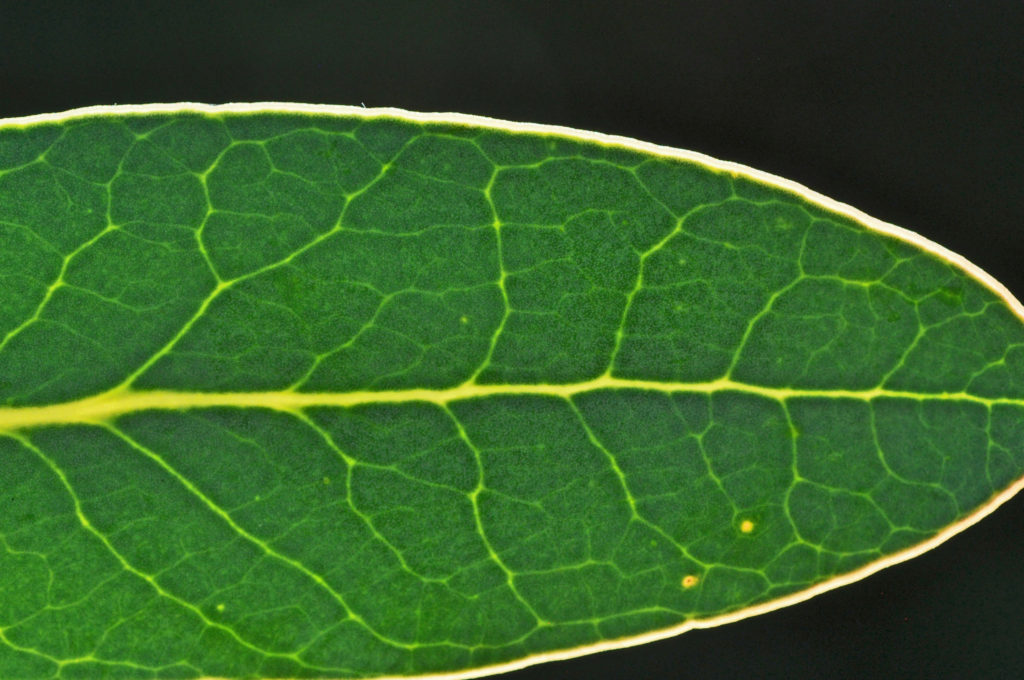
- 268. 2018/09/11. Kirstenbosch NBG. Photo David Becking. Leaf + sun.
Flowers
The bud is long, slender and tapering. In this protea, what may appear as a single flower (photo 259) is in fact a broad Flowerhead containing many flowers. Heavy flowering stems are initially provided with long soft but not matted hairs. These hairs are soon lost. The single, attractive, cup-shaped and large open flowerhead is contained in a capitulum (dense inflorescence having a large collection of usually sessile flowers at the end of the stem). This capitulum is up to 15+cm in diameter and length. It is second only to Protea cynaroides (the king protea) in size. Each capitulum has hair or bristle-like Bracts (appendages forming the surrounding cone). These bracts are usually pink (photo 260) but may be cream or yellow and are covered with attractive silky hairs. The outer bracts may be green tipped with brown, pink or reddish. The inner bracts extend above and beyond the outer bracts and may be as long as the flowers. They are broad and rounded at the end with bearded tips containing white, brown or black hairs (photo 260). These bracts emerge from a brown to black bract apex. They surround the central mass of small, soft and woolly individual flowers. Each individual flower is bisexual and zygomorphic (floral parts are unequal in size or form so that the flower is capable of division into essentially symmetrical halves by only one longitudinal plane passing through the axis). Each yellow to pinkish single Flower is very narrow and up to 6cm long. It has a Perianth (a collective term for the calyx and corolla) of 4 Tepals (one of the parts of the perianth when these parts cannot easily be divided into calyx and corolla). Three of these are fused, face the centre and forms a distinct sheath while the fourth one is completely separated.
Protea Flowers usually open from the outside towards the centre of the inflorescence. The almost sessile, oblong elliptic Anthers arise from the apex of the perianth. The sessile superior Ovary contains a single ovule and resembles an inverted cone with long, straight hairs covering it. The flowers are Protandrous (male parts develop before female). The tip of the up to 7cm long Style (photo 259En) is modified into a structure called a Pollen-presenter (close to 1cm long). The Stigma has stigmatic grooves, which are closed before anthesis (the period during which a flower is fully open and functional. During this time, the anthers release pollen that settles into the pollen-presenters. After anthesis, which often happens when pollinators disturb the flowers and cause the stigmatic grooves to open, they will receive pollen from the pollinators. This helps to ensures cross-pollination. Birds are important pollinators of protea flowers, but experiments reveal pollination still occurs in Protea magnifica in the absence of birds. Here insects also play an important part. Further tests may (or not) show weather this is true for all Proteas. (Flowering varies between Winter to Spring).
-
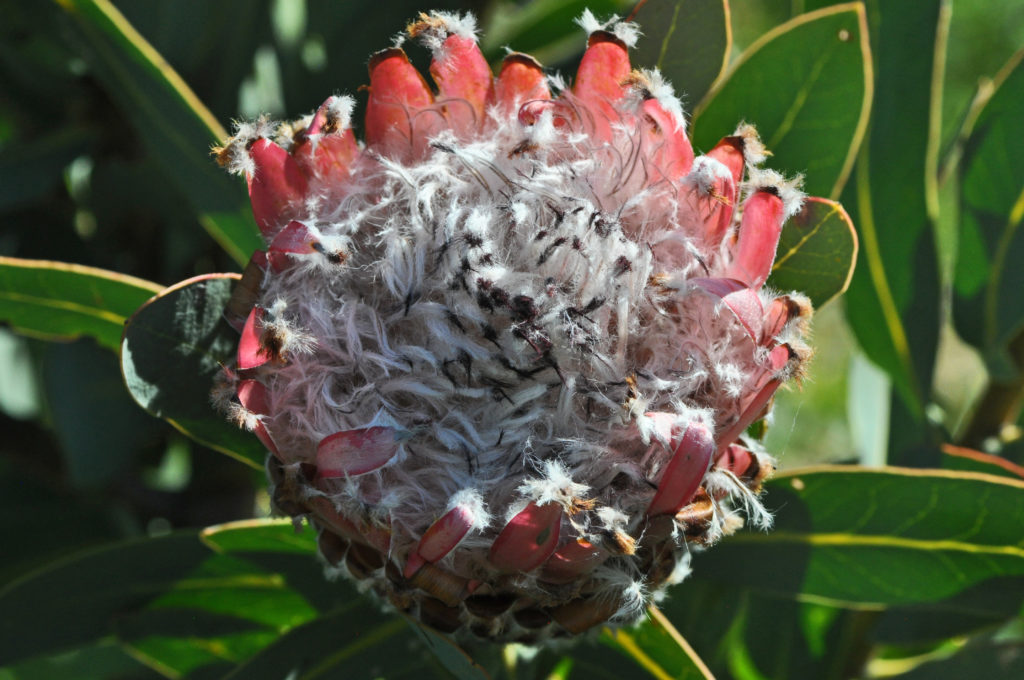
- 259. 2018/09/11. Kirstenbosch NBG. Photo David Becking.
-
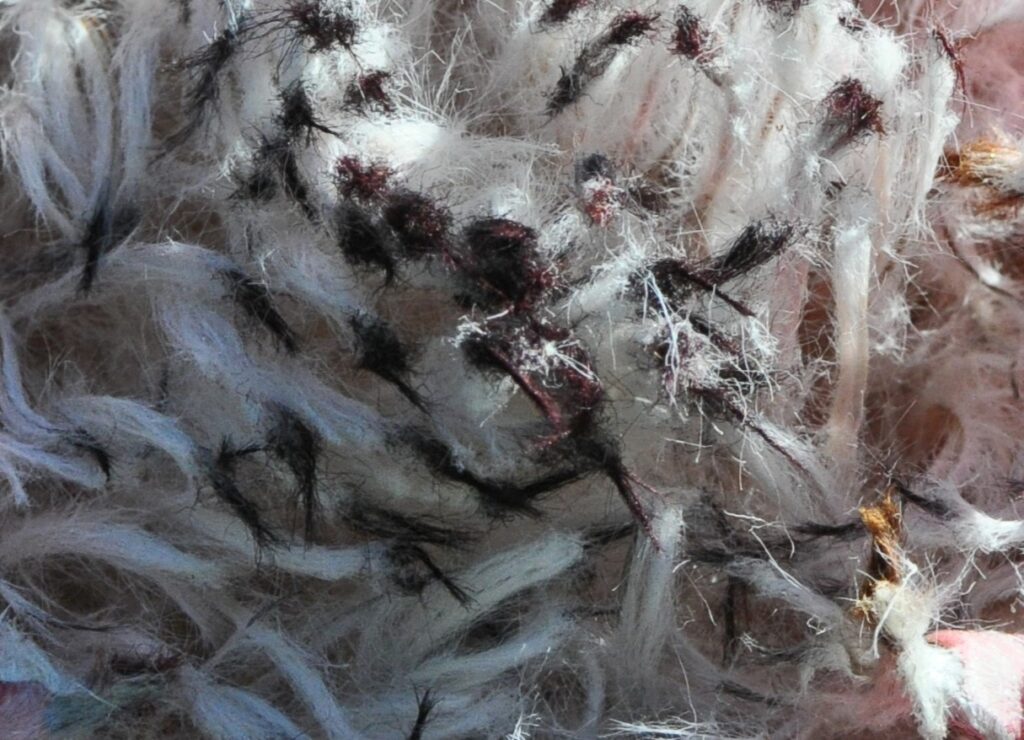
- 259En. 2018/09/11. Kirstenbosch NBG. Photo David Becking.
-
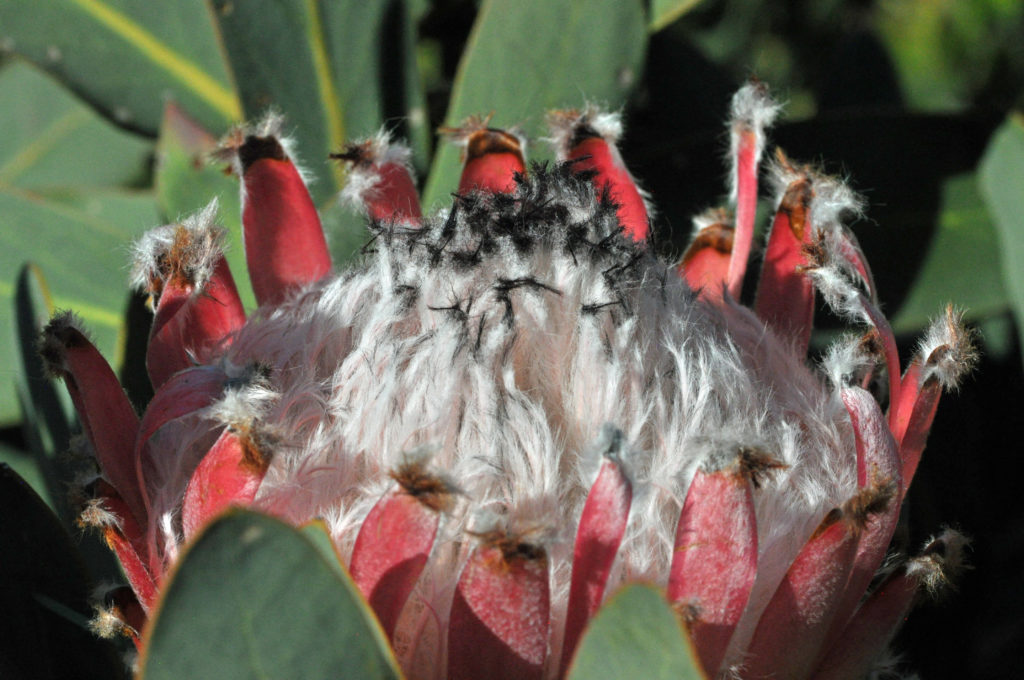
- 260. 2018/09/11. Kirstenbosch NBG. Photo David Becking.
Fruit
The Fruit is a densely hairy Achene (fruit containing the seed. The fruit is simple, dried and formed from 1 carpel. The seed-like appearance is due to the hardening of the fruit wall (pericarp), which encloses the solitary seed and only appears like a seed coat. The wind dispersed Seeds are larger than usual for proteas and are not dispersed until the plant dies – thus helping survival e.g., after a fire.
Distribution & Ecology
This slow growing, winter-rainfall protea is Endemic in South Africa – specifically the south Western Cape. (Endemism is the ecological state of a species being unique to a defined geographic location). It is found on rocky high mountains round Hottentots Holland (about 50km east of Cape Town) to the mountains round the Clanwilliam district – about 200km north of Cape Town. Snow often covers the plants. The acidic Soil in this area is nutrient deficient, well drained and derived from sandstone (usually) or quartzite. The medium to high altitude range is 1 200 – 2 700m. Here they form part of the mountain Fynbos (is a belt of natural shrubland or heathland in the winter rainfall area within the distinctive vegetation of the Western Cape. Plants in fynbos are often subjected to fires). They tolerate hot, dry summers and cold winters with snow and can survive temperatures as low as – 8 degrees C. In nature these plants survive best in rocky areas where drainage is good, and they are somewhat protected from fires. Habitat degradation and overharvesting is causing the slow plant decline.
Ethnobotany
There is an international demand for these cut flowers and hybrids are available. They should be Planted in full sun and not disturbed once established. Do not add fertilizers or manure. Seedlings take 5+ years to flower and are susceptible to fungal attack. Adult plants may survive for 30 years.
References
Coates Palgrave, M. 2002. Keith Coates Palgrave Trees of Southern Africa, edn 3. Struik, Cape Town.
Palmer, E. & Pitman, N. 1972. Trees of southern Africa. Balkema, Amsterdam, Cape Town.
Rebelo, A.G., Mtshali, H. & von Staden, L. 2019. Protea magnifica Link. National Assessment: Red List of South African Plants version . Accessed on 2025/09/03.
van Wyk, B. & van Wyk, P. 1997 Field guide to Trees of Southern Africa. Struik, Cape Town.
http://pza.sanbi.org/protea-magnifica
http://www.greenplanet.co.za/plant/Protea-magnifica
https://en.wikipedia.org/wiki/Pollen-presenter
https://www.proteaatlas.org.za/pollinat.htm