Peltophorum africanum
General Info – Summary
This unarmed, spreading Tree with longitudinally fissured bark is usually up to 10m high. Bipinnate, hairy Leaves have distinctive feathery stipules. Sharp tipped leaflets have entire margins and asymmetric bases. Sweet-scented, bisexual, zygomorphic, 5-merous & spectacular yellow, crinkled Flowers develop in dense terminal racemes. Fruit is an indehiscent, thinly woody, flattish and winged pod, with 1 or 2 seeds.
Description
Previous Names: Brasilettia africana
SA Tree No. 215.
Common names: (Afr) Boerboon, Boerboontjie, Dopperkehatenhout, Dopperkiaat, Huilboerboom, Huilboom, Huilbos, Huilwattel, Kajatehout, Kajatenhout, Kiaathout, Rooikiaat, Rooikiaathout, Transvaalsewattel, Wildewattel, Wilde-wattel, Witkiaat, Witkiaathout. (Eng) African Black Wattle, African Blackwood, African Wattle, African-wattle, Black Wattle, Natal Wattle, Rhodesian Black Wattle, Rhodesian Wattle, Weeping Wattle. (isiZulu) Isikhabamkhombe, Umsehle, Umthobo. (Northern Sotho) Mosehla, Mosêhla, Mosese, Motlepe. (Setswana) Mosetlha. (siSwati) Isikhabakhombe, Mphungankomo, Umkhabamkhombe. (Tshivenda) Musese. (Tsonga) Ndzedze.
Family: Fabaceae, or Leguminosae (Pea, bean or legume family). After the Orchidaceae and the Asteraceae, the Fabaceae is the third largest Angiosperm (flowering plants) family with 700+ genera and close to 20 000 species. Local Tree genera on this website include Acacia (Vauchellia, Senegalia), Albizia, Bauhinia, Bolusanthus, Burkea, Calpurnia, Colophospermum, Cordyla, Cyclopia, Dichrostachys, Erythrina, Erythrophleum, Faidherbia, Indigofera, Mundulea, Peltophorum, Philenoptera, Piliostigma, Schotia and Xanthocercis. The Fabaceae are recognisable by their fruit and by their pinnately compound Leaves. Leaves may also be simple – even bilobed and usually have stipules – some of which may be spinescent. Leaflets are usually entire. Flowers are bisexual and bracteate. Regular flowers usually have 4-5 sepals and the same number of petals. Irregular flowers have 4-5 sepals and 5 or less petals. Stamens have anthers that have 2 pollen sacs and there are usually at least twice the number of stamens as petals – often 10. The superior Ovary has 1 locule containing 1 or more ovules. The Stigma and Style are simple. The single carpel develops into the Fruit, which is usually a pod. The mature pods may dehisce or break into segments. Seeds vary.
Name derivation: Peltophorum – shield shaped – referring to the flower stigma (photo 153 – under flowers). africanum – from Africa. This is the only species of Peltophorum in South Africa. The fact that this plant lacks spines helps to distinguish it from the genera Senegalia and Vachellia.
Conservation: National Status: L C. (Least Concern). Assessment: 2011/06/06. (L. von Staden).
Tree
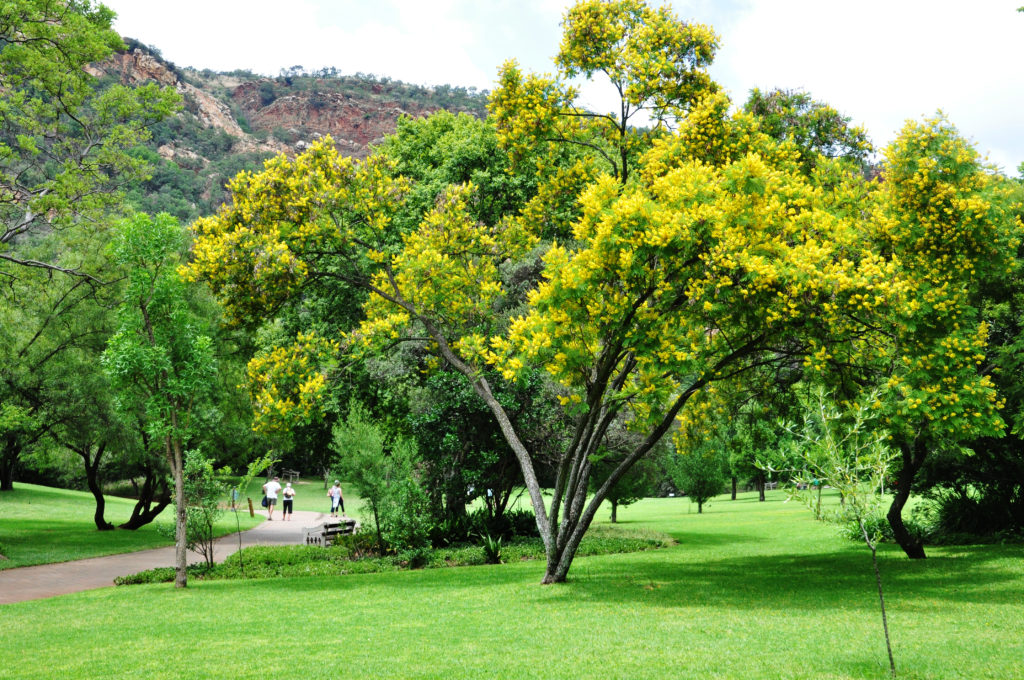
This spectacular Tree has no spines or thorns. It has a dense spreading rounded crown and is usually 5-10 but may reach 15m high. The Trunk is often multi-stemmed and may be forked (photo 301). Branches often occur near ground level (photo 693) and here they be crooked. The Bark is smooth on young branches and on the older trunk can be grey to brown, rough and longitudinal fissured (photos 640, 511 & 688). Twigs (1-year-old current branch segments) have lenticels (usually raised corky oval or elongated area on the plant that allows the uncontrolled interchange of gases with the environment – photo 946). In this photo, the rusty coloured hairs on the twig and petioles (leaf stalks), are visible.
-
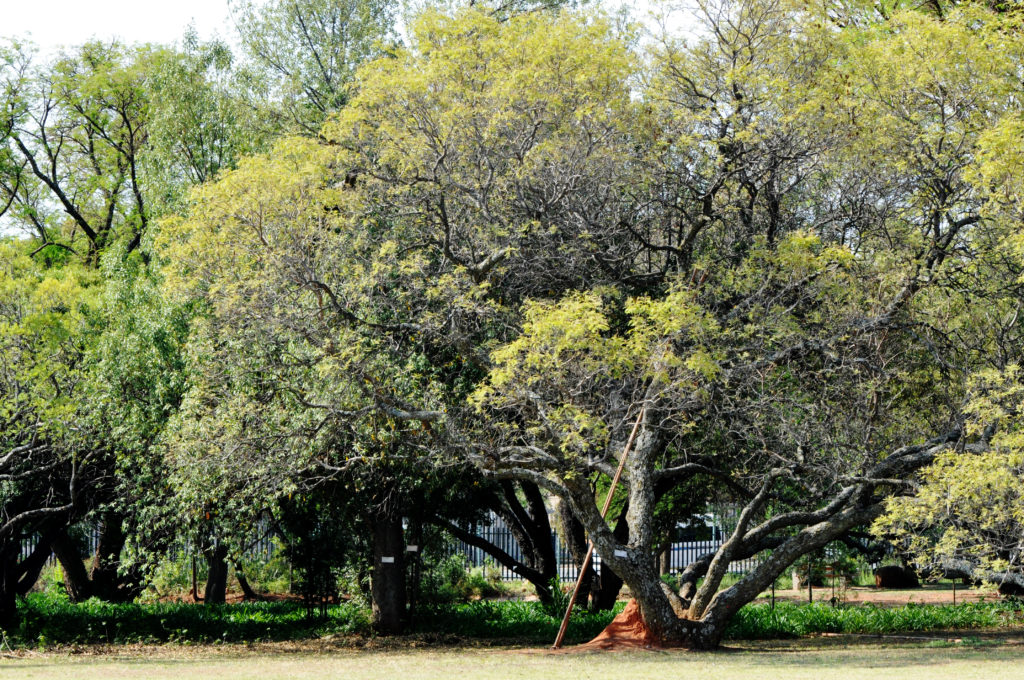
- 693. 2014/10/30. Pretoria NBG. Photo: David Becking.
-
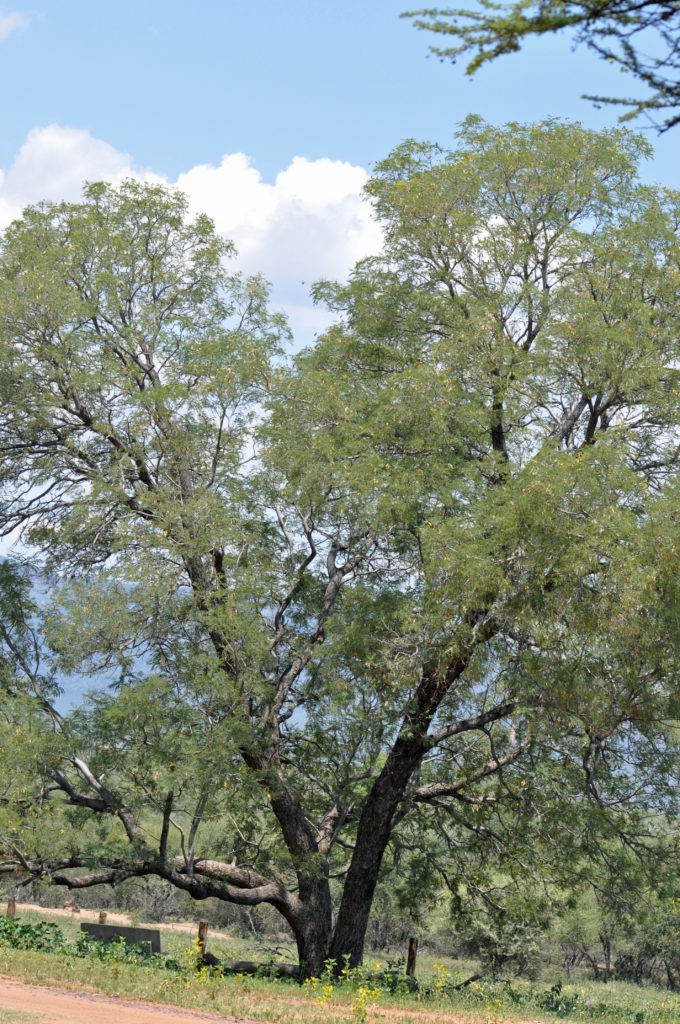
- 301. 2014/02/18. Marakele NP. Photo: David Becking.
-
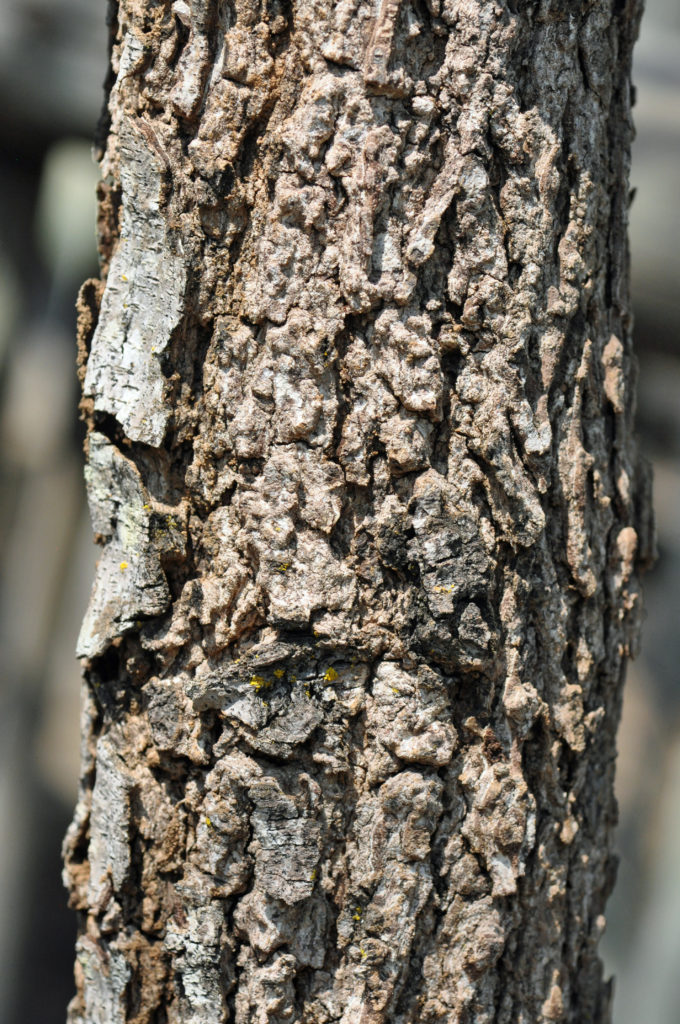
- 640. 2014/09/13. Lowveld NBG. Photo: David Becking.
-
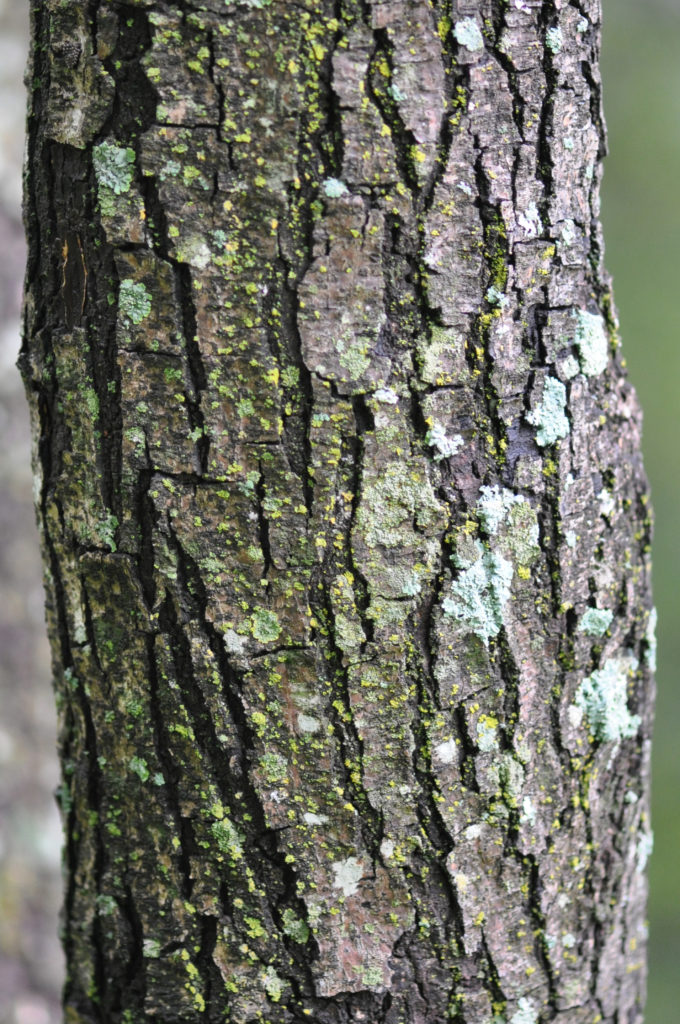
- 511. 2014/12/09. Walter Sisulu NBG. Photo: David Becking.
-
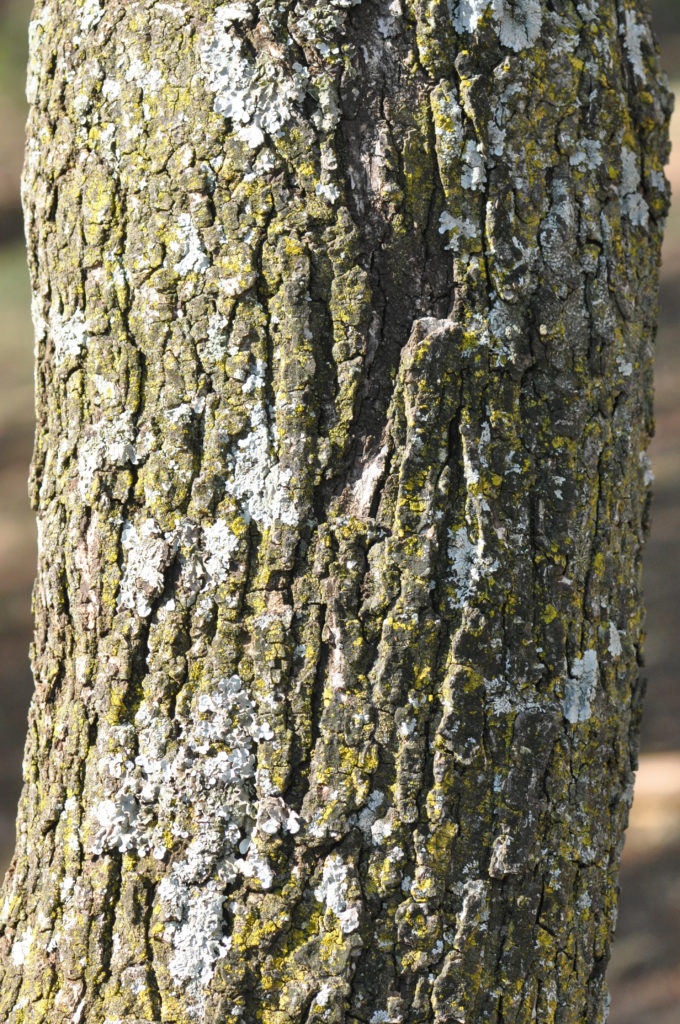
- 688. 2014/10/30. Pretoria NBG. Photo: David Becking.
-
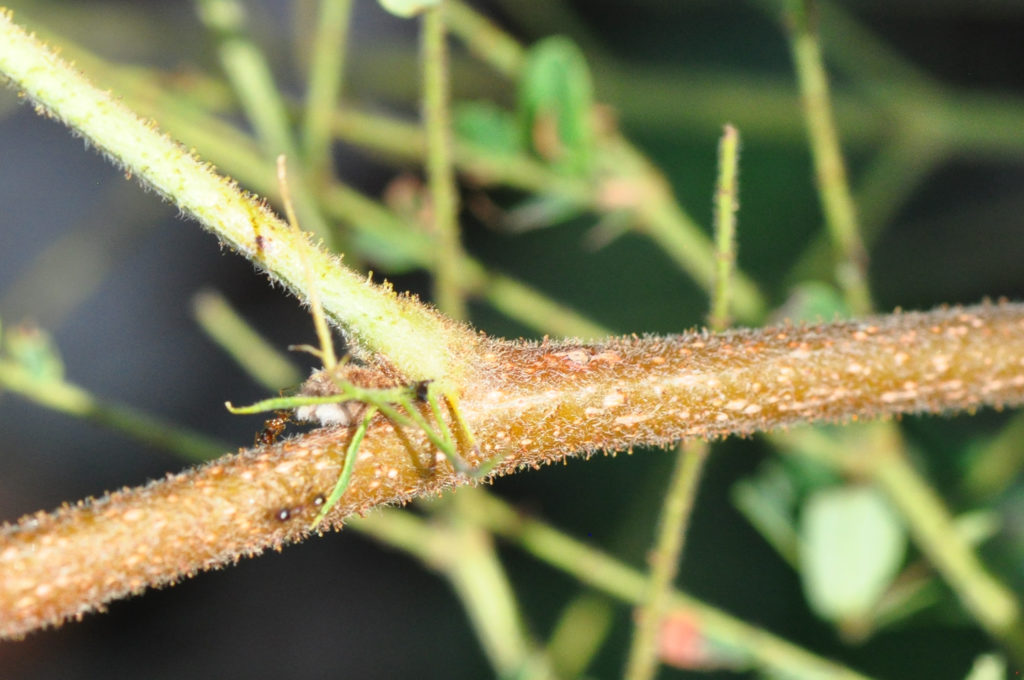
- 946. 2014/09/15. Lowveld NBG. Photo: David Becking.
Leaves
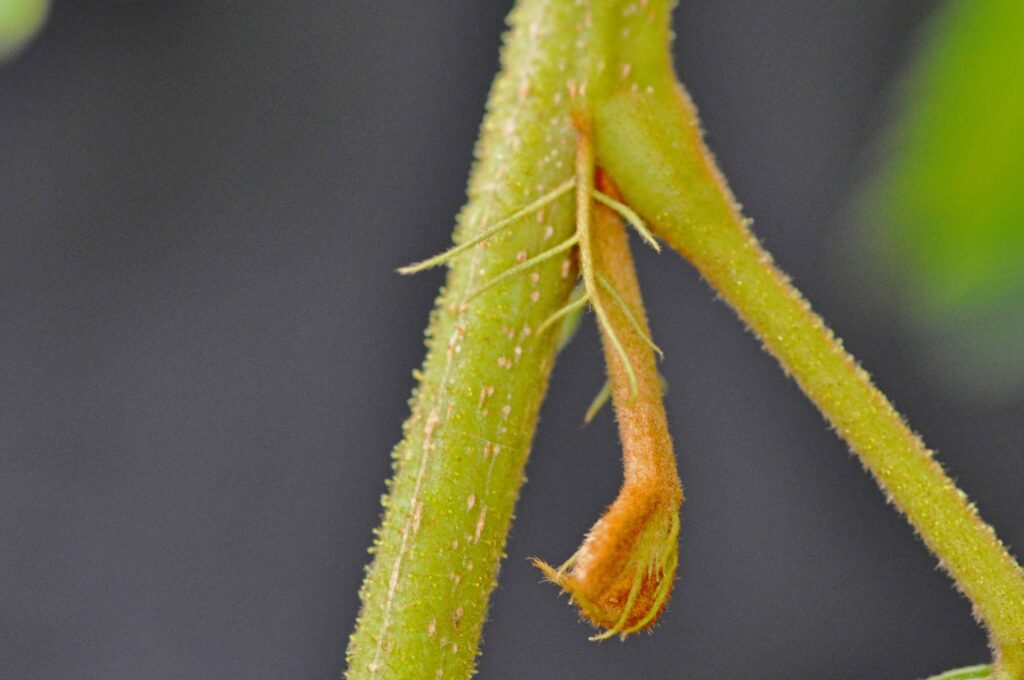
This tree is usually briefly deciduous and the feathery, silvery grey, alternative Leaves are bipinnate (compound: twice-pinnate leaves. They are similar to the feathery leaves of Vachellia (was Acacia). The Rachis (main axis of a compound structure bearing flowers in this case – not leaves) has lateral pinnae “branches” not leaflets and the pinnules “leaflets” are on these “side branches”). They are thus Bipinnate (Here the rachis – central axis, has lateral pinnae “branches” not leaflets and the pinnules “leaflets” are on these “side branches”). There are 4-9 pairs of pinna “branches” up to 9 x 3,5cm with 8 – 23 pairs of Pinnules (leaflets). Leaflets are slightly spaced apart – (photos 690 & 949). The furry Growing tip is often a rusty brown (photo 558). In this photo the young Leaflets are folded lengthwise. The usually paired leaflets are small and up to 8 x 3mm (photo 690). They are variable: oblong, slightly spaced apart and densely hairy below and less so above. Each leaflet is dull olive green above and paler green below (photos 690 & 558). The Apex is rounded with a fine distinctive pointed tip that may be rusty (photo 949). The Base is asymmetric (not equal to the opposite side – photo 949) and the Margins are entire (with a continuous margin, not indented – photo 949). The leaf Rachis is grooved on the upper surface. Rusty brown, velvety hairs envelope the Petiole (leaf stalk – photo 946 under Tree). Here the Rachis (main axis bearing the Leaflets is hairy (photo 949). Each distinctive feather shaped Stipule (basal appendages of one petiole) is small, resembles a tiny fern (photos 519 & 558). This unusual feather-shaped stipule aida identification. The stipule is caducous (an organ or part of which is easily detached and shed early).
-
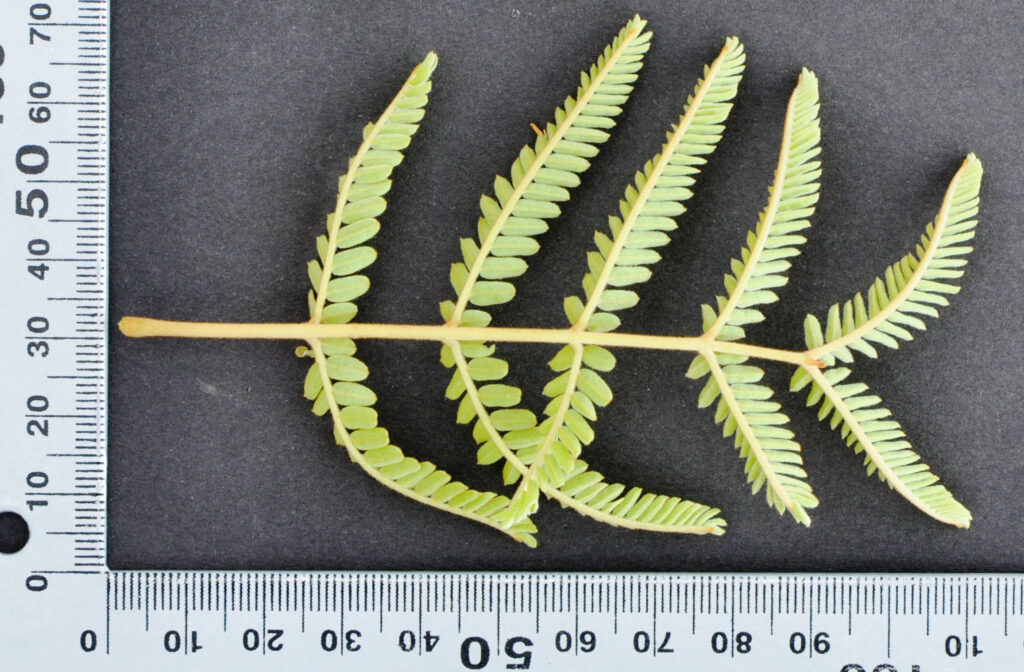
- 690. 2014/10/30. Pretoria NBG. Photo: David Becking.
-
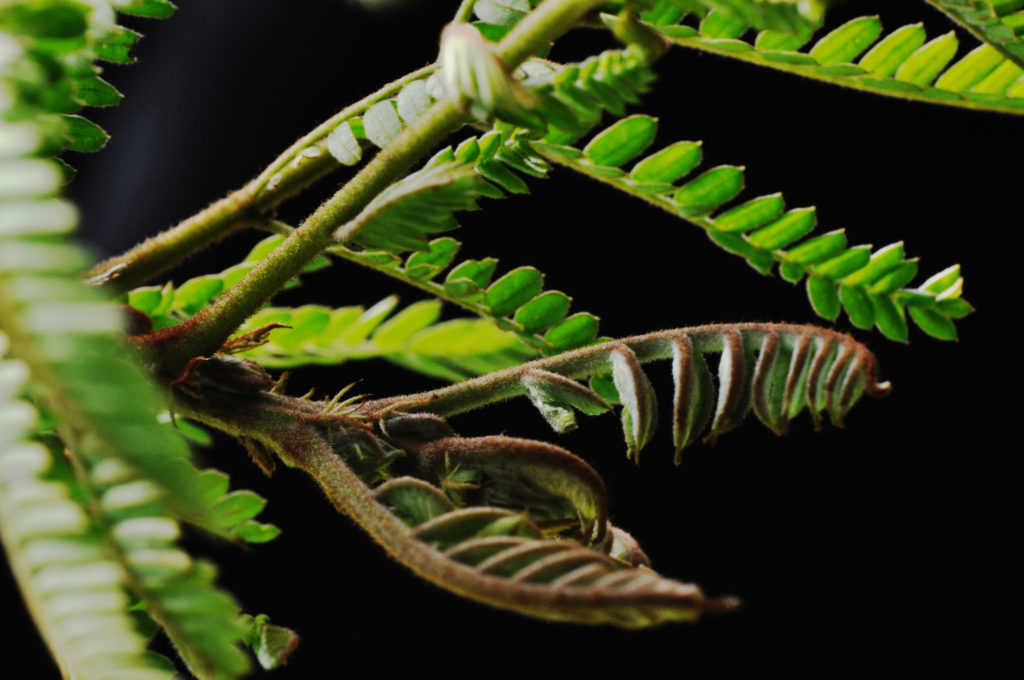
- 558. 2015/10/20. Walter Sisulu NBG. Photo: David Becking.
-
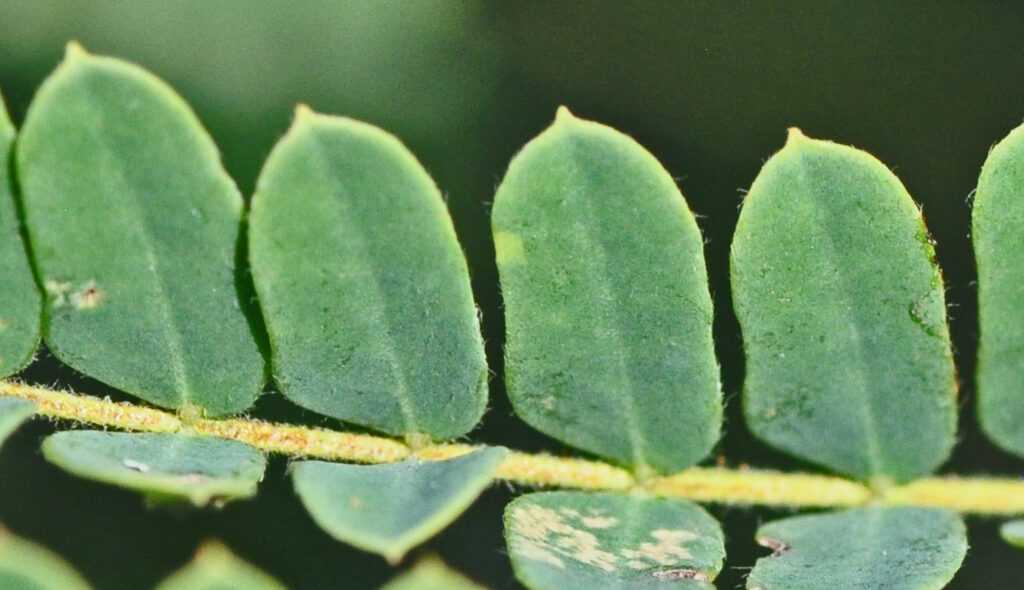
- 949. 2014/09/15. Lowveld NBG. Photo: David Becking.
-
- 519. 2014/12/09. Walter Sisulu NBG. Photo: David Becking.
Flowers
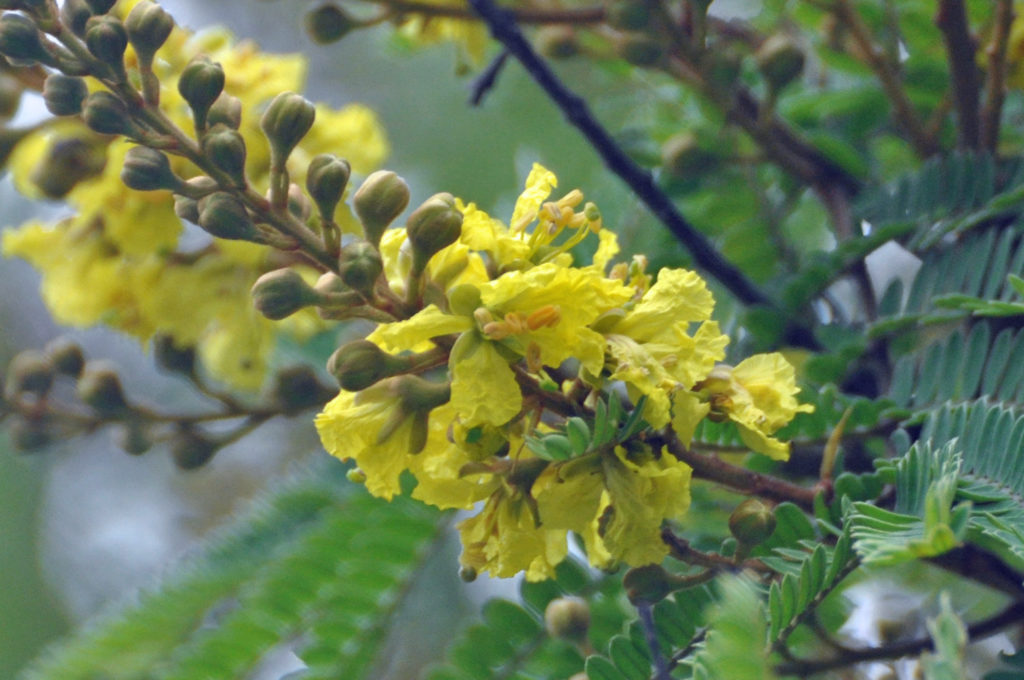
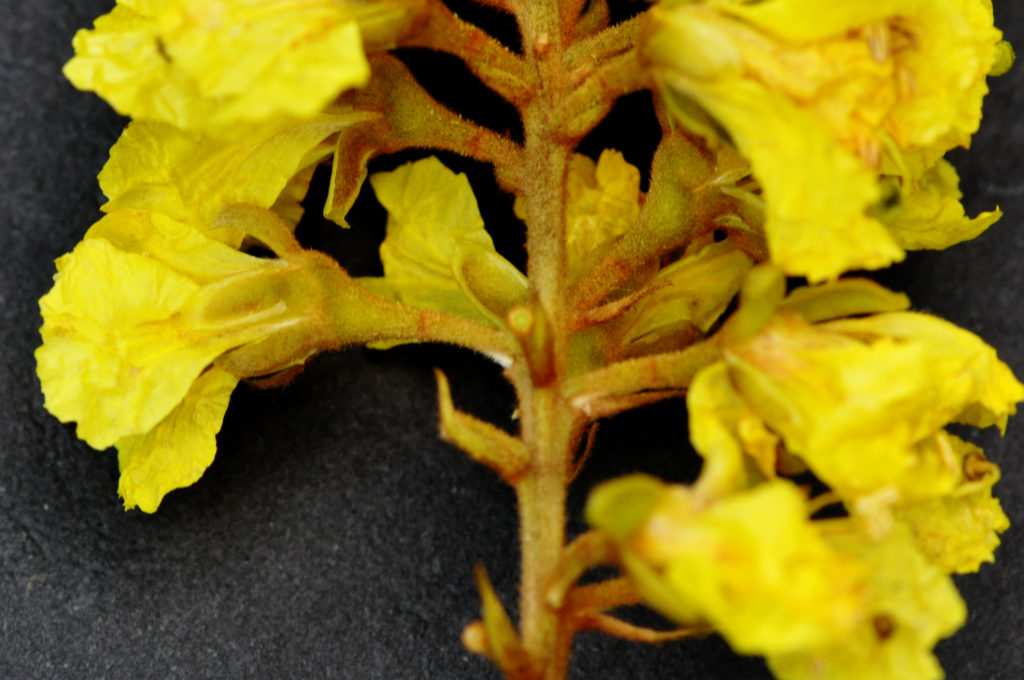
The sweet scented, impressive, bright yellow Flowers are 5-merous (with calyx, corolla and stamens in 5’s or multiples of 5 parts). Flowers often occur terminally or in dense axillary sprays up to about 22cm long. Here they are in erect terminal Racemes (a simple elongated inflorescence (photo 522) with stalked flowers (photo 632), that open in succession towards the apex – photo 522). These racemes occur in Panicles (determinate or indeterminate, much branched inflorescence with stalked flowers). Each flower is bisexual, up to 2cm wide and slightly zygomorphic (floral parts unequal in size or form so that the flower is capable of division into essentially symmetrical halves by only one longitudinal plane passing through the axis). The reddish-brown distinct Calyx (photos 632 & 148) has Sepals with brown hair at the back and has a short bell-shaped tube with 5 lobes that are longer than the tube (photo 632). The Corolla has 5 bright yellow, distinctly crinkled Petals (photo 629). These petals are all almost the same size – about 2cm in both diameter and length. Two petals are not joined to form a keel – as in the sweet-pea type flower. There are 10 free, declinate (bent downward or forward, the tips often recurved) Stamens. (photo 151). Long soft hairs cover the base of the Filaments (the usually long slender stalk that supports the pollen producing Anther – photo 151). The anthers are versatile (hung or attached near the middle usually moving freely) and open through longitudinal slits (photo 151). There is a single Pistil (a unit of the Gynoecium, the female element of the flower, composed of the Ovary, Style and Stigma). Here the superior Ovary contains 1 locule (cavity within an organ e.g. ovary, anther or fruit) usually with 2 ovules. The single Style (more or less elongated part of the pistil situated between the ovary and the stigma) ends with a broad, green, shield-shaped Stigma (green part of the pistil that receives the pollen – photo 154). Reddish-brown, velvety hairs cover the Pedicel (flower stalk) and the backs of Sepals (photo 148). Bees are probably responsible for Pollination (Sep-Feb+).
-
- 294. 2015/12/15.Walter Sisulu NBG. Photo: David Becking.
-
- 522. 2014/12/09. Walter Sisulu NBG. Photo: David Becking.
-
- 632. 2014/12/23. Walter Sisulu NBG. Photo: David Becking.
-
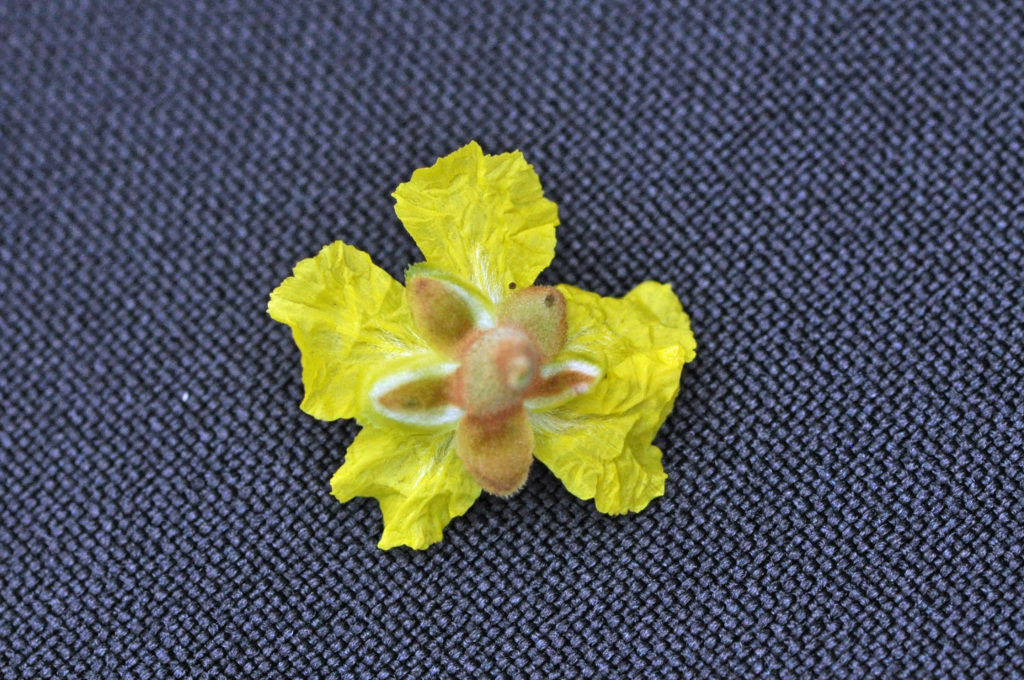
- 148. 2017/12/26. Pretoria NBG. Photo: David Becking.
-
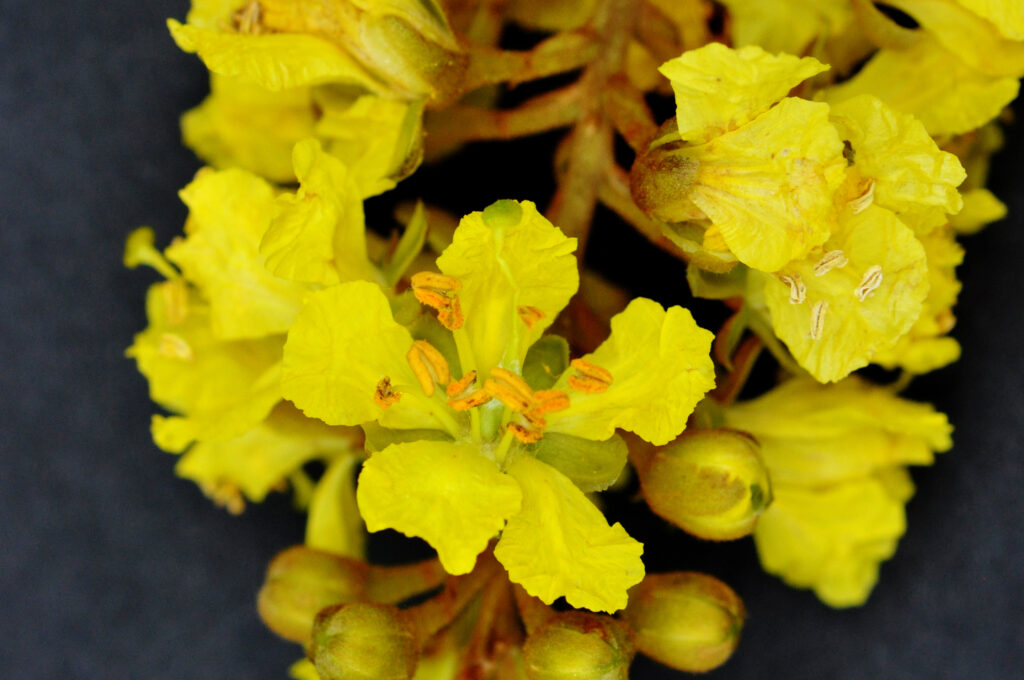
- 629. 2014/12/23. Walter Sisulu NBG. Photo: David Becking.
-
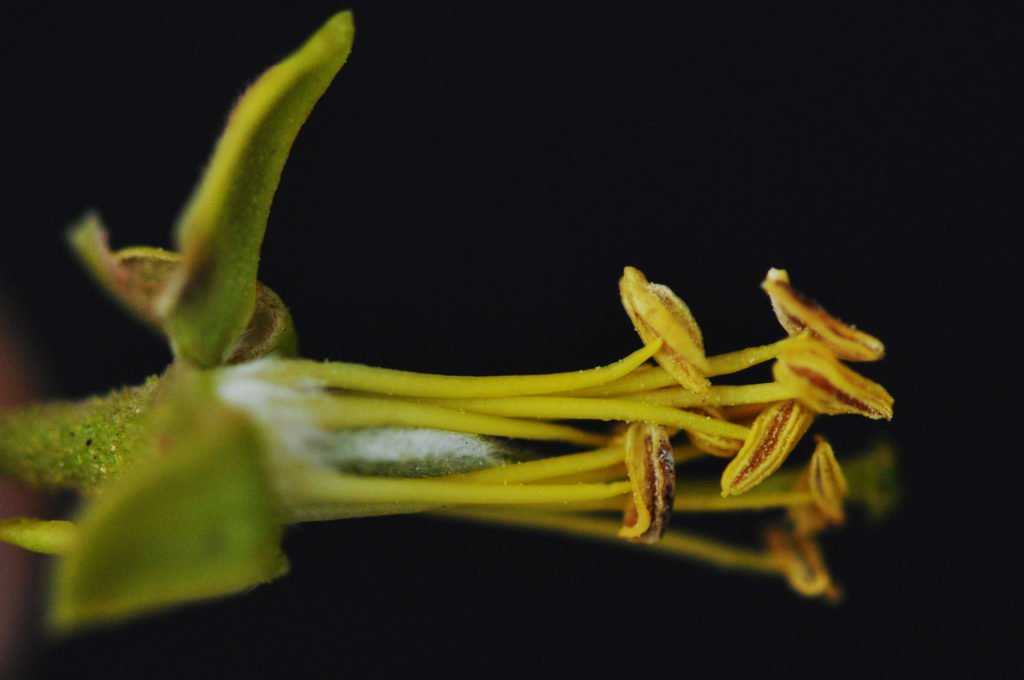
- 151. 2017/12/26. Pretoria NBG. Photo: David Becking. Dissected.
-
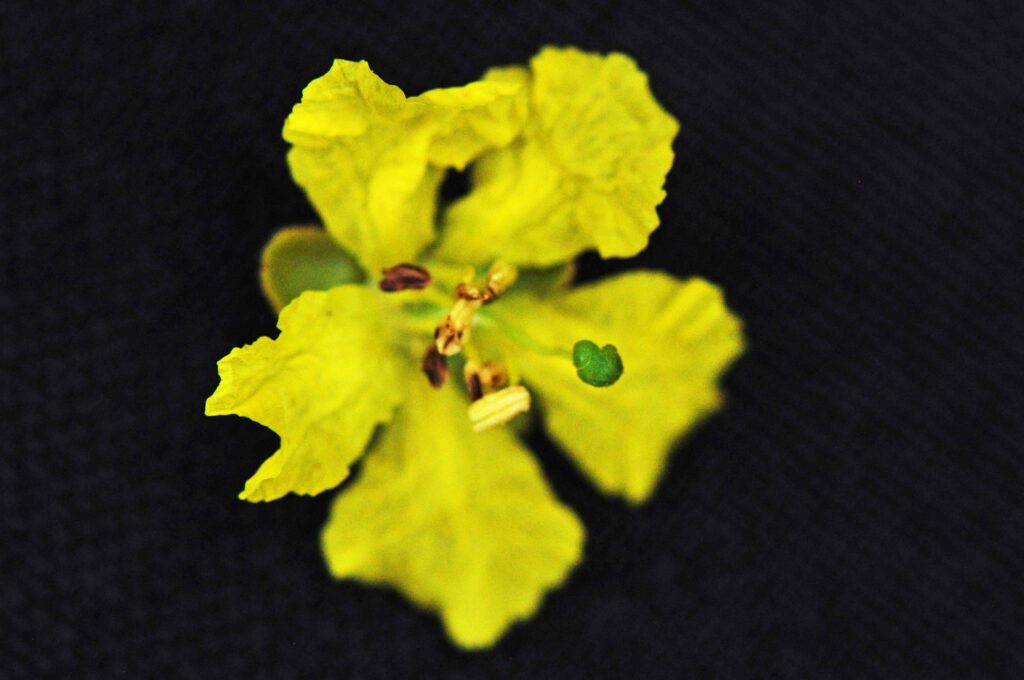
- 154. 2017/12/26. Pretoria NBG. Photo: David Becking.
Fruit
The flattish, drooping and thinly woody indehiscent Fruit is a hairy flat Pod, which is oblong to elliptic (oval in outline and widest near the middle). Many pods simply hang down in bunches. Each pod is up to about 9 x 2cm and tapers towards a point in both the apex and base. Velvety hairs cover the pod. A distinct wing may be visible along both margins. The remains of the now almost white Calyx are visible at the base of the fruit (photo 689). The pod is thinly woody, slightly leathery and green to yellowish becoming red – brown (photos 317 & 384). Seeds (photo 824) are brown and flattish, and about 11 x 7mm. Usually, 1 or 2 compressed and slightly winged seeds develop in each fruit. (Dec-Jun).
-
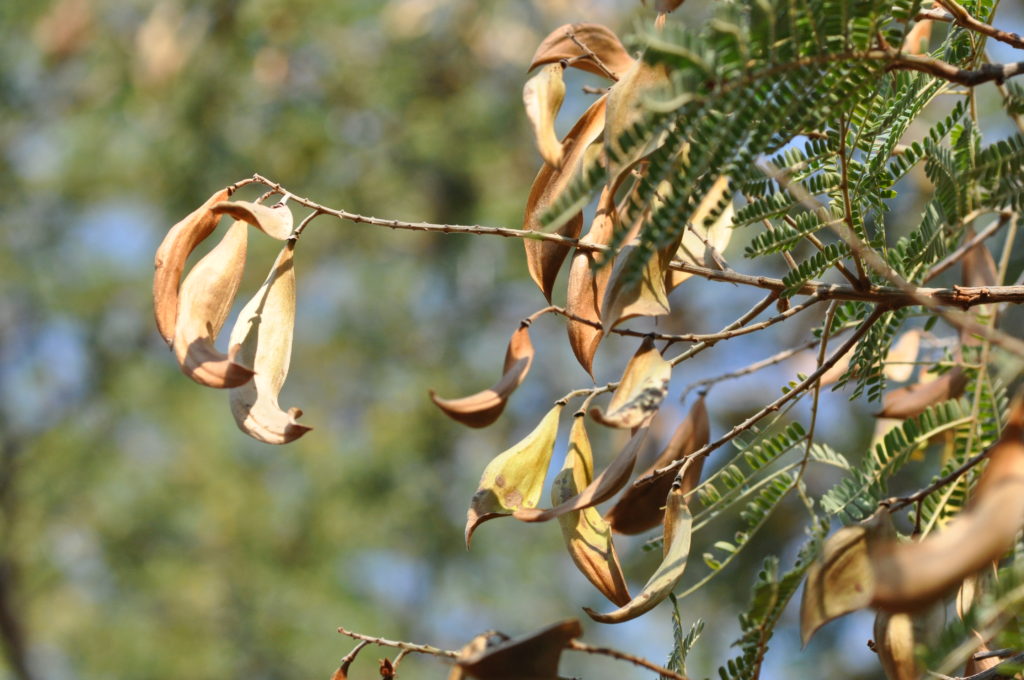
- 317. 2014/02/20. Marakele NP. Photo: David Becking.
-
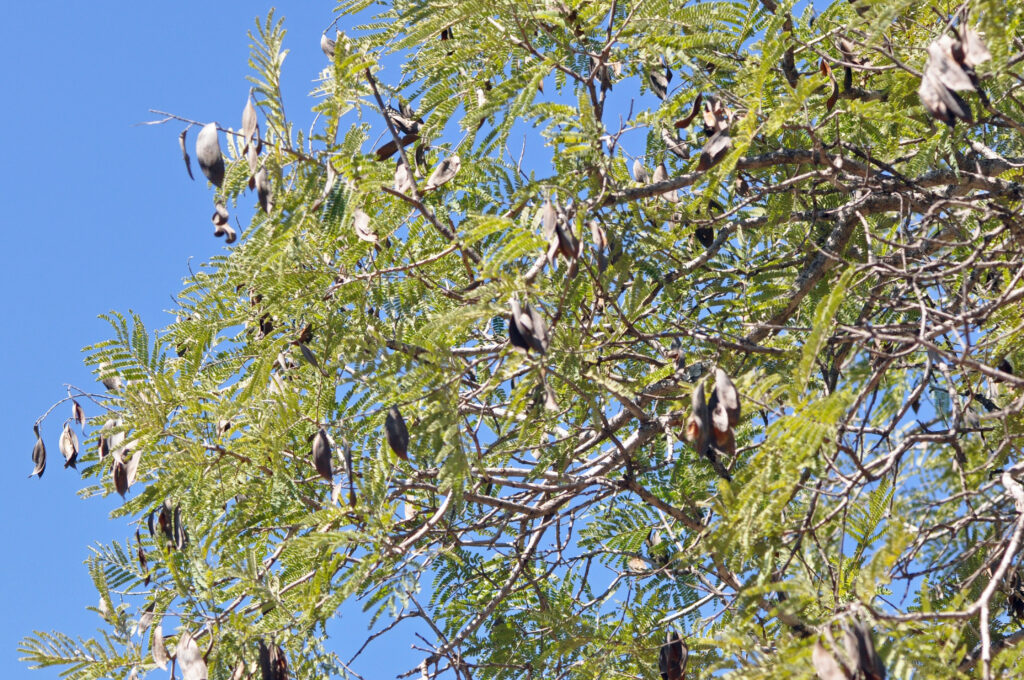
- 384. 2018/04/24. Nylesvlei Nature Reserve. Photo: David Becking.
-
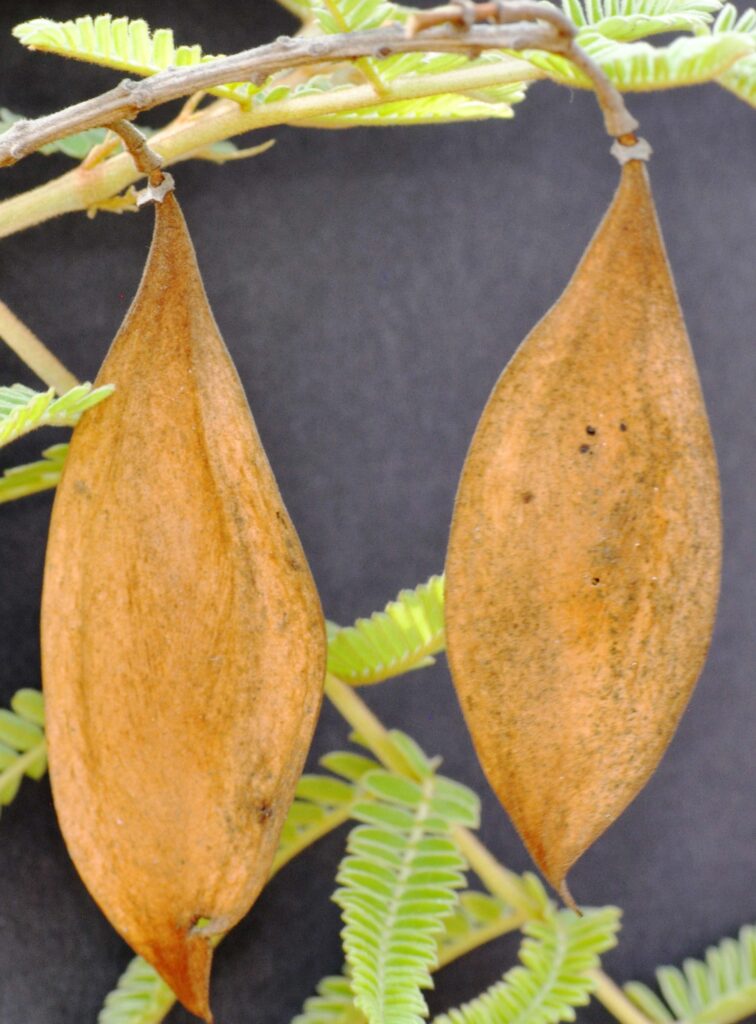
- 689. 2014/10/30. Pretoria NBG. Photo: David Becking.
-
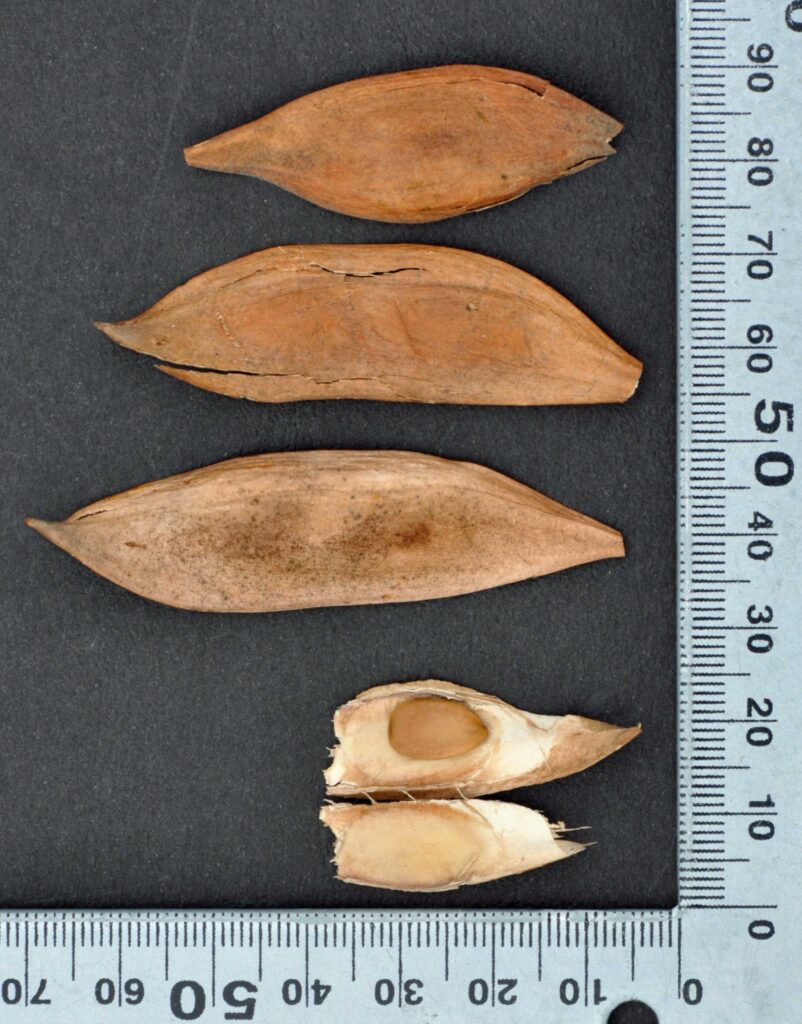
- 824. 2015/08/11. Walter Sisulu NBG. Photo: David Becking.
Distribution & Ecology
In South Africa, these Trees are located in KwaZulu-Natal, Gauteng, Mpumalanga, Limpopo and North West. Beyond South Africa, they occur in Botswana, Namibia, Angola, Swaziland (Eswatini), Mozambique, Zimbabwe, Zambia, Tanzania, Kenya and DRC. Major habitat: medium to low altitude: Grassland Savanna (a rolling grassland scattered with shrubs and isolated trees, which can be found between a tropical rainforest and desert biome). They also occur in Bushveld (a sub-tropical woodland ecoregion of southern Africa), deciduous woodlands, on rocky outcrops, on riverbanks, on sandy soil and margins of Vleis (shallow, small, seasonal lake or pond or marshy wetland) and often grow on termite mounds. Rusty brown hairs may occur on young shoots. Larvae of the Butterflies Satyr Emperor (Charaxes ethalion) and of Van Son’s Emperor (Charaxes vansoni) feed on the Leaves. Game including giraffe, elephant, rhino, and kudu browse the leaves. Black rhino strip and consume the Bark. After the start of the rainy season, plant-sucking nymphs of Spittlebugs (Ptyelus grossus) may encase themselves in extracted protective acrid foam froth. This is extracted from the plants sap – causing this and some other trees to constantly “rain” small drops. Such trees are called “Rain Trees.
Ethnobotany
This would make a good avenue Tree. Seeds germinate easily, and young plants transplant well. Adult trees are fairly fast growing and become drought and frost resistant. After the first year, trees become less frost sensitive. Protection during the first 2 years will help it develop into a good garden and shade tree. The tree has many local medicinal uses. In some communities, the presence of this tree is believed to give the feeling of comfort and freshness. Standing near a flowering tree has the same effect (at least on me). Some believe that planting the tree together with planting corn will attract rain. The close grained, fairly hard and tough Wood has reddish heartwood that is of medium density (photo 635). It is easy to work with and takes a good polish. The wood works well and is a good fuel source. In the past, it was one of the woods used in wagon making. Seasoning wood is necessary to prevent borer attack. After seasoning, it can also be used for furniture and even for buckets, axe-handles and carving. Roots are non-invasive. The Fruit is used for feeding goats and are favourites for cattle. Food. Local people consume the large green spiny lavae of the moth Gynanisa maja which feeds on the leaves. The adults are on the wing from mid-December to early February. The Gum may be poisonous. Lack of thorns helps to prevent identification confusion with similar trees.
-
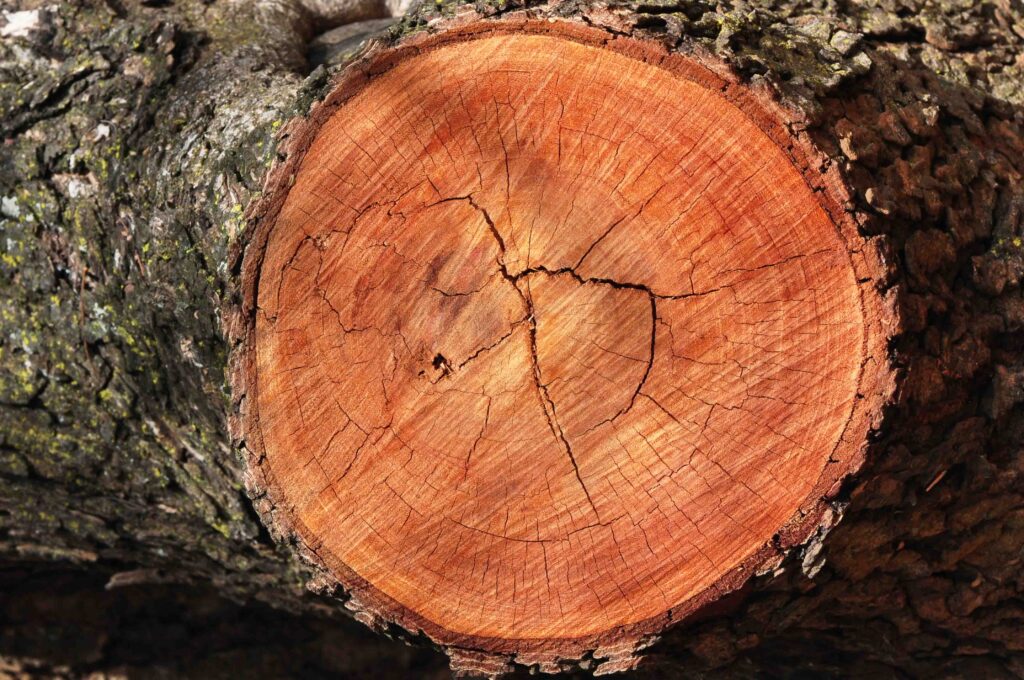
- 635. 2016/08/23. Pretoria NBG. Photo: David Becking.
References
Boon, R. 2010. Pooley’s Trees of eastern South Africa. Flora and Fauna Publications Trust, Durban.
Burrows, J.E., Burrows, S.M., Lotter, M.C. & Schmidt, E. 2018. Trees and Shrubs Mozambique. Publishing Print Matters (Pty) Ltd. Noordhoek, Cape Town.
Coates Palgrave, M. 2002. Keith Coates Palgrave Trees of Southern Africa, edn 3. Struik, Cape Town.
Lawrence, G. H. M, 1951. Taxonomy of Vascular Plants. The Macmillan Company, New York. Tenth Printing 1965.
Palmer, E. & Pitman, N. 1972. Trees of southern Africa. Balkema, Amsterdam, Cape Town.
Schmidt, S. Lotter, M. & McCleland, W. 2002. Trees and Shrubs of Mpumalanga and the Kruger National Park. Jacana, Johannesburg.
van Wyk, B. & van Wyk, P. 1997 Field guide to Trees of Southern Africa. Struik, Cape Town.
| von Staden, L. 2011. Peltophorum africanum Sond. National Assessment: Red List of South African Plants version 2024.1. Accessed on 2026/01/09. |
Woodhall, S. 2020. Field Guide to BUTTERFLIES of South Africa. Struik.
http://www.plantzafrica.com/plantnop/peltophorumafricanum.htm
https://en.wikipedia.org/wiki/Peltophorum_africanum
http://www.zimbabweflora.co.zw/speciesdata/species.php?species_id=127220
http://operationwildflower.org.za/index.php/plant-records/trees/118-peltophorum-africanum