
Piliostigma thonningii
General Info – Summary
Unarmed & usually dioecious leafy shrub or Tree up to 7m high. Bark has longitudinal fissures. Bauhinia-like, simple Leaves have red palmate veins. Small zygomorphic, whitish, unisexual Flowers in pendulous racemes. Male has 10 stamens. Female with staminodes & a stalked, superior ovary – with ovules. Fruit is a large, woody, indehiscent & nutritious pod that falls & decomposes to release the different shaped seeds.
Description
Previous Names: Bauhinia thonningii, Gigasiphon bauhinioides, Locellaria bauhinioides.
SA Tree No. 209.
Common names: (Afr) Kameelspoor, Rhodesiese Bauhinia. (Eng) Camel Foot, Camel’s Foot, Monkey Bread, Rhodesian Bauhinia (no longer valid), Wild Bauhinia. (isiNdebele) Ihabahaba. (Northern Sotho) Mokgoropo, Mukolokote, Nkolokotso. (Tshivenda) Mukalakata, Mukolokota.
Family: Fabaceae, or Leguminosae (Pea, bean or legume family). After the Orchidaceae and the Asteraceae, the Fabaceae is the third largest Angiosperm (flowering plants) family with 700+ genera and close to 20 000 species. Local Tree genera on this website include Acacia (Vauchellia, Senegalia), Albizia, Bauhinia, Bolusanthus, Burkea, Calpurnia, Colophospermum, Cordyla, Cyclopia, Dichrostachys, Erythrina, Erythrophleum, Faidherbia, Indigofera, Mundulea, Peltophorum, Philenoptera, Piliostigma, Schotia and Xanthocercis. The Fabaceae are recognisable by their fruit and their pinnately compound Leaves. Leaves may also be simple – even bilobed and usually have stipules – some of which may be spinescent. Leaflets are usually entire. Flowers are bisexual and bracteate. Regular flowers usually have 4-5 sepals and the same number of petals. Irregular flowers have 4-5 sepals and 5 or less petals. Stamens have anthers that have 2 pollen sacs and there are usually at least twice the number of stamens as petals – often 10. The superior Ovary has 1 locule containing 1 or more ovules. The Stigma and Style are simple. The single carpel develops into the Fruit, which is usually a pod. The mature pods may dehisce or break into segments. Seeds vary.
Name derivation: Piliostigma – cap shaped – referring to the stigma. thonningii named after Peter Thonning, He was a Danish botanist who collected specimens in Guinea from 1799 to 1803.
Conservation: National Status: L C. Least concern. Assessed: 2005/06/30 (W. Foden and L. Potter).
Tree
This unarmed leafy shrub or a spreading Tree (photo 250) may reach a height of 14m but is usually about half this height. The Bowl (the stem or trunk of a tree) is often crooked and the rough brown/grey Bark develops longitudinal fissures (photo & 251 252). Young branches have reddish brown hairs.
-
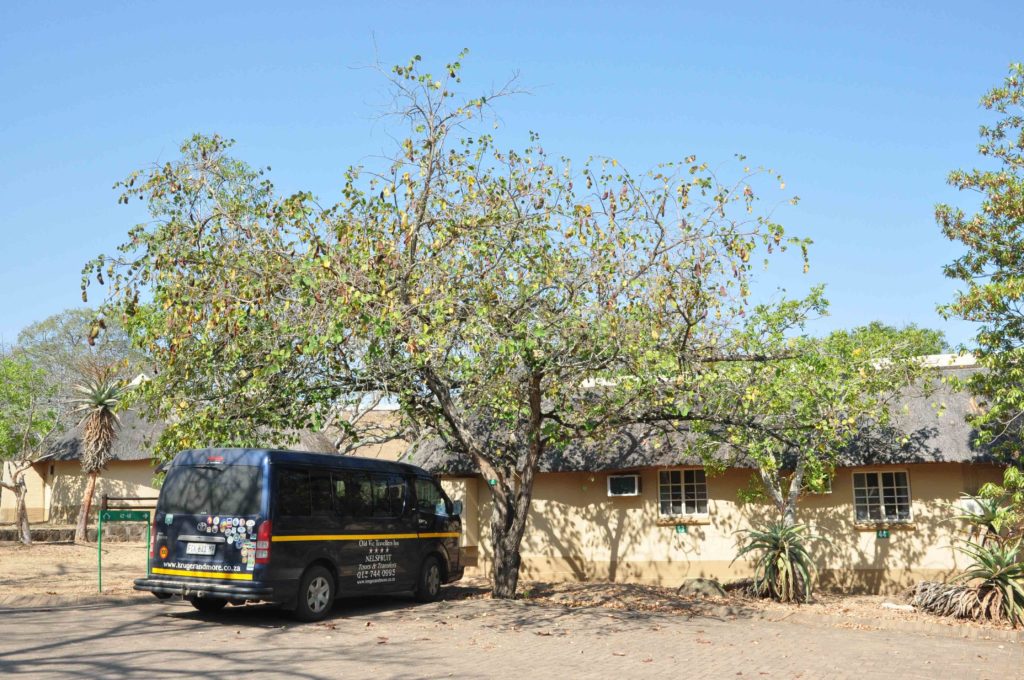
- 250. 2019/08/14. Pretoriuskop KNP. Photo: David Becking.
-
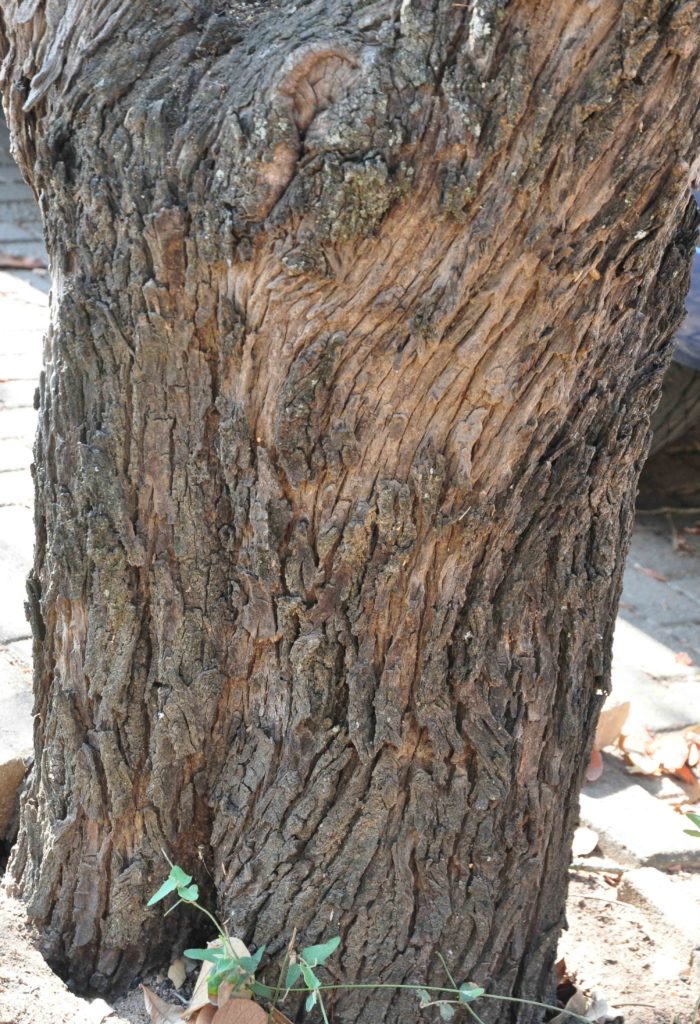
- 251. 2019/08/14. Pretoriuskop KNP. Photo: David Becking.
-
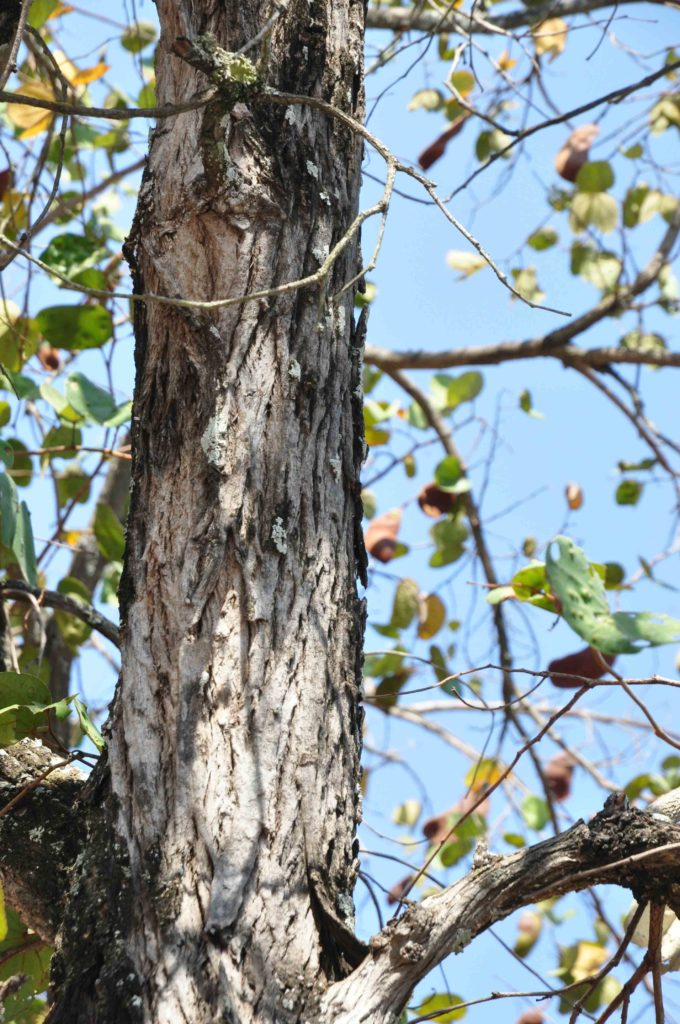
- 252. 2019/08/14. Pretoriuskop KNP. Photo: David Becking.
Leaves
On this evergreen or deciduous tree, the similarity between these Leaves and those of Bauhinia is noticeable (photo 257). They are large (up to 20cm long and slightly wider), alternate, leathery and simple (have a single blade, which may have incisions that are not deep enough to divide the leaf into leaflets). The leaf, which resembles a camel’s foot, has 2 deep lobes that extend up to one third leaf length. Between these 2 lobes is a tiny bristle-like structure (just visible on the enlarged photo 254E). The Base of each lobe is square to rounded, and the Apex of each lobe is rounded. The lower velvety surface is a lighter green. From the base, up to 11 protruding palmately arranged Veins arise. On the lower surface, they protrude, are an attractively reddish and clearly visible (photo 257). In this photo the thick Petiole (leaf stalk) is up to 4cm long. The small Stipules are caducous (an organ or part of which is easily detached and shed early).
-
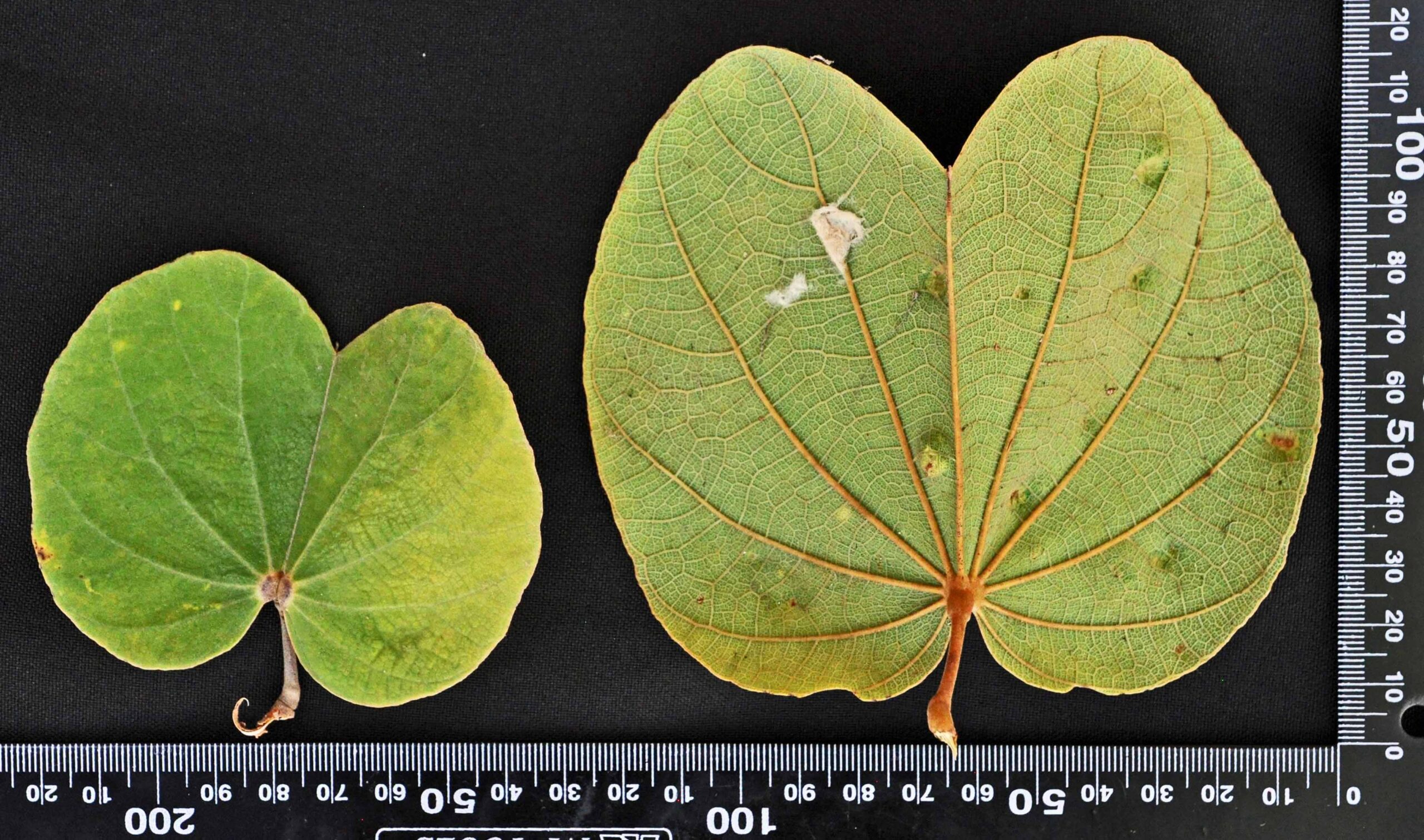
- 257. 2019/08/14. Pretoriuskop KNP. Photo: David Becking.
-
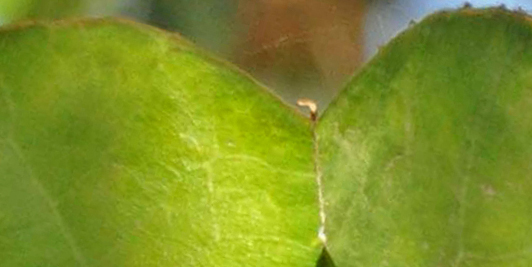
- 254E. 2019/08/14. Pretoriuskop KNP. Photo: David Becking.
Flowers
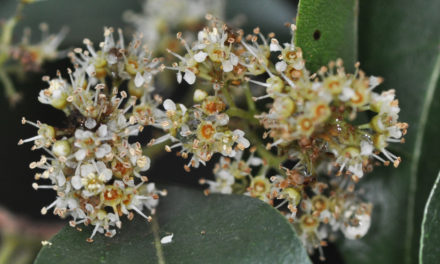
A great number of impressive fat, brown, oval and velvety buds are borne in string-like pendulous Racemes (raceme – a simple elongated inflorescence with stalked flowers that open in succession towards the apex). Each red-brown Bud rest on a sturdy Pedicel (stalk of a single flower). Generally, these buds provide a red-brown image. Unlike the bisexual Bauhinia flowers, the individual white to pinkish Flowers are unisexual and usually dioecious (unisexual flowers with male and female parts on separate plants). When on the same tree the male flowers are produced first. Flowers are zygomorphic (floral parts are unequal in size or form so that the flower is capable of division into essentially symmetrical halves by only one longitudinal plane passing through the axis). The small flowers develop terminally or in leaf axils (the upper angle between a lateral organ, such as a leaf, and the stem that bears it). They are attractive (use a hand lens) and may develop in large numbers. They tend to open gradually from the base of the raceme. The 5-merous flowers (parts in 5’s) are attractive but not spectacular flowers. The 5 short, brownish Calyx has Sepal lobes that are covered with velvety hairs. The 5 white or pinkish and crinkled Corolla Petals are imbricated (having regularly arranged, overlapping edges, as roof tiles) and are sub equal. In Male only flowers, the ovary is aborted, and 10 Stamens are present. Here the Anthers dehisce through longitudinal slits. In the Female only flowers, Staminodes (sterile stamens) surround the stalkless, superior Ovary that contains many Ovules. (Dec-Feb).
Fruit
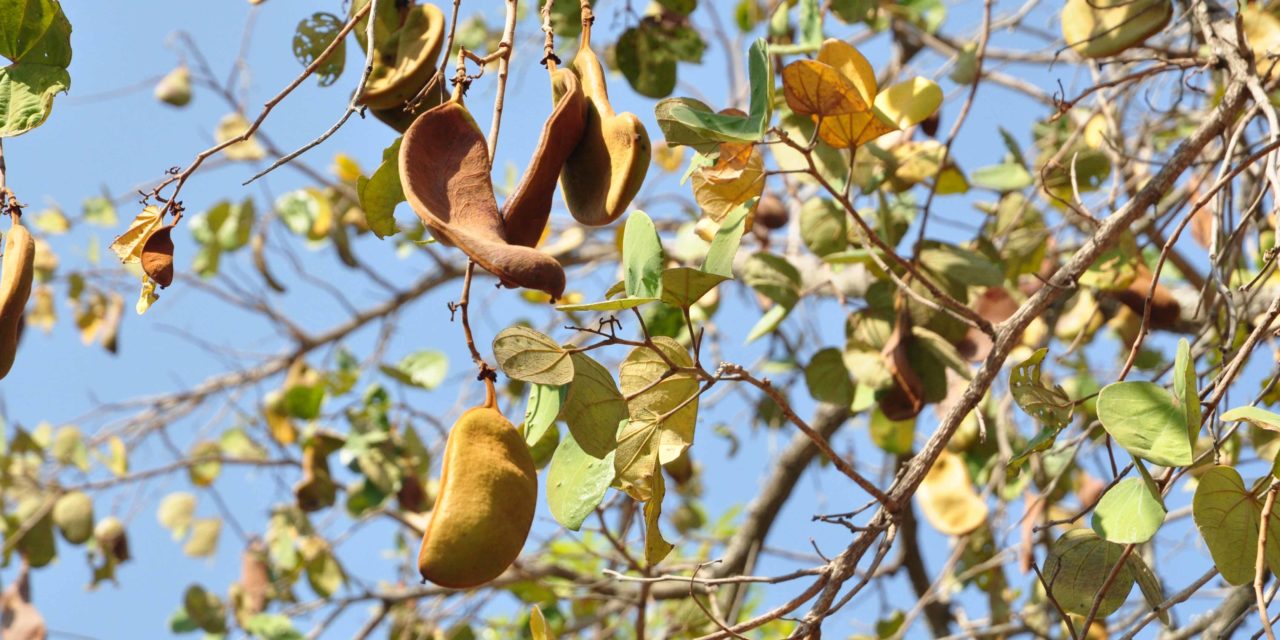
The Fruit is a large, woody, dense, indehiscent Pod (photo 259) that is up to 23 x 7cm. In this photo the remains of the calyx sepals are visible at the base of the pedicel. Initially, the many green pods turn reddish brown (photo 253). Pods then develop tiny, raised red lines (photo 259). The dense (heavy) mature pods may occur in large numbers and weigh down the branches. The variously shaped Seeds (photo 260) are imbedded in a floury pith and are small (in excess of 3 000 per kg.) Dispersal only occurs when the pods fall and decay. (Jun-Sep).
-
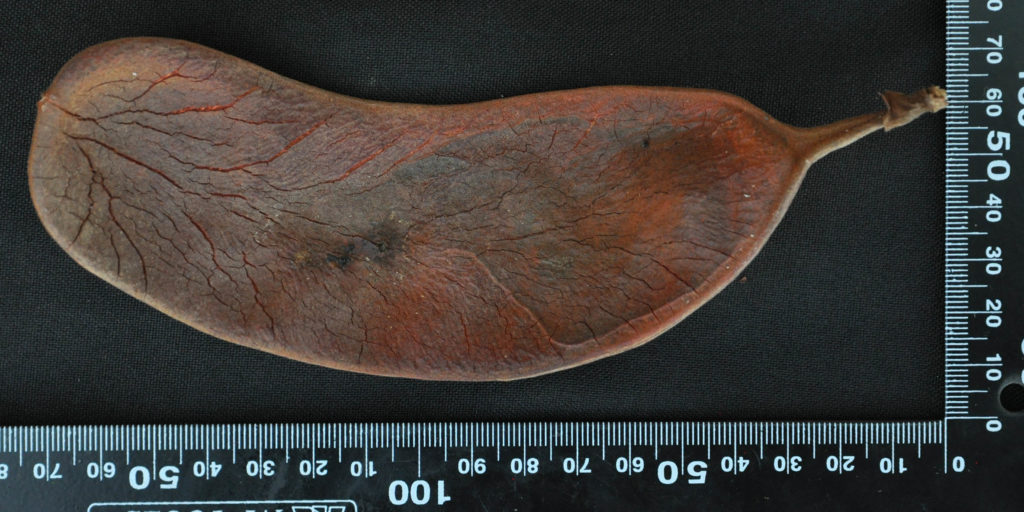
- 259. 2019/08/14. Pretoriuskop KNP. Photo: David Becking.
-
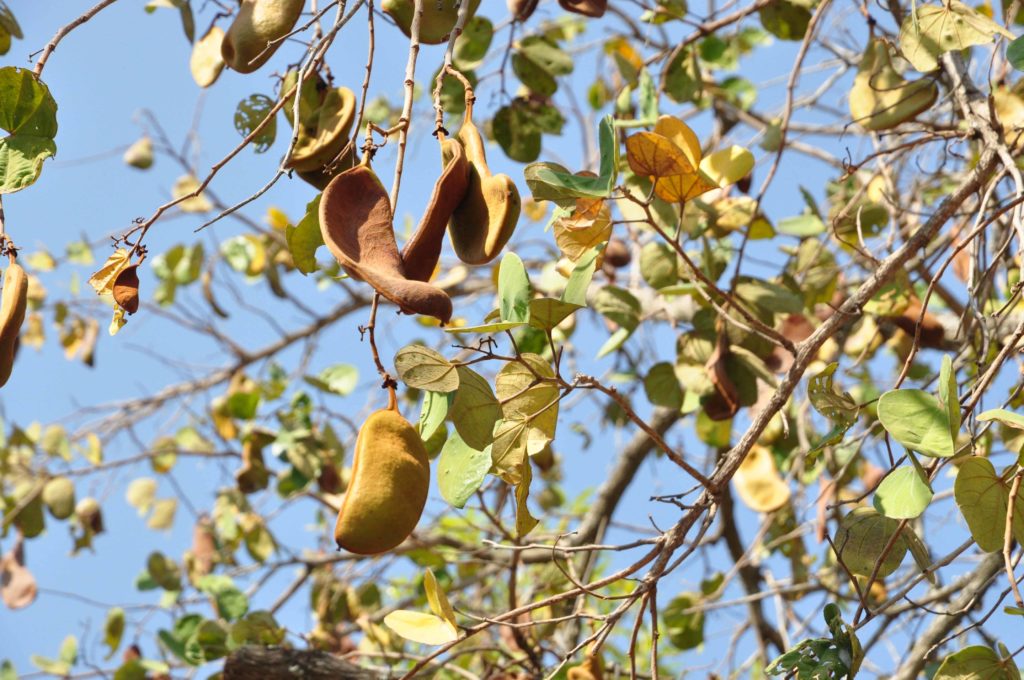
- 253. 2019/08/14. Pretoriuskop KNP. Photo: David Becking.
-
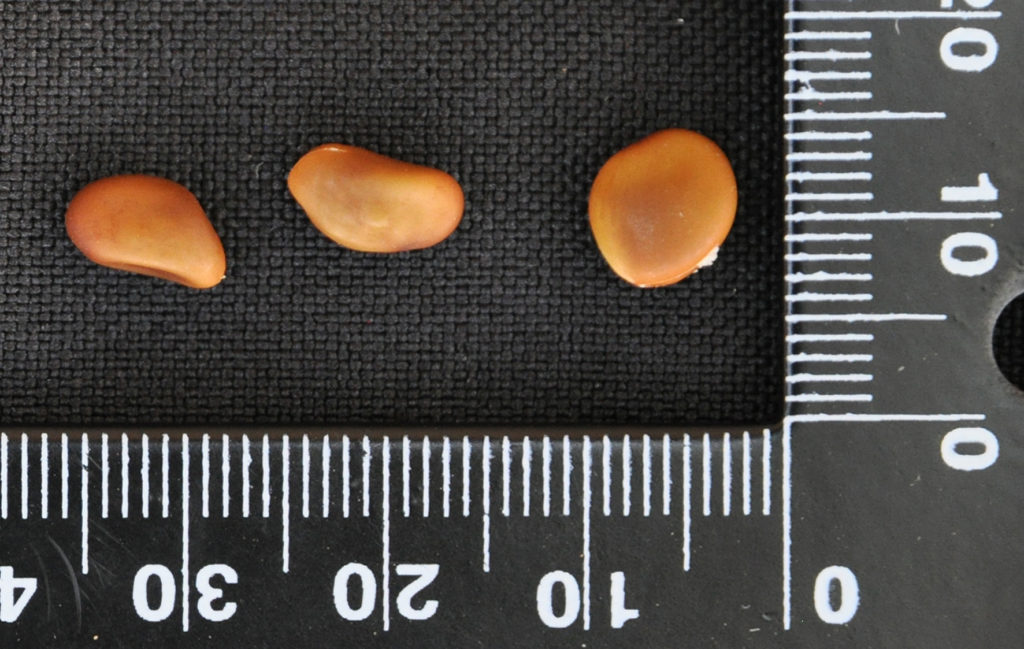
- 260. 2019/08/14. Pretoriuskop KNP. Photo: David Becking.
Distribution & Ecology
This Plant often grows on riverbanks and in open bushveld (a sub-tropical woodland ecoregion of southern Africa). They usually occur at low to medium altitudes – often on sandy soil. This tree is conspicuous because of its large bi-lobed leaves (up to one third leaf length) and of the many flowers and numerous pods. These plants are located in Limpopo and Mpumalanga e.g. Kruger National Park. Beyond South Africa, they occur in Eswatini (Swaziland), central and northern Mozambique, Zimbabwe, Namibia e.g. Caprivi, Angola and northwards into tropical Africa. Game including Kudu browse the Leaves and Fruit. Baboons, monkeys and cattle browse the Pods. Together with fungi, the Roots fix atmospheric nitrogen and this eventually benefits other plants as well. Larvae of the bushveld emperor butterfly (Charaxes achaemenes achaemenes) feed on these leaves, and other leaves including Pterocarpus (Kiaat) species, zebrawood (Brachystegia spiciformis) as well as the African Ebony (Diospyros mespiliformis).
Ethnobotany
The dry Pods have a high Vitamin C content and may be ground into a nutritional meal. This is said to equal maize in feeding value. Green pods and wood ash have a lathering quality and are used as soap. Cattle seek out the pods. The Bark is used as a substitute for lipstick. Fibre is extractable from fresh bark and is used for string and for making rope. Bark also yields tannin – used for tanning leather. Dyes are extractable from boiled plant parts. The bark yields red dye. Roots yield red-brown dye and the Pods and Seeds yield blue-back dye. The roots are used for giving a glaze to pottery. Chewed young Leaves relieve thirst and are eaten by game and cattle. Wood. The heartwood varies between dark brown and pinkish. The sapwood is light brown. The timber is generally useful. The straight-grained wood is used for grain mortars, tool handles, and spoons as well as for hut construction. Termites may cause a problem. The wood also makes a good Fuel that burning for a long time at high temperature and generating little smoke. This tree is suitable for a large garden and makes an excellent shade tree. Scarified (scarify – to slit or scratch the outer coat of seeds in order to speed up germination) seeds are used for Propagation. Here, prior to planting, the seeds can be soaked in hot water and left overnight. The trees grow in a wide range of soil types and are useable as Pioneer plants (are hardy species which are the first to colonize new or previously disturbed areas). Plant parts, including pods, are used in local medicine. This tree has deep roots.
References
Burrows, J.E., Burrows, S.M., Lotter, M.C. & Schmidt, E. Trees and Shrubs Mozambique. Publishing Print Matters (Pty) Ltd. Noordhoek, Cape Town.
Coates Palgrave, M. 2002. Keith Coates Palgrave Trees of Southern Africa, edn 3. Struik, Cape Town.
Foden, W. & Potter, L. 2005. Piliostigma thonningii (Schumach.) Milne-Redh. National Assessment: Red List of South African Plants version 2024.1. Accessed on 2025/09/24
Palmer, E. & Pitman, N. 1972. Trees of southern Africa. Balkema, Amsterdam, Cape Town.
Schmidt, S. Lotter, M. & McCleland, W. 2002. Trees and Shrubs of Mpumalanga and the Kruger National Park. Jacana, Johannesburg.
van Wyk, B. & van Wyk, P. 1997 Field guide to Trees of Southern Africa. Struik, Cape Town.
https://en.wikipedia.org/wiki/Charaxes_achaemenes
http://pza.sanbi.org/piliostigma-thonnigii
http://tropical.theferns.info/viewtropical.php?id=Piliostigma+thonningii
https://uses.plantnet-project.org/en/Piliostigma_thonningii_(PROTA)
https://www.zimbabweflora.co.zw/speciesdata/species.php?species_id=126830


Is there any health benefit from its fruit, bark, leaves etc? If yes, what can it be used for?
Greetings Joyce
Thank you for your question. You might like to try https://doi.org/10.1093/rpsppr/rqae004. Take care.
David Becking