Maerua caffra
General Info – summary
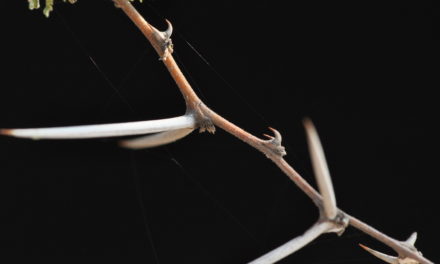
This Tree with its straight trunk and light bark lacks spines and may reach 10 high. The usually trifoliate compound Leaves are hairless. White, bisexual, actinomorphic, scented Flowers lack petals and develop at branch ends. Many stamens unfold as a mass of white filaments. The single pistil has a superior ovary with a sessile stigma & a capitate stigma. Fruit with many seeds, is initially embedded in a jelly like pulp.
Description
Maerua caffra
Previous Names: Capparis triphylla, Maerua triphylla, Niebuhria cafra, Niebuhria triphylla.
SA Tree No. 133.
Common names: (Afr) Gewone Witbos, Lemoentjie, Wilde-bashout, Wildeboshout, Witbas, Witbashout, Witboom, Witbos, Witboshout, Without. (Eng) Bush-cherry, Bush Maerua, Christmas Flower, Common Bush-cherry, Spiderbush, White-wood. (isiXhosa) Umphunzisa, Umphunziso, Umqomoqomo. (isiZulu) Umenwayo, Untswantswane. (Tshivenda) Mutshalimela.
Family: Capparaceae. (The caper family) has about 16-33 genera and 480-700 species. This family has trees, shrubs and some lianas (climbing plants that are woody and hang from trees) and herbs. Members are tropical and sub-tropical. Flowers are usually 4-merous. The superior Ovary usually has 1 locule. Fruit is a capsule or a berry. Mustard Oils are present in all genera. Local genera on this website include Boscia and Maerua.
Name derivation: Maerua – probably Arabic for the genus. cafra – refers to the Eastern Cape. There are about 60 species in the genus Maerua in southern Africa with 11 species occur in the South Africa and about 7 of these may be trees.
Conservation: National Status: L C. (Least Concern). Assessed: 2005/06/30. (W. Foden and L. Potter).
Tree
This spineless plant is often a Tree (photo 537) up to 10m high, but it may be a small multi-stemmed shrub – especially at the coast. Roots are thick and tuberous. The Trunk is straight and up to 24cm wide. The white to dark grey coloured Bark is mottled (covered with areas of different colours that do not form a regular pattern – photo 994) and Lichen (composite organism arising from a mutualistic relationship between fungi or cyanobacteria and algae species) may be present (light blue in photo 994). Angular young branches are hairless, yellowish or grey-green with conspicuous raised, light Lenticels (usually raised corky oval or elongated areas on the plant that allows the uncontrolled interchange of gases with the environment – photo 808).
-
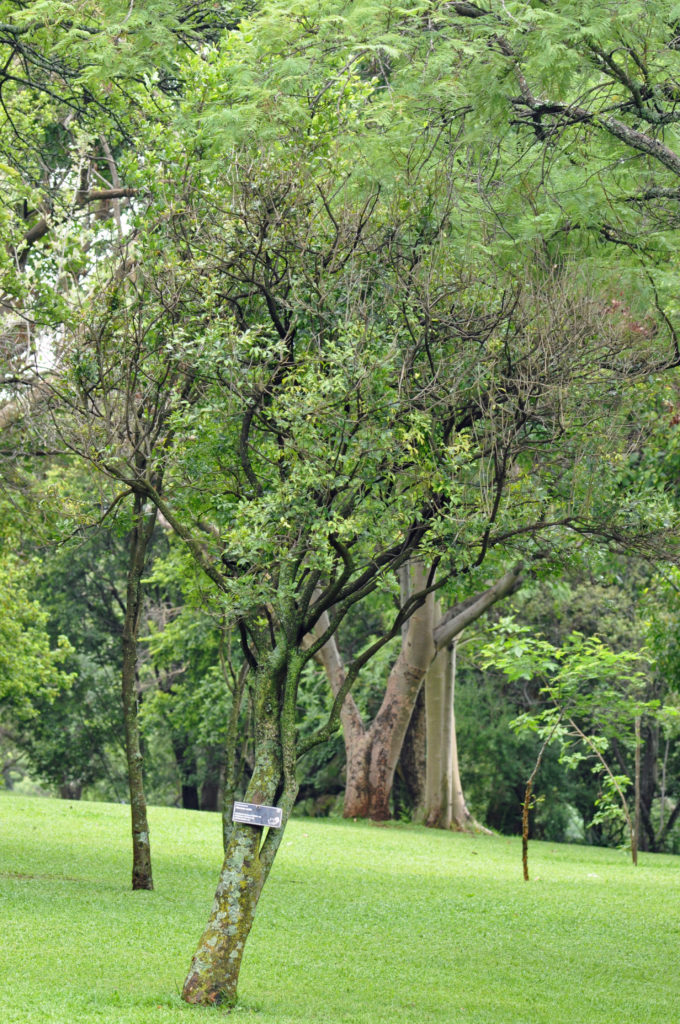
- 537. 2014/12/09. Walter Sisulu NBG. Photo: David Becking.
-
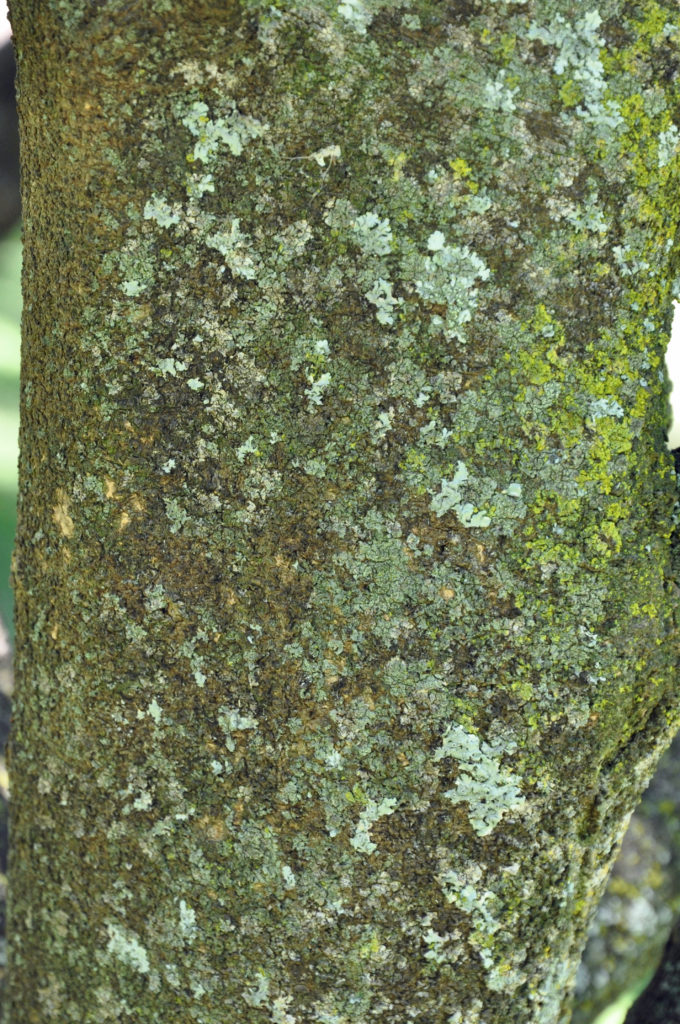
- 994. 2014/11/25. Walter Sisulu NBG. Photo: David Becking.
-
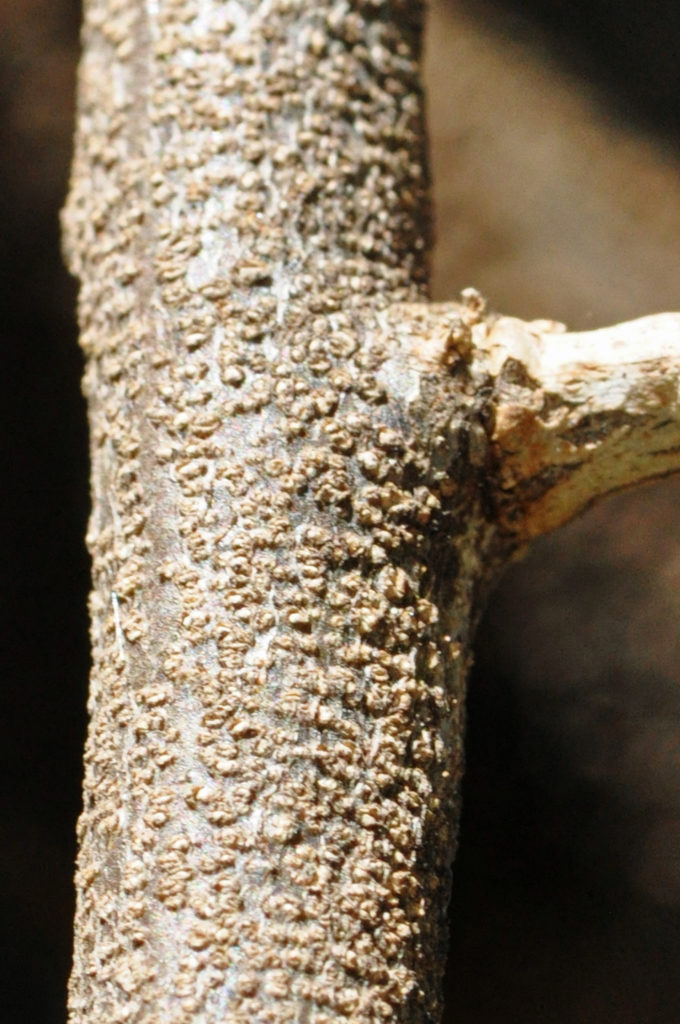
- 808M. 2016/08/30. Walter Sisulu NBG. Photo: David Becking.
Leaves
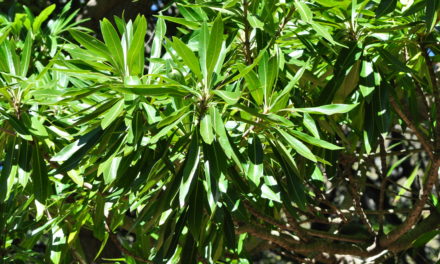
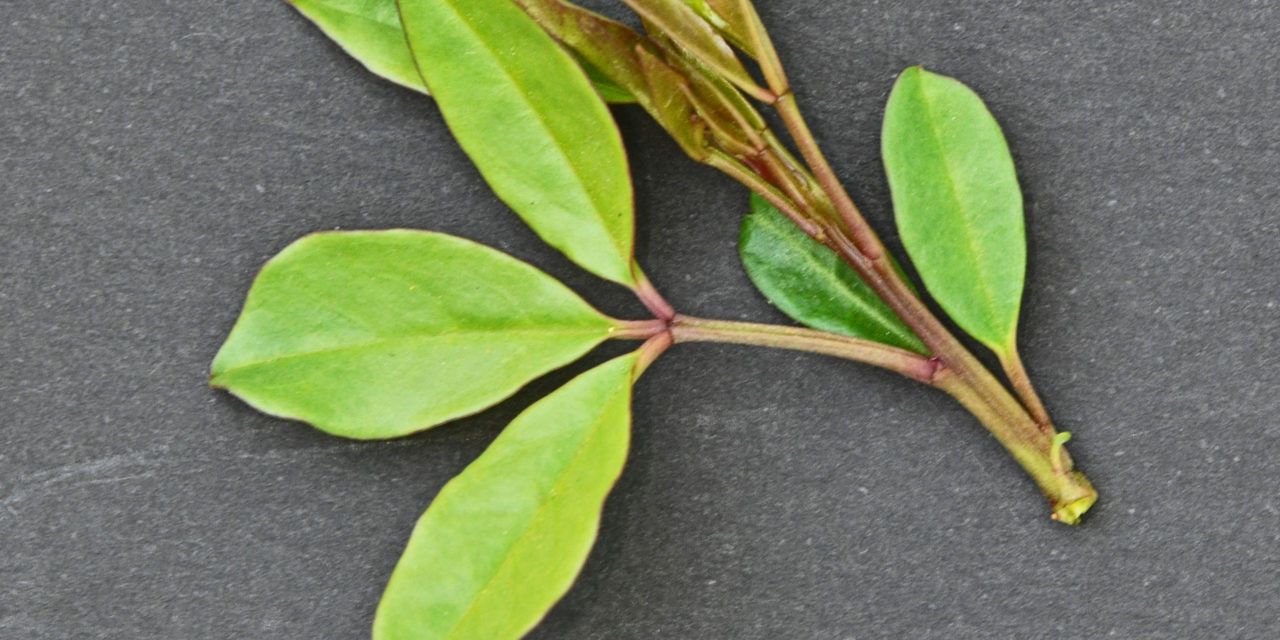
The alternate, compound and usually trifoliate Leaves (photo 250) are up to about 12cm long. Occasionally there are 5 Leaflets present (photo 995). Each leaflet is up to 7,5 x 3,5cm and the central leaflet is usually the longest (photo 995). The coastal form may be more succulent. Leaflets are often elliptic but may be obovate or lanceolate. The central or terminal leaflet is usually the longest (photo 995). The hairless, papery or slightly coriaceous (leathery) Blade is dark green above and paler below (photo 995). Apart from the protruding Midrib on the lower surface, Veins on both surfaces are difficult to see (photo 995). The usually pointed Apex is tapering to rounded and may be notched. A hairlike tip is present. The Base tapers and the Margin is entire (with a continuous margin, not in any way indented). The relatively long Petiole (leaf stalk – photo 250) may reach 6cm in length and is grooved on the upper surface (photo 250). Petiolules (leaflet stalks) are short – up to 5mm long and grooved on upper surface (photo 250).
-
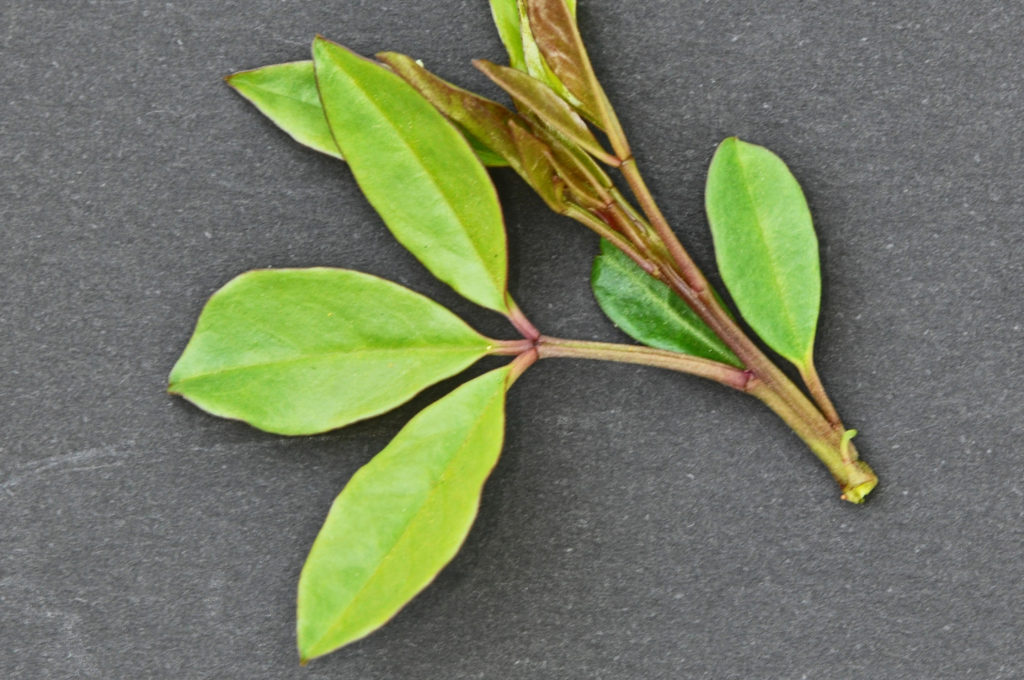
- 250. 2014/10/07. Walter Sisulu NBG. Photo: David Becking.
-
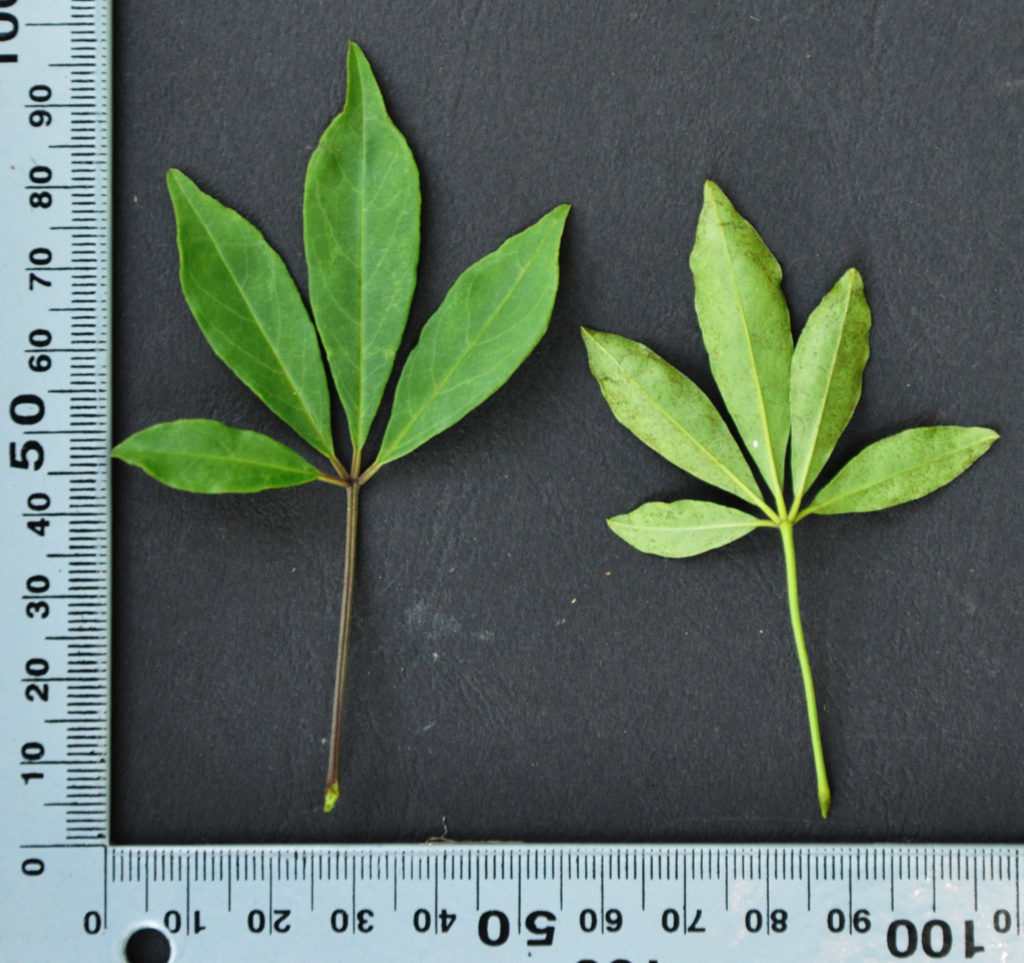
- 995. 2014/11/25. Walter Sisulu NBG. Photo: David Becking.
Flowers
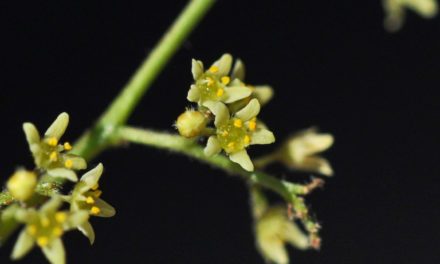
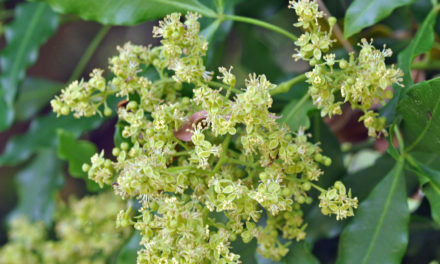
The green scented and 4-merous (merous: having a specific number of parts in the whorl of a flower. Here 4 parts). Flowers are large, up to 4,5cm long and are located at branch ends in a Corymb (a short and broad, more or less flat-topped indeterminate inflorescence with the outer flowers opening first). Up to 12 flowers that extend beyond the leaves may be present. These flowers are bisexual and actinomorphic (Regular, symmetrical. Flowers are vertically divisible into similar halves by more than 1 plane passing through the axis). There are 4 greenish spreading Calyx Sepals about 1,7cm long that help provide the flower its colour. Corolla Petals are absent. The Male part of the flower has many Stamens (male reproductive part of a flower) that develop on the Receptacle (is that expanded tip of the flower petiole – flower stalk). The stamens only unfold once the bud opens producing a distinctively attractive white central mass of 30-45 stamens – up to 3cm long. Each Filament (the usually long slender stalks that supports the anther) ends in an oblong Anther (where the pollen grains are formed). The anthers dehisce longitudinally to release the pollen. Towards the end of September, and October the impressive stamens decline leaving a dull coloured bush. In the Female part of the flower is a single Pistil (a unit of the Gynoecium, the female element of the flower, containing a stigma style and ovary). The Ovary is superior, and its Ovules are arranged in 2 rows. The sessile (no style) Stigma is capitate (formed like a head). (Aug-Oct). Chrysanthemoides monilifera in the Asteraceae (daisy) family is a bush or shrub that develops bright yellow flowers at the same time.
Fruit
Stout Pedicels (flower stalks) carry the mature, hanging and clearly visible Fruit that has a thick rind and is clearly visible when the fruit develops. The fruit is pale green with lengthwise darker green in longitudinal suture lines. The fruit is almost spherical, ellipsoidal, funnel-shaped or oval. The fruit is smooth or slightly ribbed and may have very small bumps. Each fruit opens along the suture lines and is about 5 x 3,5cm. Up to 30 small flattened, round to kidney shaped Seeds develop inside, in a jelly-like pulp. (Oct-Dec).
Distribution & Ecology
This plant is widely distributed from the coast to the mountains in South Africa. In spring, the yellow and white flowers (stamens) are a common site in the scrub between Grahamstown and Port Elizabeth. These plants occur in a wide range of habitats including dry places, dune bush, forest fringes and bushveld (is a sub-tropical woodland ecoregion of southern Africa). They often occur in rocky places and may occur from sea level to relatively high altitudes e.g., Soutpansberg Mountains in Limpopo. This tree is a southern African endemic (restricted to a particular geographic location). They are Located from the Eastern Cape e.g., from Humansdorp, Utenhage and Knysna: Eastwards and Northwards to KwaZulu-Natal, Mpumalanga, North West, Limpopo, Eswatini (Swaziland), Eastern Zimbabwe and probably southern Mozambique. Many bird species consume the Fruit. Game consume the Leaves. A number of butterfly feed on the leaves. These include the larvae of the brown-veined white butterfly Belenois aurota. During summer large numbers migrate northeast over the interior. Another butterfly is the Zebra White Pinacopteryx eriphia eriphia whose larvae also feed on Boscia species like Boscia albitrunca. Maerua cafra is classified as an invasive species in Australia.
Ethnobotany
A chicory substitute is extractable from the non-aggressive tuberous Roots. The roots are used in local medicine. The soft, white, brittle Wood smells when cut. It is not often used. Stock may browse the Leaves. The tree grows well from seeds and cuttings but may take some time to reach a height of 1m.
References
Boon, R. 2010. Pooley’s Trees of eastern South Africa. Flora and Fauna Publications Trust, Durban.
Burrows, J.E., Burrows, S.M., Lotter, M.C. & Schmidt, E. 2018. Trees and Shrubs Mozambique. Publishing Print Matters (Pty) Ltd. Noordhoek, Cape Town.
Coates Palgrave, M. 2002. Keith Coates Palgrave Trees of Southern Africa, edn 3. Struik, Cape Town.
Foden, W. & Potter, L. 2005. Maerua cafra (DC.) Pax. National Assessment: Red List of South African Plants version 2024.1. Accessed on 2025/12/03..
Lawrence, G. H. M, 1951. Taxonomy of Vascular Plants. The Macmillan Company, New York. Tenth Printing 1965.
Palmer, E. & Pitman, N. 1972. Trees of southern Africa. Balkema, Amsterdam, Cape Town.
Schmidt, S. Lotter, M. & McCleland, W. 2002. Trees and Shrubs of Mpumalanga and the Kruger National Park. Jacana, Johannesburg.
van Wyk, B. & van Wyk, P. 1997 Field guide to Trees of Southern Africa. Struik, Cape Town.
Woodhall, S. 2020. Field Guide to Butterflies of South Africa, edn 2. Donnelley, RR, China.
http://www.plantzafrica.com/plantklm/maeruacafra.htm
https://en.wikipedia.org/wiki/Maerua_cafra
http://www.zimbabweflora.co.zw/speciesdata/species.php?species_id=124600
http://posa.sanbi.org/flora/browse.php?src=SP
https://www.britannica.com/plant/Capparaceae