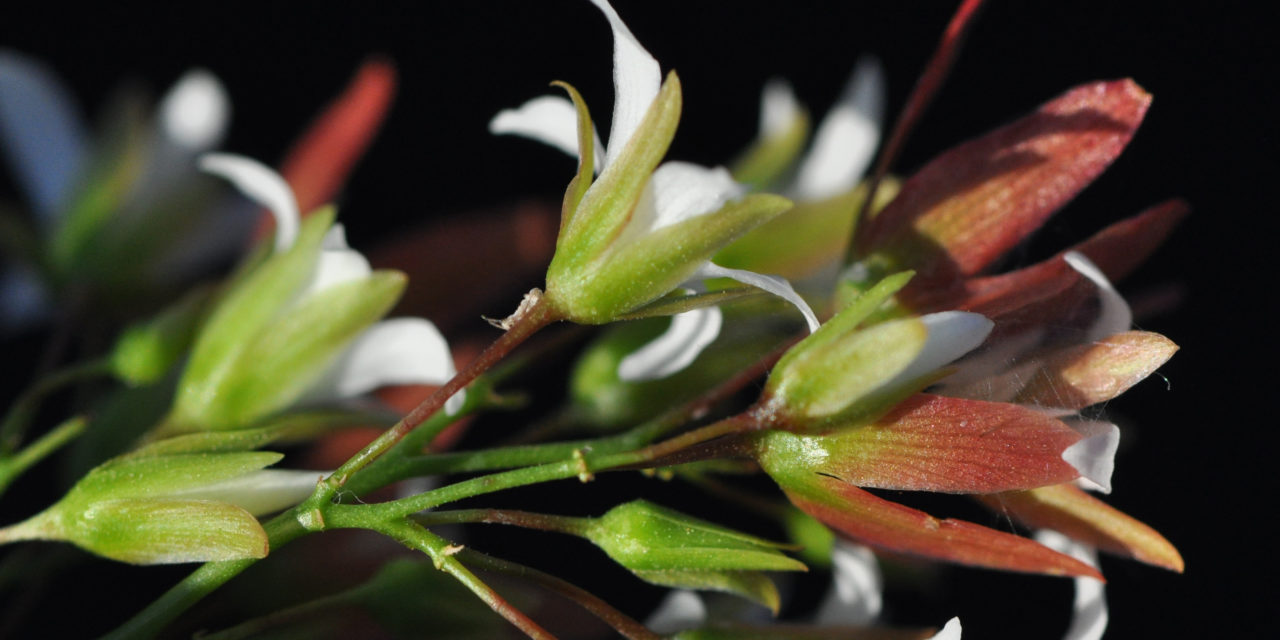
Loxostylis alata
General Info – Summary
Small, endemic, dioecious much branched Tree has grey bark. Compound imparipinnate Leaves each have a distinctively winged rachis. Petiolules and stipules are absent. Regular 5-merous Flowers are in terminal panicles. Male: 5 unequal stamens. Female: have staminodes and a superior ovary with 4 styles. Fruit: a small, red fleshy, one seeded compressed drupe surrounded by accrescent, sepals that turn red.
Description
SA Tree No. 365.
Common names: (Afr) Breekhout, Tederhout, Teerhout, Tierhout, Wildepeperboom, Wilde-peperboom. (Eng) Tarwood, Tigerwood, Tiger-wood, Wild Peper Tree, Wild Pepper Tree. (isiXhosa) Isibara, Isibhaha. (isiZulu) Isibara, Isibhaha.
Family: Anacardiaceae. (Mango family), which has about 83 genera and 850+ species – including Cashew). About 80 species occur in South Africa. Hunting arrows have been made from straight stems. Resin canals are present and woolly stellate hairs cover all young parts. Leaves lack stipules. They may be deciduous or evergreen and usually alternate. Leaves are simple, trifoliate or digitally compound and imparipinnate. Leaflets are usually opposite. Crushed leaves may smell of turpentine. Trees are monoecious or dioecious with occasional bisexual Flowers. Flowers are small, greenish or yellowish white and usually regular. The Calyx has 4-7 sepals and there are 4-7 Petals. The number of Stamens is the same as, or twice the number of petals and the Anthers are versatile. The superior Ovary has up to 4 locules, each with a single ovule. The 1-5 Styles are free or connate and separated at the base. Fruit is usually an indehiscent fleshy drupe that provides food in dry areas. They contain a single quick growing Seed. The southern Africa genera containing trees on this website include Harpephyllum, Lannea, Loxostylis (is a genus with only 1 species). Ozoroa, Sclerocarya and Searsia.
Name derivation: Loxostylis – from the Greek words for oblique and style– referring to the oblique carpels. alata– from Latin – winged – referring to the rachis.
Conservation: National Status: L C. Least Concern. 2016/06/28 (A.T.D. Abbott, V.L. Williams and D. Raimondo). Numbers are declining. Bark harvesting for the medicinal plant trade may become a problem.
Tree
This much-branched, evergreen and ornamental Tree (photo 900) with its spreading habit may reach 6-10m high (higher in forests) and may be single or multi–stemmed. The Trunk is up to 30cm in diameter. The numerous Branches are grey and slightly vertically fissured. Visible on young stems are Leaf scars and Lenticels (usually raised corky oval or elongated area on the plant that allows the uncontrolled interchange of gases with the environment – photo 979). The Bark, which has resin ducts, is pale grey (photo 833) and has shallow vertical fissures between which small pinkish patches may be visible. In this photo the light blue patches on the stem indicate the presence of Lichen (composite organism arising from a mutualistic relationship between fungi/cyanobacteria and algae species. The bark becomes bright red if damaged. Young growth is yellowish to coral pink.
-
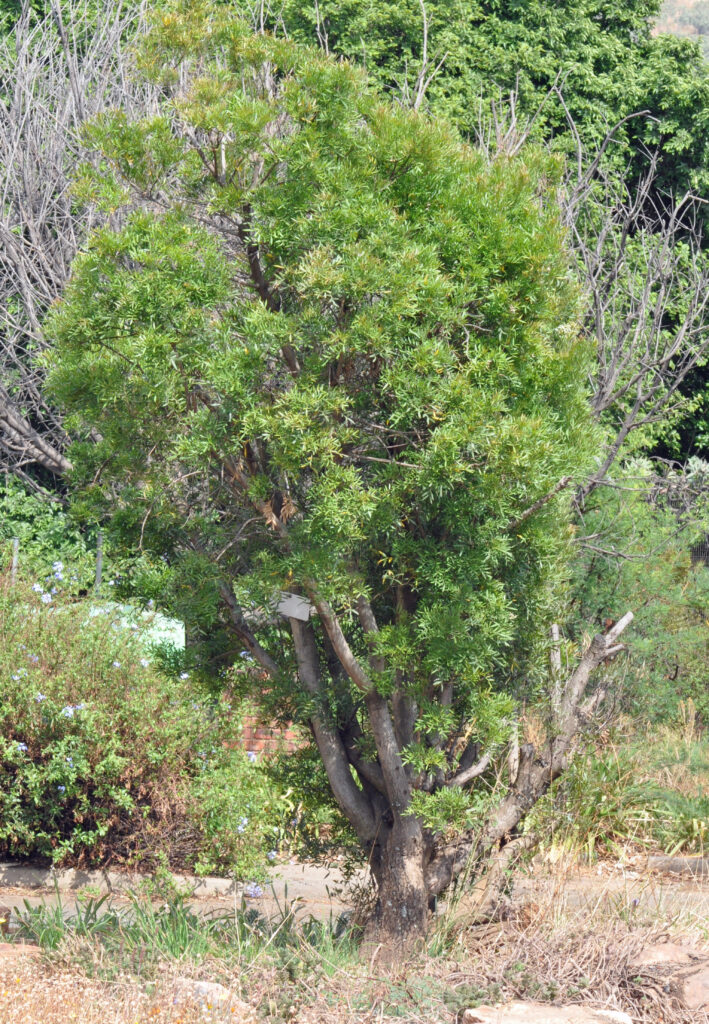
- 900. 2014/10/14. Walter Sisulu NBG. Photo: David Becking.
-
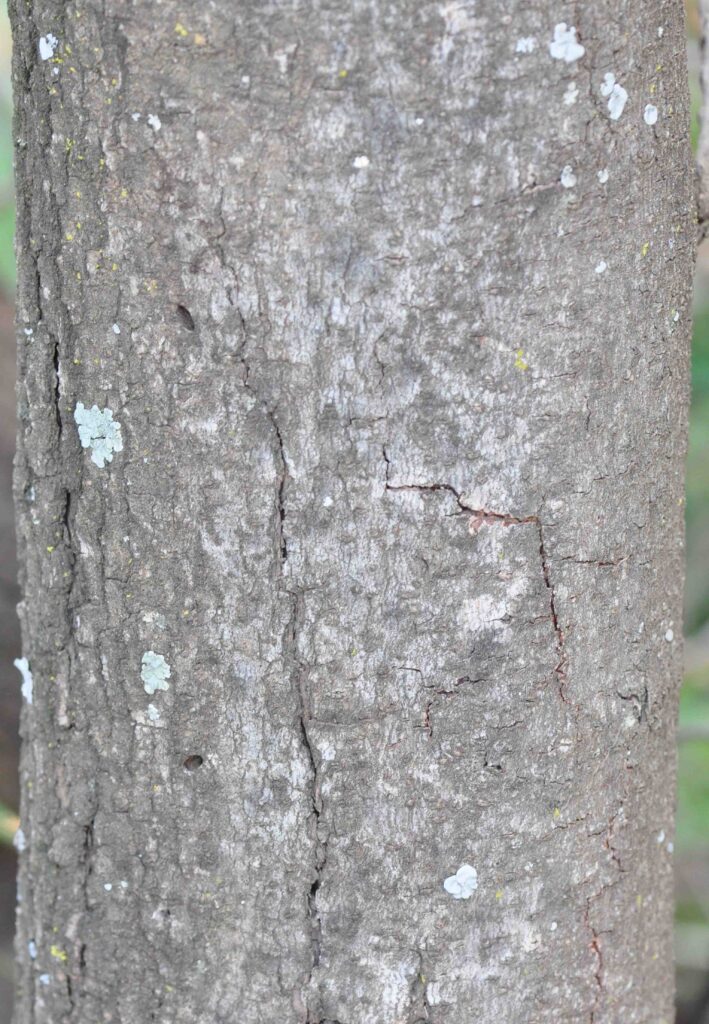
- 833. 2016/09/06. Walter Sisulu NBG. Photo: David Becking.
-
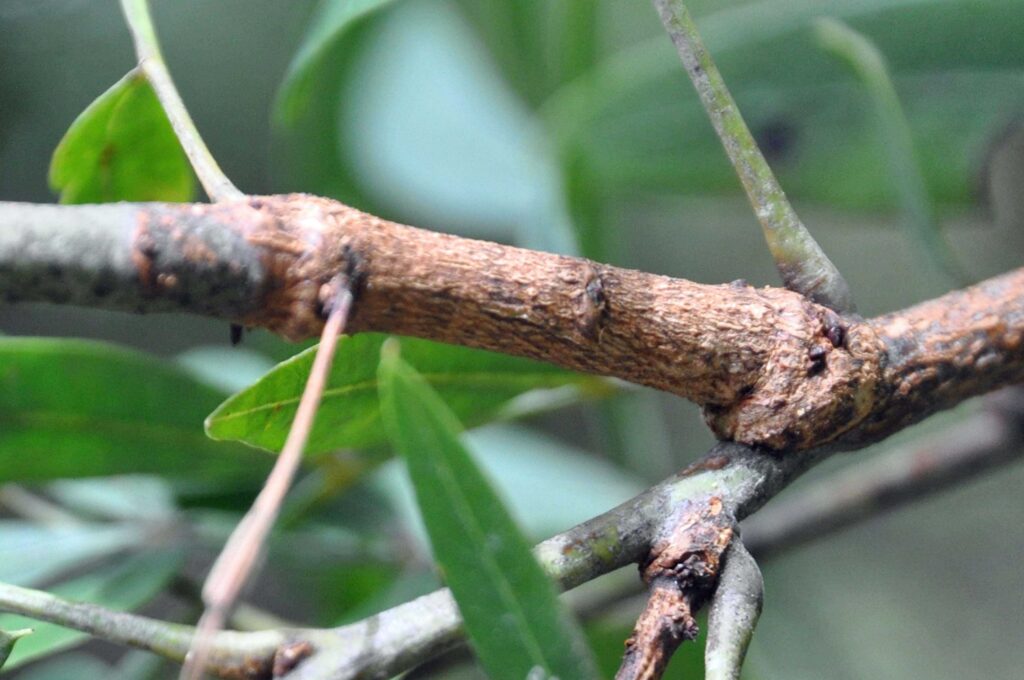
- 979. 2018/09/15. Kirstenbosch NBG. Photo: David Becking.
Leaves
On this evergreen plant, the mature alternately arranged Leaves are hairless, tough dark green and imparipinnate (pinnately compound leaf ending in a single leaflet – photo 662). Leaves are up to 20cm long (photo 826) and tend to droop. Young leaves are yellowish and tinged with red (photo 997). Each leaf has 2-6 pairs of Leaflets, plus the terminal one. Apart from the single terminal leaflet (photo 662), the leaflets are usually in opposite pairs (photo 826). Leaflets are slender, lanceolate to narrowly elliptic, up to 6 x 2,5cm and may be slightly curved. Between the spaced apart paired leaflets, the Rachis (axis, bearing flowers or, in this case, leaflets), is distinctly winged (photo 826). These green photosynthetic wings are leaf-like. The narrowly rounded leaflet Apex may have a hair-like tip (photo 662). The leaflet Base is narrowly tapering. The Margin is rolled under and entire (with a continuous margin, not in any way indented). The Petiole (leaf stalk) is up to 2,5cm long (photo 826). It is ridged but not winged. Petiolules (stalks of leaflets – photo 662), and Stipules (basal appendages of the petiole) are absent.
Flowers
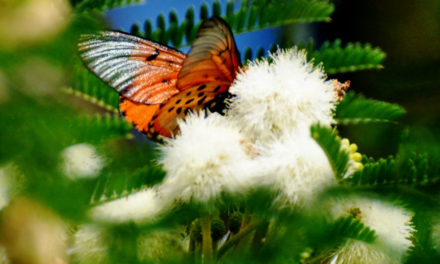
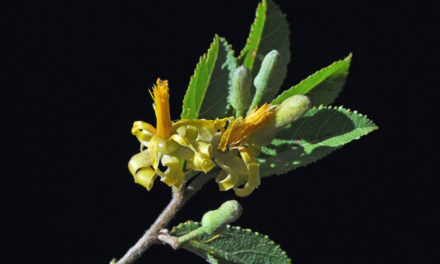
This plant is dioecious (unisexual floral structures with male and female parts on separate plants). Individual small Flowers are actinomorphic (Regular, symmetrical. Flowers are vertically divisible into similar halves by more than 1 plane passing through the axis). They occur in dense terminal impressive sprays or are in dense and up to 30cm long Panicles (indeterminate, branched inflorescence. Here the individual flowers are pedicellate – with stalked flowers – photo 835). Floral parts are in 4s or 5s. As they grow the calyx parts increase in size, become petal like and are the most conspicuous part of the flower. Petals fall early. The Male Flowers have 5 green Calyx lobes (photo 835). The Corolla has 5 star-like reflexed white petals (photo 786) that fall early. There are 5 unequal (photo 831), free Stamens that arise from between the scales of the Disc (a more or less fleshy or elevated development of the receptacle). The Stamens have 4-5 Anthers that each have 2 Thecae (pollen sacs) and dehisce longitudinally (photo 831). No Pistil is present. The Female Flowers have 5 Sepals that are almost divided to the base and are greenish white. The Petals are small, narrow, star like and fall early. The 4-5 Stamens are rudimentary. The superior, single locular Ovary is obliquely obovoid (egg-shaped with the narrow end at the base). Up to 4 unequal and laterally arising Styles may be present. These terminate in nipple-like Stigmas (the parts of the pistil that receives the pollen). After fertilization, Sepals of the deeply divided calyx grow longer and turn pink to red, and these sepals become distinctive, persistent and petal-like (photo 760). They surround the base of the Fruit. (Sep-Apr).
-
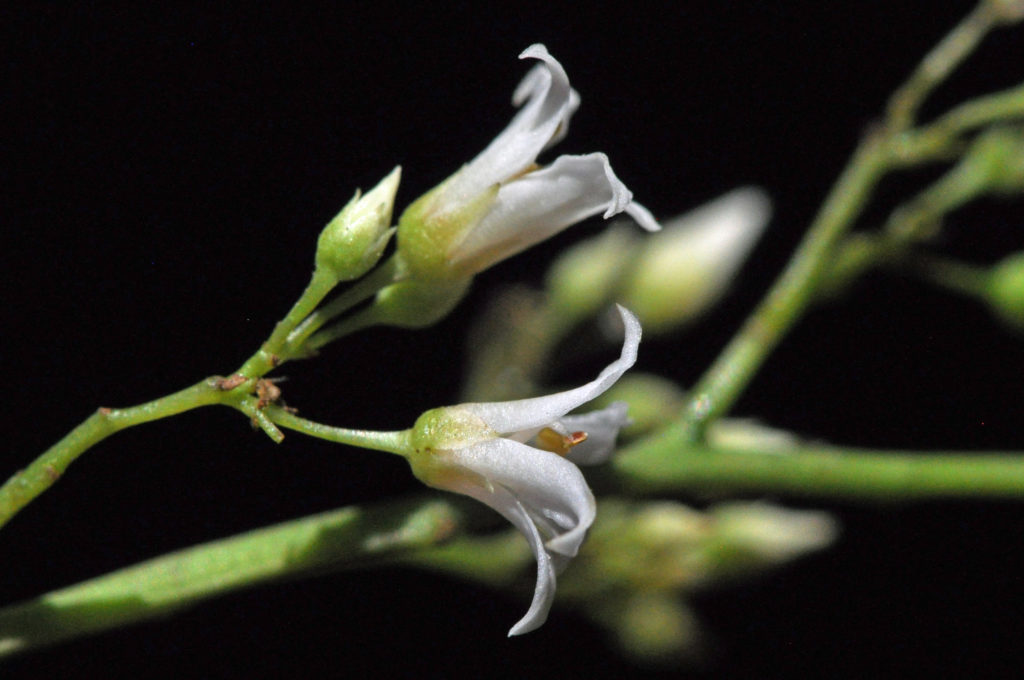
- Male. 835. 2018/02/12. Pretoria NBG. Photo: David Becking.
-
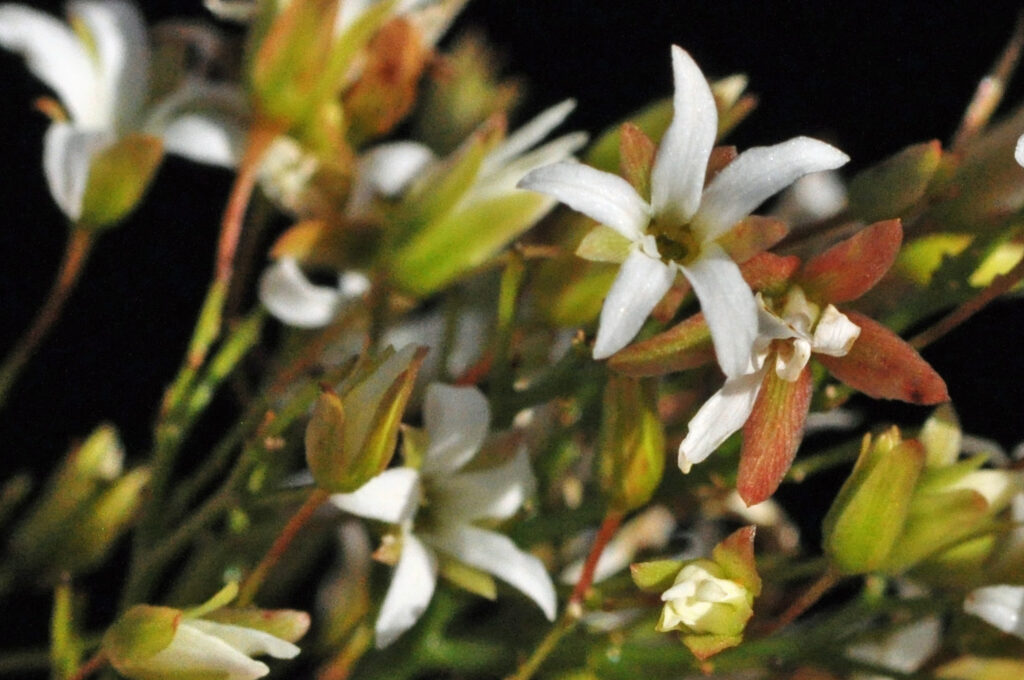
- Female. 786R. 2016/11/29. Walter Sisulu NBG. Photo: David Becking.
-
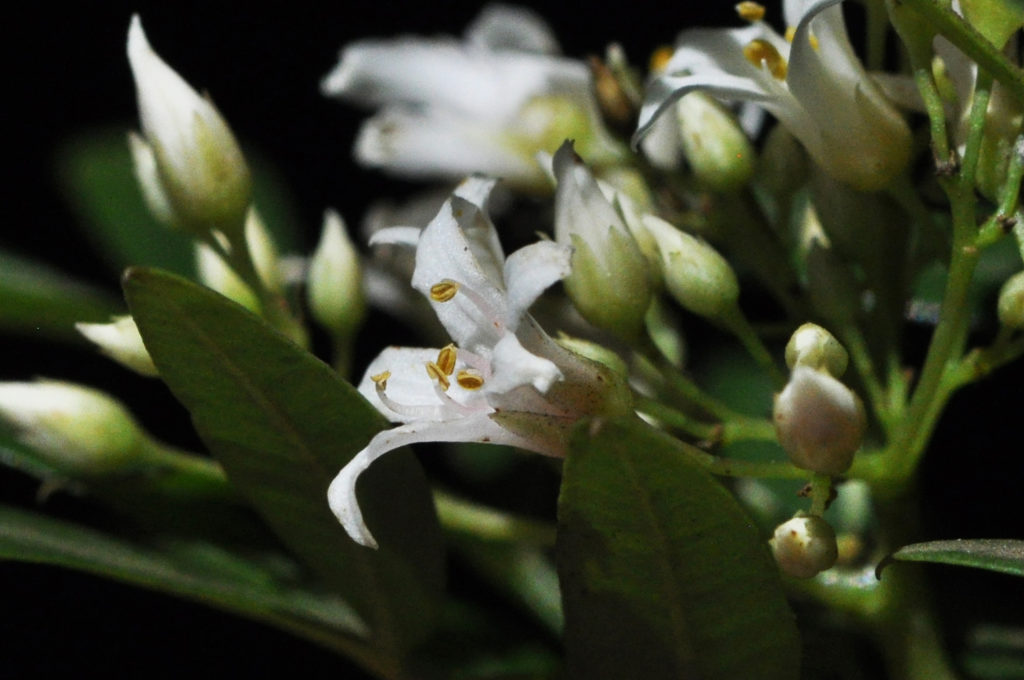
- Male. 831. 2018/02/12. Pretoria NBG. Photo: David Becking.
-
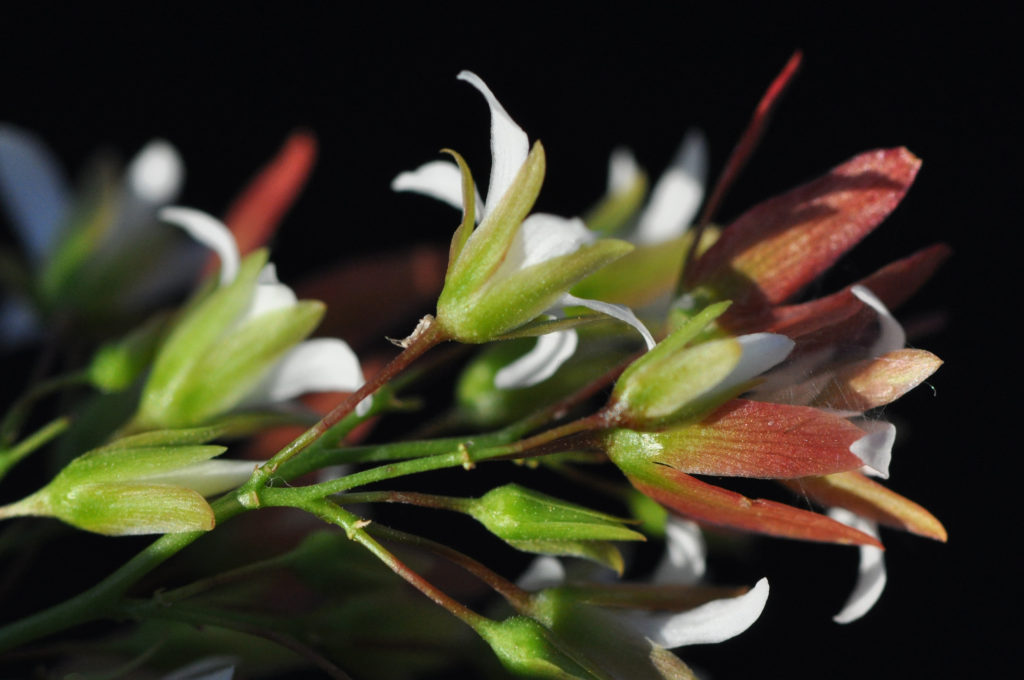
- Female. 760. 2017/11/07. Walter Sisulu NBG. Photo: David Becking.
Fruit
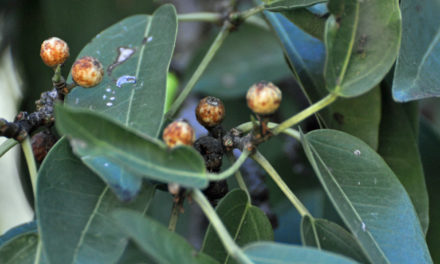
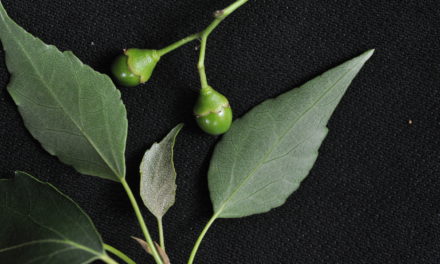
The hidden small (diameter 4mm) mature red Fruit is a dry Drupe (a 1-seeded indehiscent fruit with the seed enclosed in a stony endocarp; stone fruit like a peach). The persistent, accrescent (continuing to grow after flowering) Sepals become bright red, (photo 611) and conspicuously petal-like. At this stage, they partially surround the fruit (photo 761). Styles are also persistent. The Skin of the fruit produces a black sticky substance that sticks to the hands and is difficult to rub off – hence the common names including tarwood. The Seeds are compressed and lack endosperm (the starch and oil-containing tissue of many seeds; often referred to as the albumen). Seeds germinate easily but are difficult to transplant. (Jan-Aug).
-
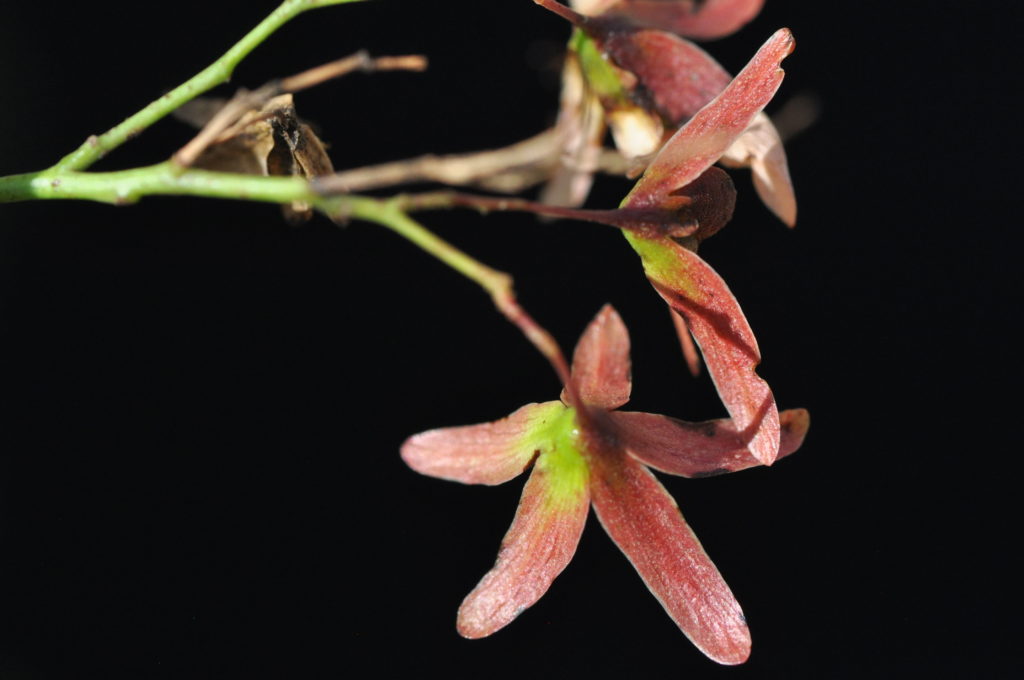
- 611. 2017/01/24. Walter Sisulu NBG. Photo: David Becking.
-
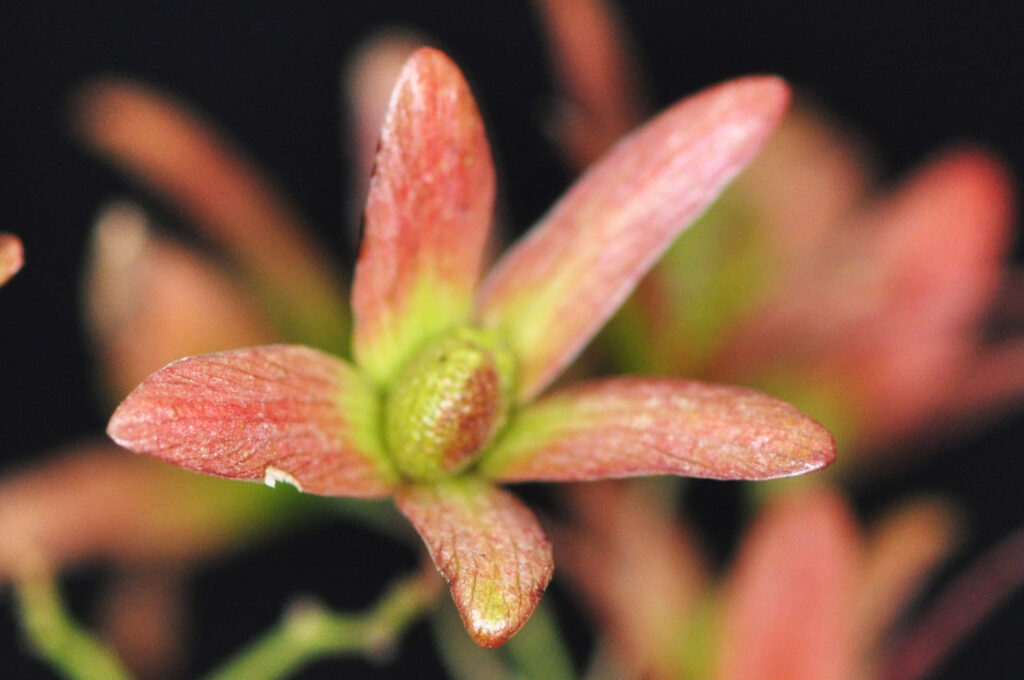
- 761. 2017/02/07. Walter Sisulu NBG. Photo: David Becking.
Distribution & Ecology
These plants occur in bushy areas, forests, forest margins and rocky (sandstone and quartzite) outcrops up to slightly less than 1 400m. They also occur in kloofs (steep-sided, wooded ravines or valleys). Trees can tolerate light frost and are drought resistant. They are located in the Western and Eastern Cape e.g., in the Suurberg mountains north of Port Elizabeth and in KwaZulu-Natal up the coast to Durban. This plant is Endemic (Endemism is the ecological state of a species being unique to a defined geographic location) in the Western Cape, Eastern Cape and KwaZulu-Natal of South Africa.
Ethnobotany
The plants have a spreading habit with non-invasive Roots. Seeds, which should be planted in full-sun – in the spot where they are required because they do not transplant well. Only the female plant produces red fruit – hence the need to grow both male and female plants for fruit production. This can best be achieved by using cuttings from male and female plants. Plant in full sun and reasonably spaced apart. Bark and leaves are used in local medicine. Plant extracts have been shown to have the potential to be used as an antifungal agent against Aspergillus fumigatus. This fungus is a problem in the poultry industry.
References
Abbott, A.T.D., Williams, V.L. & Raimondo, D. 2016. Loxostylis alata A.Spreng. ex Rchb. National Assessment: Red List of South African Plants version 2024.1. Accessed on 2025/12/07.
Boon, R. 2010. Pooley’s Trees of eastern South Africa. Flora and Fauna Publications Trust, Durban.
Coates Palgrave, M. 2002. Keith Coates Palgrave Trees of Southern Africa, edn 3. Struik, Cape Town.
Lawrence, G. H. M, 1951. Taxonomy of Vascular Plants. The Macmillan Company, New York. Tenth Printing 1965.
Palmer, E. & Pitman, N. 1972. Trees of southern Africa. Balkema, Amsterdam, Cape Town.
van Wyk, B. & van Wyk, P. 1997 Field guide to Trees of Southern Africa. Struik, Cape Town.
http://global.britannica.com/plant/Anacardiaceae
http://repository.up.ac.za/bitstream/handle/2263/21087/Suleiman_Controlled%282012%29.pdf?sequence=1
http://www.poultrydvm.com/supplement/loxostylis-alata