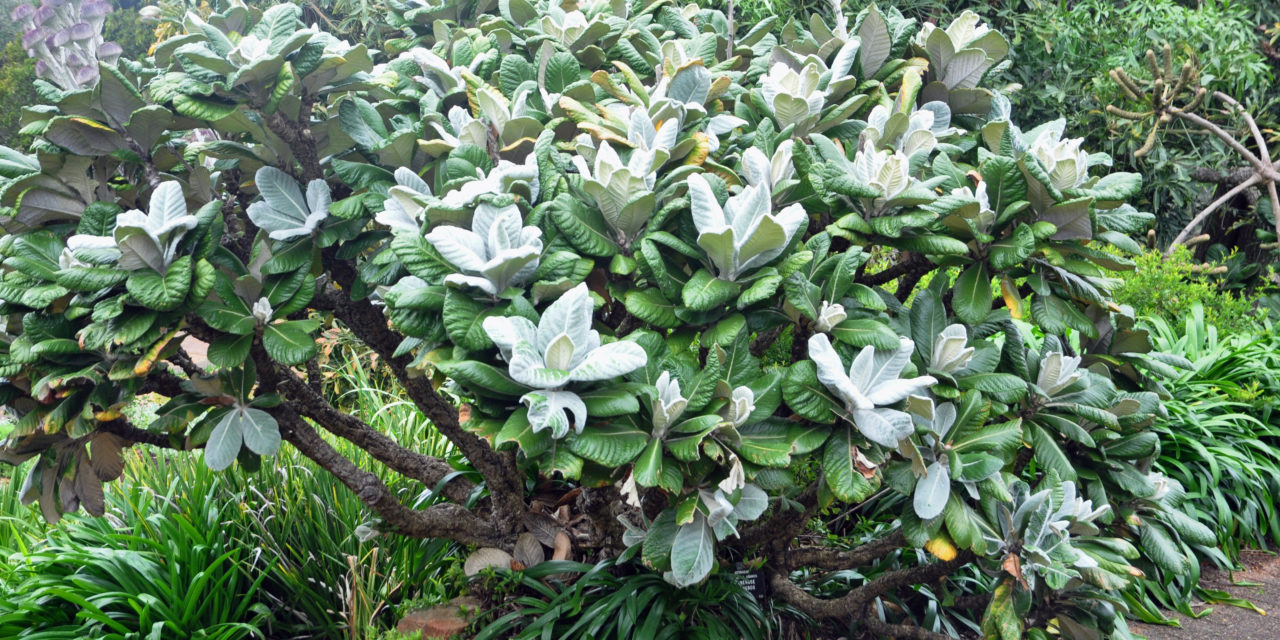
Oldenburgia grandis
General Information – Summary
This fire-resistant shrub or Tree with its thick stem & corky bark is up 6m high. Young Leaves are white and become bicoloured, large, leathery, stiff, simple & widely rolled under. Arising on a peduncle from the centre of the leafy rosette is a purplish, bract-lacking capitulum, with many small Florets. Lanceolate anthers present. Style emerges from the inferior ovary. Fruit is a tufted cypsela + 1 wind dispersed seed.
Description
Previous Names: Arnica grandis, Oldenburgia arbuscular.
SA Tree No. 737.
Common names: (Afr) Suurberg Kussingbos, Suurberg-kussingbos. (Eng) Donkey’s ears, Donkeys-ears, Rabbit’s ears, Lamb’s ears, Mountain hunchback, Oldebburgia, Suurberg Cushion Bush, Suurberg Daisycushion.
Family Asteraceae, Compositae. (Daisy family: includes sunflowers, lettuce, chicory and marigolds). There are in excess of 1 900 genera and close to 33 000 species. This is possibly the second biggest plant family. In southern Africa, there are 246 genera and about 2 300 species. Local genera containing trees on this website include Brachylaena, Oldenburgia and Tarchonanthus. Some members have flowers grouped in heads and the whole head may appear to be a single flower – like the “sunflower”. Surrounding each flower are bracts. Individual Flowers have sepals replaced by a pappus which may be bristle, plume, scale or awn like. Individual flowers are called Florets that may have 5 fused petals. In the Asteraceae, the flowers are called florets. All members have, Central or Disc Florets present. In some members, excluding Brachylaena, Outer or Ray Florets are also present. These occur around the periphery and are usually long and brightly coloured e.g., yellow outer florets in the sunflower. Each inferior Ovary contains one Ovule, and the Style has 2 lobes.
Name derivation: Oldenburgia– named after Franz Pehr Oldenburg who was a Swedish soldier who worked for the Danish Company of the East Indies. He also collected plants from 1772 – until he died from a fever in Madagascar in 1774. He spent a couple of years in South Africa with Thunberg and Masson. grandis – large: presumably referring to the flowerheads.
Conservation Status: L C. (Least Concern). Assessed: 2005 (A.G. Rebel0 et al.).
Tree
This slow growing plant is a small Tree with a maximum height of 6m. It may also be a dwarf shrub. The plant may be stemless or the gnarled Stem may reach a circumference of 46cm. Covering the thick stem are the remains of old leaf bases (photo 320). The thick dark Bark (photo 321) is corky with woolly layers below. The young branches (photo 312) are stiff, spreading and the youngest ones appear white due to a woolly covering. Emma Mostert (associated with Rhodes University – department of Botany) describes the plant as, “A very strange plant that looks almost prehistoric”.
-
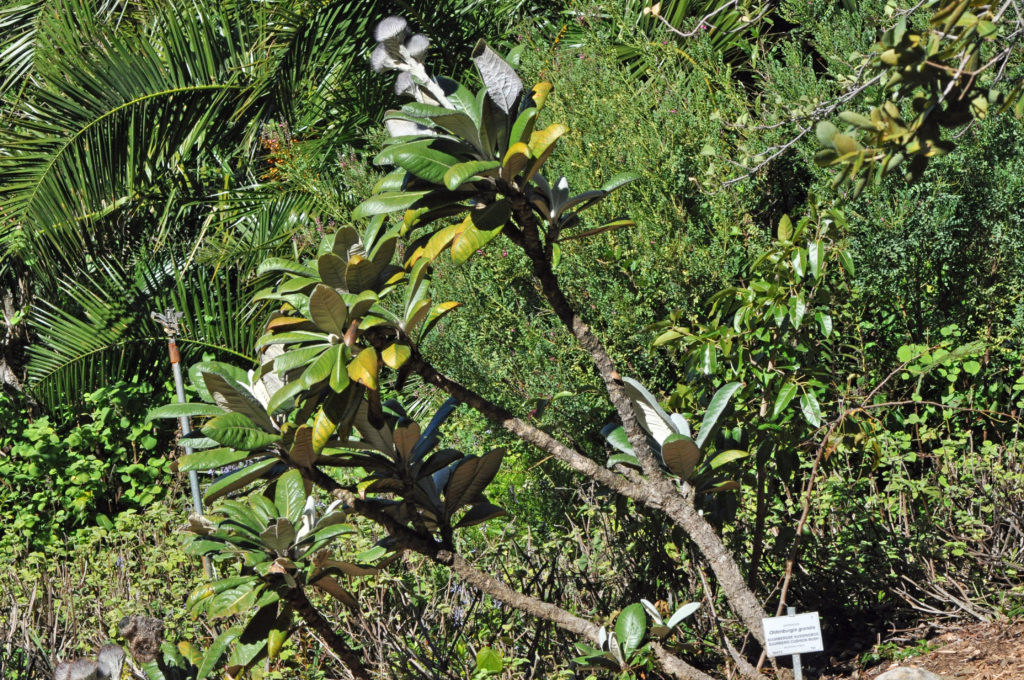
- 312. 2018/09/15. Kirstenbosch NBG. Photo: David Becking.
-
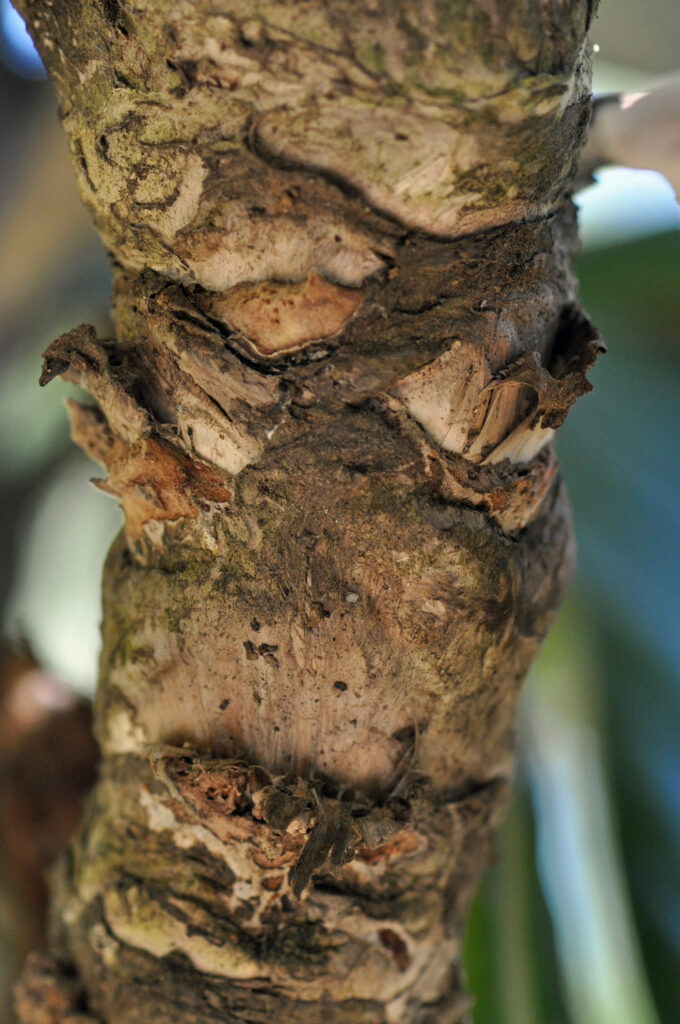
- 320. 2018/09/15. Kirstenbosch NBG. Photo: David Becking.
-
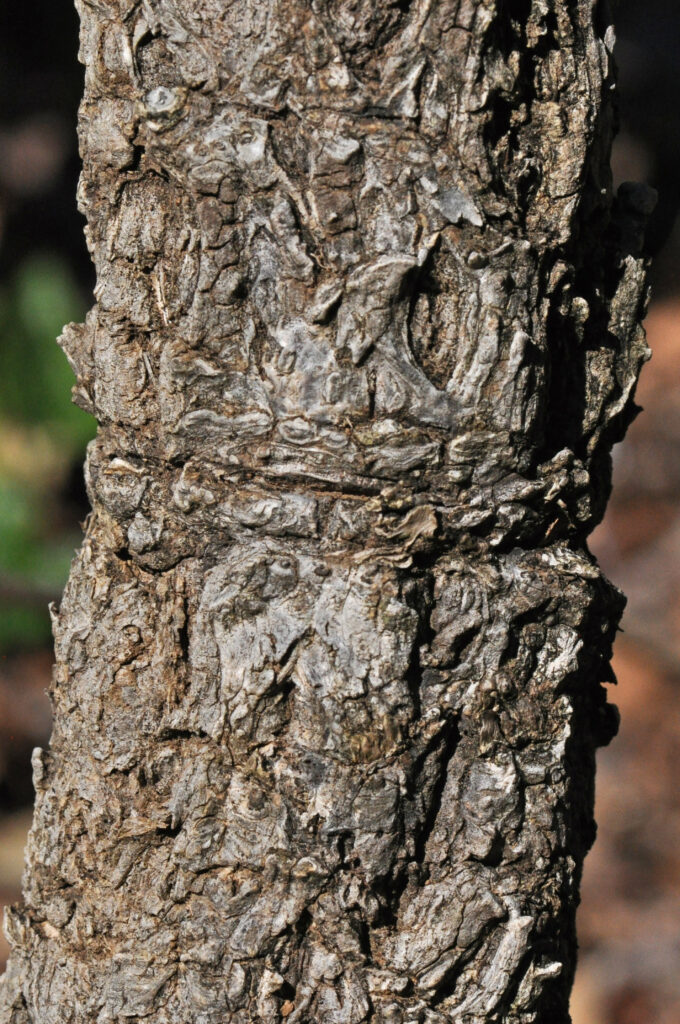
- 321. 2018/09/15. Kirstenbosch NBG. Photo: David Becking.
Leaves
The attractive Leaves develop at branch ends. Here the initially white folded up leaves (photo 316) expand, and are silvery white on both sides. In this photo, the young light coloured midrib is clearly visible. Leaves emerge with each successive pair at right angles to the previous one. Initially they are short, fat and densely tomentose (covered with densely matted woolly hairs – photo 315). At this stage, they are ear-shaped (see common names & photo 315). In texture, they are similar to young rabbit’s ears. From a distance the young white leaves against the much darker green mature leaves have the appearance of large flowers (photo 887).
As they mature leaves become dark green, large (up to 35 x 15cm), extremely leathery and very stiff. Each leaf is now oblong, ovate (egg-shaped) or elliptic and simple (have a single blade that may have incisions that are not deep enough to divide the leaf into leaflets – photo 887Enl). The Apex is rounded or bluntly pointed. Petiolues (stalks of leaflet) and Petioles (Leaf stalk) are absent (photo 316). The untoothed Margins are entire (with a continuous margin, not in any way indented) and widely rolled under (photo 318). The Blade of a mature leaf is impressively bicoloured: the upper surface is noticeably a shiny dark green (photo 887) and the lower surface is a velvety creamy-white and woolly (photo 319). The broad Midrib is distinctively creamy white on both surfaces (photos 887En & 319) and lateral Veins are clearly visible on both sides. They protrude below (photo 319) and are sunken above (photo 315).
-
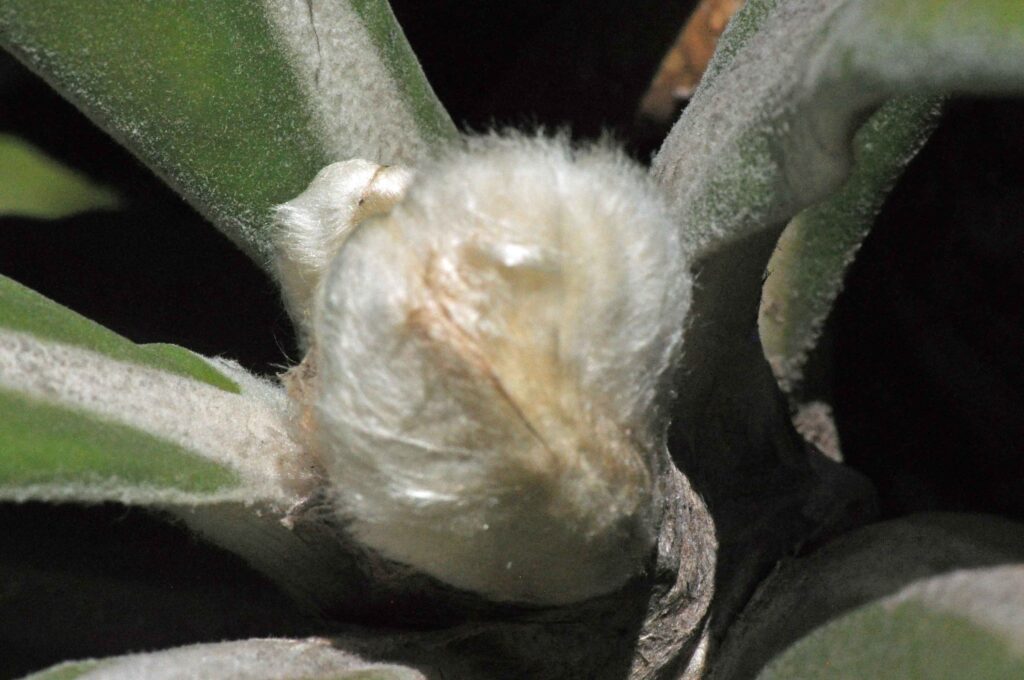
- 316. 2018/09/15. Kirstenbosch NBG. Photo: David Becking.
-
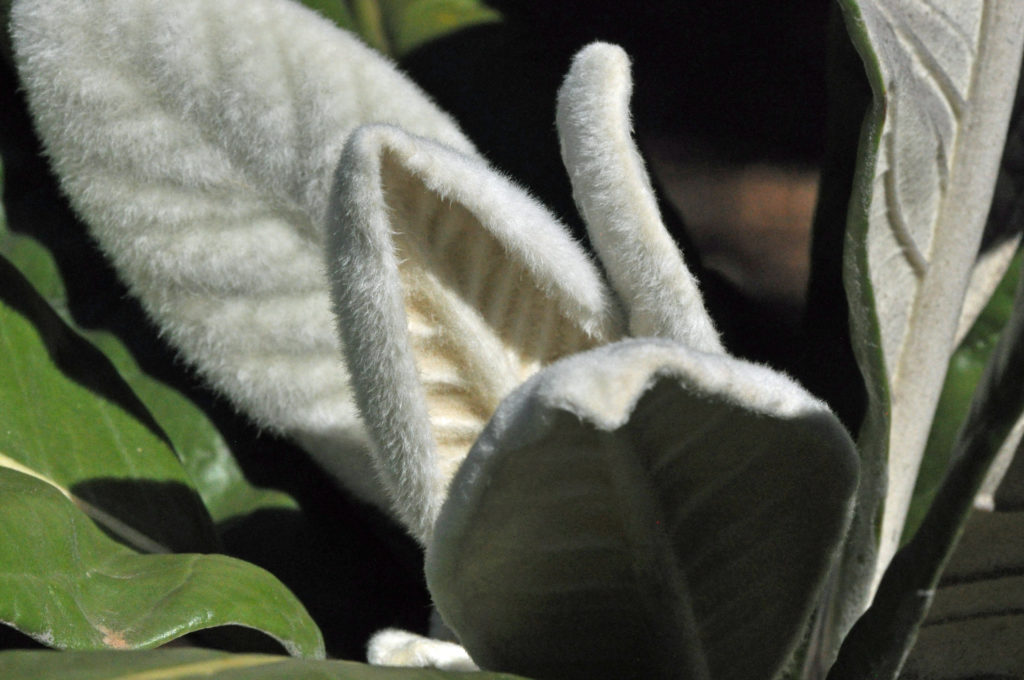
- 315. 2018/09/11. Kirstenbosch NBG. Photo: David Becking.
-
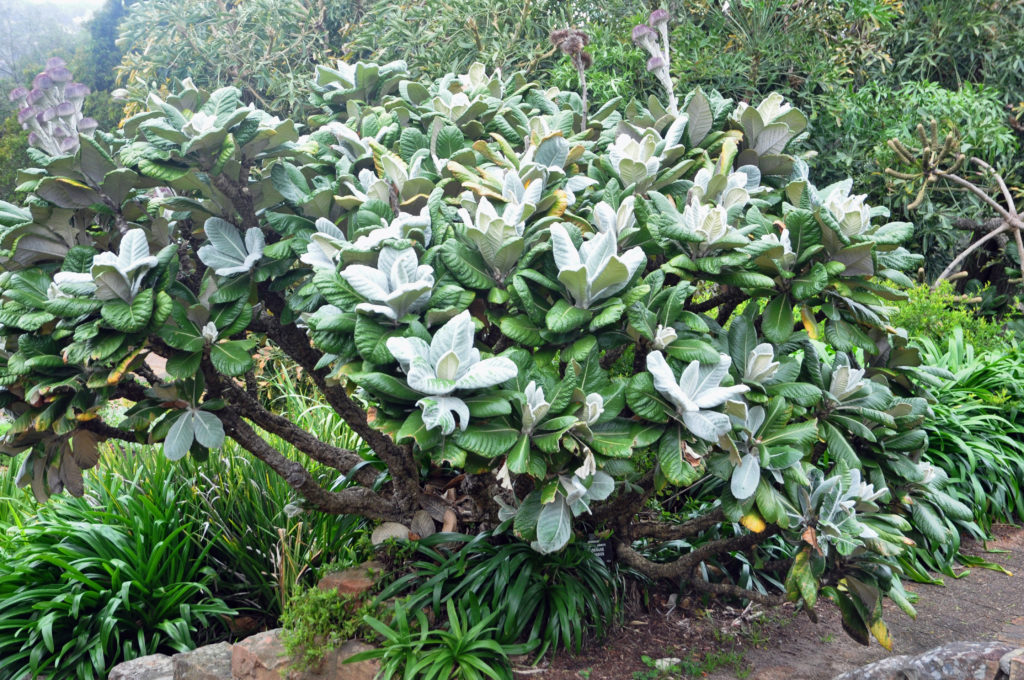
- 887. 2018/09/15. Kirstenbosch NBG. Photo: David Becking.
-
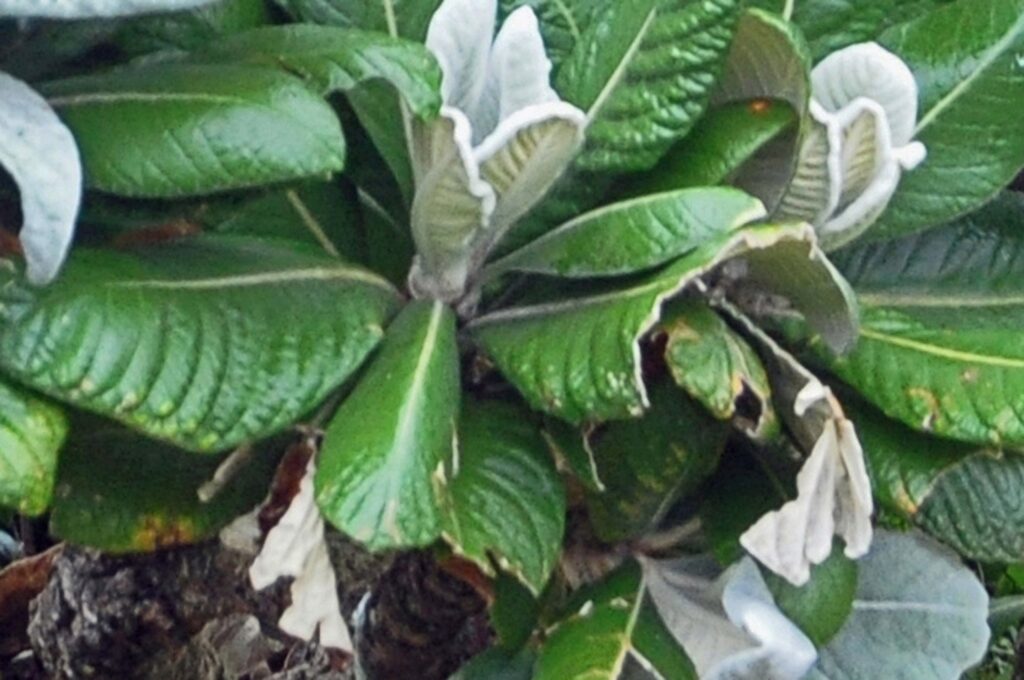
- 887Enl 2018/09/15. Kirstenbosch NBG. Photo: David Becking.
-
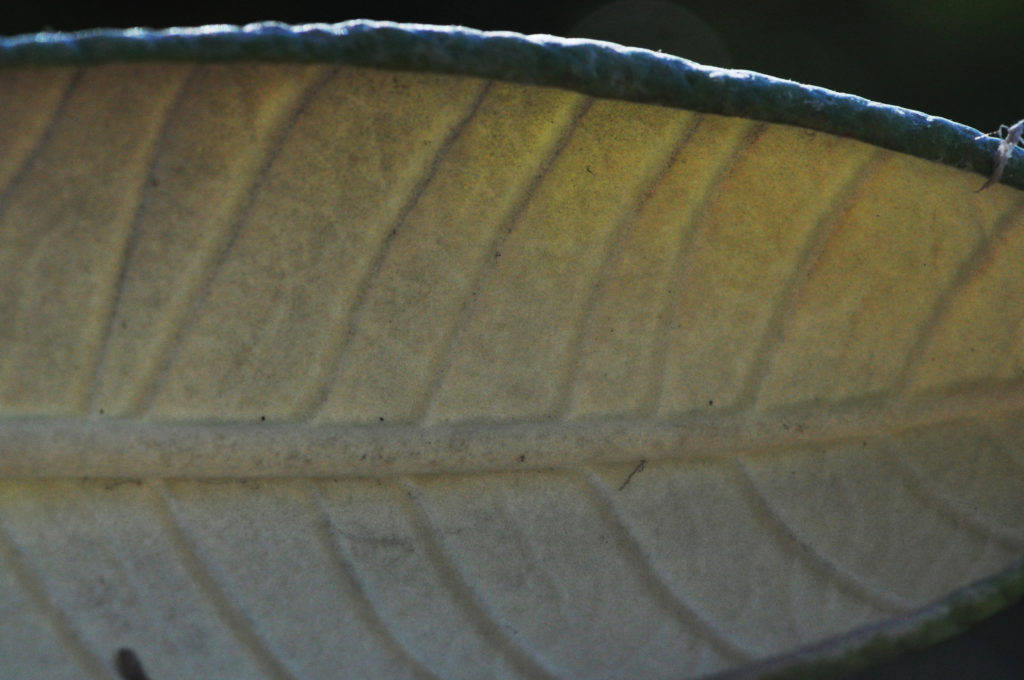
- 318. 2018/09/15. Kirstenbosch NBG. Photo: David Becking.
-
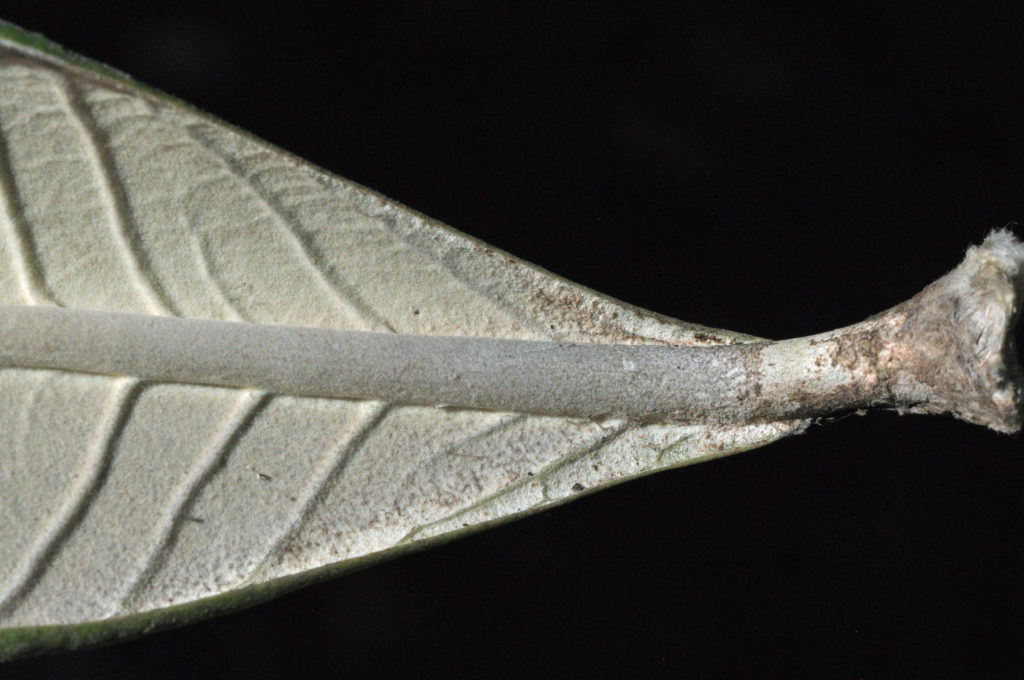
- 319. 2018/09/15. Kirstenbosch NBG. Photo: David Becking.
Flowers/Florets
Flowers arise from the centre of the leaf rosette (an arrangement of leaves radiating from a crown or centre) of leaves (photo 312 under Tree). The solitary, stout, velvety and purplish Peduncle (here referring to the stalk of a flower cluster – photo 313) is up to 50cm long has several leaf-like Involucral (standing underneath) bracts. This peduncle terminates in the large, honey-scented, sunflower-like, purplish cream Capitulum (a dense inflorescence having a collection of usually sessile flowers in the form of a disc with the youngest at the centre – photo 317). These terminal capitula are up to 13cm wide and constitutes the widest of our indigenous Family Asteraceae (photo 313). In the Involucre (here the whorls of bracts standing underneath each flower-cluster), the outer layers of bracts are shorter (photo 313). The Receptacle is that expanded tip of the flower stalk from which the floral parts develop and is greatly expanded in the Asteraceae and in Ficus. Here it lacks bracts and has honeycomb-like cavities.
Florets (Individual flowers mainly in Asteraceae and grasses that make up a dense form of inflorescence) are terminal. Ray Florets (often attractive yellow in the sunflower (photo 197) but only white here), that may resemble petals of other flowering plants and occur in the outer circle of the capitulum. These ray florets have a long white, bilabiate corolla. The outer lip is long, and the inner lip has 2 delicate linear, curled lobes. The numerous Disc florets (flowers) have 5 fused petals at the base and are actinomorphic (Regular, symmetrical. Flowers are vertically divisible into similar halves by more than 1 plane passing through the axis). Individual disc florets mature from the circumference towards the centre of the capitulum. The creamy Stamens with filiform (thread-like) Filaments (the slender stalk that supports the anther) have lanceolate Anthers (where the pollen grains are formed) with an arrow–shaped base. The Style (more or less elongated part of the pistil situated between the ovary and the Stigma (the part of the pistil that receives the pollen). Here the stigma emerges from an inferior Ovary that is circular in cross section. (May-Jun but most of the year). Apart from the lack of attractive bracts the capitulum somewhat resembles that of the Protea e.g. the impressive Protea cynaroides – (photo 197).
-
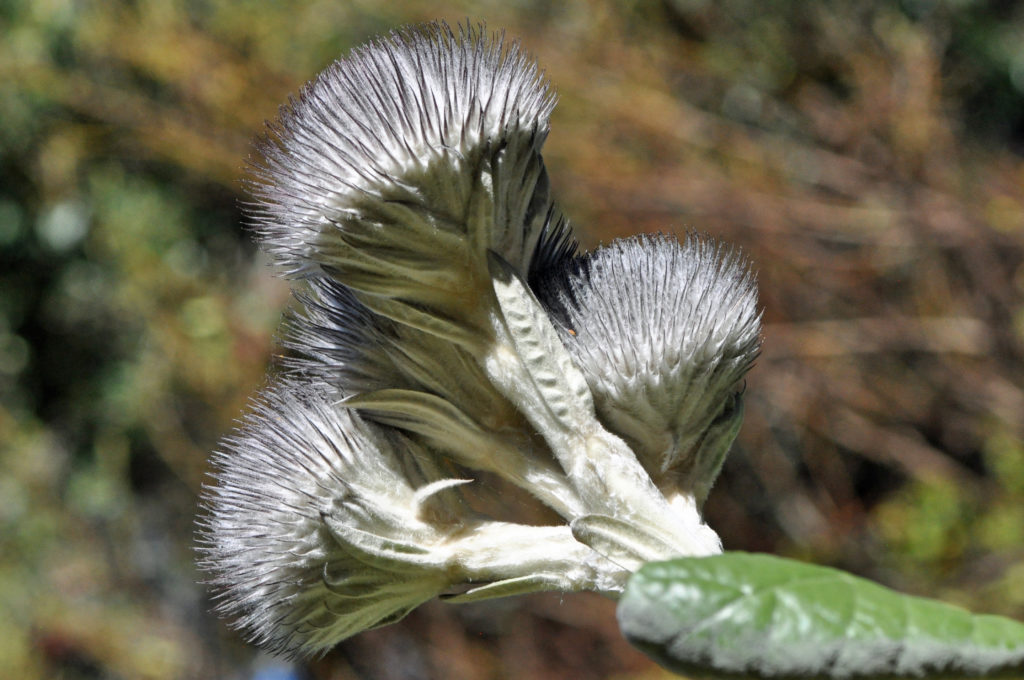
- 317 2018.09.15 Kirstenbosch NBG. Photo: David Becking.
-
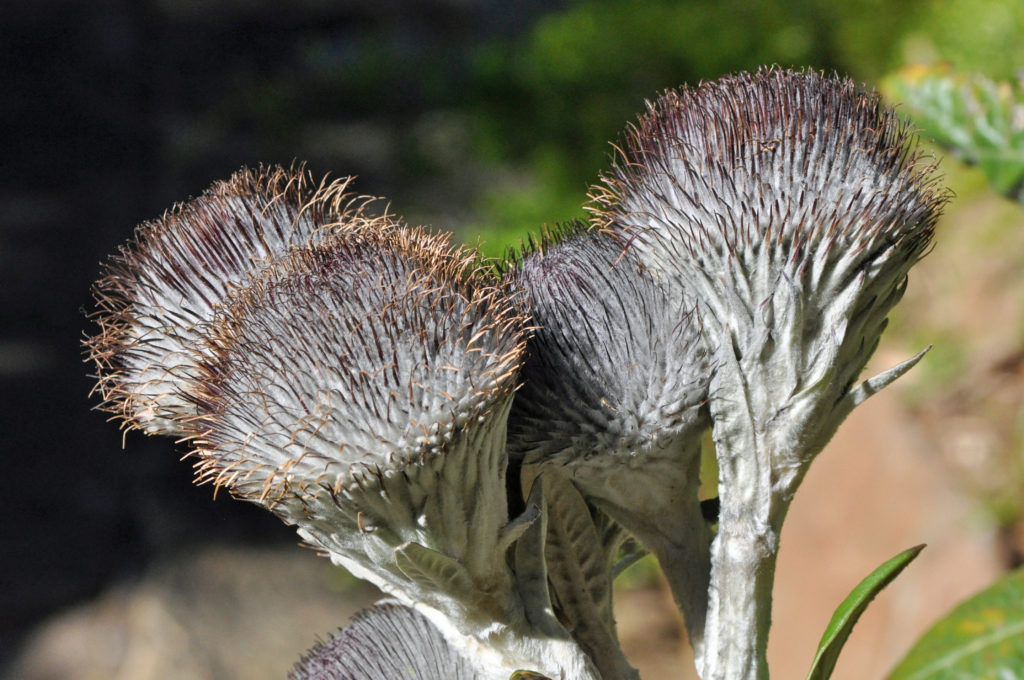
- 313 2018.09.15 Kirstenbosch NBG. Photo: David Becking.
-
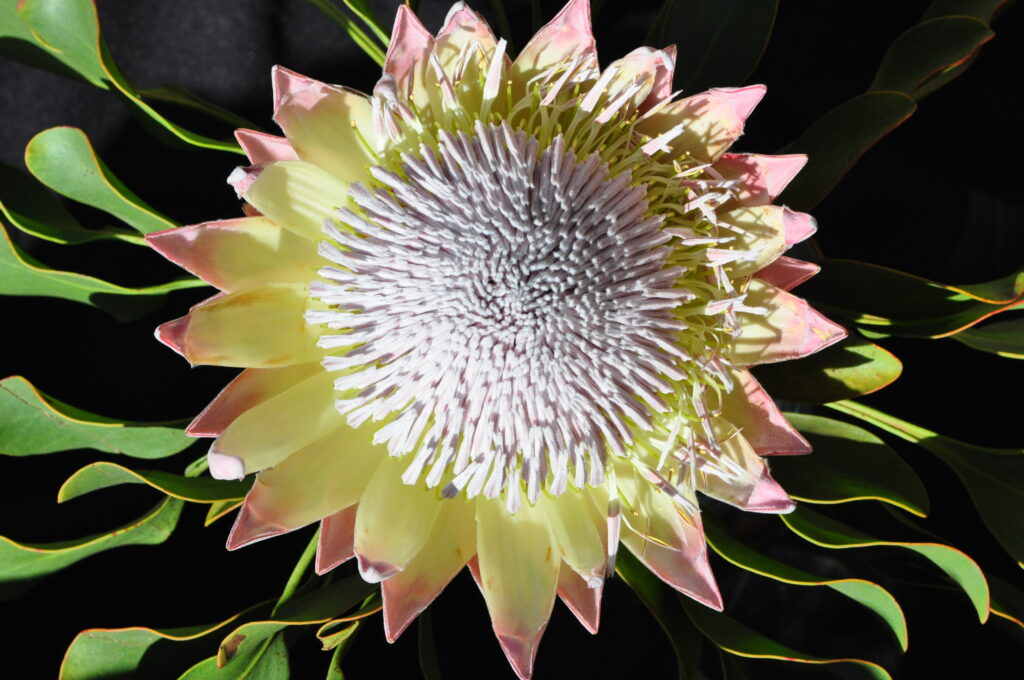
- 197. 2019/10/04. Kirstenbosch NBG. Photo: David Becking.
Fruit
The Fruit is a Cypsela (an Asteraceae fruit is a dry single-seeded fruit formed from a double ovary of which only one develops into a seed. This fruit develops a hard covering. The seed has an apical tuft containing a single row of stiff bristles that act as a parachute to aid wind dispersal.
-
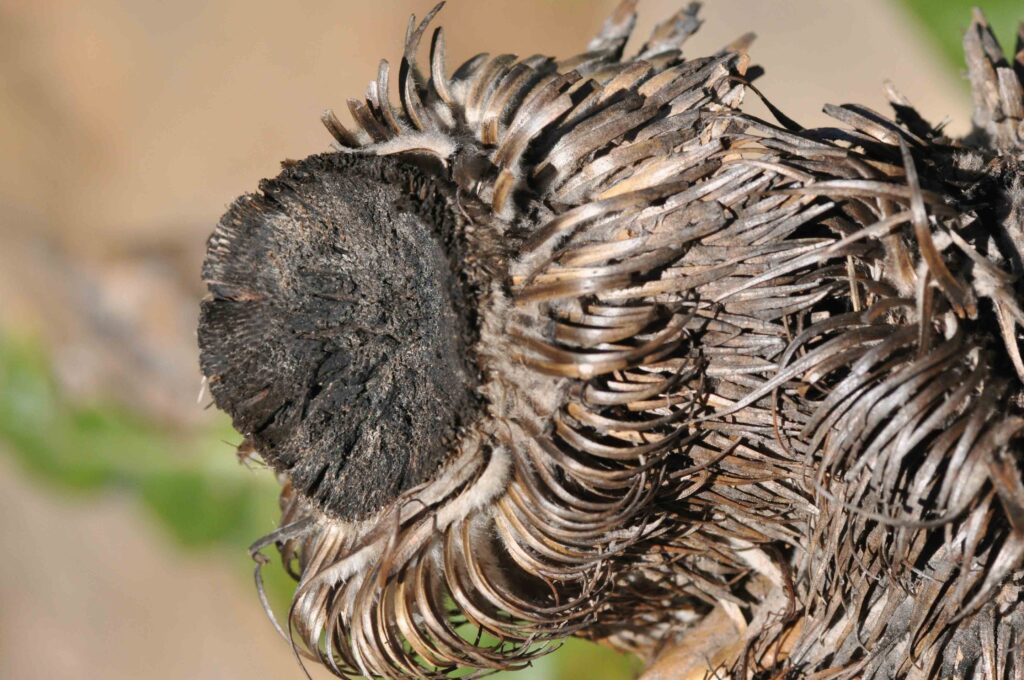
- 314. 2018/09/15. Kirstenbosch NBG. Photo: David Becking.
Distribution & Ecology
The native range of this species is Cape Prov. It grows primarily in the subtropical biome. This plant is Endemic (Endemism is the ecological state of a species being unique to a defined geographic location) in the Eastern Cape – specifically in the mountains from Makhanda (Grahamstown until 2018). Here rocks age from about 400 million years ago till now. There are 3 main divisions of rock. The lowest (base) is the Cape Supergroup, followed by the massive Karoo Supergroup that extends into Namibia, Botswana and Zimbabwe. On top is the younger sedimentary and alteration deposits which occur along the coast but also in Makhanda. From the Makhanda the plant occurs to Port Elizabeth and occurs on hard Witteberg quartzite (rock composed almost entirely of quartz. It is non-foliated and usually forms from the metamorphism of sandstone. Here rainfall occurs mainly in summer. This plant has a corky, fire-resistant bark that provides the ability to regrow after a fire. Young leaves are thick and very hairy, and these silver hairs protect them from the heat, sun and wind. Agents of pollination include the endemic, long tailed, fynbos Cape Sugarbird, Promerops cafer and the Cape honeybee, Apis mellifera capensis – which is a southern South African subspecies of the western honeybee. It plays an important part in the Cape by pollinating crops and honey production. The cliff nester Red-winged Starling, Onychognathus morio with its long-pointed tail, black feet legs and beak, also visits this plant, which is able to support the bird’s weight (80g). Its habitat extends from the Western Cape, includes the Eastern Cape and upwards through KwaZulu Natal and northwards through Eastern Africa.
Ethnobotany
The leaves may be poisonous to man (contain saponins that are bitter-tasting and usually toxic plant-derived organic chemicals that have a foamy quality when agitated in water). Saponins are both water and fat soluble, which gives them their useful soap properties. They may serve as antifeedants (organic compounds produced by plants, which inhibit attacks by grazing animals including insects, microbes and fungi. Worldwide fishing communities have used plants that kill fish and most of these contain saponins. Oldenburgia grandis is a very interesting plant. It is difficult to germinate from seeds, but semi-hard cuttings may be successful. Plant in full sun, in a well-drained, acidic area and do not water in winter. The temperatures should be above zero.
References
Coates Palgrave, M. 2002. Keith Coates Palgrave Trees of Southern Africa, edn 3. Struik, Cape Town.
Ginn P, McIlleron W. Milstein P. 1991. The Complete Book of Southern African Birds. Struik, Cape Town.
Lawrence, G. H. M, 1951. Taxonomy of Vascular Plants. The Macmillan Company, New York. Tenth Printing 1965.
Palmer, E. & Pitman, N. 1972. Trees of southern Africa. Balkema, Amsterdam, Cape Town.
National Assessment: Red List of South African Plants – not available on 2025/10/25.
Rebelo, A.G., Helme, N.A., Holmes, P.M., Forshaw, C.N., Richardson, S.H., Raimondo, D., Euston-Brown, D.I.W., Victor, J.E., Foden, W., Ebrahim, I., Bomhard, B., Oliver, E.G.H., Johns, A., van der Venter, J., van der Walt, R., von Witt, C., Low, A.B., Paterson-Jones, C., Rourke, J.P., Hitchcock, A.N., Potter, L., Vlok, J.H. & Pillay, D. 2005. Oldenburgia grandis (Thunb.) Baill. National Assessment: Red List of South African Plants version 2020.1. Accessed on 2023/09/21.
van Wyk, B. & van Wyk, P. 1997 Field guide to Trees of Southern Africa. Struik, Cape Town.
http://hdl.handle.net/10962/d1003799
http://pza.sanbi.org/oldenburgia-grandis
https://stop-over.co.za/saving-the-old-man-oldenburgia-grandis/
https://plants.jstor.org/stable/10.5555/al.ap.person.bm000058416
https://en.wiktionary.org/wiki/grandis#Synonyms