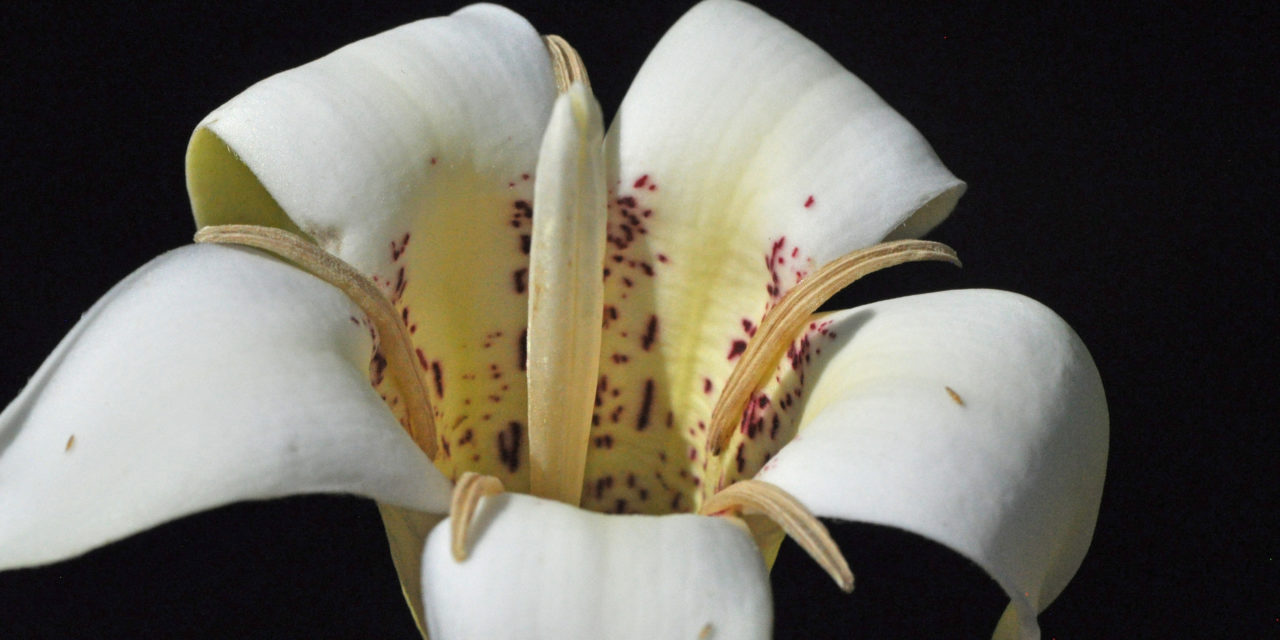
Rothmannia capensis
General Info – summary
This shrub or stocky evergreen Tree lacks spines and usually up 10m high. Bark becomes rough. Simple opposite Leaves with entire margins are glossy and leathery. Flowers: large solitary stalkless terminal & 5-merous scented regular, develop in leaf axils. 5 long sessile anthers, single pistil + one two-chambered ovary. Ripe brown Fruit to 7cm wide + persistent calyx. Many seeds develop in a pulpy placental tissue.
Description
Previous Names: Gardenia capensis, Randia bellatula, Gardenia rothmannia.
SA Tree No. 693.
Common names: (Afr) Aapkos, Aapsekos, Bergkatjiepiering, Bobbejaanappel, Kaapse Katjiepiering, Swarthout, Valskatjiepiering, Wildekatjiepiering, Witklokke. (Eng) Candlewood, Cape Gardenia, Common Rothmannia, Stately Rothmannia, Wild Gardenia. (isiXhosa) Isithebe, Umzukuza, Umgupa, Ibolo. (isiZulu) isiqathankobe, Umphazane-omkhulu. (Northern Sotho) Modula-tshwene, Monkgobo. (siSwati) Sikhokho. (Tshivenda) Mukubudu, Muratha-mapfene.
Common names: (Afr) Aapkos, Aapsekos, Bergkatjiepiering, Bobbejaanappel, Kaapse Katjiepiering, Kershout, Swarthout, Valskatjiepiering, Wildekatjiepiering, Witklokke. (Eng) Candlewood, Cape Gardenia, Common Rothmannia, Stately Rothmannia, Wild Gardenia. (isiXhosa) Isithebe, Umzukuza, Umgupa, Ibolo. (isiZulu) isiqathankobe, Umphazane-omkhulu. (Northern Sotho) Modula-tshwene, Monkgobo. (siSwati) Sikhokho. (Tshivenda) Mukubudu, Muratha-mapfene.
Family: Rubiaceae (Coffee/Gardenia family). This family of dicotyledonous plants has in excess of 600 genera and about 13 000 species and members include trees, shrubs and herbs. The plants are terrestrial and predominantly woody and sometimes Scandent (climbing without the aid of tendrils). Local genera with trees on this website include Afrocanthium, Canthium, Coddia, Gardenia, Pavetta, Rothmannia and Vangueria. Leaves are simple, opposite or whorled and have interpetiolar stipules. The 4 or 5 merous, usually regular Flowers are bisexual or unisexual. The calyx has sepals that are at least partly united. Petals are joined – at least at the base. Stamens are usually as many as corolla lobes and alternating with them. The Ovary is inferior. Fruit is a drupe, berry or capsule.
Name derivation: Rothmannia: named by Carl Peter Thunberg after his friend: Dr Goran Rothman (1739-1778) a Swedish botanist, physician, translator, African explorer and pupil of Linnaeus. capensis: of the Cape. Thunberg first collected Rothmannia capensis in 1776. The genus Rothmannia has 3 species in South Africa.
Conservation National Status: L C (least concern). Assessed: Raimondo et al. (2009).
Tree
This is an impressive addition to a garden. It may be a shrub or a sturdy, stocky Tree with a small Crown and is usually up to 10m high but may reach at least 23m in forests. The straight slender trunk has Bark that is initially smooth and somewhat pale, grey-brown (photo 281) and darkish. With aging, bark becomes rough and finely cracked by horizontal lines into segments. This may reveal a reddish underbark (photo 971). The slightly rough Branches are erect and spineless (photo 972). This tree is taller than other Rothmannia species.
-
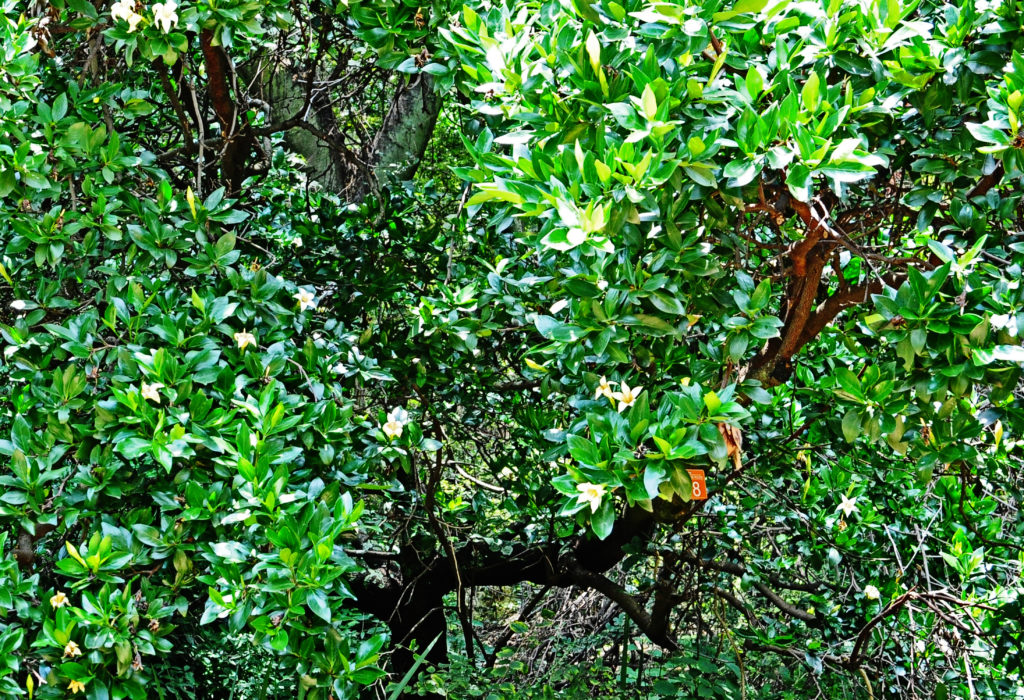
- 569M. 2014/01/21. Walter Sisulu NBG. Photo: David Becking.
-
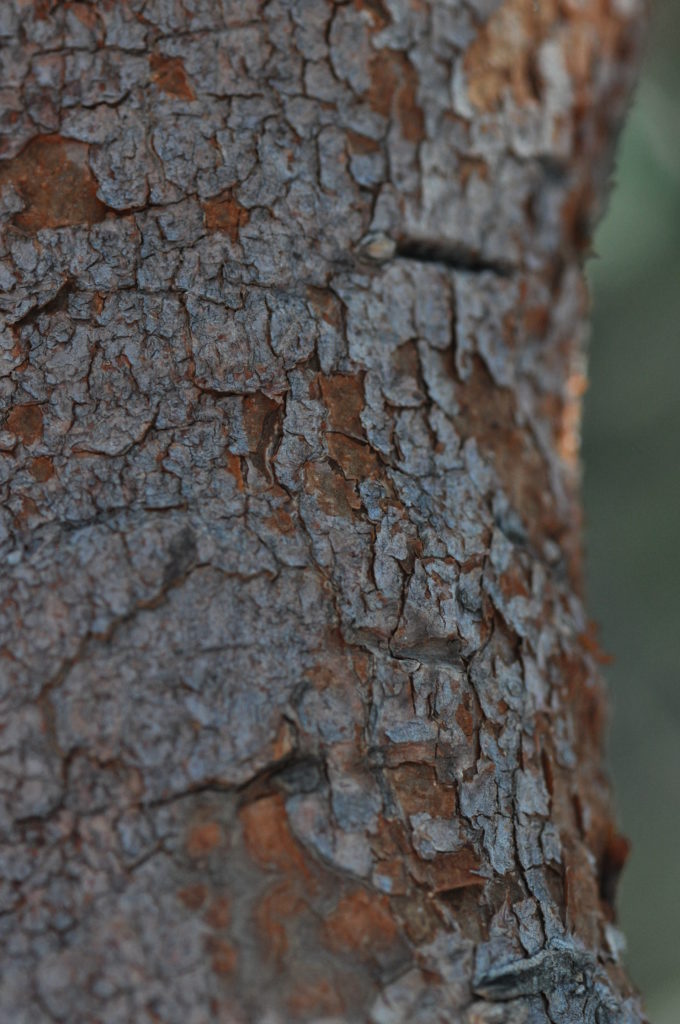
- 971. 2017/11/14. Pretoria NBG. Photo: David Becking.
-
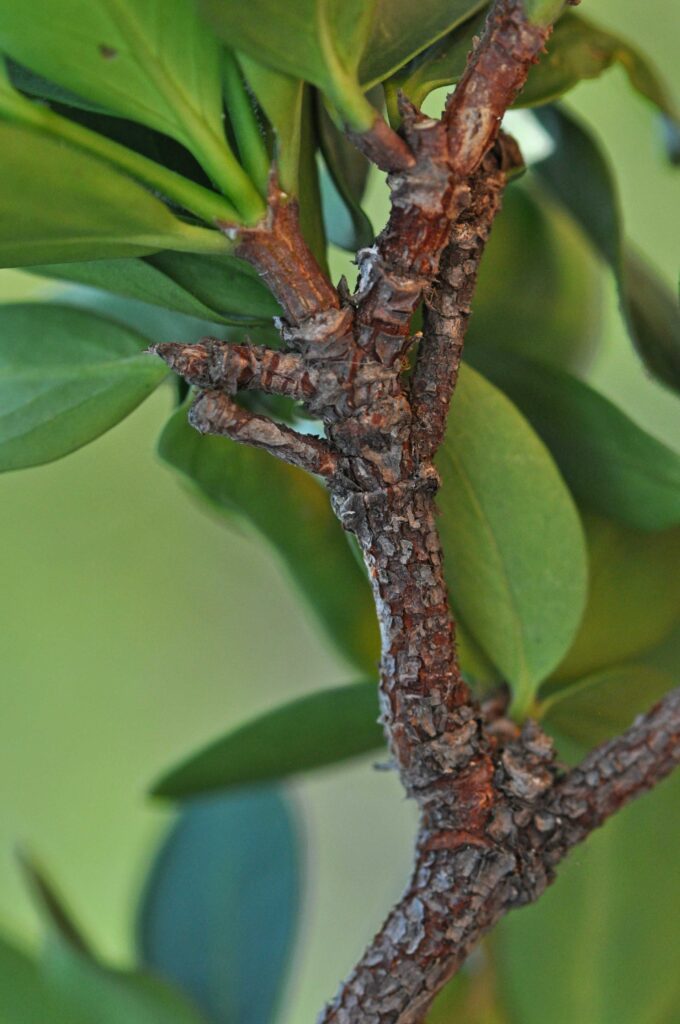
- 972. 2017/11/14. Pretoria NBG. Photo: David Becking.
Leaves
On this evergreen tree, the glossy and leathery Leaves usually develop near the ends of branches (photo 972 under Tree). Each leaf is up to 11 x 4cm and simple (has a single blade which may have incisions that are not deep enough to divide the blade into leaflets). Although they are usually opposite, a third leaf may also be present. When leaves do fall, they leave a leaf scar (photo 972 under Tree). Leaves are velvety and light green when young (photo 973) and become hairless as they age. The mature Blade is elliptic to oval or slightly lanceolate. It is shiny dark green above and a lighter green below (photo 577). Young leaves are folded around the Midrib (the main rib of the leaf). Midrib and side Veins protrude below and are lighter and just visible above (photo 577). Distinct raised pockets with Domatia (hair-tuft domatia – a tiny chamber produced by plants that house arthropods like insect & arachnids) are present. They occur as surface swellings in the vein axils. Even without a hand lens, their small bumps are visible – more so on the upper surface (photo 577). The waxy and possibly slightly wavy leaf Margin is entire (with a continuous margin, not in any way indented). The Apex tapers and is pointed or rounded (photo 284). The Base tapers. The Petiole (leaf stalk) is relatively short – up to 5mm long (photo 284) or absent. Stipules (basal appendages of the petiole) are ovate and hairy.
-
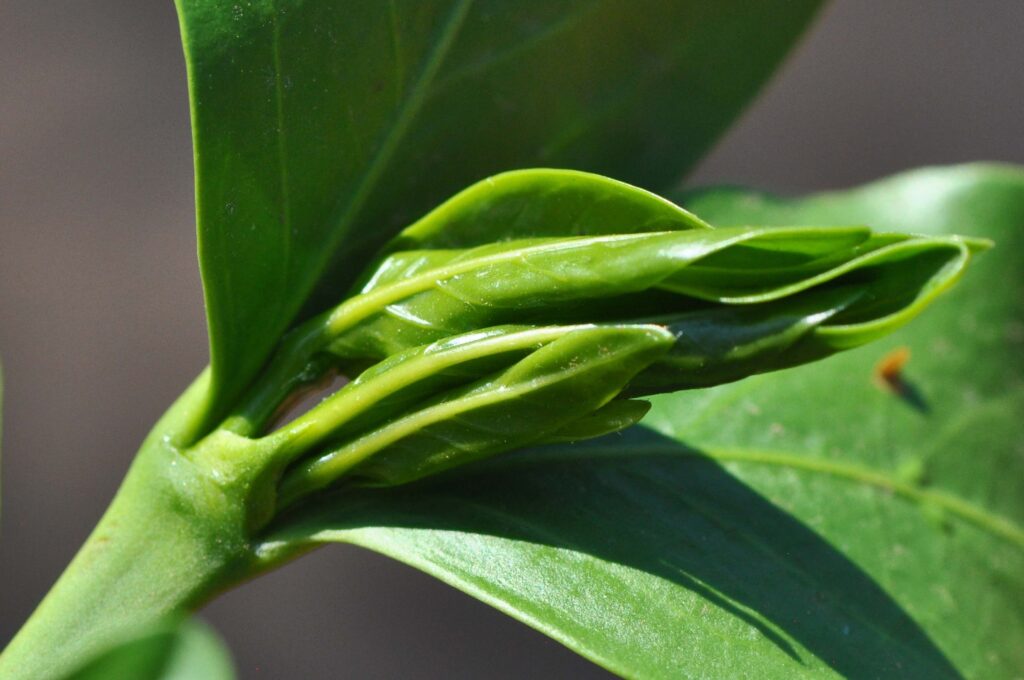
- 973. 2017/11/14. Pretoria NBG. Photo: David Becking.
-
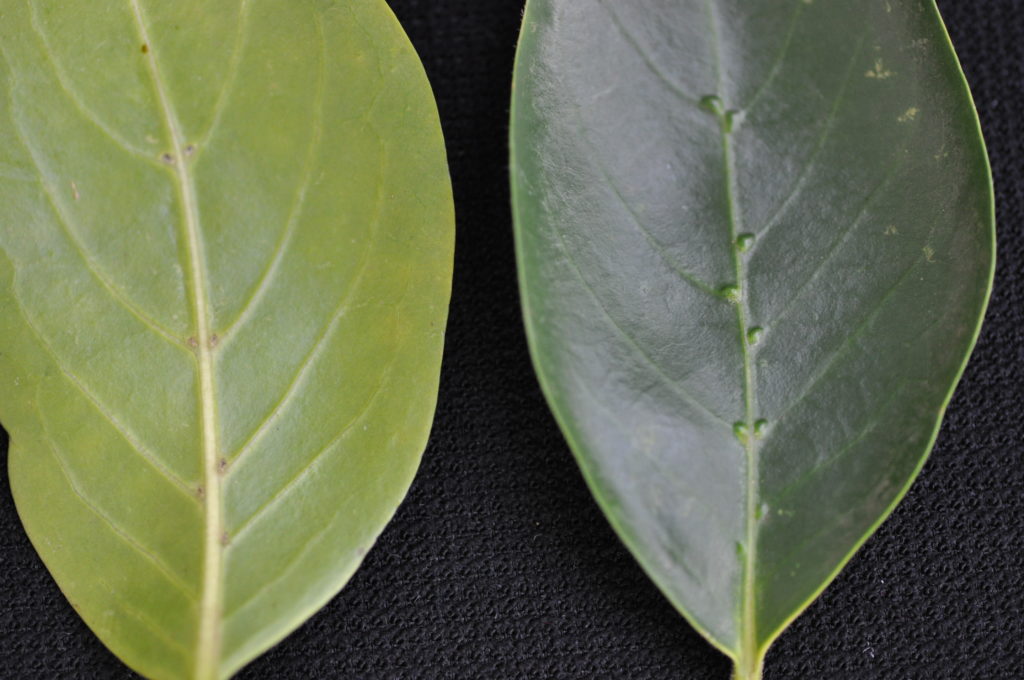
- 577. 2016/11/22. Pretoria NBG. Photo: David Becking.
-
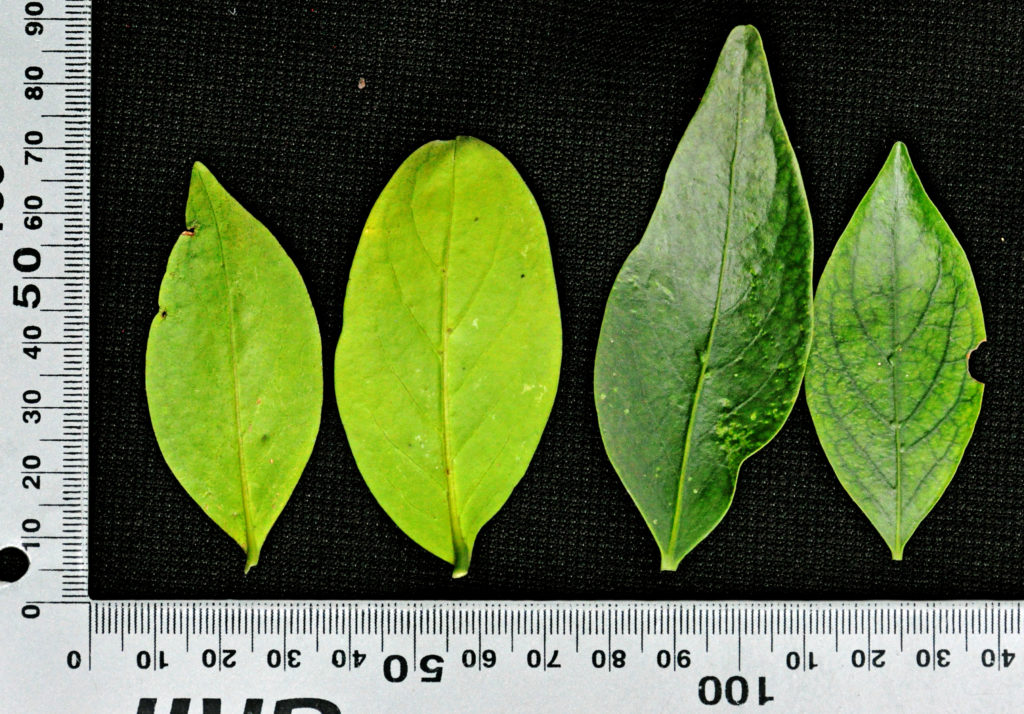
- 284. 2015/10/13. Walter Sisulu NBG. Photo: David Becking.
Flowers
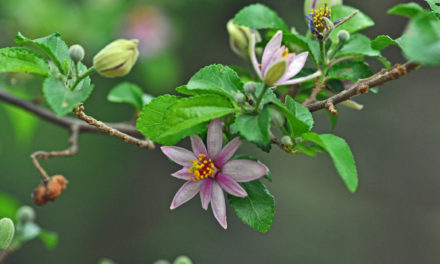
The large (up to 8cm long and 7cm wide), sessile (stalkless) terminal and solitary Flowers open in January and February. They are strongly sweetly scented. Dry flowers retain the sweet scent. The single flowers are borne in leaf axils (photo 471). Flowers are bisexual and actinomorphic (Regular, symmetrical. Flowers are vertically divisible into similar halves by more than 1 plane passing through the axis). They occur towards the ends of branches. The cylindrical Calyx tube ends with its Sepals in vertical thin lobes (15 x 2mm – photos 24, 225 & 471) that may not adhere to part of the lower corolla tube (photos 471 & 225 – under Flowers). This makes the flower distinguishable from Rothmannia globosa. The Corolla tube is funnel-shaped (photo 828) and not cylindrical as in Gardenia. This tube ends with a maximum of 5 Petal Lobes which are spreading, pointed and have recurved ends (photo 222). The inside of the corolla tube is white to cream coloured with maroon streaks and speckles in the inside. These streaks are best seen in the partly dissected flower (photo 828). White Hairs are just visible near the inner base of the tube. The 5 Stamens arise from near the corolla mouth and alternate with the corolla lobes (photo 222). Mature linear sessile and very long Anthers curl outwards between the corolla lobes (photos 222). Anthers dehisce longitudinally. In the enlarged (photo 223) of an anther, the individual pollen grains are visible. The Disc (a more or less fleshy or elevated development of the receptacle) is enlarged. There is a single Pistil (a unit of the Gynoecium, the female element of the flower, composed of the Ovary, Style and Stigma) and the inferior Ovary is two-chambered – not one as in Gardenia. It has many Ovules. There a single, hairless Style that extends about 2cm beyond the mouth of the tube (photo 828). The Stigma has a short bilobed apex. A Pollen presenter is fusiform (narrowing at both ends; spindle-shaped) to club-shaped with a stigmatic surface confined to shortly bilobed apex. Although situated near the tip of the style, its function to aid cross-fertilization. (Dec-Mar).
-
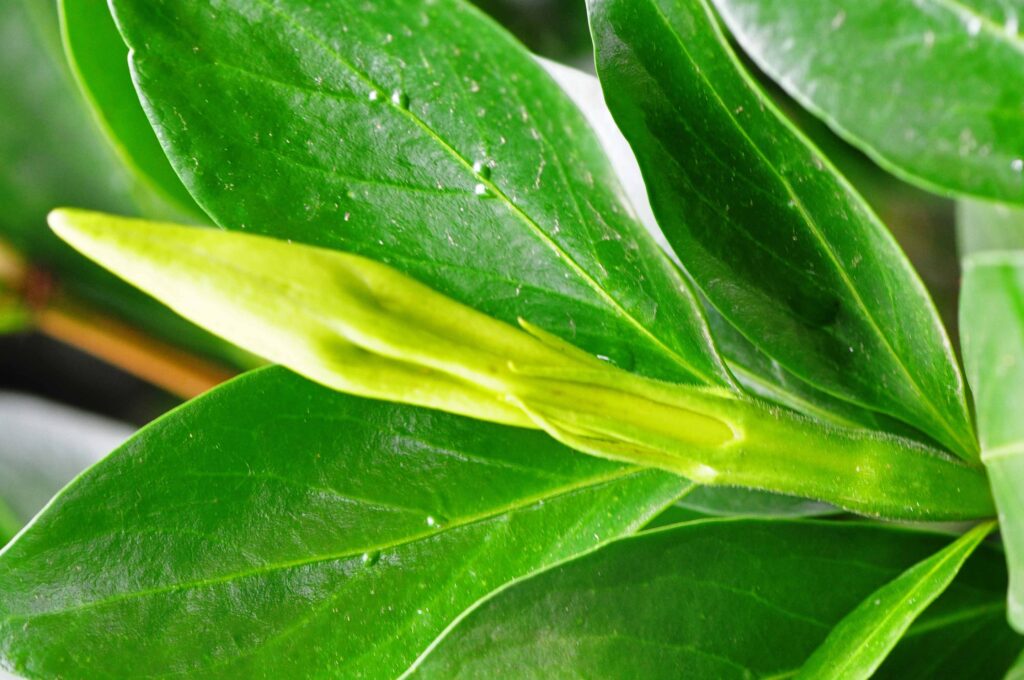
- 24. 2014/01/28. Walter Sisulu NBG. Photo: David Becking.
-
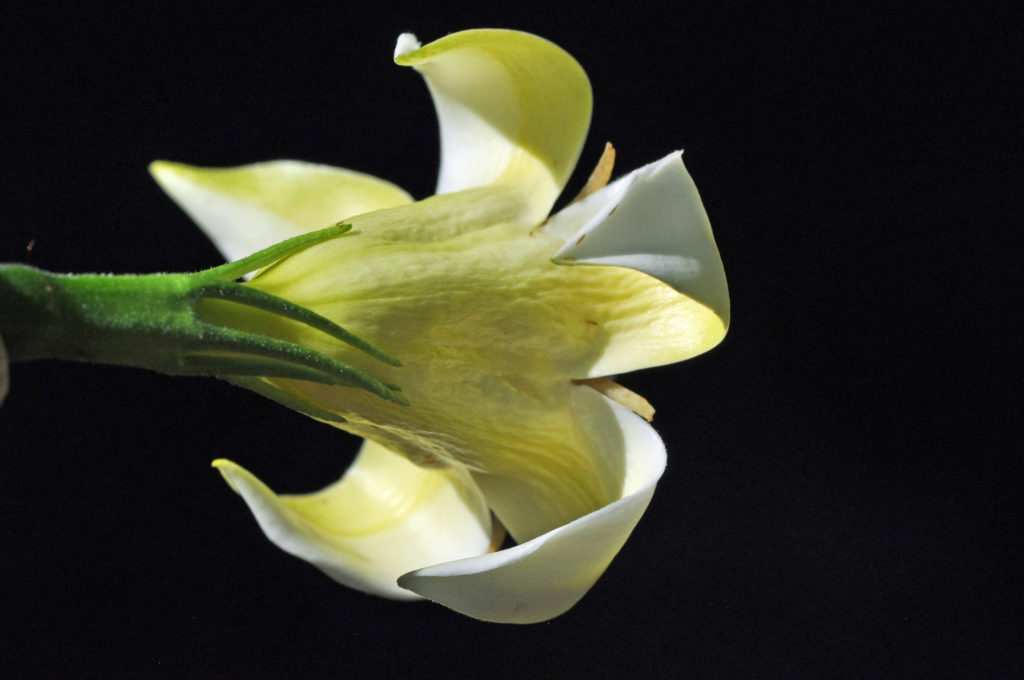
- 225. 2018/01/03. Walter Sisulu NBG. Photo: David Becking.
-
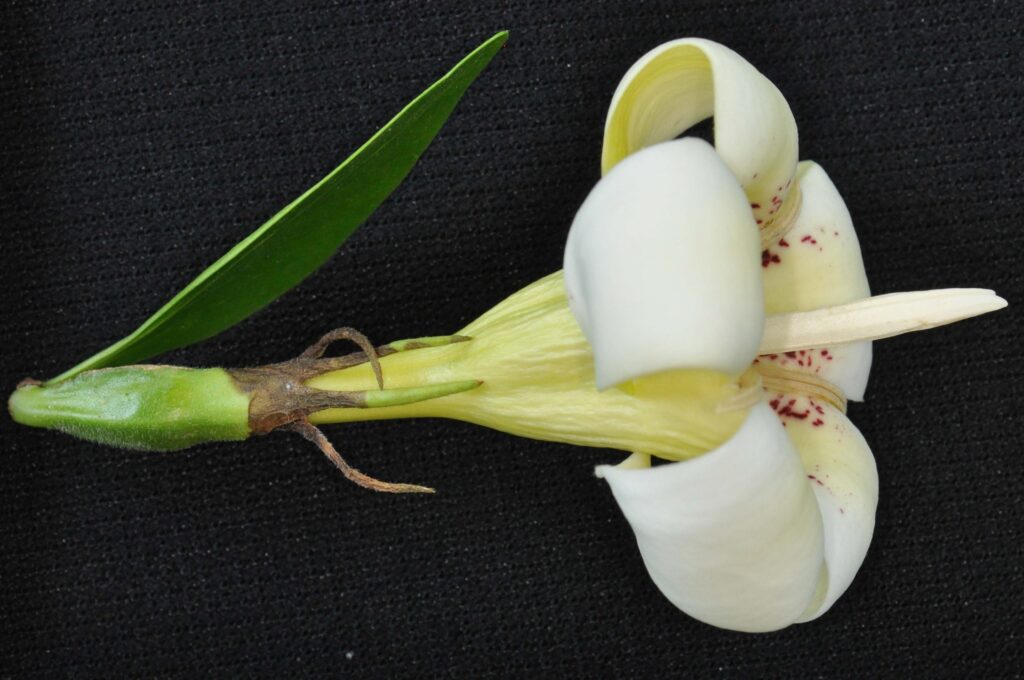
- 471. 2016/02/02. Walter Sisulu NBG. Photo: David Becking.
-
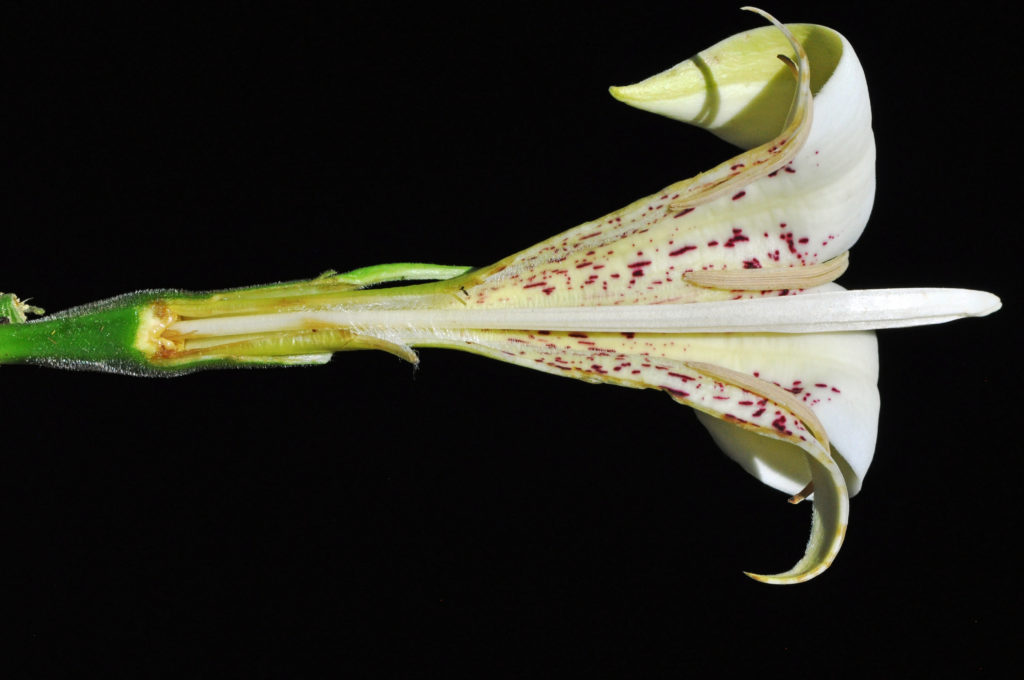
- 828. 2016/11/29. Walter Sisulu NBG. Photo: David Becking.
-
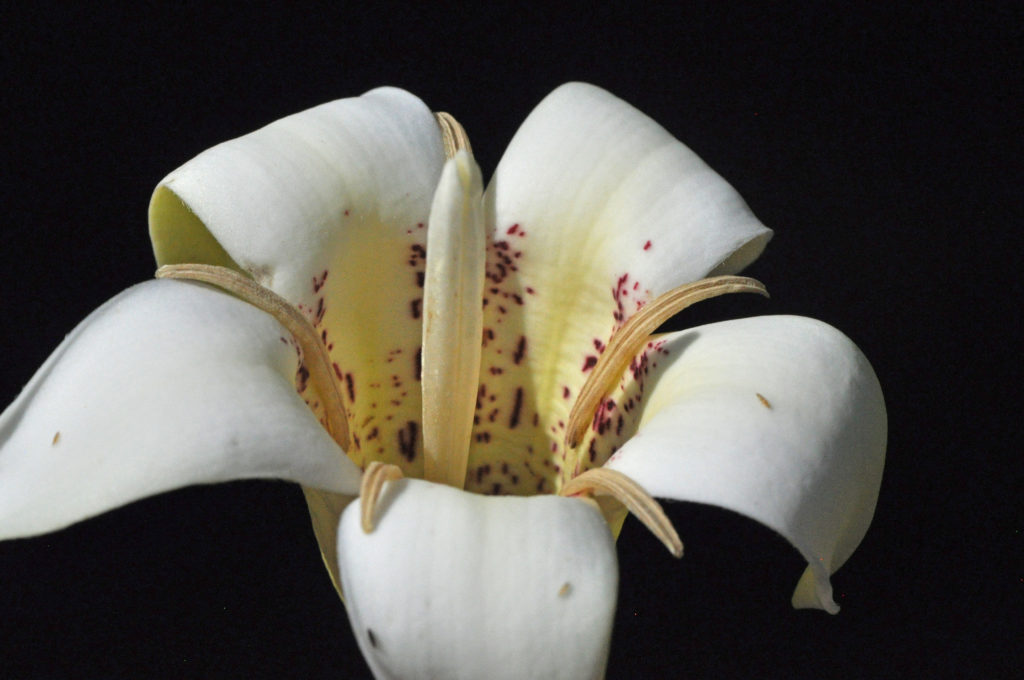
- 222. 2018/01/03. Walter Sisulu NBG. Photo: David Becking.
-
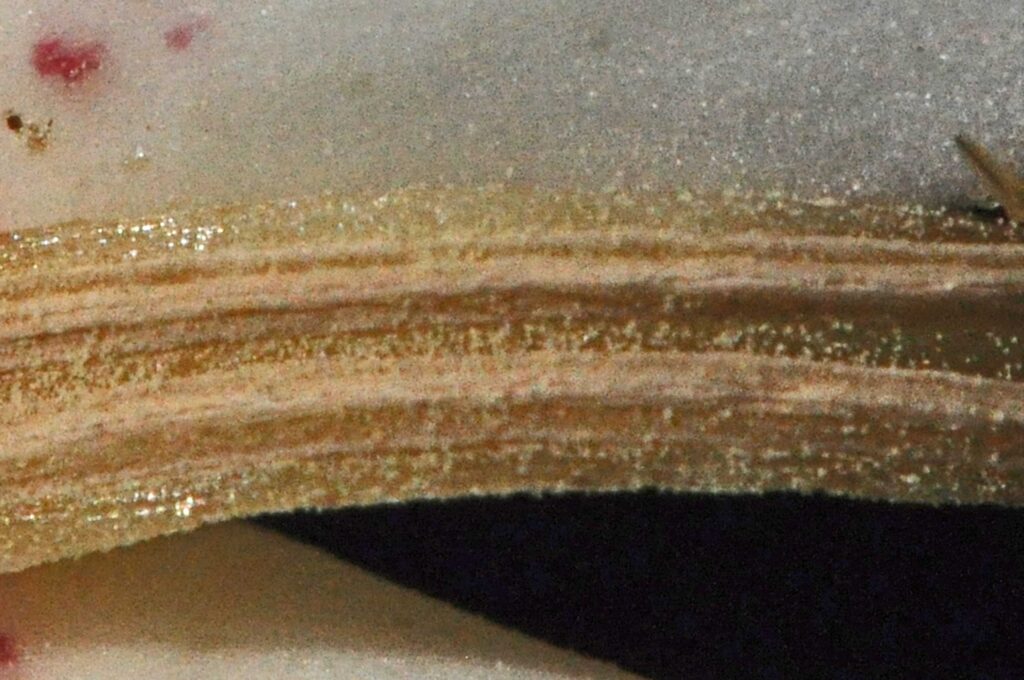
- 223. 2018/01/03. Walter Sisulu NBG. Photo: David Becking.
Fruit
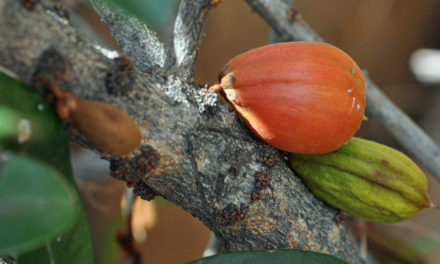
The shiny green, ribbed, leathery and almost spherical Fruit may reach 7,5cm in diameter. At the end of each fruit, the remains of a persistent Calyx may be visible. The hard, plain green, shiny, segmented fruits become soft when mature and are consumed by baboons, monkeys and birds. Imbedded in the solid mass of pulpy placental tissue are many smooth, flat seeds. (Jan-Aug++).
Distribution & Ecology
These trees are slightly drought resistant and can survive some frost. Trees and are usually taller than the gardenias. Location. They are found in the bushveld (is a sub-tropical woodland ecoregion of southern Africa), most forests, rocky hillsides and kloofs (a kloof is a steep-sided, wooded ravine or valley) up to an altitude of 1 900m. These trees are located in the Western Cape, Eastern Cape, through KwaZulu-Natal, Gauteng (common around Johannesburg and Pretoria), Mpumalanga, North-West Province, Limpopo, including Waterberg and Soutpansberg), Siswati (Swaziland), Botswana and possibly southern Mozambique. They are absent in the Northern Cape and Free State. Monkeys and baboons consume the Fruit (hence the name “Aapsekos” or ape-food). Bushpigs and bushbuck consume fallen fruit. Ripe fruit also attracts fruit eating birds.
Ethnobotany
The pale grey, hard and strong Wood is used for hut building, household implements, instrument handles and for fuel. These trees are slightly frost and drought resistant and may be taller than the gardenias. Location. They are found in most forests, rocky hillsides and kloofs (a kloof is a steep-sided, wooded ravine or valley) up to an altitude of 1 900m. Seeds germinate easily and trees have a non-aggressive root system. Fruit juice stains blue. They grow well in full sun or partial shade at a rate of a little over 0,5m per year. Seeds should be removed from the pulpy placental tissue before planting. They may take several years to flower. Roots and other parts are used in local medicine. The scent of picked Flowers lasts a long time – even when dried. Mason sent the plant to Kew Gardens as early as 1774. Plants may take 7 years to flower.
References
Boon, R. 2010. Pooley’s Trees of eastern South Africa. Flora and Fauna Publications Trust, Durban.
Burrows, J.E., Burrows, S.M., Lotter, M.C. & Schmidt, E. 2018. Trees and Shrubs Mozambique. Publishing Print Matters (Pty) Ltd. Noordhoek, Cape Town.
Coates Palgrave, M. 2002. Keith Coates Palgrave Trees of Southern Africa, edn 3. Struik, Cape Town.
Foden, W. & Potter, L. 2005. Rothmannia capensis Thunb. National Assessment: Red List of South African Plants version . Accessed on 2025/08/09.
Lawrence, G. H. M, 1951. Taxonomy of Vascular Plants. The Macmillan Company, New York. Tenth Printing 1965.
Palmer, E. & Pitman, N. 1972. Trees of southern Africa. Balkema, Amsterdam, Cape Town.
Schmidt, S. Lotter, M. & McCleland, W. 2002. Trees and Shrubs of Mpumalanga and the Kruger National Park. Jacana, Johannesburg.
van Wyk, B. & van Wyk, P. 1997 Field guide to Trees of Southern Africa. Struik, Cape Town.
https://en.wikipedia.org/wiki/Rothmannia_capensis
http://www.plantzafrica.com/plantqrs/rothmancapen.htm
https://en.wikipedia.org/wiki/Rothmannia
http://witbos.co.za/plant.aspx?plant=rothmannia-capensis
http://iscantree.co.za/rothmannia-capensis-wildekatjiepiering-wild-gardenia/
http://posa.sanbi.org/flora/browse.php?src=SP
https://en.wikipedia.org/wiki/Rubiaceae