Pterocarpus angolensis – Updating website!
General Info – Summary
This deciduous, local Tree is usually up to 15 x 0,6m. Sticky red sap is present. Imparipinnate, alternate Leaves are relatively sparse with well-spaced leaflets with parallel curving side veins. Zygomorphic, bisexual pea-like Flowers in racemes + yellowish, crinkled petals. The Fruit is a distinctive flattened, setose, orbicular and indehiscent pod. Wind dispersed pods have poor germinating kidney shaped seeds.
Description
Previous Names: Pterocarpus bussei, Pterocarpus dekindtianus.
SA Tree No. 236.
Common Names: (Afr) Bastergreinhout, Bloedboom, Bloedhout, Dolfhout, Greinhout, Kiaat, Kiaatboom, Lakboom, Lakhout, Wildekiaat, Wilde-kiaat, Wildekiaathout, Kajatenhout. (Eng) African teak, Bloodwood, Kiaat, Matabeleland deal, Paddle-wood, Rhodesian teak, Sealing Wax Tree, Sealing-wax Tree, Tati Bloodwood, Transvaal Teak, Wild Teak. (Northern Sotho) Morôtô. (Setswana) Mokwa, Morotômadi. (siSwati) Umvangati, Umvangatsi. (Tshivenda) Mutondo. (isiZulu) Indlandlovu, Ingozina, Umbilo, Umvangazi. (Xitsonga) Mutondo.
Family: Fabaceae or Leguminosae (Pea, bean or legume family). After the Orchidaceae and the Asteraceae, the Fabaceae is the third largest Angiosperm (flowering plants) family with 700+ genera and close to 20 000 species. Local Tree genera on this website include Acacia (Vauchellia, Senegalia), Albizia, Bauhinia, Bolusanthus, Burkea, Calpurnia, Colophospermum, Cordyla, Cyclopia, Dichrostachys, Erythrina, Erythrophleum, Faidherbia, Indigofera, Mundulea, Peltophorum, Philenoptera, Piliostigma, Schotia and Xanthocercis. The Fabaceae are recognisable by their fruit and their pinnately compound Leaves. Leaves may also be simple – even bilobed and usually have stipules – some of which may be spinescent. Leaflets are usually entire. Flowers are bisexual and bracteate. Regular flowers usually have 4-5 sepals and the same number of petals. Irregular flowers have 4-5 sepals and 5 or less petals. Stamens have anthers that have 2 pollen sacs and there are usually at least twice the number of stamens as petals – often 10. The superior Ovary has 1 locule containing 1 or more ovules. The Stigma and Style are simple. The single carpel develops into the Fruit, which is usually a pod. The mature pods may dehisce or break into segments. Seeds vary.
Name derivation: Pterocarpus – Winged fruit from Greek: pteran meaning wing and karpos meaning fruit. angolensis – from Angola. Other species of Pterocarpus in South Africa include Pterocarpus rotundifolius which is widespread to the North and East and Pterocarpus echinatus.
Conservation: National Status: L C (least concern). Assessment: 2005/06/30 (W. Foden and L. Potter).
Tree
In South Africa, this Tree is usually up to 15m high. Beyond our northern boarders e.g., in Mozambique, it may reach 30m or more. The long straight, usually single Trunk (photo 730) is up to 0,6m wide and has an open flattish spreading crown – especially when on its own (photos 808 & 945). Lichen (composite organism arising from a mutualistic relationship between fungi or cyanobacteria and algae species) may be present on the trunk (photo 672). The darkish grey to brown Bark is rough and longitudinal fissured with protruding parts that become roughly rectangular (photo 725). Young branches are hairy. Sap is sticky and blood red – hence the common name “bloodwood”. Damaged bark leaks the blood-red colour. This sap leaves a permanent dye colour on cloth.
-
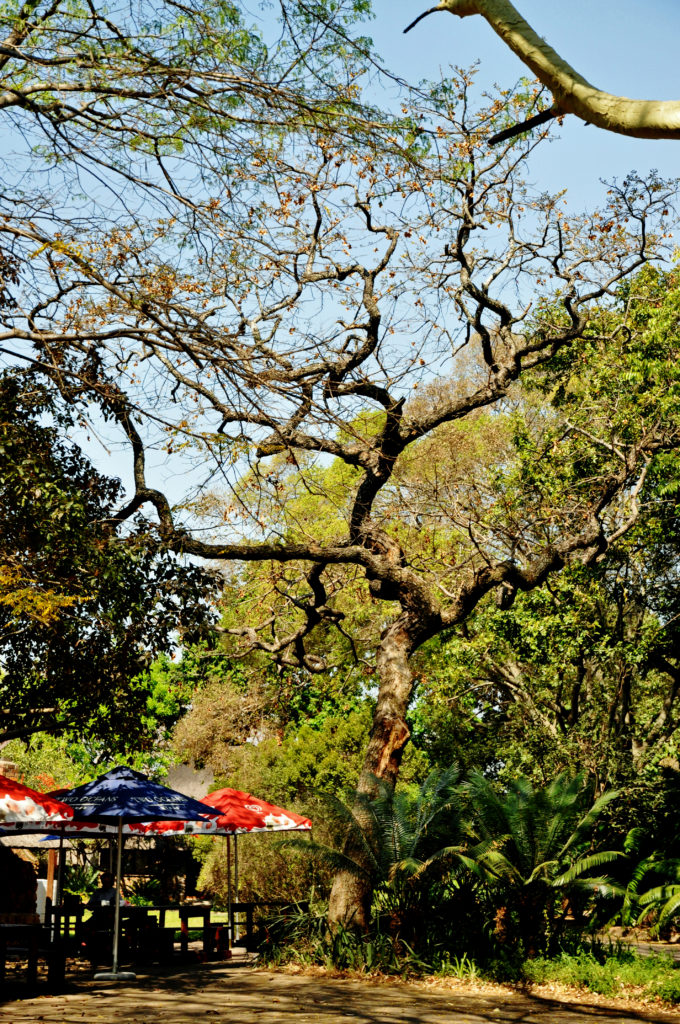
- 730. 2014/09/13. Lowveld NBG. Photo: David Becking.
-
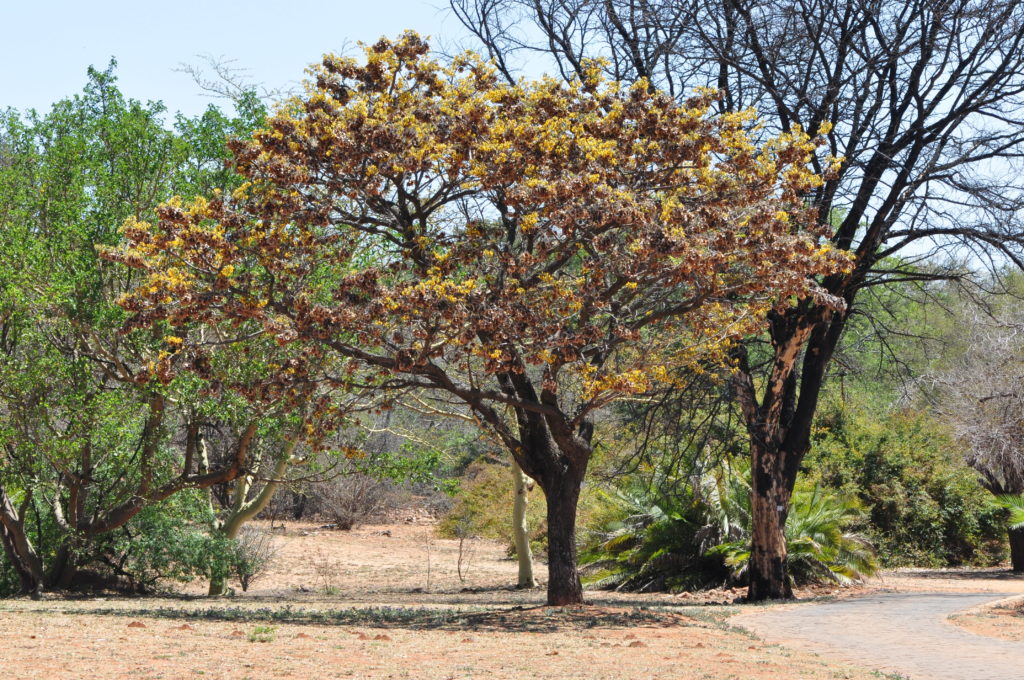
- 808. 2016/10/11. Pretoria NBG. Photo: David Becking.
-
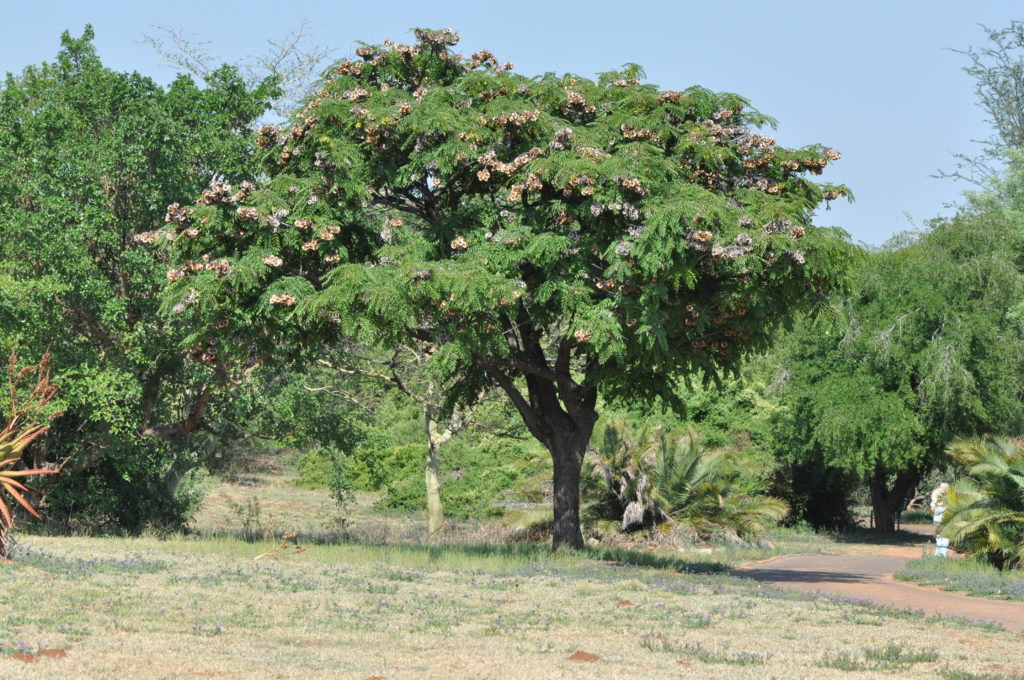
- 945. 2017/11/14. Pretoria NBG. Photo: David Becking.
-
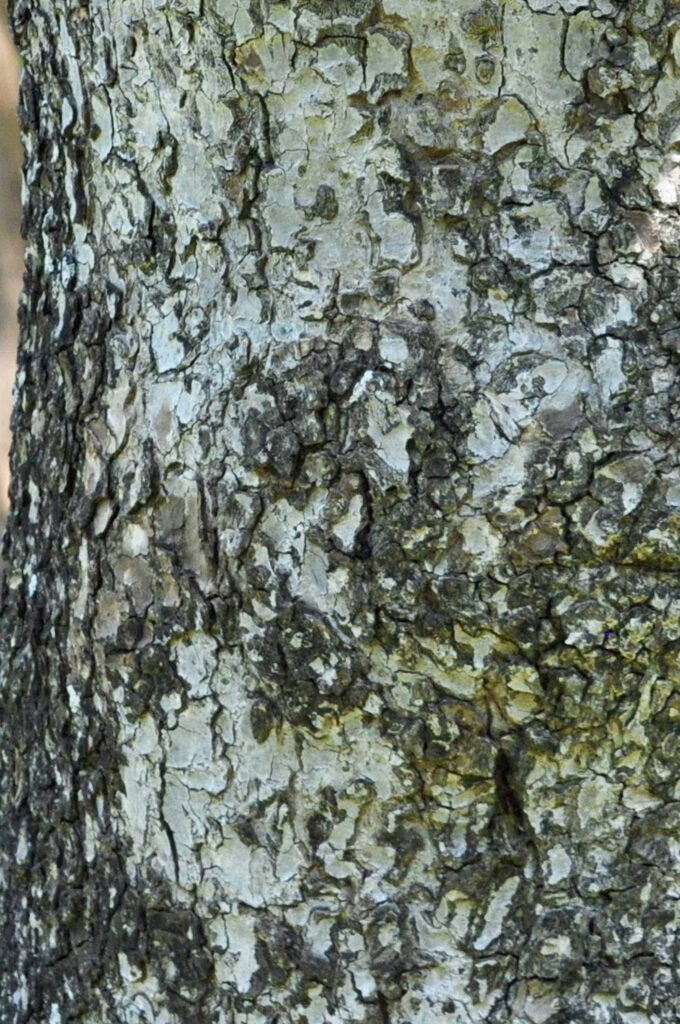
- 672. 2014/09/13. Lowveld NBG. Photo: David Becking.
-
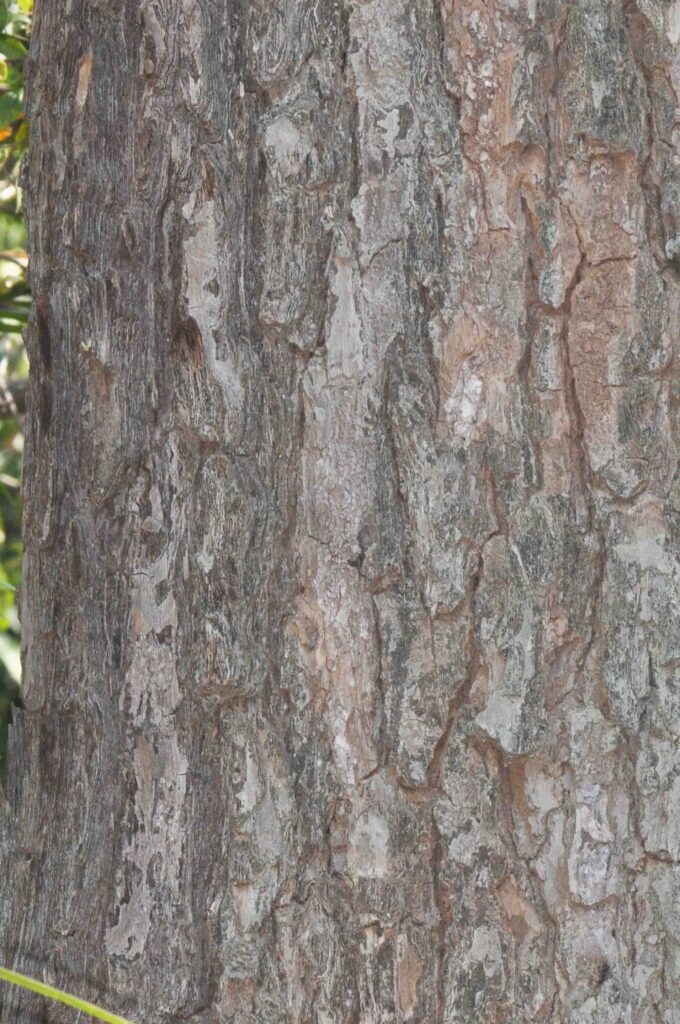
- 725. 2014.09.13 Lowveld NBG. Photo: David Becking.
Leaves
This Tree is deciduous, and Leaves become yellowish before falling in winter (photo 808 above). The drooping leaves are imparipinnate (pinnately compound leaf ending in a single leaflet – photo 674), alternate, and up to 35cm long and tend to hang down. Each Leaflet is ovate (egg shaped) to oblong, elliptic or obovate, and is up to 7,5 x 4,5cm. They are dark, shiny green and hairless above, lighter and initially hairy below and hairs are lost as they mature. There are 4-12 pairs of sub-opposite to alternate Leaflets (photo 674) and the terminal one. Each well-spaced leaflet has between 12 and 18 pairs of fine Side veins that protrude above. These veins cover the whole surface and run ‘parallel’ to each other and bend towards the apex. The narrowly tapering Apex is bristle tipped (photo 674). It may be acuminate (said of an acute apex whose sides are somewhat concave and taper to a protracted point). The Base is rounded. The wavy Margin is tightly rolled under and entire (with a continuous margin, not in any way indented). Pale brown hairs cover the thickened Petiole (leaf stalk that is up to 5cm long). The thickened and hairy Petiolules (stalks of leaflets – photo 674) are up to 5mm long. Both the petiole and petiolules are velvety (having a smooth, soft appearance, feel, or taste). The narrow, hairy Stipules (basal appendages of the petiole) are lanceolate to elliptical, up to 2cm long and caducous (an organ or part of which is easily detached and shed early).
-
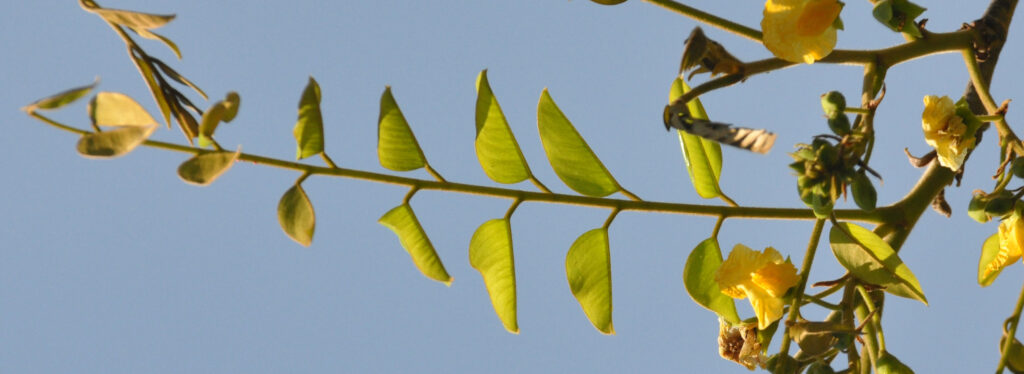
- 674. 2014/09/14. Lowveld NBG. Photo: David Becking.
Flowers
The orange-yellow (photo 276) or yellow (photo 271) Flowers are distinctly sweetly scented, and pea-shaped. They appear shortly before or with the new leaves. They occur in long hanging Racemes (simple elongated inflorescence with stalked flowers that open in succession towards the apex. Here the terminal bud keeps growing and forms lateral flowers). They form large, branched sprays up to 20cm long (photo 676). Flowering lasts about 3 weeks and flowers are bracteate (bearing bracts – modified specialised leaves usually found with inflorescences and flowers. Bracts may be different from “normal” leaves – bigger or smaller in shape and colour. Here they are narrow (photo 676) and hairy (photo 276). Against the dark branches, the flowers are impressive. Flowers are bisexual, and zygomorphic (irregular floral parts are unequal in size or form so that the flower is capable of division into essentially symmetrical halves by only one longitudinal plane passing through the axis). The flowers develop in hanging Racemes (a simple elongated inflorescence with flowers that open in succession towards the apex – photo 676). Each flower rests on a hairy Pedicel (stalk of a single flower) that is up to 2cm long (photo 676). The 5-short lobed hairy Calyx (photo 276) is green and campanulate (bell shaped) with the upper 2 Sepal lobes partially joined. The Corolla has 5 crinkled Petals (photo 271) which consists of the single large uppermost Vexillum or standard petal, two expanded Wing petals and 2 fused Keel petals at the base. 10 connate (united) Stamens are present – one of which may be free or partly so. Stamens are longer than the petals. The dorsifixed Anthers are equal in length and dehisce longitudinally to release pollen. There is a single Pistil (a unit of the Gynoecium, the female element of the flower, composed of the Ovary, Style and Stigma). The superior Ovary has a small Stigma. (Aug-Dec).
-
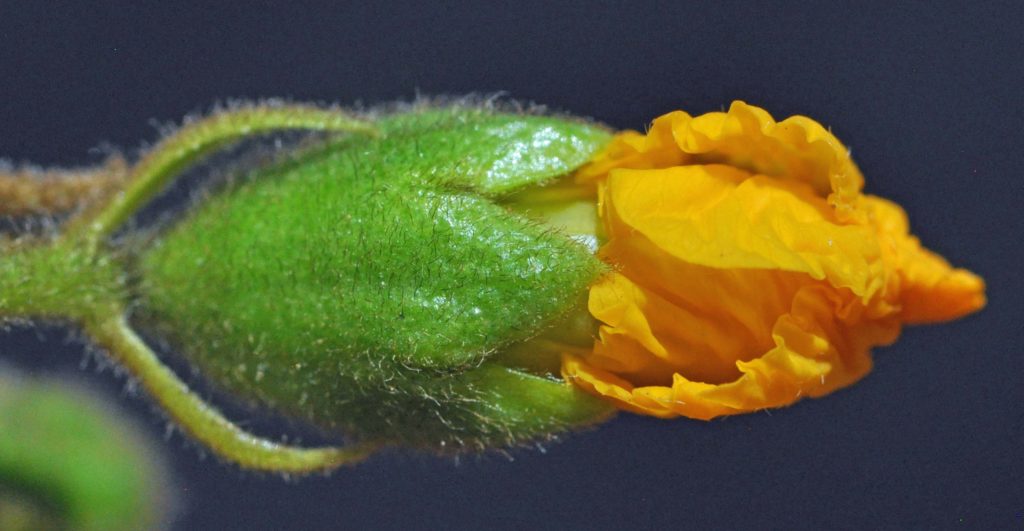
- 276. 2019/10/08. Pretoria NBG. Photo: David Becking.
-
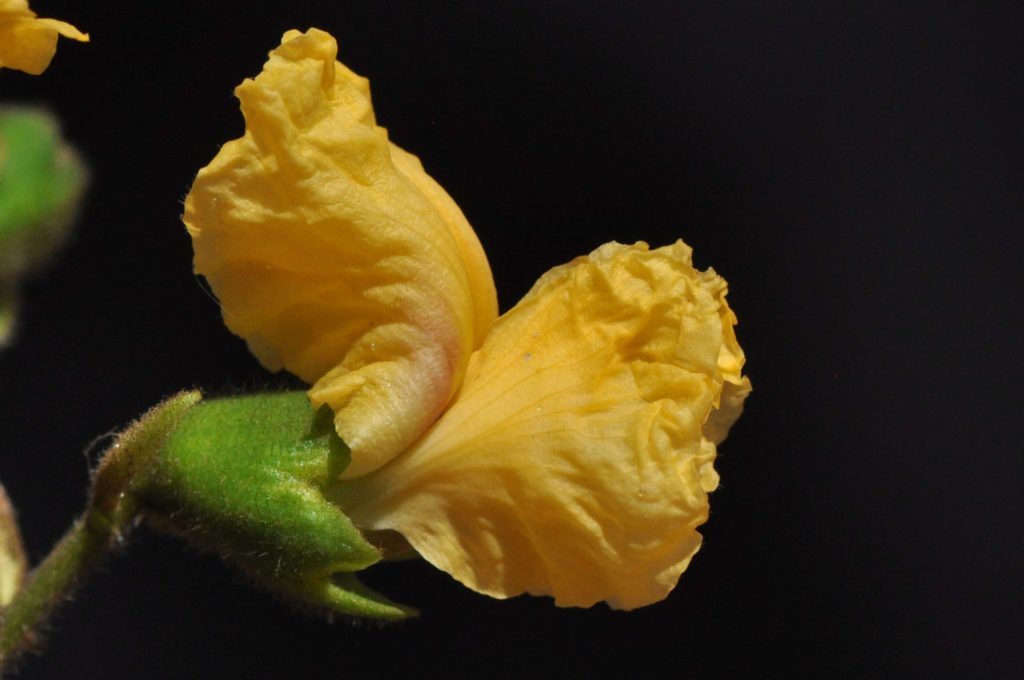
- 271. 2019/10/08. Pretoria NBG. Photo: David Becking.
-
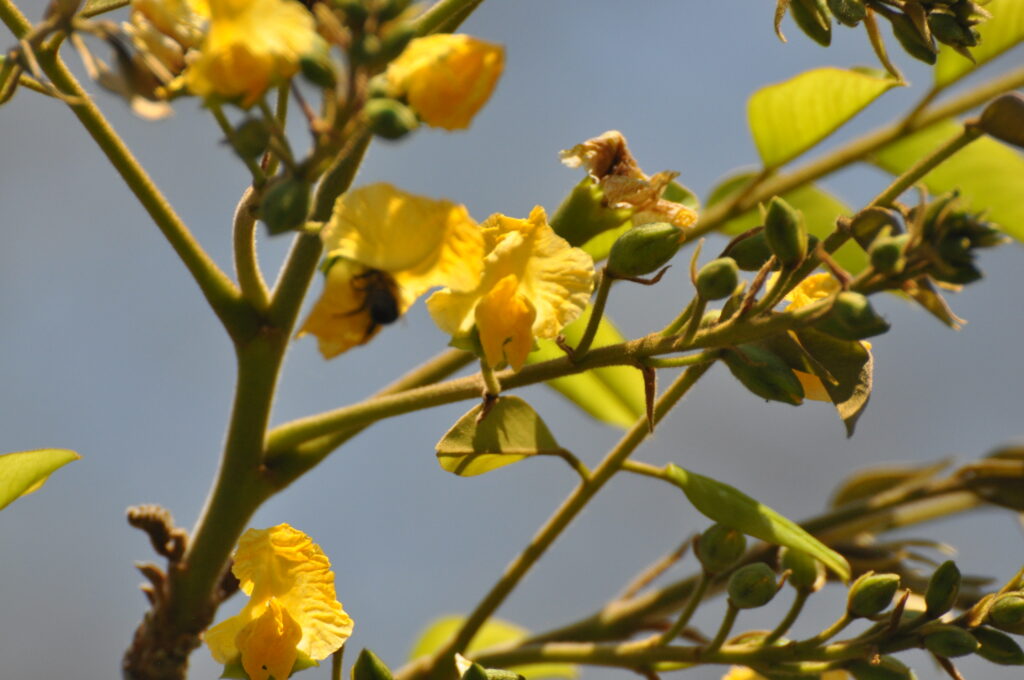
- 676. 2014/09/14. Lowveld NBG. Photo: David Becking.
Fruit
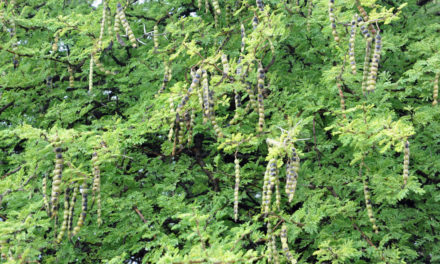
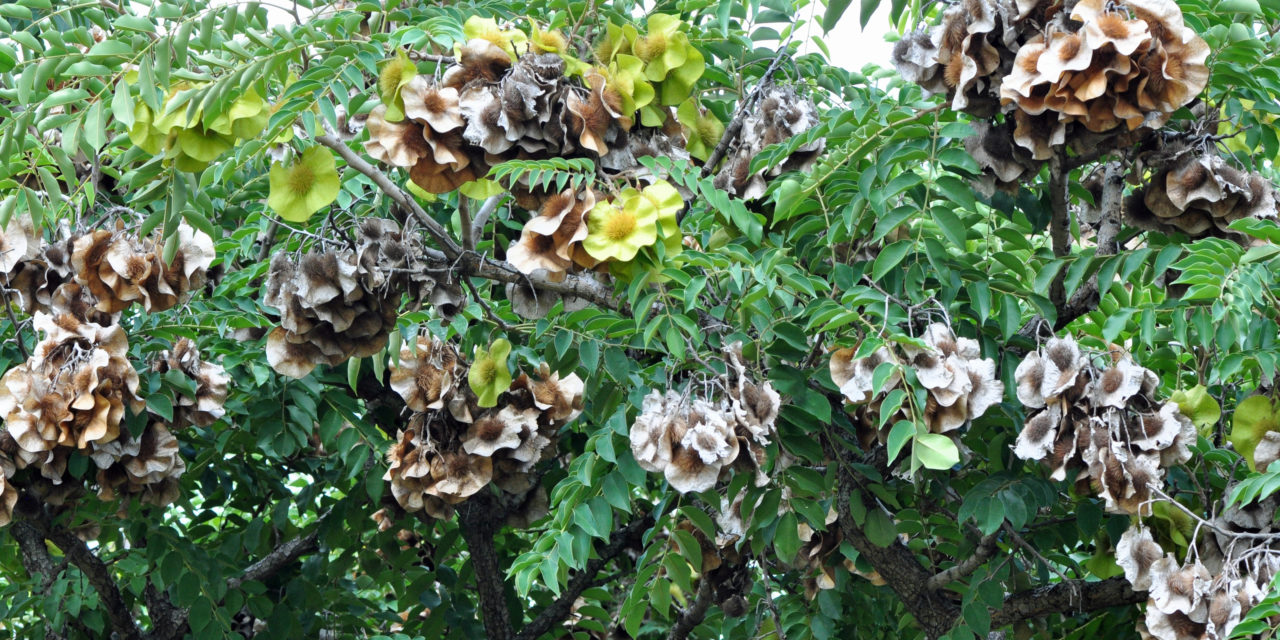
The initially flattened, often very wavy and indehiscent Fruit is an orbicular (circular or disc-shaped) Pod that is usually up to 10cm but may reach 15cm wide). The thickened seed case is centrally situated and setose (covered with long sharp bristles) each up to 1,3cm long. The fruit hangs down from the tree (photo 727). In this photo, leaves are absent and the new flower buds are beginning to emerge. Each pod is initially green, has a raised centre, turns yellow to brown (intro photo) and finally becomes wavy (photo 726). The persistent old Calyx is visible “below” the pod base (photo 726). The fruit may have up to 3 small, smooth, kidney shaped Seeds (Nov-Jul). About 3 000 of these seeds has a mass of 1kg. The seeds lack endosperm (the starch and oil-containing tissue of many seeds; often referred to as albumen). The shape of the fruit aids wind dispersal – usually up to about 50m from the tree. This distance is mainly dependent on the wind and the height of the tree (Nov-Jul). Pods may remain on the tree for close to one year (intro photo) and make plant ID much easier – especially in winter. Extraction of seeds involves quite an effort!
-
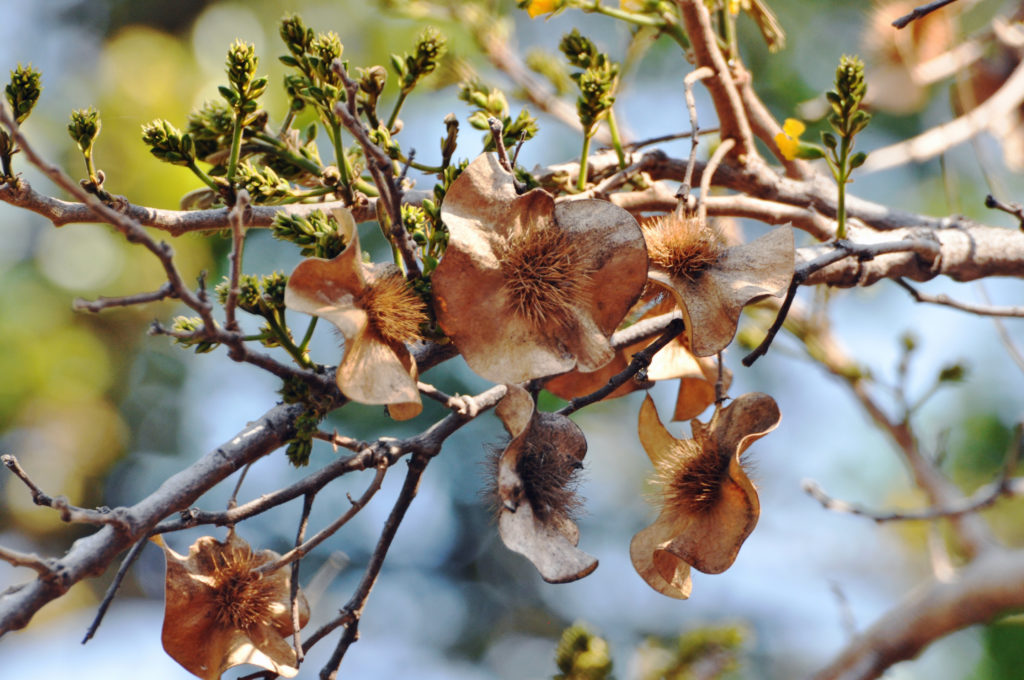
- 727. 2014/09/13. Lowveld NBG. Photo: David Becking.
-
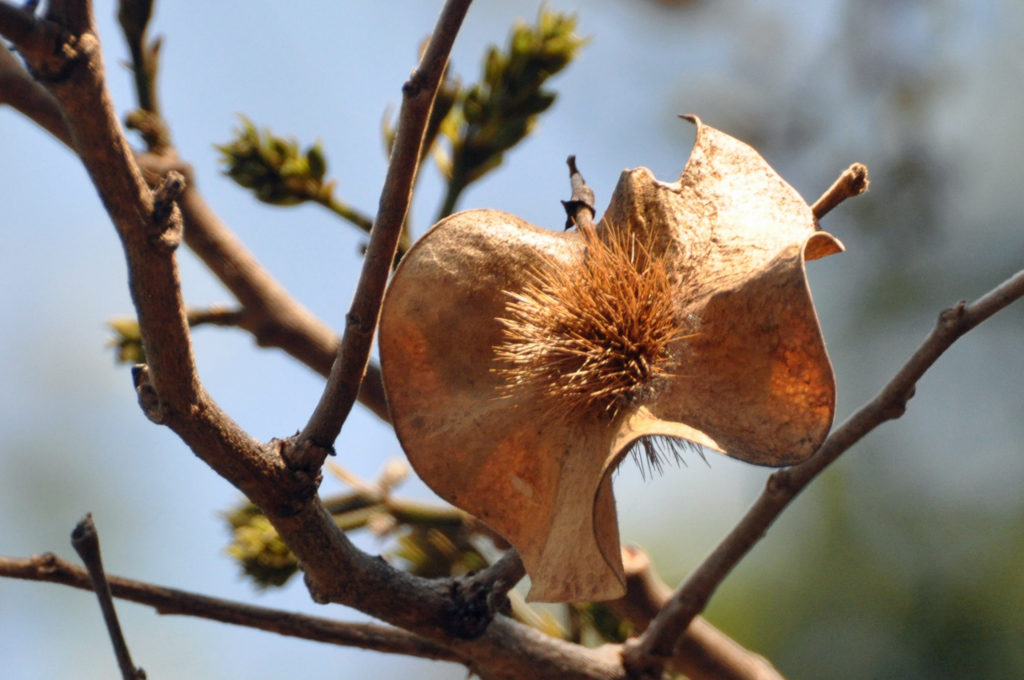
- 726. 2014/09/13. Lowveld NBG. Photo: David Becking.
Distribution & Ecology
These Trees occur naturally in deep, well-drained sandy soil (where the rainfall is greater than 500mm per year). In South Africa they occur in rocky Savanna (rolling grassland scattered with shrubs and isolated trees, which can be found between a tropical rainforest and desert biome) and lowveld woodland up to an altitude of 1 600m. The tree is frost sensitive and has a poor capacity for Coppicing (when stems are cut or burned, it causes regrowth from the stump or roots). Leaves are relatively spares on the tree. This allows sun to penetrate close to the trunk and permits grass to grow close to the trunk. The Bark of saplings is fire resistant. Geographical Location: – widespread in central Africa from Northern KwaZulu-Natal e.g., Lebombo mountains, Mpumalanga, Limpopo, Eswatini (Swaziland), Mozambique, Namibia e.g., Caprivi Strip, Zimbabwe, Zambia and northwards into Tropical Africa. Baboons, monkeys and yellow-footed Squirrels (Paraxerus cepapi) eat the Pods and flowers. These squirrels are small (about 200g) and are widespread in southern Africa. Kudu and elephant browse the Leaves. Butterfly larvae of the Bushveld Emperor or Bush Charaxes: (Charaxes achaemenes achaemenes) also feed on these Leaves, and on the leaves of Piliostigma thonningii, Diospyros mespiliformis and others. Flowers attract bees and make this plant a good honey tree.
Ethnobotany
These attractive Trees are sensitive to frost. The much-used Wood is similar to the that of Albizia versicolor. The wood of Podocarpus angolensis has a relatively low density – about 500kg per cubic metre – but this does vary. It is one of the most widely used timber trees and is considered second only to stinkwood for making furniture. In Namibia it is use for carving. The sawdust may be irritant. Sapwood is pale grey to yellow and is susceptible to borer and termite attack and should be treated with insecticide. The extremely durable Heartwood is light brown to dark reddish brown with wavy streaks and is not susceptible to borers or termite attacks. The attractive wood glues and screws well and takes a fine polish. It is strong, durable, and is also used for canoe building, carving as well as for parquet flooring, canoe paddles, construction, doors, windows, and for fuel. The wood is used to make mortars, drums and dishes. The very durable wood works and turns well and only shrinks slightly when drying. Wood to the north of South Africa is usually lighter. It is used for making canoes. Root heartwood yields a brownish dye. Extracts from the roots kill parasitic flatworms, which may carry bilharzia. Basket manufacture makes use of the fibrous Inner bark. The red Sap exuded/extracted from the bark makes an impressive red dye. Local medicine makes much use of this plant. Powdered root bark is mixed with fat and used to colour skin. The Seeds are difficult to germinate, however filed seeds are slightly more successful. Usually only 1% of seeds germinate and last more than 1 year. Heat e.g., from a fire may speed up the germination. Truncheons (stem cutting from a selected plant – used to produce genetically identically new plants) do well. Plant them in well-drained soils during spring – when the sap is rising. This is a protected tree.
References
Boon, R. 2010. Pooley’s Trees of eastern South Africa. Flora and Fauna Publications Trust, Durban.
Burrows, J.E., Burrows, S.M., Lotter, M.C. & Schmidt, E. 2018. Trees and Shrubs Mozambique. Publishing Print Matters (Pty) Ltd. Noordhoek, Cape Town.
Coates Palgrave, M. 2002. Keith Coates Palgrave Trees of Southern Africa, edn 3. Struik, Cape Town.
Foden, W. & Potter, L. 2005. Pterocarpus angolensis DC. National Assessment: Red List of South African Plants version . Accessed on 2025/08/26.
Lawrence, G. H. M, 1951. Taxonomy of Vascular Plants. The Macmillan Company, New York. Tenth Printing 1965.
Palmer, E. & Pitman, N. 1972. Trees of southern Africa. Balkema, Amsterdam, Cape Town.
Schmidt, S. Lotter, M. & McCleland, W. 2002. Trees and Shrubs of Mpumalanga and the Kruger National Park. Jacana, Johannesburg.
van Wyk, B. & van Wyk, P. 1997 Field guide to Trees of Southern Africa. Struik, Cape Town.
http://www.plantzafrica.com/plantnop/pterocarpangol.htm
http://www.worldagroforestry.org/treedb/AFTPDFS/Pterocarpus_angolensis.PDF
http://prota4u.org/protav8.asp?p=Pterocarpus+angolensis
http://posa.sanbi.org/flora/browse.php?src=SP