Morella pilulifera
General Info – Summary
This small, evergreen plant is usually a Tree with a roundish crown. Bark has white protruding lenticels. Alternative, leathery & longish Leaves are simple, estipulate. Small, unisexual Flowers lack a perianth and develop in erect spikes. Male flowers with short filaments. Female has 1 pistil and a superior ovary with 1 ovule and a short style with 2 stigmas. Bracts surround the Fruit (a small, wax-coated drupe).
Description
Previous Names: Myrica pilulifera, Myrica rogersii.
SA Tree No. 37.
Common names: (Afr) Breëblaarwasbessie. (Eng) Broad-leaved Waxberry. (IsiZulu) Umbhemiso. (siSwati) Maluleka, Meluleka. (Shona) Nyamvura. (Tshivenda) Tshifhangwana.
Family Myricaceae (waxberry family). There are 3 or 4 genera with about 55 species in this aromatic and resinous family of shrubs or small Trees. Roots may contain nitrogen-fixing bacteria. Leathery Leaves are alternate and may be entire, lobed or serrated. Leaves are often gland dotted and aromatic. The tiny Flowers lack a perianth (Calyx and Corolla) and are wind pollinated. Unisexual flowers are in catkin-like spikes. Male flowers are often dense and are on the same or different plants. When on the same spikes, the male flowers are below the female flowers. The roughly spherical Fruit is a drupe with a hard endocarp. The fruit frequently has an unusual waxy coating. Morella/Myrica is the only genus in southern Africa and has 9 species. These are mainly located in the Western and Eastern Cape.
Name derivation: Morella – resembles a mulberry. pilulifera – bearing hairs or little almost spherical balls – referring to the fruit. 9 of the about 45 species of Morella are in southern Africa. Reduction in the number of species is a future possibility. This is happening now. Morella pilulifera and Myrica pilulifera are now both considered the same plant. Morella pilulifera was collected for the first time on Mount Milanje/Mulanje (peak. is 3 002m) in southern Malawi. It is the highest mountain in the country.
Conservation: National Status: L C. (Least Concern). Assessment: 2005/06/30. (W. Foden & L. Potter).
Tree
This plant may be a large shrub, or more often a small slender Tree, occasionally reaching 12m high in swamp forest but is usually 3-5m high (photo 546). Here a number of trees were planted close together. Single trees have a neat, rounded dense crown. The light to dark grey, brown to almost black Bark (Photo 822 below the new growth) has a reddish tinge (photo 344). Bark is thin and rather smooth. It often grows with a clean stem. Vertical growth divisions reveal a reddish underbark (photo 354). Young Branches may be smooth or initially covered with dense hairs that are usually soon lost. Branches are initially green but turn black (photo 822). In this photo the colour change on the newer bark is visible. In this slightly older stem (photo 817), distinctly raised, whitish Lenticels are visible. Lenticels area usually raised corky oval or elongated area on the plant that allows the uncontrolled interchange of gases with the environment (photos 822 & 817). In photo 817 distinct raised Leaf Scars are also visible.
-
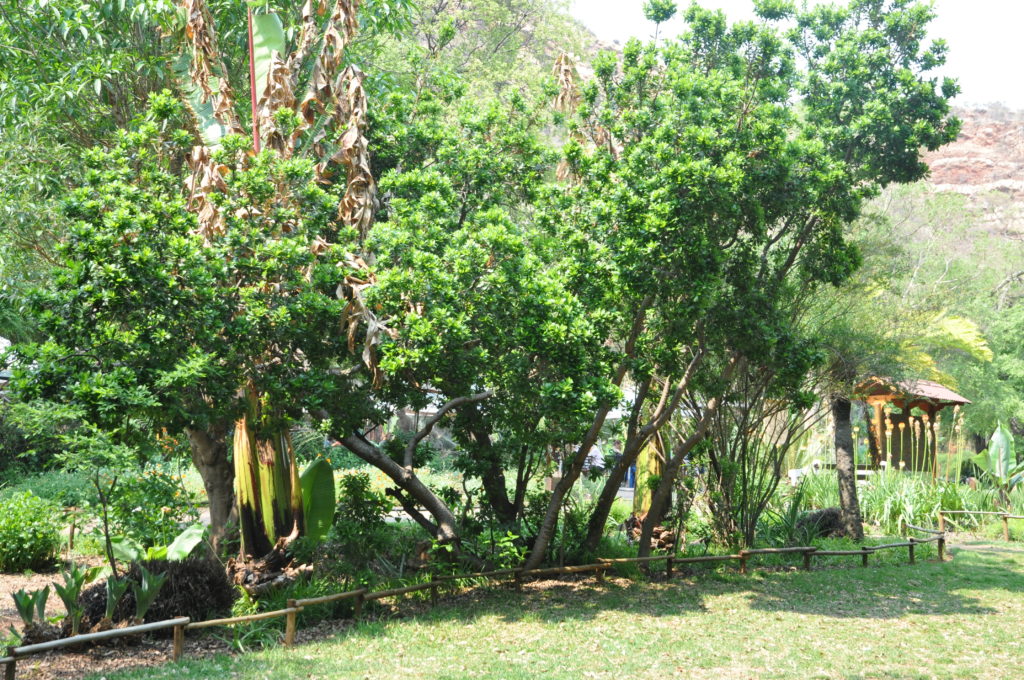
- 546. 2016/09/27. Walter Sisulu NBG. Photo: David Becking.
-
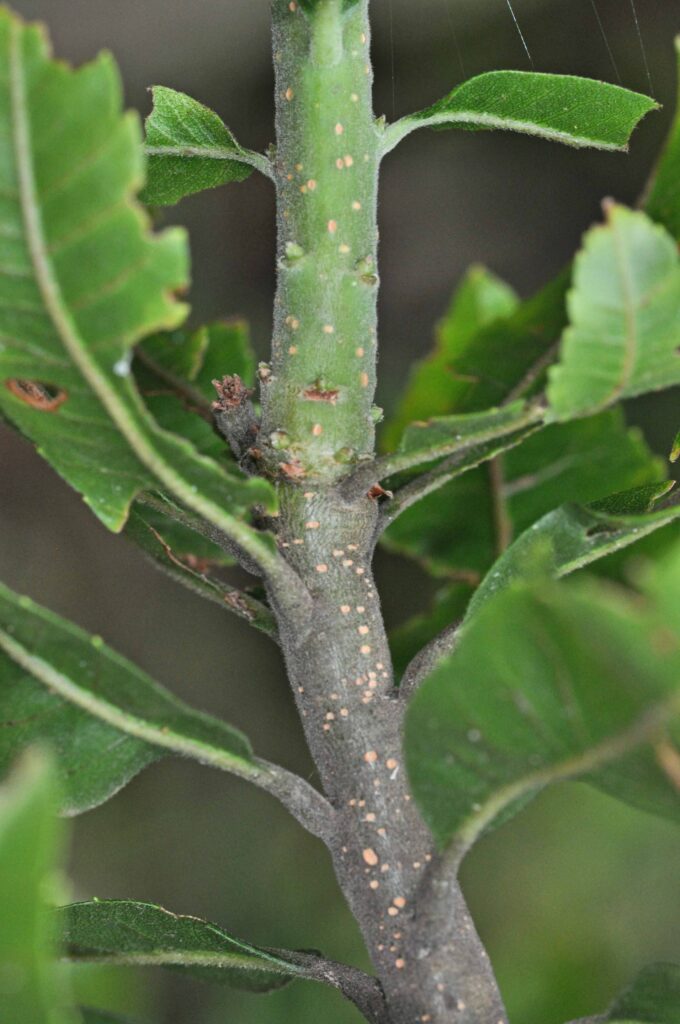
- 822. 2017/02/07. Walter Sisulu NBG. Photo: David Becking.
-
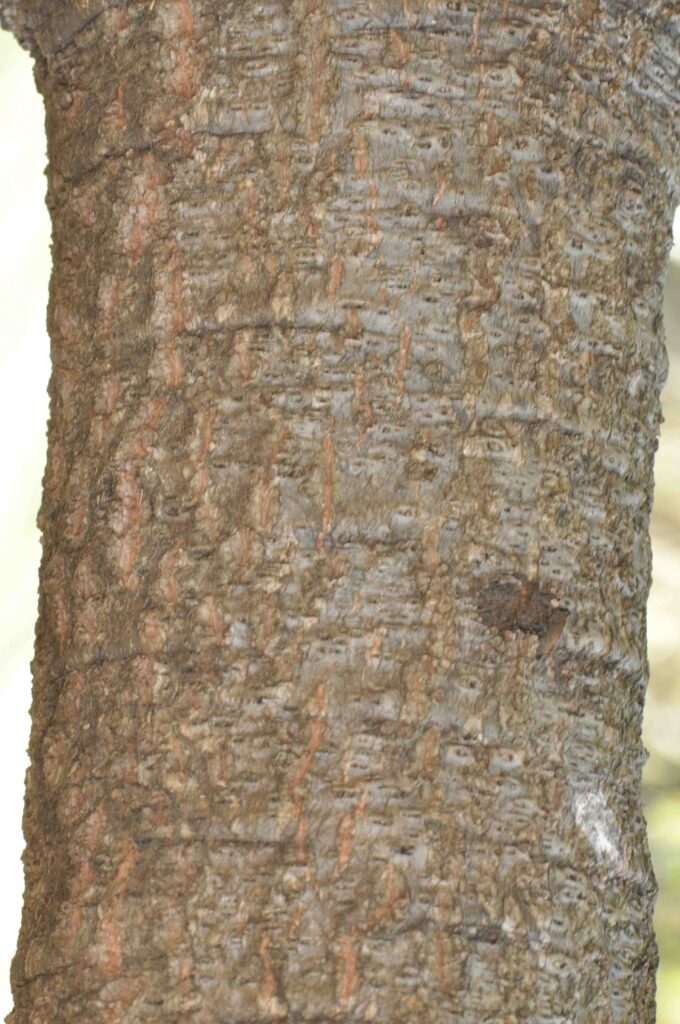
- 344. 2015/07/21. Walter Sisulu NBG. Photo: David Becking.
-
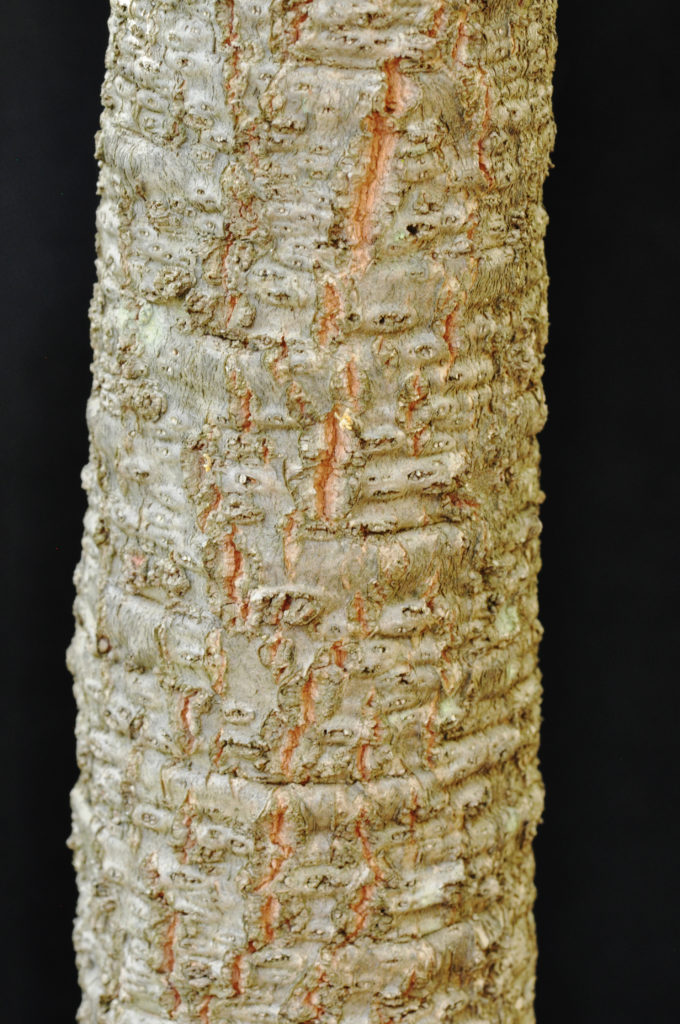
- 354. 2015/09/15. Walter Sisulu NBG. Photo: David Becking.
-
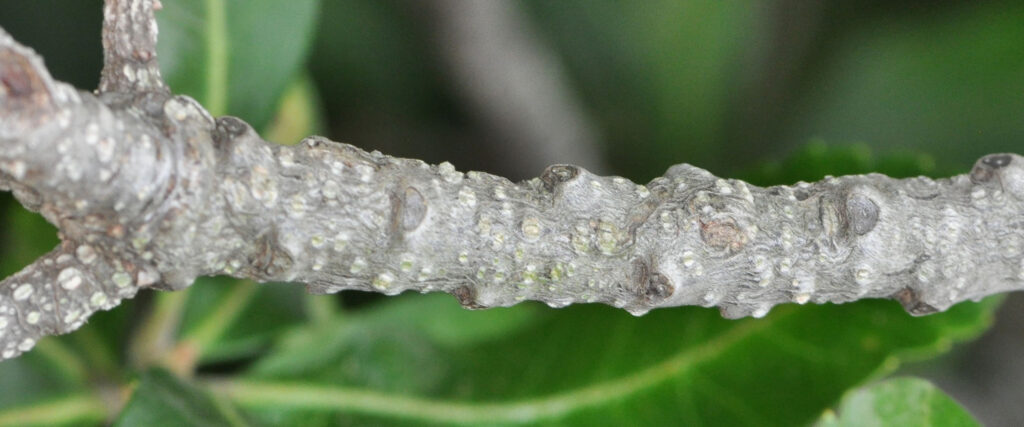
- 817. 2017/02/07. Walter Sisulu NBG. Photo: David Becking.
Leaves
This evergreen tree has Leaves that are simple (has a single blade which may have incisions that are not deep enough to divide the blade into leaflets – photo 342). They are leathery and elliptic, oval or obovate (the reverse of ovate, the terminal half-broader than the basal). Most hair is lost with age. Leaves are up to 11 x 5ca but are usually smaller (photo 342). In this photo the leaves are dark green to yellowish on the upper surface and lighter below. Young leaves may be slightly maroon (photo 974 – under Fruit) and start a shiny bright green in front of the older darker leaves (photo 360). They are velvety (having a smooth, soft appearance or feel). They may also be reddish purple (photo 974 – under Fruit). This colour may persist for some time. The yellowish Midrib protrudes below (photo 342) as do the yellowish lateral veins. These lateral veins occasionally form a Y before reaching the margin (photo 464). Vein details are best seen against a strong light – using hand lens. Each lateral vein usually terminates inside a marginal tooth (photo 464). In this photo the lighter or reddish patches of Gland Dots are usually obscure. The leaf Apex is shortly pointed (photo 342), rounded or broadly tapering (photo 665) and the Base is round, slightly narrowed or broadly tapering. The Margin may be hairy (photo 464) and is either almost entire (with a continuous margin, not in any way indented) or scalloped or jaggedly toothed – away from the base (photo 360). The broad, initially reddish Petiole (leaf stalk) is up to 9mm long with a broad base (photo 342) and is hairy on new growth. Stipules (basal appendages of the petiole) are absent. Crushed leaves have a distinctive waxberry smell which can aid identification.
-
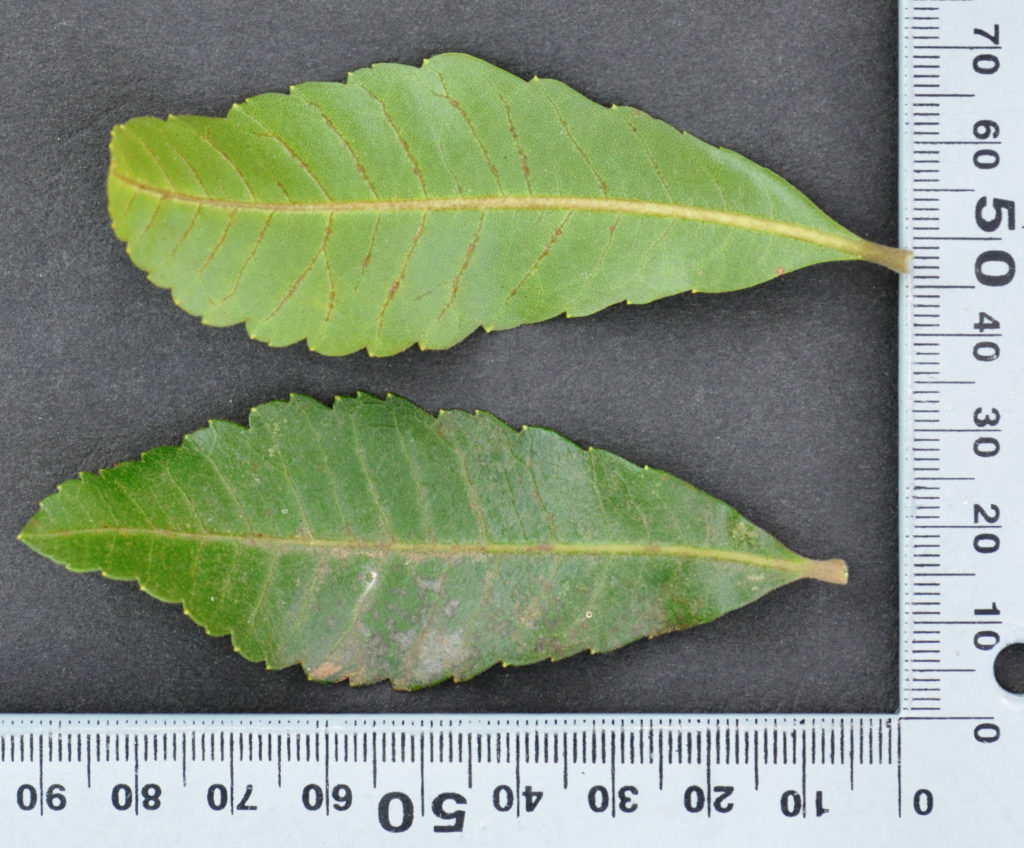
- 342. 2015/07/21. Walter Sisulu NBG. Photo: David Becking.
-
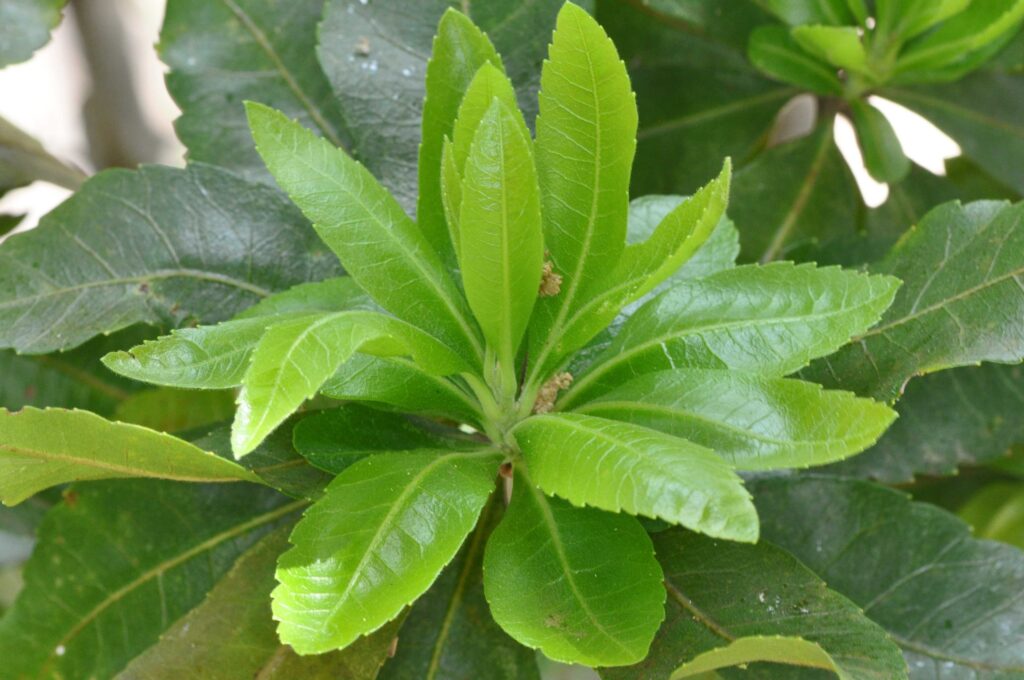
- 360. 2015/09/15. Walter Sisulu NBG. Photo: David Becking.
-
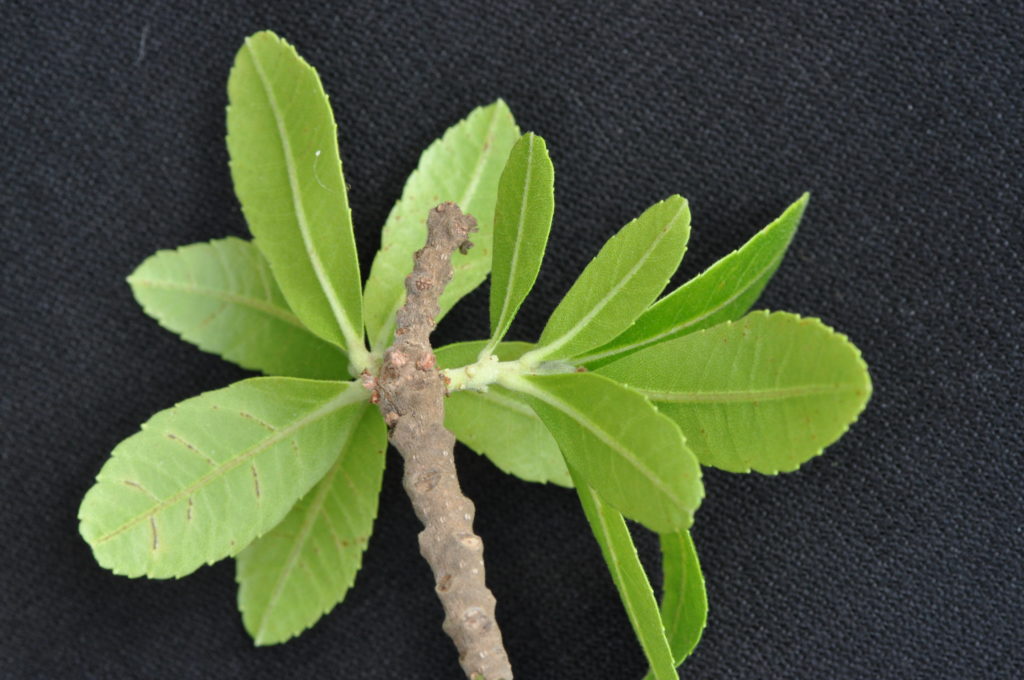
- 665. 2016/04/05. Walter Sisulu NBG. Photo: David Becking.
-
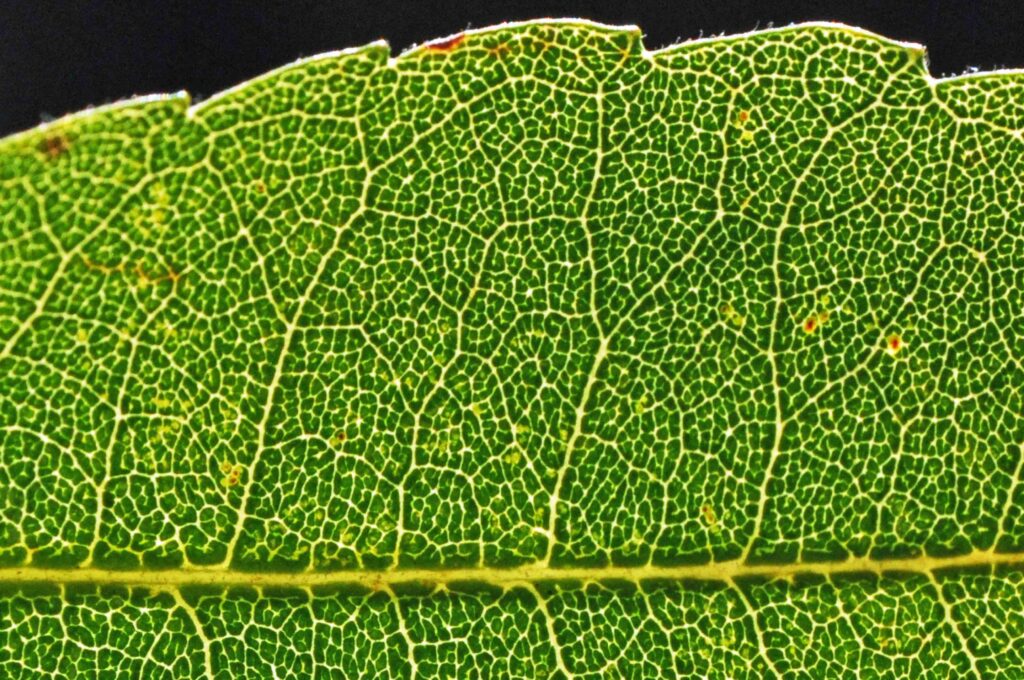
- 464. 2018/07/25. Walter Sisulu NBG. Photo: David Becking.
Flowers
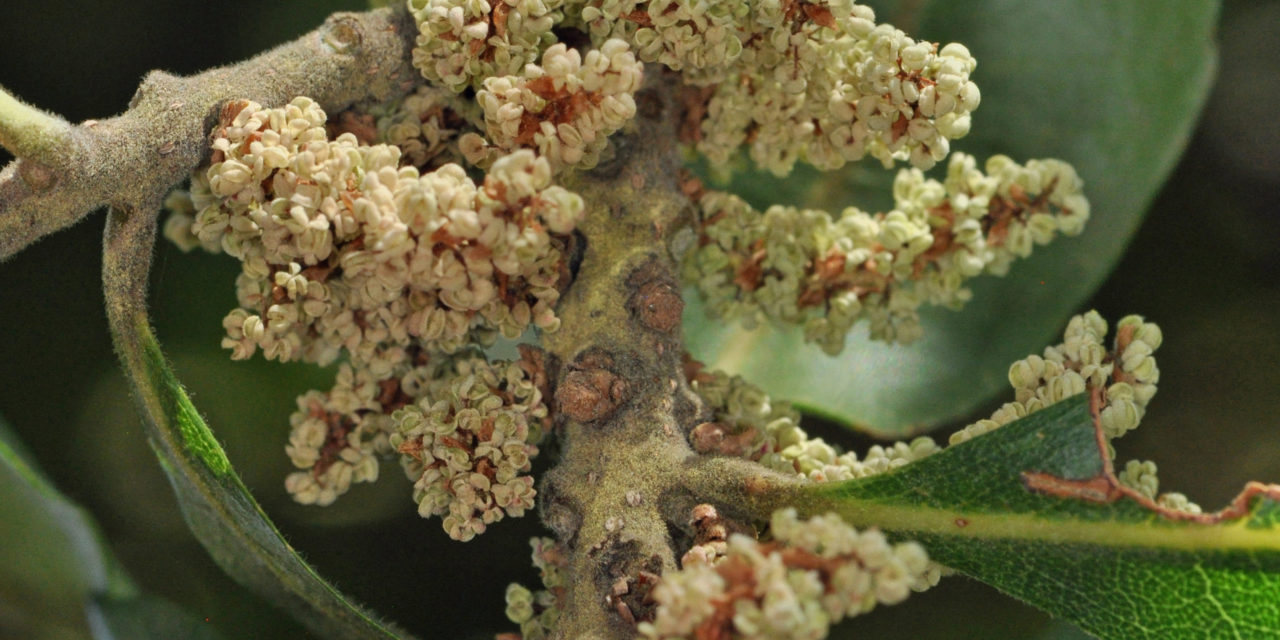
The small, usually unisexual Flowers are unobtrusive. Separate male and female flowers are either on the same or different short erect Spikes (simple indeterminate inflorescence with sessile flowers on a single unbranched stalk – photo 700). These spikes are up to 4,5cm long. They are located in leaf axils (the upper angle between the leaf stalk and the stems). Reddish male spikes are slightly shorter than the yellowish green female spikes. Solitary Bracts (usually a much-reduced specialised leaf) subtend each flower (brown in photo 700). In these wind-pollinated plants, the Perianth (a collective term for the usually outer Calyx and Corolla) is absent. In Male Flowers, the Stamens have short Filaments, (stalks that supports each anther) and the 1-6 Anthers (where the pollen grains are formed) are erect and dorsifixed with 2 thecae (pollen sacs) that dehisce through longitudinal slits. Here the Ovary is rudimentary. The yellowish green Female Flowers (photo 700) have a single Pistil (a unit of the Gynoecium, the female element of the flower, composed of the Ovary, Style and Stigma). Here the superior, sessile Ovary has one locule containing a single ovule. The protruding Style (is clearly visible in the enlarged photo 700×1 as are the brown bracts. The style ends with 2 Stigmas. (the parts of the pistil that receives the pollen). (May-Dec).
-
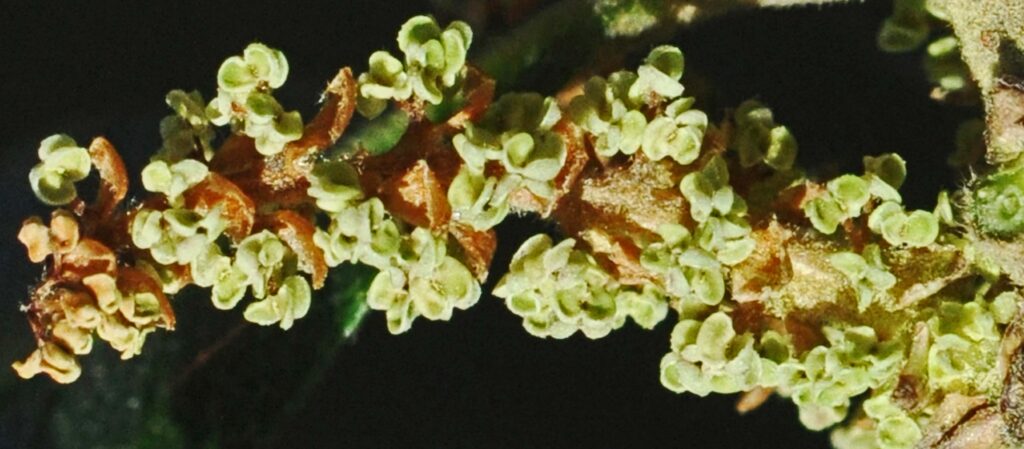
- 700. 2017/08/08. Walter Sisulu NBG. Photo: David Becking.
-
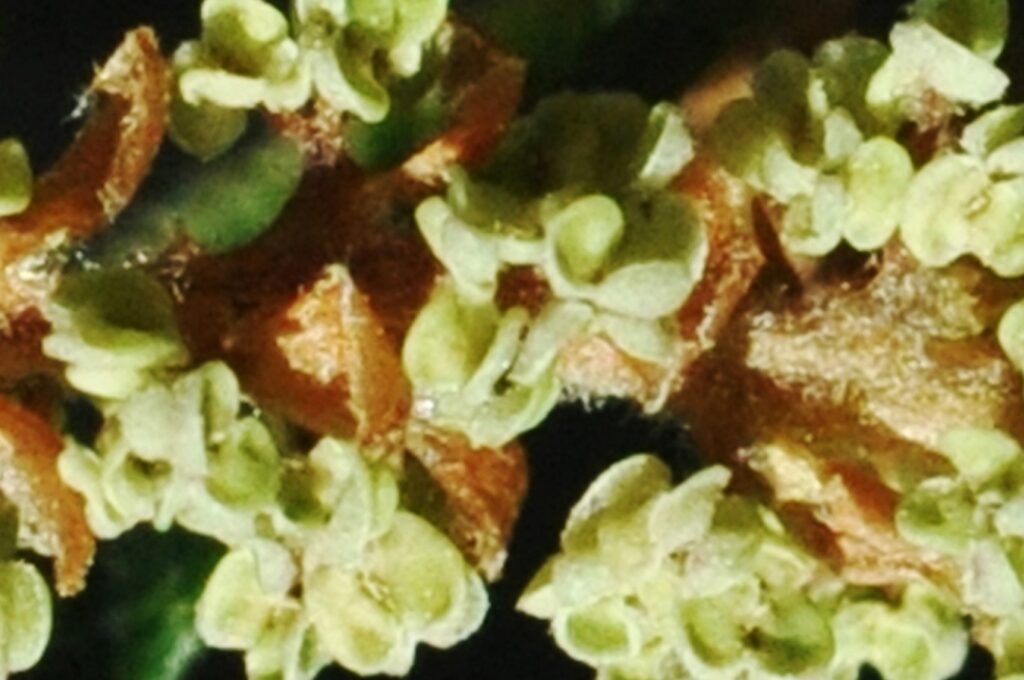
- 700.X1 2017/08/08. Walter Sisulu NBG. Photo: David Becking.
Fruit
Each small, almost spherical Fruit is a Drupe (fleshy, 1-seeded indehiscent fruits with each seed enclosed in a stony endocarp; stone fruit e.g., peach) that occur in short, crowed spikes. Persistent bracts and bracteoles encircle them. When ripe they become dark brown to black with a warty appearance. Each drupe is up to 3mm in diameter and usually has a warty coat. The Endocarp is the inner layer of the pericarp or fruit wall. It may be membranous e.g. apples but here it is hard and woody – like a peach pip). Seeds are blackish when ripe and have little or no Endosperm (the starch and oil-containing tissue of many seeds; often referred to as the albumen). At this stage they are usually almost spherical: black with a white waxy covering. Oct-Nov.
-
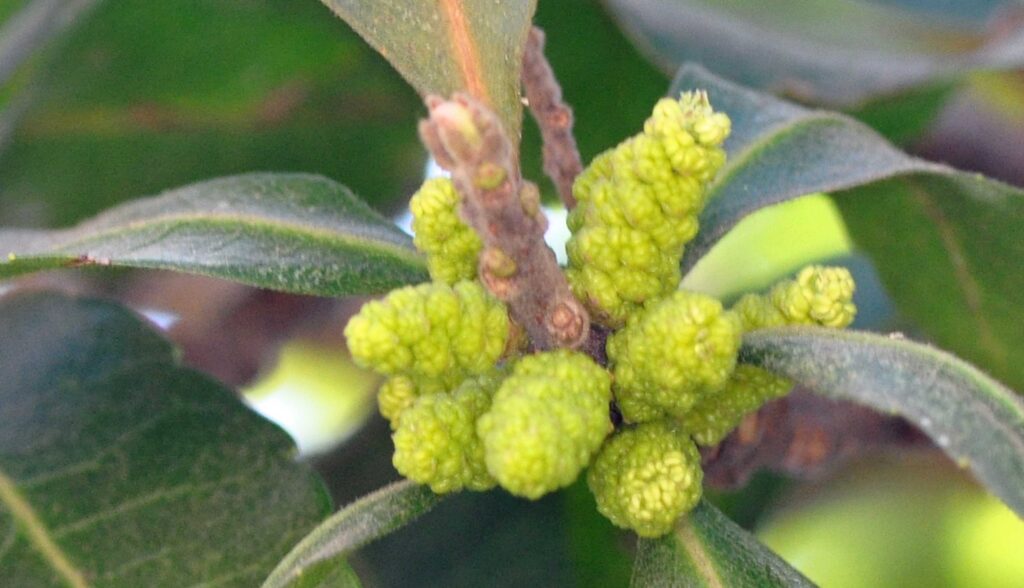
- 974. 2014/08/05. Walter Sisulu NBG. Photo: David Becking.
Distribution & Ecology
These trees are often Found at high altitudes in the Eastern Cape, KwaZulu-Natal, Mpumalanga e.g., on the edge of the Drakensberg escarpment near Graskop. They also occur in Gauteng, North West and Limpopo provinces e.g., Pilanesberg National Park. Beyond South Africa they occur in Eswatini (Swaziland) – western, Mozambique – east central, Zimbabwe, Malawi and Zambia. This plant was first collected on Mount Mulanje in southern Malawi (here the highest point is 3 001m). The tree is common among rocks, on forests fringes, on mountain slopes, open sloped grasslands, kloofs (steep-sided, wooded ravines or valleys) stream banks and in high attitude forests. Flowers attract bees. Leaves of this plant are food for larvae of some Athene species of butterflies (active, fast flying).
Ethnobotany
Traditional medicine makes use of this plant. Leaves contain yellowish oils and chewed leaves cause a lingering intense burning sensation in the mouth. The Fruit is occasionally eaten. Extracted fat from boiled fruiting branches has been used to make candles, polish floors and as food.
References
Boon, R. 2010. Pooley’s Trees of eastern South Africa. Flora and Fauna Publications Trust, Durban.
Burrows, J.E., Burrows, S.M., Lotter, M.C. & Schmidt, E. 2018. Trees and Shrubs Mozambique. Publishing Print Matters (Pty) Ltd. Noordhoek, Cape Town.
Coates Palgrave, M. 2002. Keith Coates Palgrave Trees of Southern Africa, edn 3. Struik, Cape Town.
Foden, W. & Potter, L. 2005. Morella pilulifera (Rendle) Killick. National Assessment: Red List of South African Plants version 2024.1. Accessed on 2026/01/25.
Lawrence, G. H. M, 1951. Taxonomy of Vascular Plants. The Macmillan Company, New York. Tenth Printing 1965.
Palmer, E. & Pitman, N. 1972. Trees of southern Africa. Balkema, Amsterdam, Cape Town.
Schmidt, S. Lotter, M. & McCleland, W. 2002. Trees and Shrubs of Mpumalanga and the Kruger National Park. Jacana, Johannesburg.
http://www.zimbabweflora.co.zw/speciesdata/species.php?species_id=120040
http://www.biodiversityexplorer.org/plants/myricaceae/morella_pilulifera.htm
http://posa.sanbi.org/flora/browse.php?src=SP