Maesa lanceolata
General Info – Summary
This smallish Tree with its non-invasive roots has simple Leaves with margins that may be entire or toothed. Small, sweet-scented, creamy-white, bisexual, actinomorphic and usually 5-meros Flowers are in panicles. The single pistil has a single chambered, semi-inferior ovary ending in a style + a lobed stigma. Fruit is a creamy drupe in which many small black seeds develop. This is an extremely variable species.
Description
Previous Names: Baeobotrys lanceolate, Maesa angolensis, Maesa lanceolate var. mildbraedii, Maesa lanceolate var. rufescens, Maesa palustris, Maesa picta, Maesa rufescens.
SA Tree No. 577.
Common names: (Afr) Baster Assegaai, Bruinsapblaar, Valsassegaai. (Eng) False Assegaai, False Assegai, Maesa Northern False Assegal. (isiXhosa) Intendekhiwane, Intentikilwane. (isiZulu) Indende, Inhlavubele, Isidenda, Isithende, Ubhoqobhoqo, Umagukhu, Umalunguzalazikahkona, Umagupa, Umagupu, Umaguqu, Umaququ, Uphongaphonga, Uphophopho. (Northern Sotho) Motswakhu. (siSwati) Ligucu, Magucu, Umbhongozi, Umbhungubhungu, Umbohlobohlo. (Tshivenda) Mutaku, Mutiba-mmela, Muunguri. (Xitsonga) Xithuthu.
Family: Maesaceae. This new family comprises a single genus, Maesa. It has about 100 species of trees or shrubs. Well-developed secretary canals are present. Leaves are simple. Flower pedicels have two bracteoles. There is a semi‐inferior ovary. The many seeded fleshy fruits are indehiscent.
Name derivation: Maesa – Arabic for a genus is maas. lanceolata – lance/spear shaped leaves: but many leaves are not lance shaped. There are 2 species of the genus Maesa in South Africa. The other is Maesa alnifolia (usually a low shrub).
Conservation: National Status: L C (Least Concern). Assessment: 2005/06/30 (W. Foden & L. Potter).
Tree
The plant is often a much-branched straggling even a multi-stemmed shrub up to 3m high or even a scrambler. In forests it may grow into a slender Tree with a rounded crown. The tree is usually up to 6m high but may reach 15+m in forests. A tree usually has a single trunk that is up to 20+cm in diameter. The Bark is smooth to roughish grey, to red-brown and vertically fissured (photo 684). Young stems are smooth or have many reddish-brown hairs (photo 426 – under Flowers). Brittle smooth branches develop either near ground level to near the top of the tree. In both places there are often visible raised Lenticels (usually raised corky oval or elongated area on the plant that allows the uncontrolled interchange of gases with the environment) present.
-
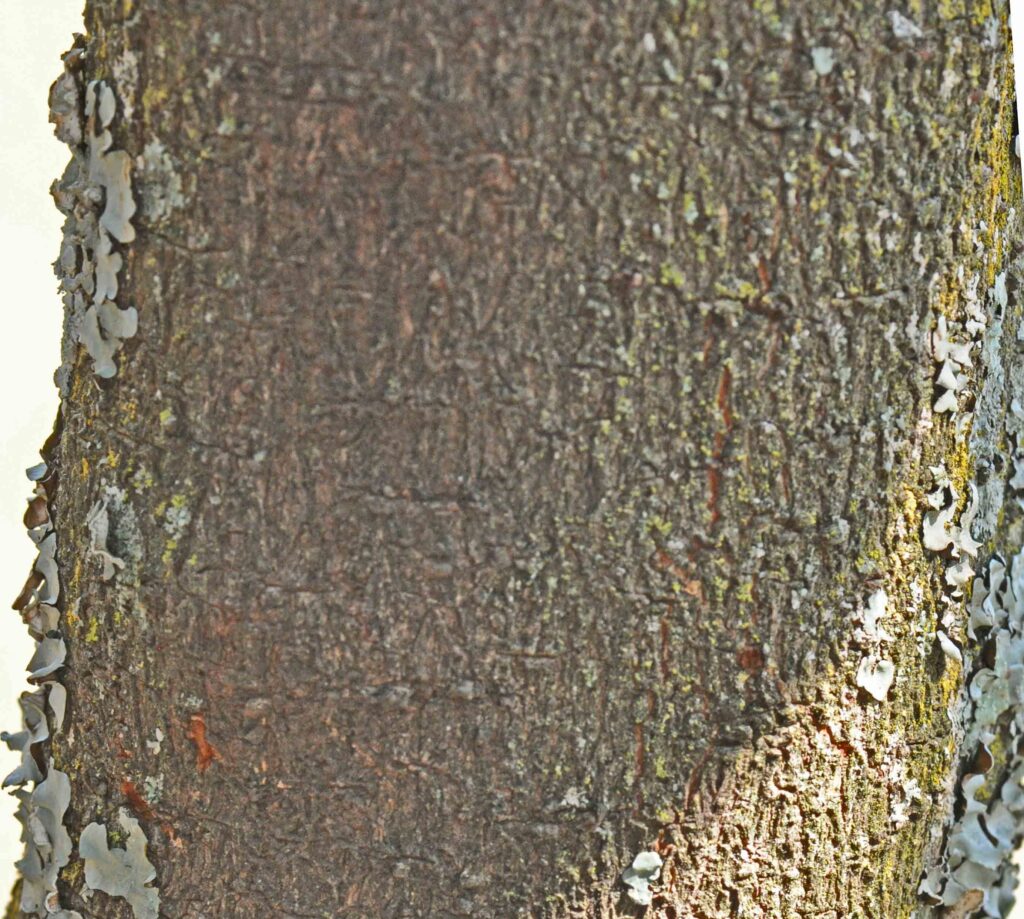
- 684. 2014/10/30. Pretoria NBG. Photo: David Becking.
Leaves
On this evergreen tree, the thickish, leathery, hairless and often gland-dotted Leaves are simple (have a single blade which may have incisions that are not deep enough to divide the blade into leaflets). The Leaves are similar to Curtisia dentata but are spirally arranged (not opposite as in Curtisia dentata). Each alternate leaf is nearly elliptic, lanceolate, ovate ovate-elliptic or obovate. It is up to 16x13cm – usually less (photo 685). The medium green Blade is a glossy or dull green and hairless above and paler below. The pale green lower surface is hairy, and rusty hairs may be present – especially along the midrib and side veins. The protruding yellowish midrib and lateral veins are clearly visible on both sides and protrude below (photo 685). The Apex broadly tapering to rounded or pointed. The Base is narrowed or rounded. The rolled under Margin may be entire (with a continuous margin, not in any way indented) or distinctly to shallowly toothed (photo 685). The Petiole (leaf stalk) is up to 3cm long and covered with rusty hairs. Stipules (basal appendages of the petiole) are absent.
-
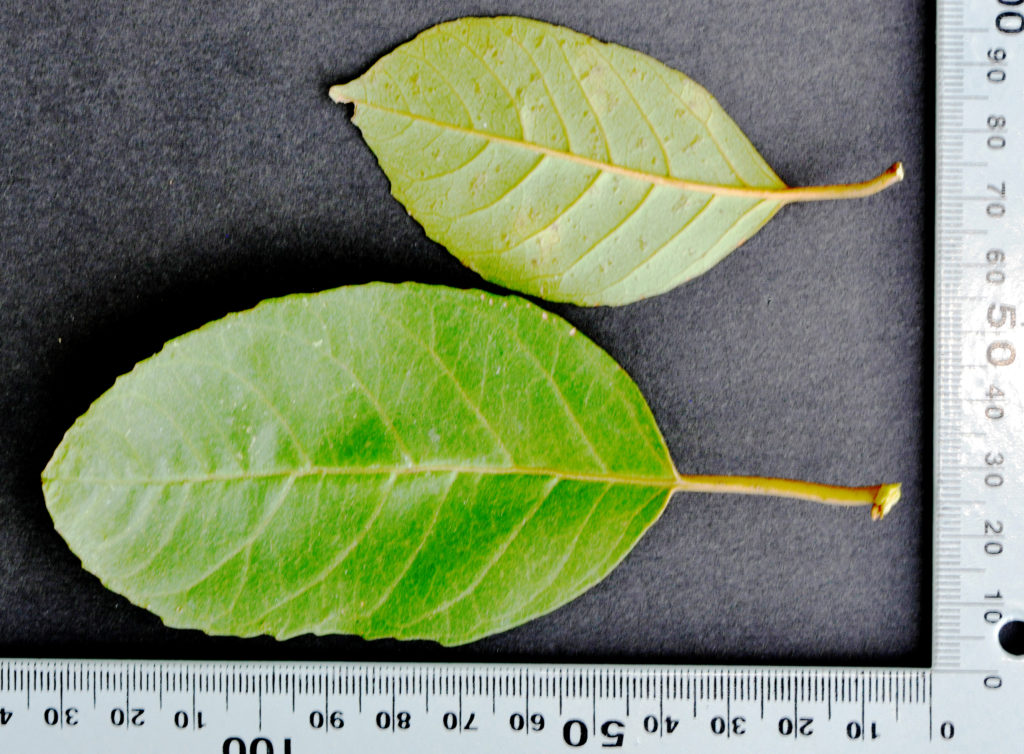
- 685. 2014/10/30. Pretoria NBG. Photo: David Becking.
Flowers
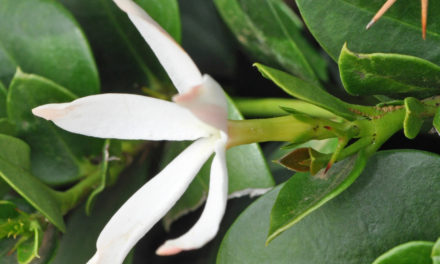
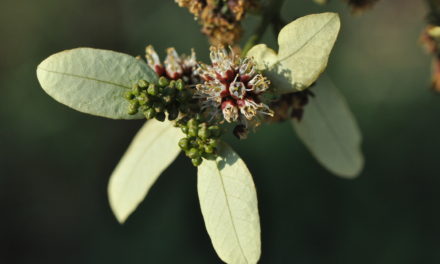
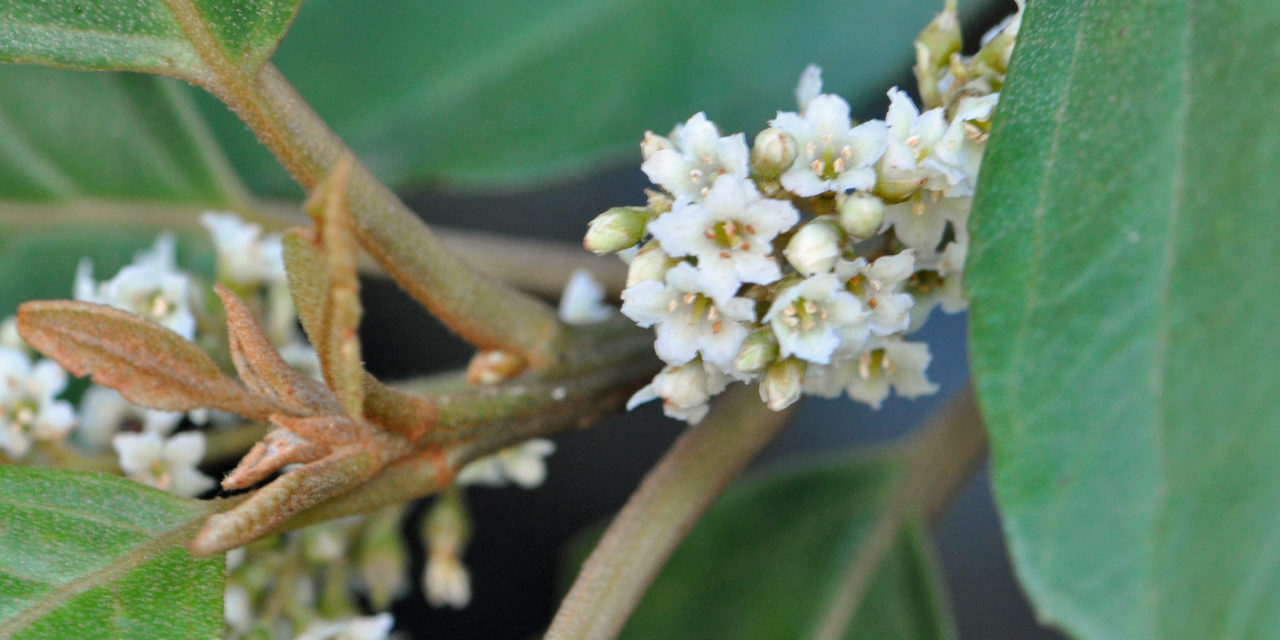
The sweet-scented, white to creamy-white and very small Flowers develop in 10 x 5cm Panicles (indeterminate, branched inflorescence with stalked flowers – photos 19 & 426). Each Inflorescences is up to 10 x 5cm. Each Pedicel (stalk of a single flower) and Peduncle (stalk of a cluster of flowers) are hairy and in leaf axils (P&P (photo 426). The flowers may also occur singly – in the axils of leaves or just above leaf scars. Floral parts may be in 4’s but are usually in 5’s (photos 19 & 23). The flowers are bisexual and actinomorphic (Regular, symmetrical. Each flower is vertically divisible into similar halves by more than 1 plane passing through the axis). The initially green, persistent Calyx lobes have rusty hairs outside and there are 2 Bracts (usually much-reduced specialised leaves) at the base (photo 426). The apex of the bud is initially red (photo 426). The joined bases of the Corolla lobes form a short tube, from which 5 spreading, white, lobes extend (photo 23) and turn pink. These lobes are not smooth. The 5 Stamens are attached to the mouth of the corolla tube (photo 27). The Anthers are dorsifixed – at least close to the middle. They are oblong to heart-shaped (photo 27) and dehisce through longitudinal slits. There is a single Pistil (a unit of the Gynoecium, the female element of the flower, composed of the Ovary, Style and Stigma). The semi-inferior Ovary is single chambered and there is a short persistent style ending in a lobed Stigma (photo 27). Nov- Aug, but most of the year).
-
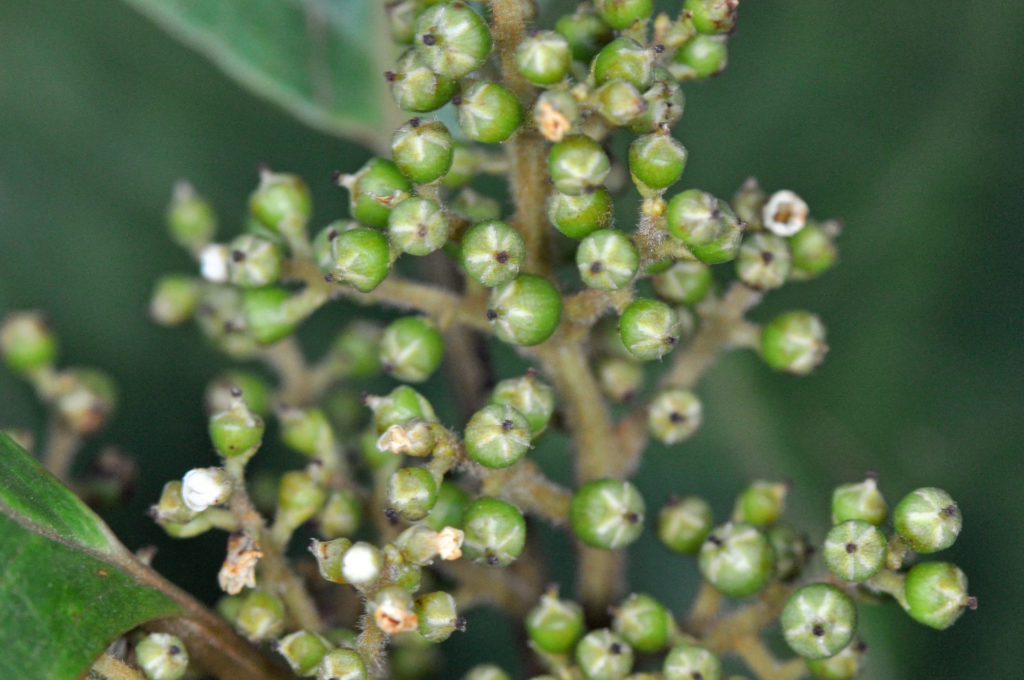
- 19. 2017/03/21. Pretoria NBG. Photo: David Becking.
-
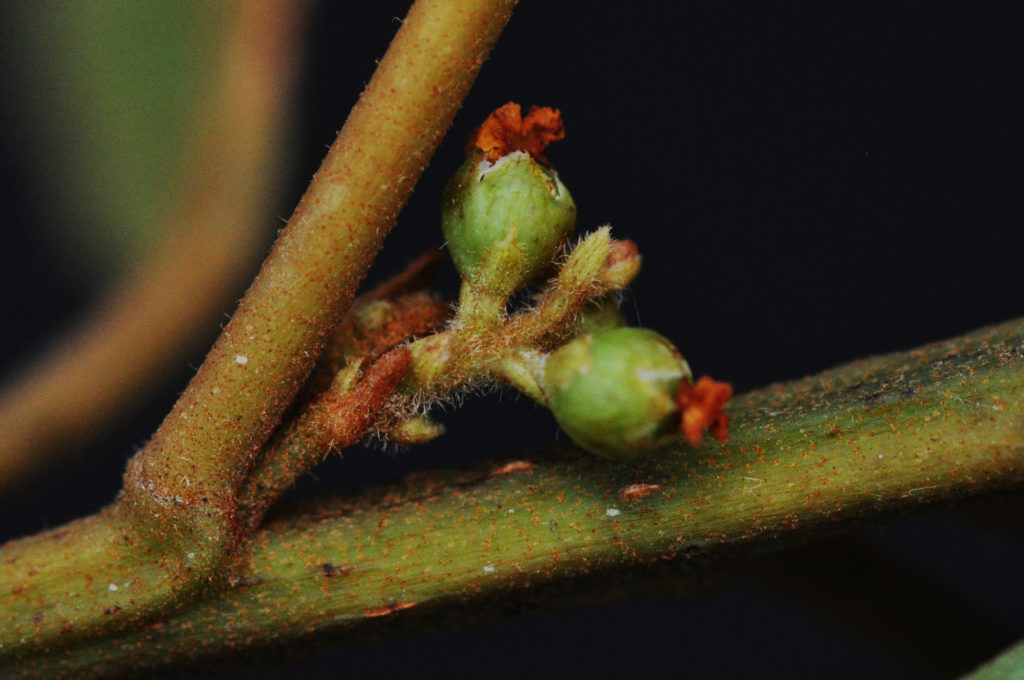
- 426. 2018/01/16. Pretoria NBG. Photo: David Becking.
-
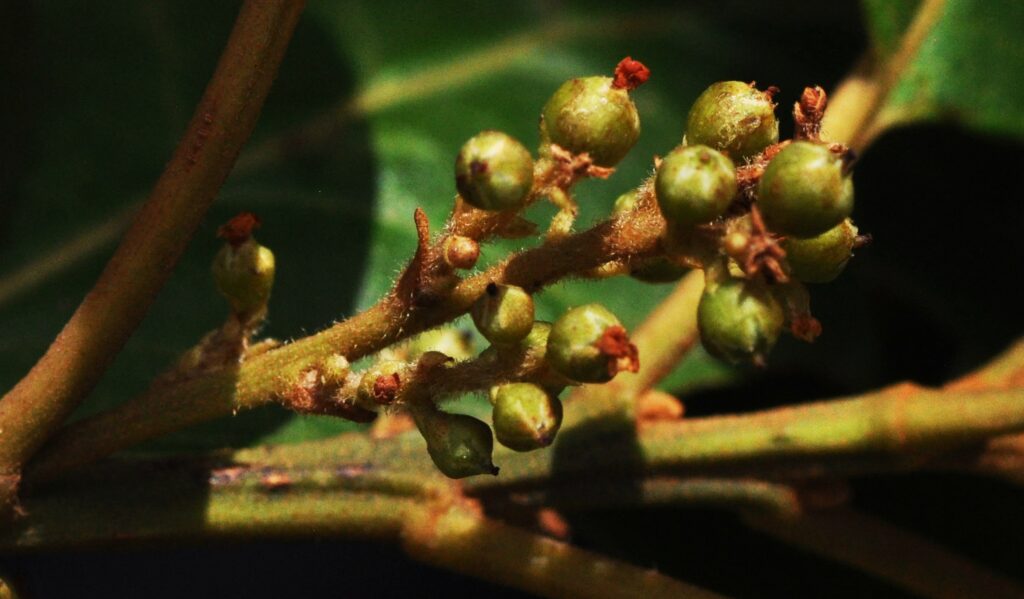
- 419Red. 2018/01/16. Pretoria NBG. Photo: David Becking.
-
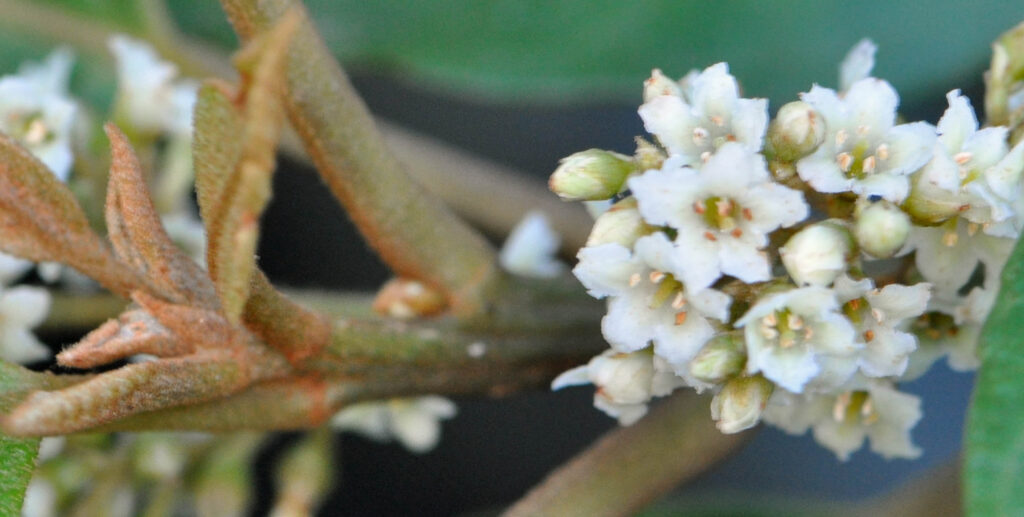
- 23. 2017/03/21. Pretoria NBG. Photo: David Becking.
-
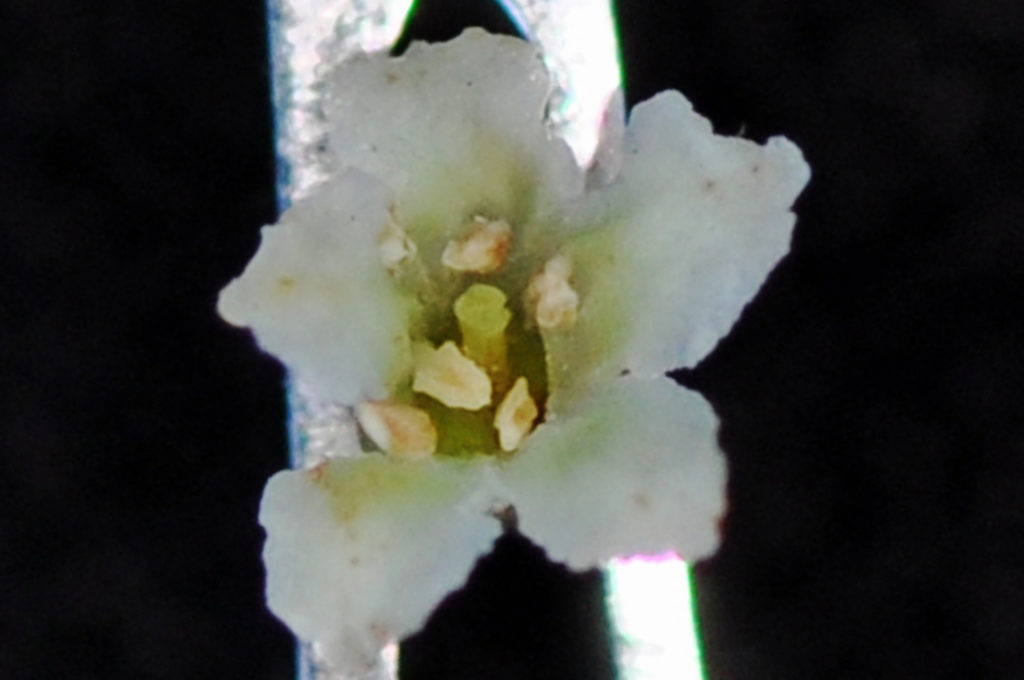
- 27. 2017/03/21. Pretoria NBG. Photo: David Becking.
Fruit
The white cream or pinkish, thinly fleshy, small almost spherical Fruit is a Berry (pulpy, indehiscent fruit like a grape or tomato). The berries may be crowded in dense hanging sprays and occur in bunches up to 10cm wide. Here each berry is up to 6mm in diameter. Each berry ends with the remains of both the persistent Calyx lobes at the base, and the Style at the apex. Here the style leaves a small point. The berries are usually crowded in leaf axils in dense sprays. Within each berry are many tiny black Seeds, each containing endosperm (the starch and oil-containing tissue of many seeds; often referred to as the albumen). (Mar-Dec).
Distribution & Ecology
These Trees occur in the Eastern Cape, KwaZulu-Natal e.g., in north-eastern forests, Limpopo and Mpumalanga e.g. near Kowyns Pass and Graskop. They also occur in Eswatini (Swaziland), western-central Mozambique, Eastern Zimbabwe and northwards into Tropical Africa as well as Madagascar, Asia and India. They occur in a variety of habitats – often in small groups with little or no undergrowth (due to the dense leaf cover. They also do well along stream verges. Trees can be found on the escarpment, on rocky slopes, grassy hillsides or in the bushveld (a sub-tropical woodland ecoregion of southern Africa) or forest margins. Their altitude range is from sea level up to about 1 900m. They are common along rivers and in mist belt regions and may become pioneer plants. Birds eat the fruit and aid with dispersal of seeds. Insects, including bees, visit the flowers and probably aid pollination.
Ethnobotany
The Fruit is “edible” but may be poisonous. Plants grow readily from Seeds. This good shade tree has roots that are not invasive. In the process of beer making, the grain may be covered with leaves to hasten fermentation. Extracts from Roots and Leaves have antimicrobial activity against Erwinia carotovora. This is a gram-negative, rod-shaped Bacterial plant pathogen, which infects potato tubers, carrots, onions, lettuce, and tomato plants. Local medicine makes use of plant parts including roots, bark, leaves and fruit.
References
Boon, R. 2010. Pooley’s Trees of eastern South Africa. Flora and Fauna Publications Trust, Durban.
Burrows, J.E., Burrows, S.M., Lotter, M.C. & Schmidt, E. 2018. Trees and Shrubs Mozambique. Publishing Print Matters (Pty) Ltd. Noordhoek, Cape Town.
Coates Palgrave, M. 2002. Keith Coates Palgrave Trees of Southern Africa, edn 3. Struik, Cape Town.
Foden, W. & Potter, L. 2005. Maesa lanceolata Forssk. National Assessment: Red List of South African Plants version 2024.1. Accessed on 2025/12/02.
Lawrence, G. H. M, 1951. Taxonomy of Vascular Plants. The Macmillan Company, New York. Tenth Printing 1965.
Palmer, E. & Pitman, N. 1972. Trees of southern Africa. Balkema, Amsterdam, Cape Town.
Schmidt, S. Lotter, M. & McCleland, W. 2002. Trees and Shrubs of Mpumalanga and the Kruger National Park. Jacana, Johannesburg.
van Wyk, B. & van Wyk, P. 1997 Field guide to Trees of Southern Africa. Struik, Cape Town.
http://www.plantzafrica.com/plantklm/voteplant.php
http://www.plantbook.co.za/maesa-lanceolata/
https://en.wikipedia.org/wiki/Maesa_lanceolata
http://medical-dictionary.thefreedictionary.com/Maesa+lanceolata
http://posa.sanbi.org/flora/browse.php?src=SP
https://microbewiki.kenyon.edu/index.php/Erwinia_carotovora
https://www.researchgate.net/publication/312765577_Maesaceae
https://www.britannica.com/plant/Maesaceae
https://en.wikipedia.org/wiki/Primulaceae
http://pza.sanbi.org/maesa-lanceolata