Kigelia africana
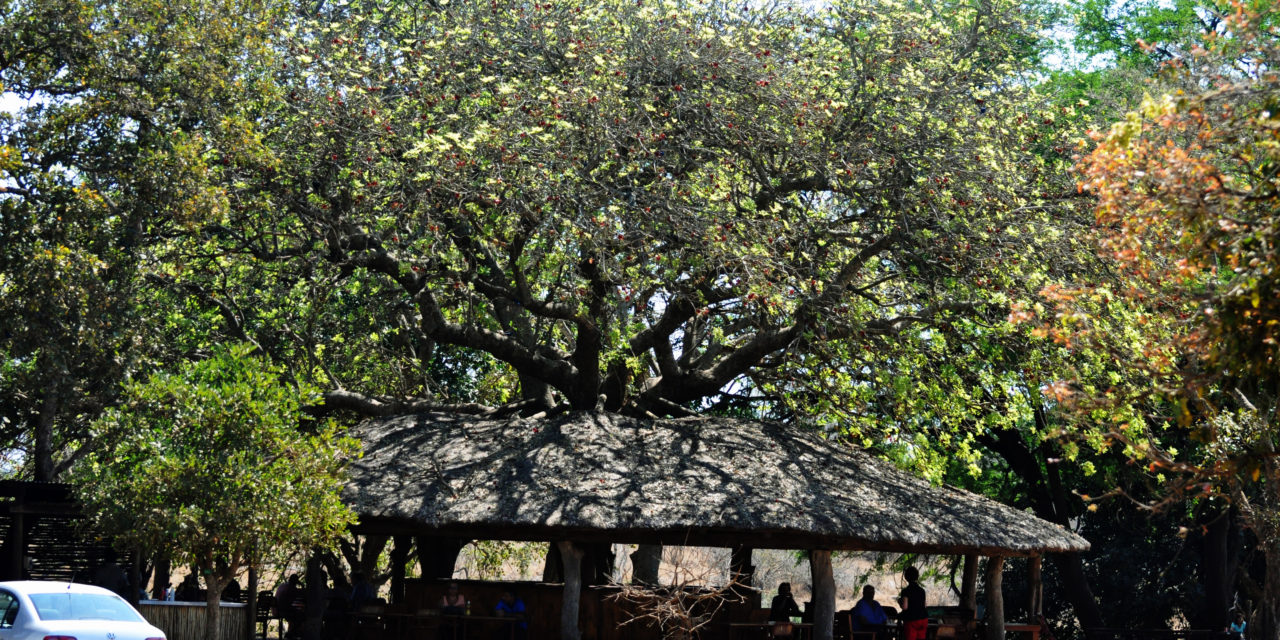
Photo 491. 2014/09/10. Tshokwane KNP. Photo: David Becking.
General Info – Summary
This fascinating Tree with its grey/brown, straight stout trunk may reach 15+m high. The imparipinnate Leaves are frost sensitive. The paired leaflets are asymmetric. The impressive large, deep red, bisexual, zygomorphic Flowers develop in panicles and have didynamous stamens and 1 staminode. The ovary is superior and rests on a single pistil. The very large, heavy Fruit is an indehiscent pod with many seeds.
Description
Previous Names: Bignonia africana, Crescentia pinnata, Kigelia abyssinica, Kigelia acutifolia, Kigelia aethiopica, Kigelia aethiopum, Kigelia pinnata.
SA Tree No. 678.
Common names: (Afr) Kalabasboom, Komkommerboom, Worsboom. (Eng) Sausage-tree, German sausage tree, Cucumber tree, Fettish bean. (isiZulu) Ibelendlovu, Umbele-le-wendlovu, Mutshata, umFongothi, Umvongothi, Umbongothi, Umvunguta. (Northern Sotho) Modukguhlu, Pidiso. (Setswana) Amvungutsha, Mpfungurhu. (siSwati) Umvongotsi. (Tshivenda) Mutshata, , Mubvevha, Muvevha.
Family Bignoniaceae (Jacaranda family). In this mainly tropical family, there are about 83 genera and 810+ species. In South Africa, there are 6 genera + 2 naturalised with a total of 13 species. The indigenous genera with trees on this website include Bignonia, Kigelia, Markhamia, Rhigozum, and Tecomaria. Most species are woody. Leaves are usually compound, opposite and lack stipules. The usually large and brightly coloured Flowers are bisexual and irregular. They usually occur in panicles or racemes or are solitary. The Calyx has 5 partly united sepals which are shorter than the usually 5 joined Petals producing a conspicuous tube. The petals are often 2-lipped with the upper lip having 3 lobes and the lower lip with 2 lobes. There are occasionally 2 but usually 4 didynamous Stamens (2 long and 2 short) which arise from the corolla tube. A single staminode may be present. The Anthers have 2 pollen sacs which dehisce longitudinally. There is a superior Ovary with 2 united carpels. Many ovules are present. The simple Style terminates in a Stigma with 2 flattened lobes. The Fruit is usually a bivalved capsule. Seeds are usually flat and usually have a glassy, translucent wing.
Name derivation: Kigelia – from the Mozambique name: Kigeli-keia. africana – of Africa. K. africana is monotypic (a genus containing one species) and Kigelia is a purely African genus.
Conservation: Natural Status: L C. (Least Concern). 2005 (W. Foden and L. Potter). This status is enhanced because the tree is considered as sacred to many communities.
Tree
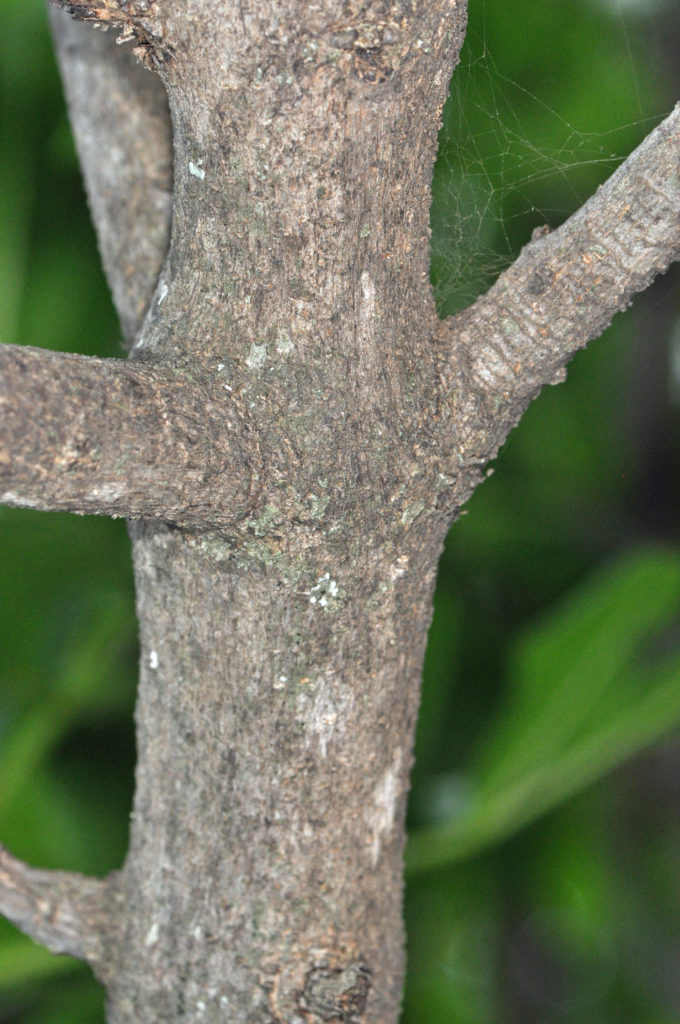
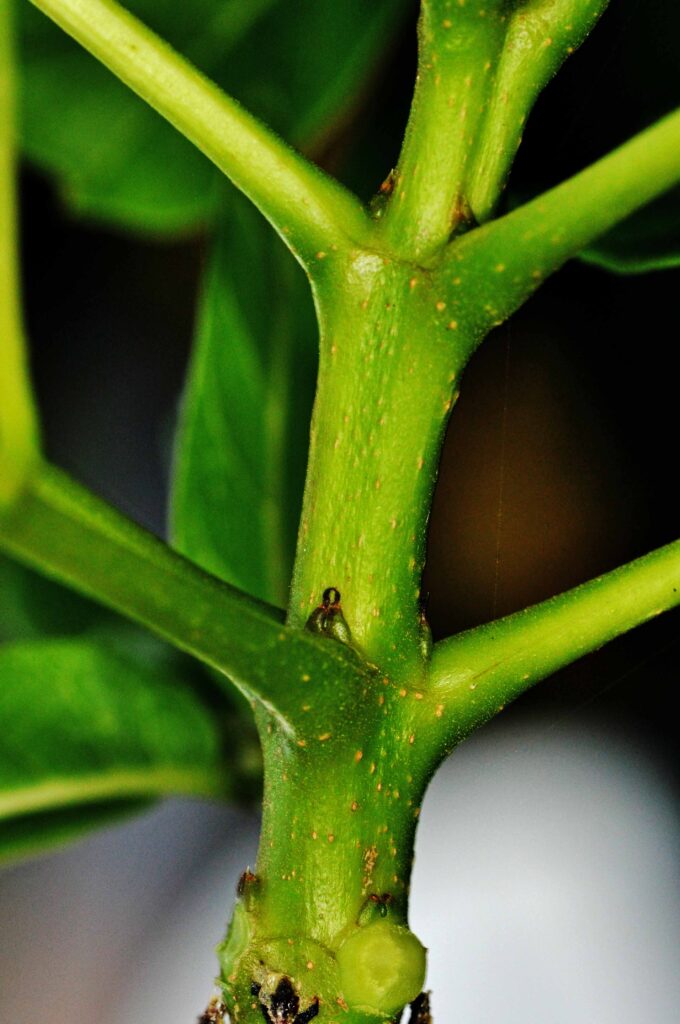
This is a typical tropical, strange African Tree with a rounded crown (photo 362) and its clean a squat bole (the bole, or trunk, is the stem and main wooden axis of a tree). It is often up to 9m high but does reach 15m high and may reach 25m high in Zimbabwe. The short stout and straight Trunk (photo 1 012) has a diameter of up to 0,8m. The spreading and nearly horizontal Branches are often stout (photos 491 – intro photo & 340). Young branches are green and here Lenticels (a usually raised corky oval or elongated area on the plant that allows the uncontrolled interchange of gases with the environment) are visible (small white patches in photo 342). Bark is grey to brown and flakes off on very large trees or remains more or less smooth (photo 338). In young branches Lichen (specialised fungi cultivate algae partners that manufacture food for them by photosynthesis) may be visible (whitish in photo 338).
-
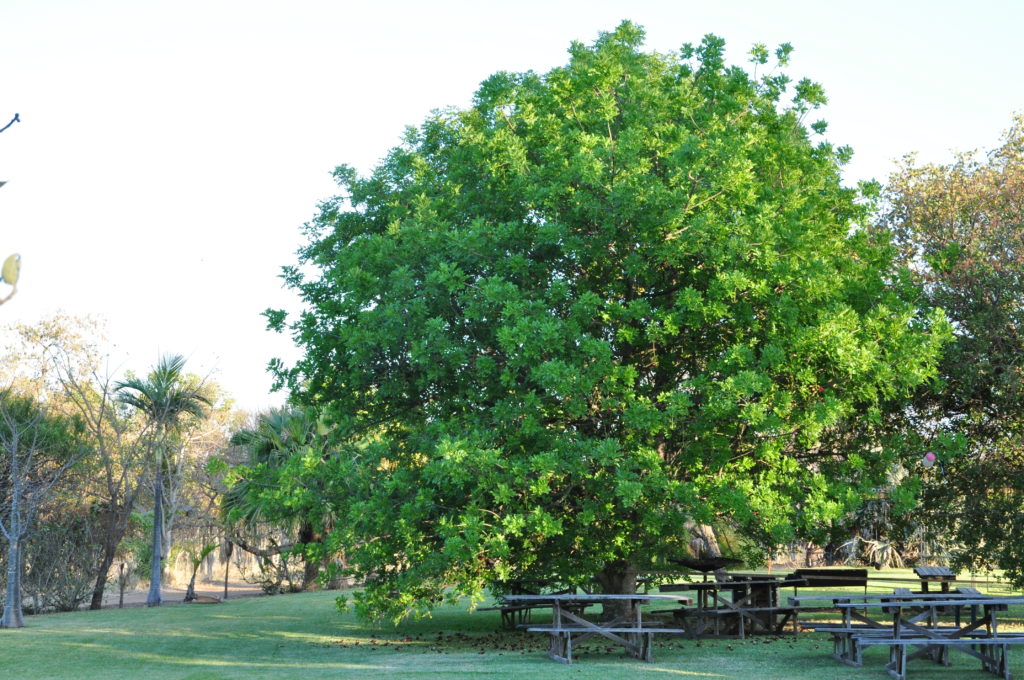
- 362. 2014/09/07. Duiwelskloof. Photo: David Becking.
-
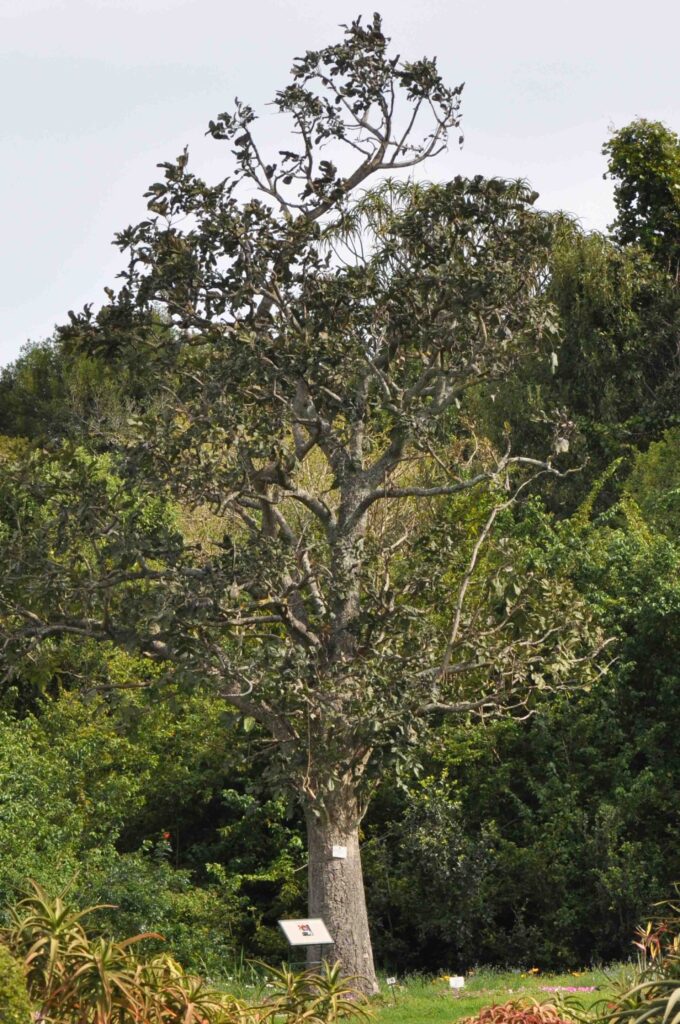
- 1 012. 2018/09/15. Kirstenbosch NBG. Photo: David Becking.
-
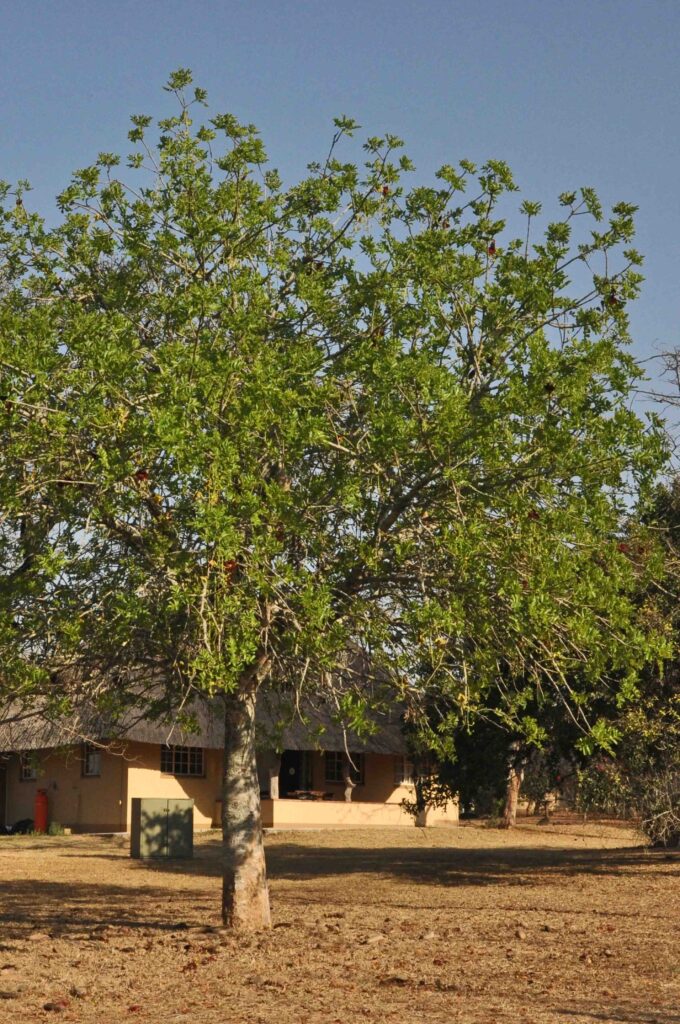
- 328. 2014/09/10. Pretoriuskop KNP. Photo: David Becking.
-
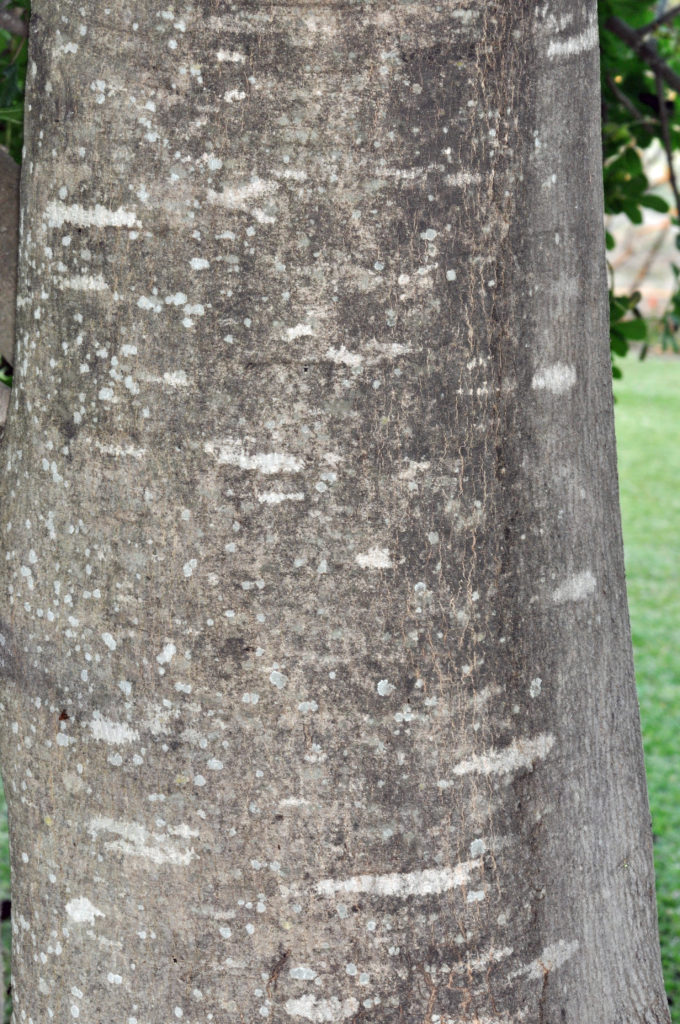
- 338. 2014/09/07. Modjadjiskloof. Photo: David Becking.
-
- 340. 2014/09/07. Modjadjiskloof. Photo: David Becking.
-
- 342. 2014/09/07. Modjadjiskloof. Photo: David Becking.
Leaves
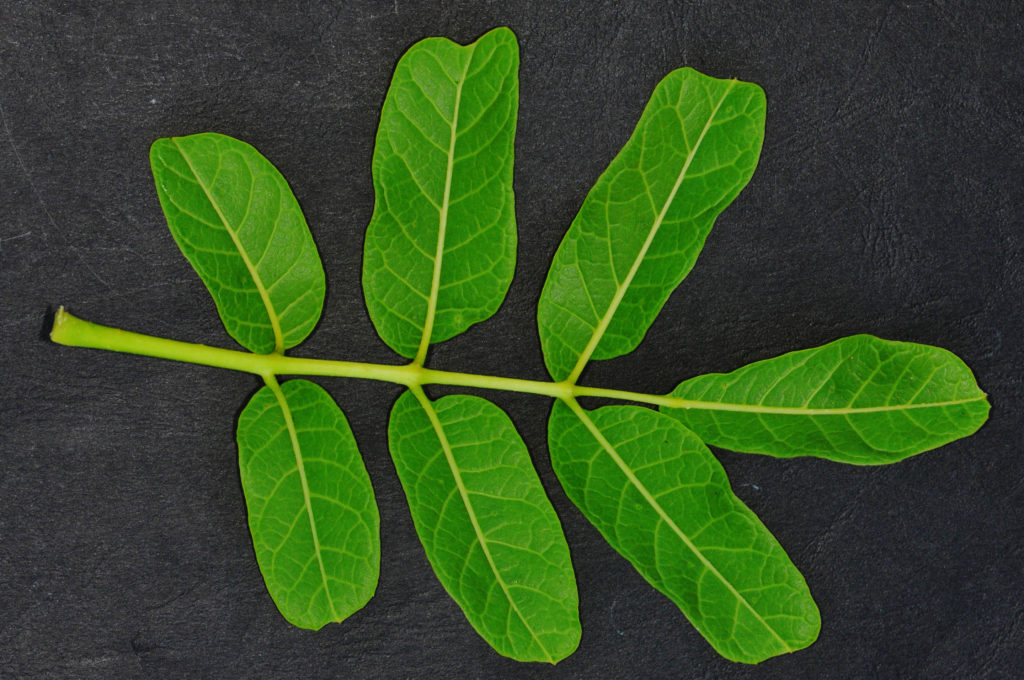
This tree may be briefly deciduous (loss of leaves for part of the year), in which case the new foliage is a conspicuous fresh coppery green in spring. Leaves and may reach a length of 30+cm. They become dark green or glossy and clustered towards the ends of branches (photo 1 012 under Tree). A Compound leaf has distinctive parts that separate it from the midrib (the main rib of a leaf or leaf-like part, a continuation of but excludes the Petiole – leaf stalk). Leaves on this tree are Imparipinnate (pinnately compound leaves ending in a single leaflet – photo 347). [Compound leaves of different plants that end in a pair of leaves are referred to as Paripinnate].
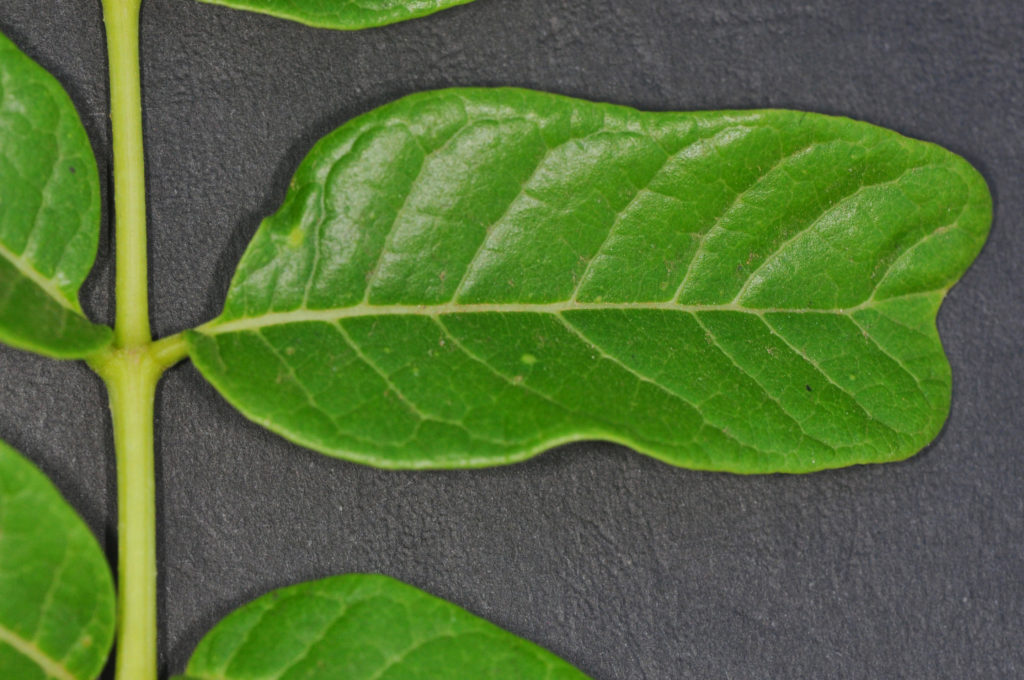
In photo 347 the yellow main axis to which the leaflets are attached is the Rachis (here an extension of the petiole of a compound leaf that eventually bears the leaflets that are arranged in a feather-like pattern extending along the rachis. The upper surface of the rachis may be grooved. Trees growing in the forests tend to have larger leaves. In addition to the single terminal leaflet, there are 2-5 pairs of large, well-spaced apart opposite leaflets (or in whorls of 3) that are slightly rough and hard. These hairy leaflets (photo 324) are up to 13 x 7cm. In this photo taken against a strong light, the side veins arch and join prior to reaching the margin. Each, rather rough, leaflet is oblong, obovate (the reverse of ovate) or elliptic. The leaflet Apex is broadly tapering to rounded or even notched (photo 344). With the exception of the terminal one, leaflets Bases are distinctly asymmetric (not equal to the opposite side – photos 347 & 344). In each leaflet the main and side Veins are indented above and prominently protrude below. The Petiole (leaf stalk) is up to 15cm long (photo 347). Except for the terminal leaflet (photo 347), where the Petiolules (leaflet stalks) are up to 1,3cm long, petiolules are very short or absent. The Margin of mature leaflets is usually entire (with a continuous margin), may be wavy (photo 344) and occasionally scalloped. Young leaves may be serrated and have a pointed apex.
-
- 347. 2014/09/07. Modjadjiskloof. Photo: David Becking.
-
- 344. 2014/09/07. Modjadjiskloof. Photo: David Becking.
-
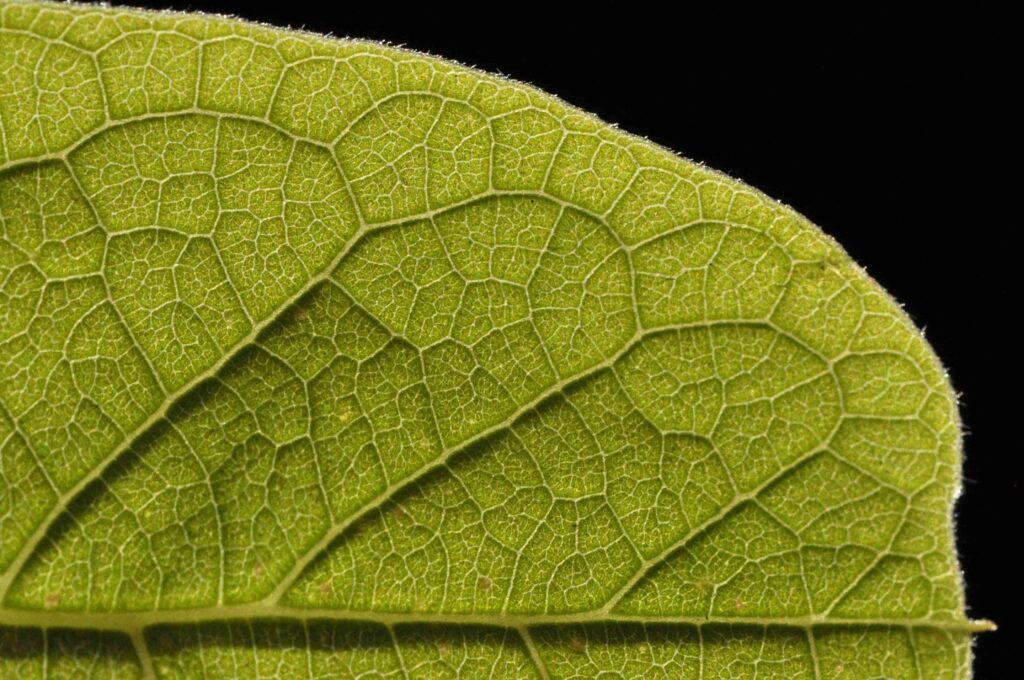
- 324. 2019/08/16. Pretoriuskop KNP. Photo: David Becking.
Flowers
Palmer & Pitman refer to this Flowers as “having barbaric splendour.” The large (up to 15cm across the mouth), impressive flowers are bisexual and zygomorphic (floral parts are unequal in size or form so that the flower is capable of division into essentially symmetrical halves by only one longitudinal plane passing through the axis). The red or orange flowers open at night, and the crumpled petals fall the next day. Initially they are yellowish but become deep red (photo 336) and trumpet or bell shaped. The flowers have up to 50-night opening buds that are arranged in lax pendulous Panicles (indeterminate, branched inflorescence with stalked flowers).
Flowers hang down in sprays that are up to 90cm long (photo 341). Long, light green Peduncles (stalks of a flower cluster) are present and hang down vertically from the branches. (photo 341).
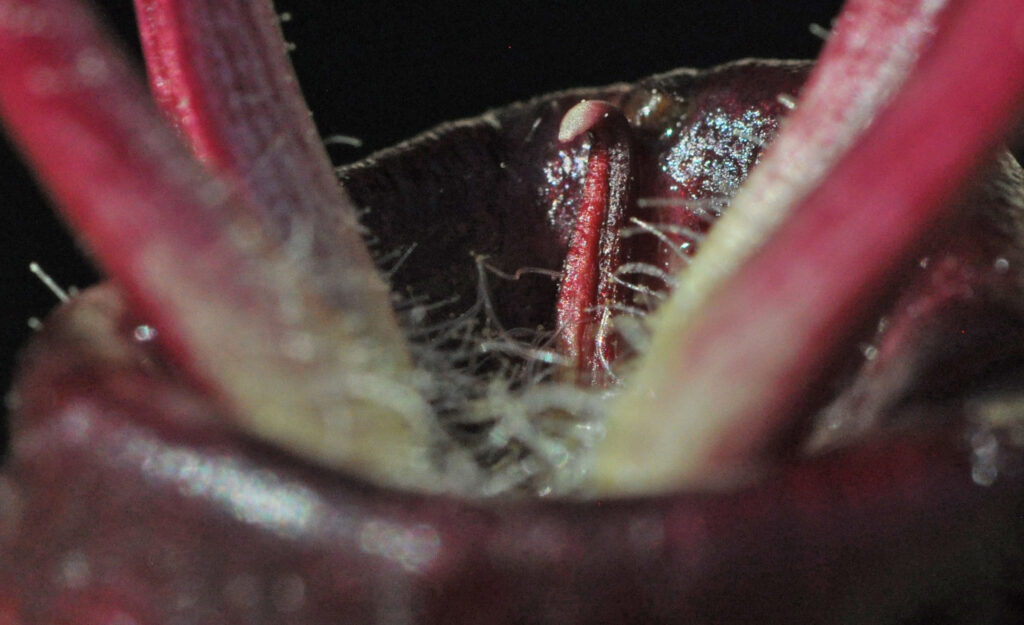
From here the sturdy Pedicels (flower stalks) in groups of 3 extend sideways, are up to 11cm long and curve upwards at the tip (photo 341) causing the flower to face upwards and hold its large supply of nectar inside. The abundant available Nectar and the unpleasant Smell of the flowers (for humans) attract pollinators, including bats and hawk moths. The annular Nectary is leathery and covered with densely matted woolly hairs. Once a single flower in a panicle has been pollinated, the rest of the up to 50 buds become non-functional. This makes sense in view of the very heavy fruit produced. The leathery Calyx is short and tubular with 2-5 ribbed lobes (photo 341). The 5-lobed Corolla tube is slightly curved, cylindrical below and bell-shaped above. Here the Petals are bilobed (have 2-lipps). The upper lip is erect and has 2 lobes (photo 336). The longer lower lip has 3 lobes and bends abruptly downwards. The crumpled flowers change from yellowish to reddish and finally are slightly purple. The 4 Stamens are didynamous (having 4 stamens disposed in 2 pairs of 2 different lengths – photo 291). These are attached at the top of the cylindrical part of the corolla tube and protrude slightly (photo 336). Soft hairs cover the base of the linear, red, thick and leathery Filaments (photo 293). This close up photo shows the single short posterior Staminode (sterile stamen). The Anthers have separate Theca (pollen sacs – photo 291). In this photo the pollen grains are just visible. The single Pistil (a unit of the Gynoecium, the female element of the flower, composed of the Ovary, Style and Stigma) has a superior unilocular Ovary containing many ovules. The Stigma has 2 elliptic lobes (photo 336 & 341). (Jul-Oct).
-
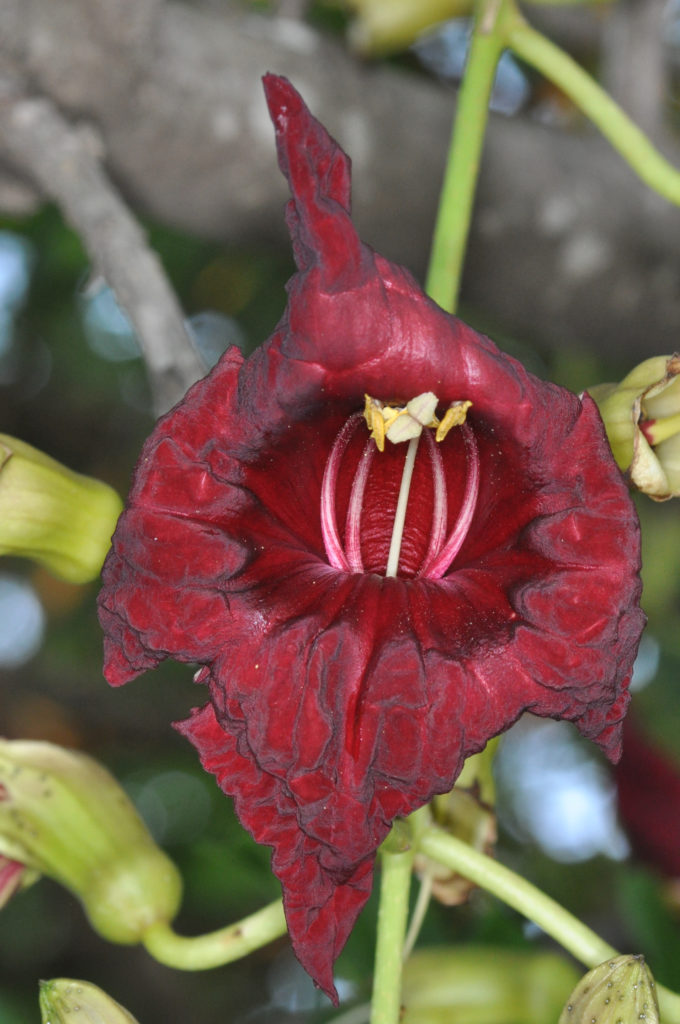
- 336. 2014/09/07. Modjadjiskloof. Photo: David Becking.
-
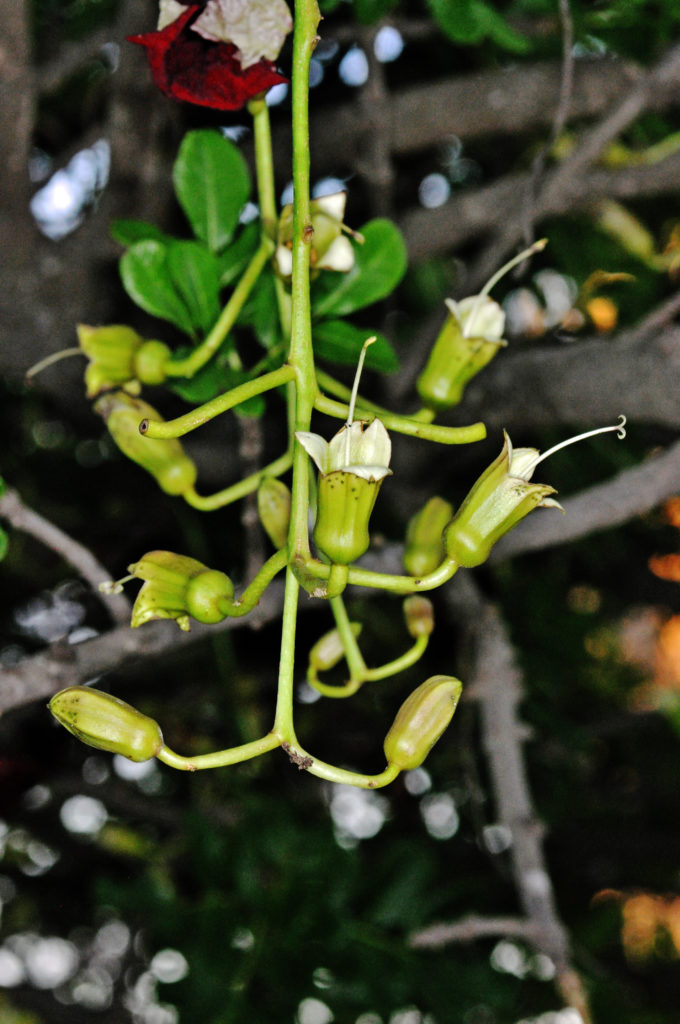
- 341. 2014/09/07. Modjadjiskloof. Photo: David Becking.
-
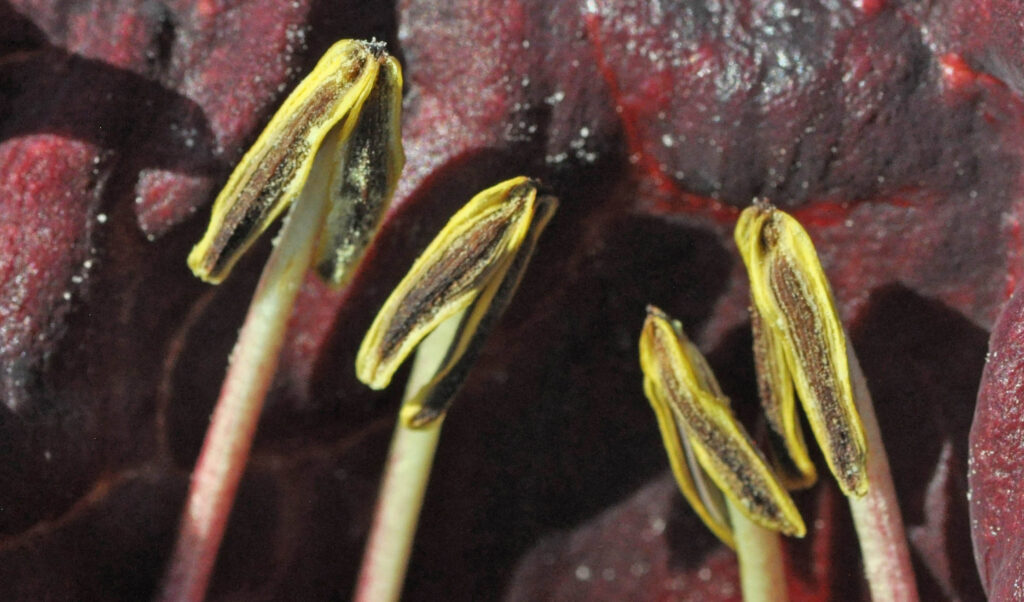
- 291. 2019/08/14. Pretoriuskop KNP. Photo David Becking – Dissected.
-
- 293. 2019/08/14. Pretoriuskop KNP. Photo David Becking. Dissected.
Fruit
The grey, cylindrical, woody, pendulous and sausage shaped Fruit is a very large, indehiscent Pod (up to 100 x 18cm – photo 577) that is dotted with lenticels. This pod, with its grainy surface, is diagnostic. It is fleshy and fibrous within (photo 330). The indehiscent hard-walled fruit may have a mass of up to 12kg and hangs down from a sturdy stalk (photo 577). The numerous small wingless Seeds (photo 330) are imbedded in a fibrous pulp, and each seed has a leathery Testa (seed coat) which intrudes between the 2 Cotyledons (i.e. seed leaves; primary leaves in the embryo). (Nov-Aug).
-
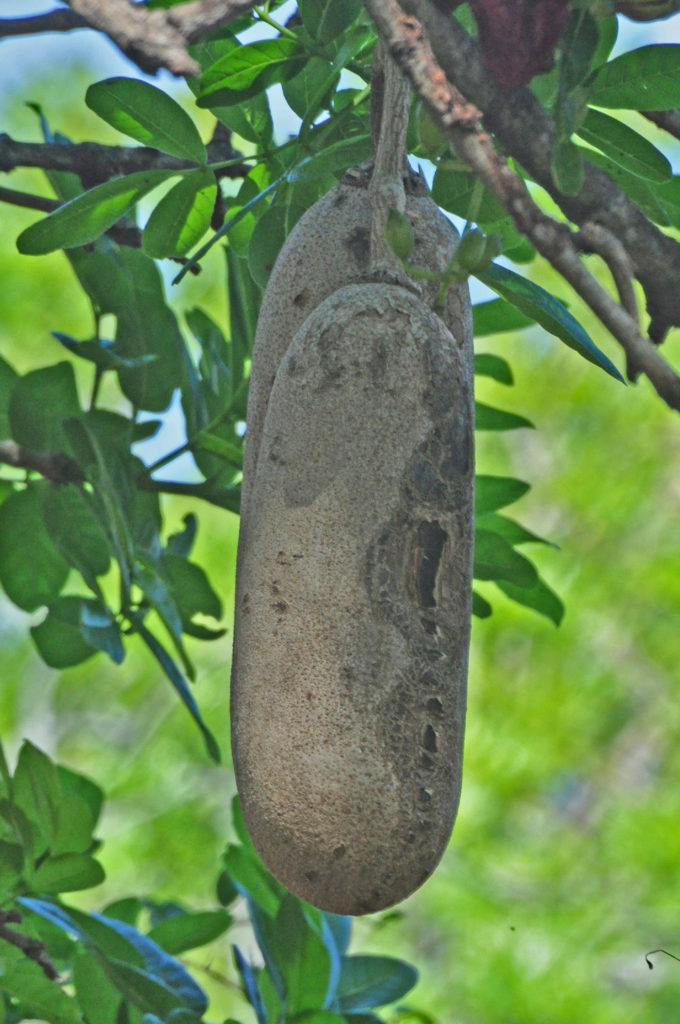
- 577. 2014/09/11. Lower Sabi Road KNP. Photo: David Becking.
-
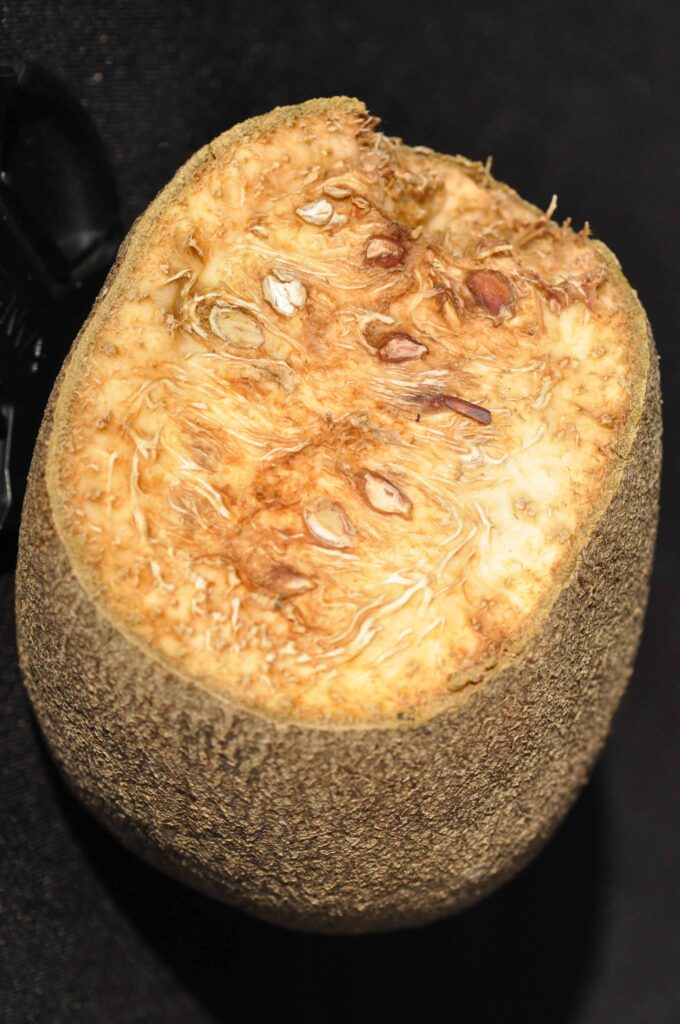
- 330. 2014/09/11. Lower Sabi KNP. Photo: David Becking.
Distribution & Ecology
These Trees occur in flood plains and along watercourses at relatively low altitudes. They are common in the bushveld (a sub-tropical woodland ecoregion of southern Africa) along riverine fringes and may occur near the coast. They also occur on rocky hills. These trees are naturally located in North East Southern Africa, including northern KwaZulu-Natal, Gauteng, Mpumalanga, and Limpopo, through Eswatini (Swaziland), Mozambique (widespread) and Zimbabwe. They also occur in Northern Province, Northern Botswana, and North-eastern Namibia – Caprivi Strip. From here, they occur northwards into tropical Africa. Kudu browse the Leaves and baboons and bushpigs (Potamochoerus larvatus) eat the Fruit. Many insects visit the Flowers, and the fallen flowers are eaten by game. Monkeys and baboons consume the masses of Nectar, the whole flower and flower buds. The abundant nectar attracts a wide variety of birds in the early morning – including sunbirds. Seeds (especially when unripe) may be poisonous to man. In needy times, the seeds have been eaten after roasting. However, baboons, monkeys, porcupines and bushpigs consume them. Apart from its diet of small animals, the Southern Boubou (a bushshrike) also feeds on the seeds. Tree Sap attracts Charaxis butterflies, known locally as Emperors. They are relatively strong and high-flying. This plant is also the larval food for the Garden Acraea (Acraea horta) butterfly with its partly transparent wings.
Ethnobotany
The Fruit is considered poisonous to man. It is a strong purgative and causies mouth blisters but is eaten by domestic animals. The baked fruit has been used to ferment beer. The Wood is light to pale brown, soft, tough and does not split easily. It is resistant to cracking and is used for planking, yokes, oars, stampers and plates. The low-density wood makes it good for canoes. The tree produces a dense shade. Propagation is from fresh seeds or truncheons (stem cutting from a selected plant – used to produce genetically identically new plants) and does well in warm areas. However, the leaves are sensitive to severe frost and branching may take a couple of years. This plant makes a good bonsai. After roasting, the Seeds are possibly edible. Bark and Leaves are bitter tasting. These trees have been planted to help stabilise riverbanks. A yellow dye is extractable from the Roots. When used as a shade tree, care must be taken to avoid the heavy falling fruits. It is safer to remove the young fruit. This Tree is widely used in local medicine.
References
Boon, R. 2010. Pooley’s Trees of eastern South Africa. Flora and Fauna Publications Trust, Durban.
Burrows, J.E., Burrows, S.M., Lotter, M.C. & Schmidt, E. 2018. Trees and Shrubs Mozambique. Publishing Print Matters (Pty) Ltd. Noordhoek, Cape Town.
Coates Palgrave, M. 2002. Keith Coates Palgrave Trees of Southern Africa. edn 3. Struik, Cape Town.
Foden, W. & Potter, L. 2005. Kigelia africana (Lam.) Benth. National Assessment: Red List of South African Plants version 2024.1. Accessed on 2026/01/01.
Palmer, E. & Pitman, N. 1972. Trees of southern Africa. Balkema, Amsterdam, Cape Town.
Schmidt, S. Lotter, M. & McCleland, W. 2002. Trees and Shrubs of Mpumalanga and the Kruger National Park. Jacana, Johannesburg
van Wyk, B. & van Wyk, P. 1997 Field guide to Trees of Southern Africa. Struik, Cape Town.
http://www.plantzafrica.com/plantklm/kigeliaafric.htm
https://en.wikipedia.org/wiki/Kigelia
http://www.kew.org/science-conservation/plants-fungi/kigelia-africana-sausage-tree
http://posa.sanbi.org/flora/browse.php?src=SP