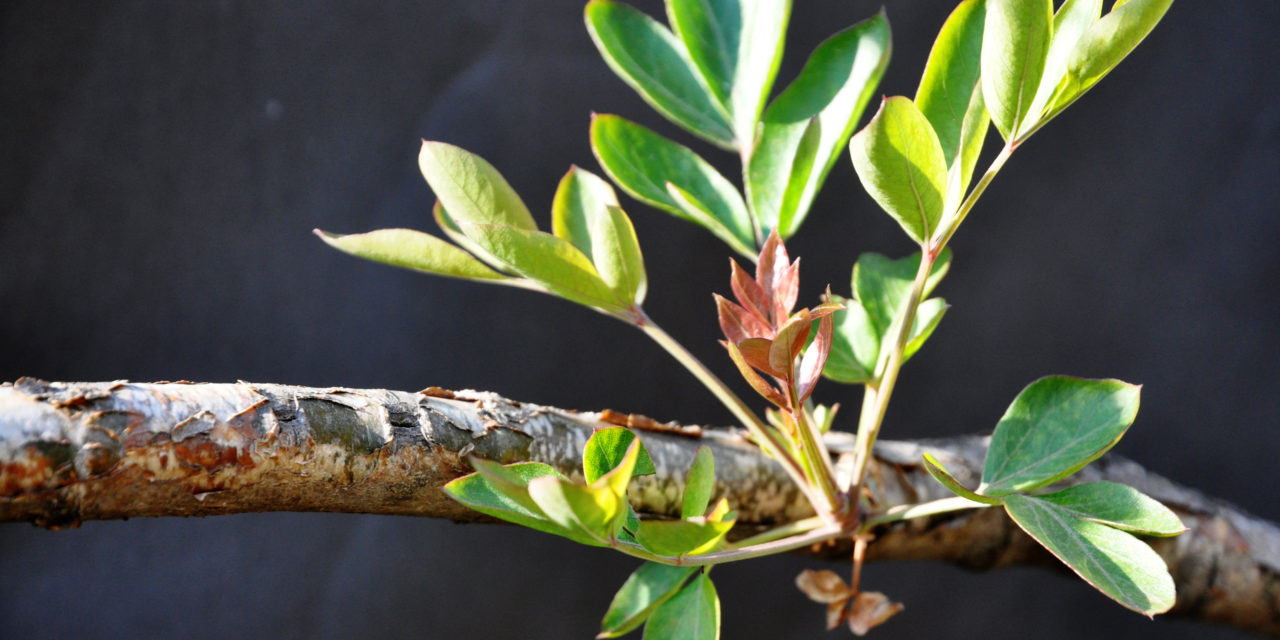
Heteromorpha arborescens var. abyssinica
General Info – Summary. Currently updating all!
This variable spineless Tree up to 15m high, has distinctive peeling, smooth & papery bronze bark. Each entire, deciduous, imparipinnate, variously shaped Leaf smell of parsley when crushed. Small, bisexual, 5-merous, regular Flowers in umbels appear with the new leaves. They have extended stamens, a superior ovary and two short styles. Fruit is a small dehiscent schizocarp with subterete seeds with oil ducts.
Description
Previous Names: Annesorhiza abyssinica, Bupleurum trifoliatum, Heteromorpha arborescens, Heteromorpha trifoliate, Tenoria arborescens.
SA Tree No. 568.1 and 568.2
Common names: (Afr) Gewone pieterieliebos, Kraaibos, Kraaihout, Papierboom (refers to the papery, pealing bark), Skilferbaspieterseliebos, Stinkbos, Wildepietersieliebos. (Eng) Common Parsley-tree, Parsley Tree, Pealing-bark Parsley-tree, Parsnip tree, Pealing-bark Parsley-tree. (isiXhosa) Umbhangandlahla. (isiZulu), Umbangandlala. (NS) Mokadala. (siSwati) Imvusankunzi, umbangandlala. (Tshivenda) Muthatha-vhanna.
Family: Apiaceae, Umbelliferae (This carrot family includes parsnip, parsley, turnip, aniseed and dill). The family has 300+ genera and 3 200+ species worldwide. There are about 36 genera and 152 species of this family in the South Africa. On this website, genera with trees include Heteromorpha. Furrowed stems have hollow or pithy internodes. Leaves are usually alternate and usually compound. They have a sheathing petiole and stipules are absent. Flowers occur in conspicuous Umbels. Individual flowers are small, regular and usually bisexual. The Calyx tube usually has 5 sepals which are attached to the ovary. The 5 Petals are free and soon fall. Alternating with the petals are 5 Stamens whose anthers contain 2 pollen sacs that open laterally. The inferior Ovary has up to 3 locules – each with 1 ovule. There are 2 free styles. The Fruit is usually crowned with calyx, disc and styles.
Name derivation: Heteromorpha – widespread different forms or shapes including referring to the fruit or the number of wings on the fruit. arborescens: tree-like. var. abyssinica – from Abyssinia (now called Ethiopia). In Heteromorpha arborescence var frutescens, the petiolules are much longer.
Conservation: National Status: L C. (Least Concern). 2005/09/11 (J.E. Victor and P.J.D. Winter).
Tree
This spineless Tree (photo 79) is usually up to 9m but may reach 15m high. The straightish, upright and initially translucent Trunk is up to 30cm in diameter. The plant may be a multi-stemmed, straggling open branched shrub. Fallen leaves leave ring like scars on youngish branches (photo 578 under Leaves). The distinctive Bark is smooth, papery bronze coloured and may be slightly waxy. Pealing bark (photo 654) may also be in horizontal bands that occur in older specimens (photo 1012). Exposed bark is yellowish-brown (photo 78) or reddish. The shiny bark darkens with age. New branches, with a glossy greenish colour (photo 654), resemble satin (a smooth, often silk fabric that is woven with a glossy face and a dull back). This plant can hybridise.
-
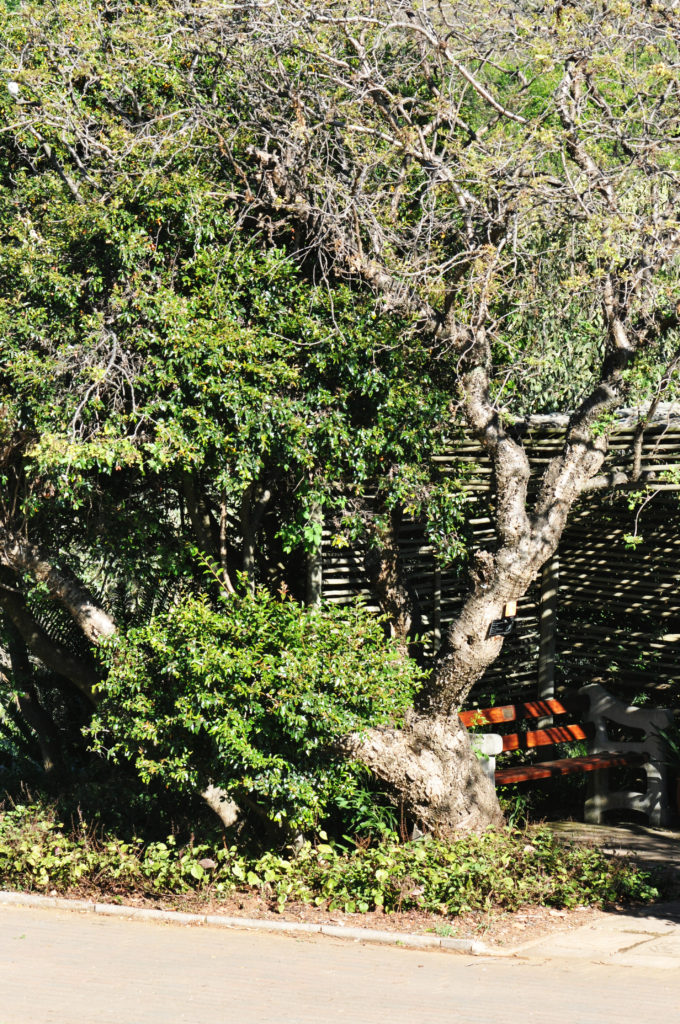
- 79. 2014/06/03. Walter Sisulu NBG. Photo: David Becking.
-
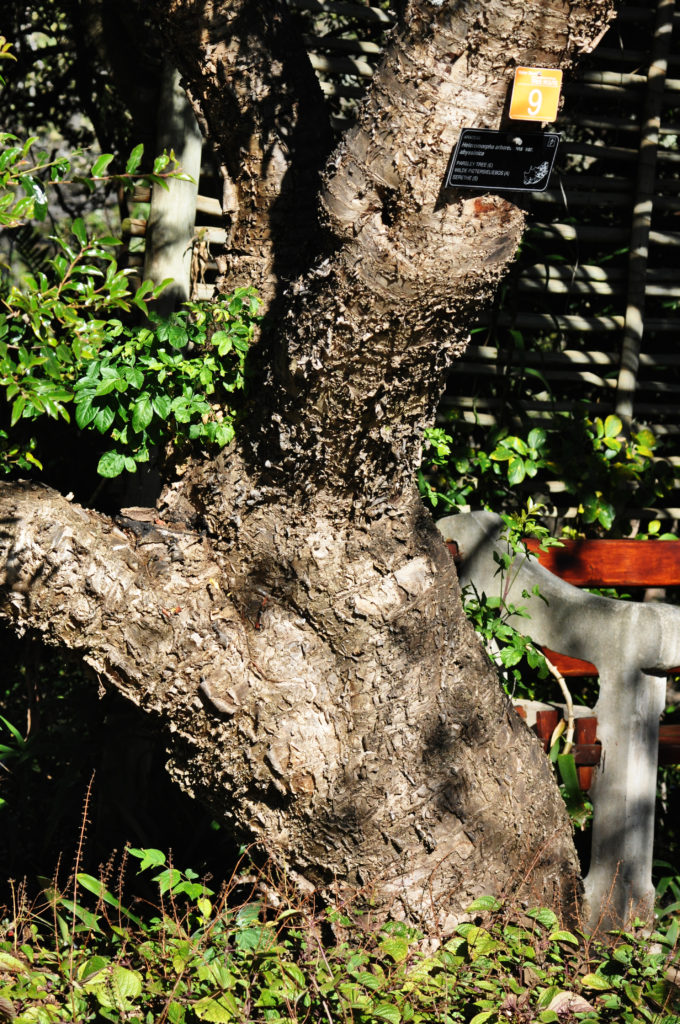
- 78. 2014/06/03. Walter Sisulu NBG. Photo: David Becking.
-
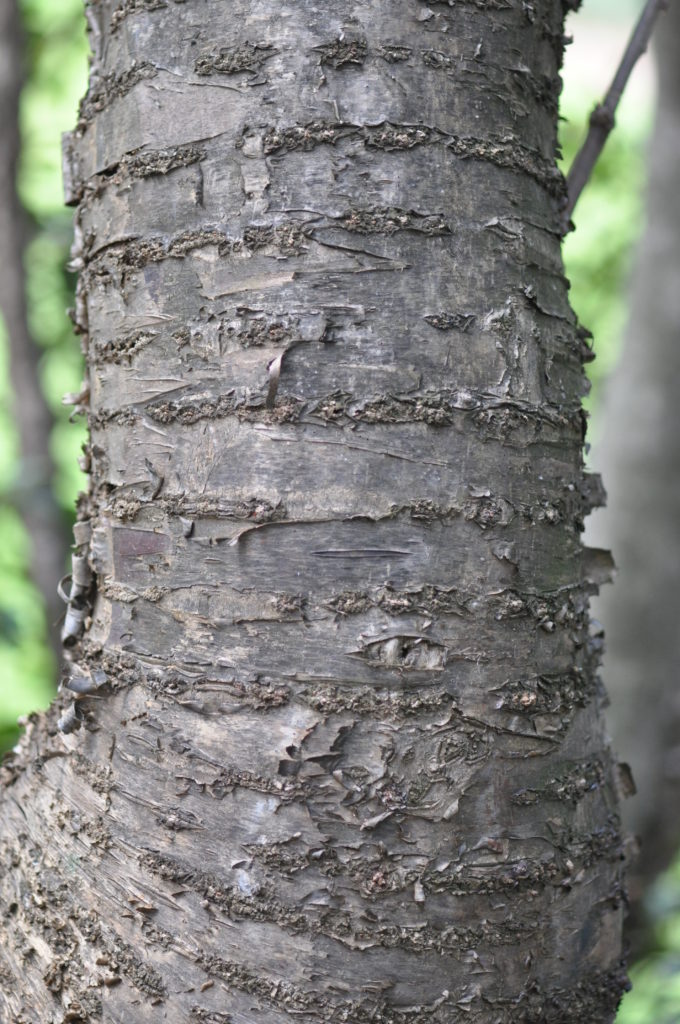
- 1012. 2014/04/01. Walter Sisulu NBG. Photo: David Becking.
-
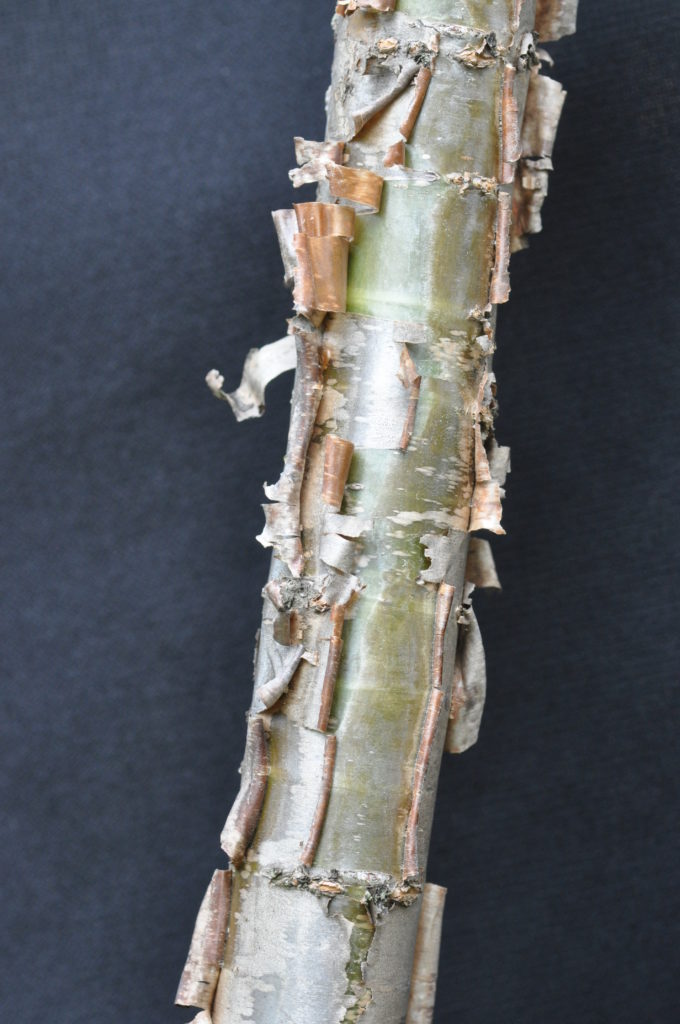
- 564. 2017/01/24. Walter Sisulu NBG. Photo: David Becking.
Leaves
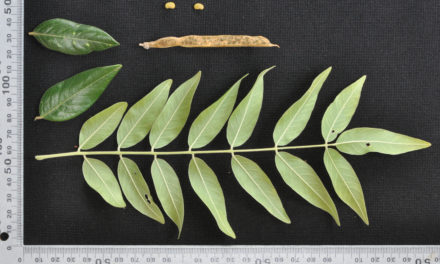
Leaves tend to be crowded towards the ends of branches. Occasionally simple leaves are produced (e.g. in the Cape) but usually this deciduous tree has soft, spirally arranged compound Leaves. They are up to 15 x 10cm. Young leaves are initially reddish (photo 1164 and trifoliate photo 578). When mature, the soft compound leaves are often imparipinnate (pinnately compound leaf ending in a single leaflet (a leaf-like part of a compound leaf). Each leaf has a broad-based Petiole (leaf stalk that attaches the leaf blade to the stem – photo 696). Here it is up to 5cm long and is channelled on the upper side (photo 74). The petiole clasps the stem at the base (photo 696). The Petiolule (leaflet stalk – photo 696) is up to 3cm long. In this photo it is clear that some petiolules are more conspicuous. There may be up to 9 variably arranged Leaflets with 2, 3 or 4 arising from the same point (photo 74) on the rachis (the main axis bearing flowers, here leaflets – photo 696). Leaflets may vary – even on the same tree. They may be ovate, obovate, elliptic or sickle shaped. Leaflets are soft and usually hairless and tend to droop. Leaflets may be strongly asymmetric (not equal to the opposite side as in some leaflet bases (photos 74 & 593). The leaflet Apex is round, tapering or notched and may end in a sharp point (photos 696 & 595). The Base is rounded or tapering and may be slightly decurrent (the edge of the leaflet base runs down the petiole). The Upper surface of the blade is a darker green (photo 74). In this photo the slightly sunken veins are visible. The Lower surface is a lighter green and the veins are raised (photo 696). Vein details are best viewed with the leaf held against a strong light (in this case the sun -photo 595 & 593). The veins near the base on either side of the midrib of asymmetric leaves may differ substantially (photo 593). After a cold spell, leaves may turn yellow or red before falling. Crushed leaves are usually aromatic and have the smell of parsley or parsnip hence the common name. The Margin is usually entire (with a smooth unlobed edge and no teeth or notches) but may be slightly scalloped (having a margin that is gently rounded or wavy – photo 696).
-
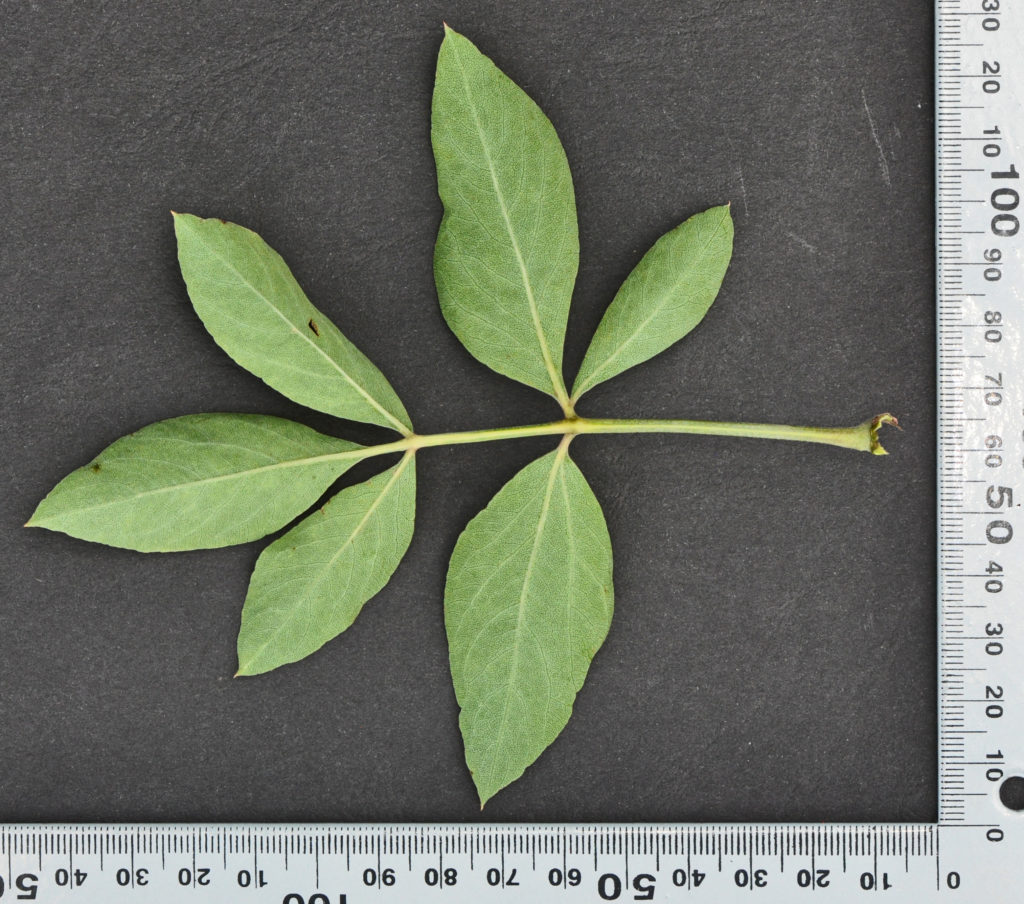
- 696. 2014/11/18. Walter Sisulu NBG. Photo: David Becking.
-
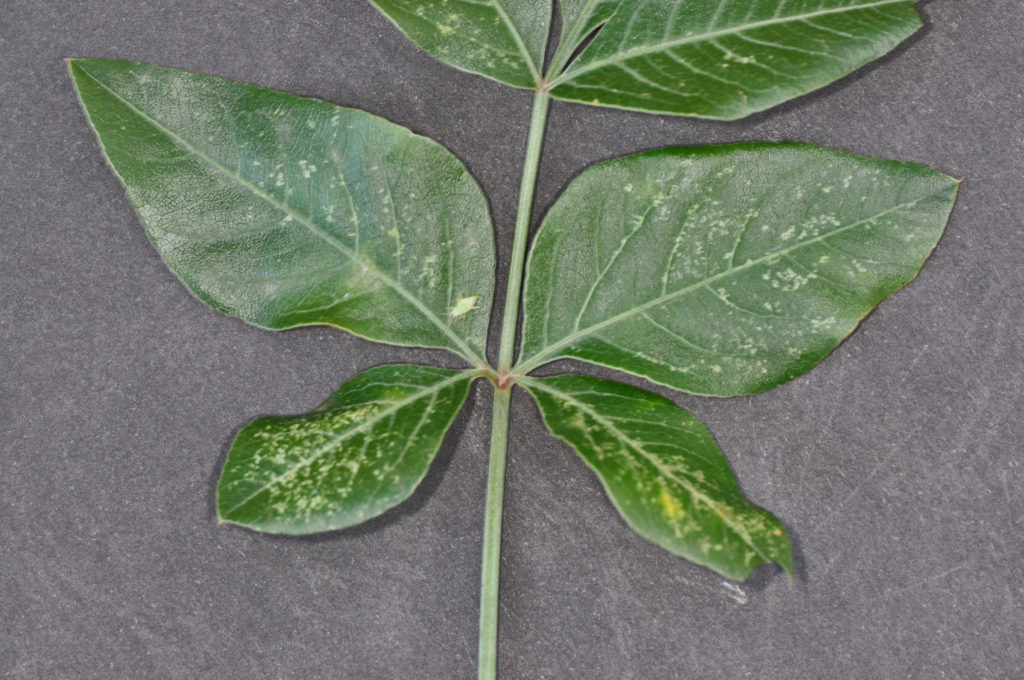
- 74. 2014/09/30. Walter Sisulu NBG. Photo: David Becking.
-
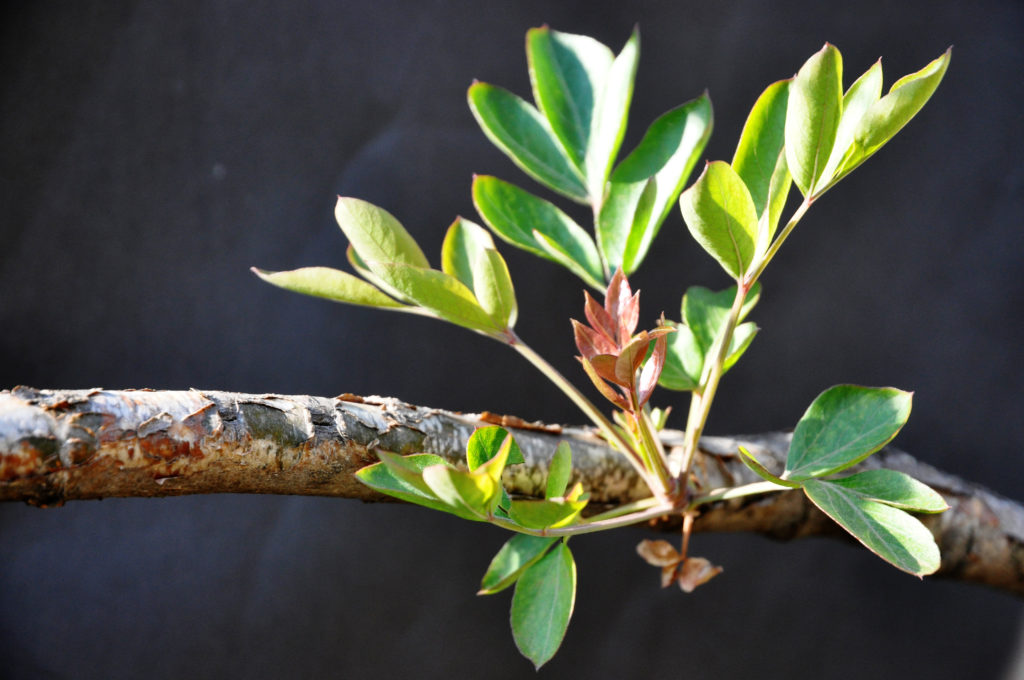
- 1164. 2015/08/18. Walter Sisulu NBG. Photo: David Becking.
-
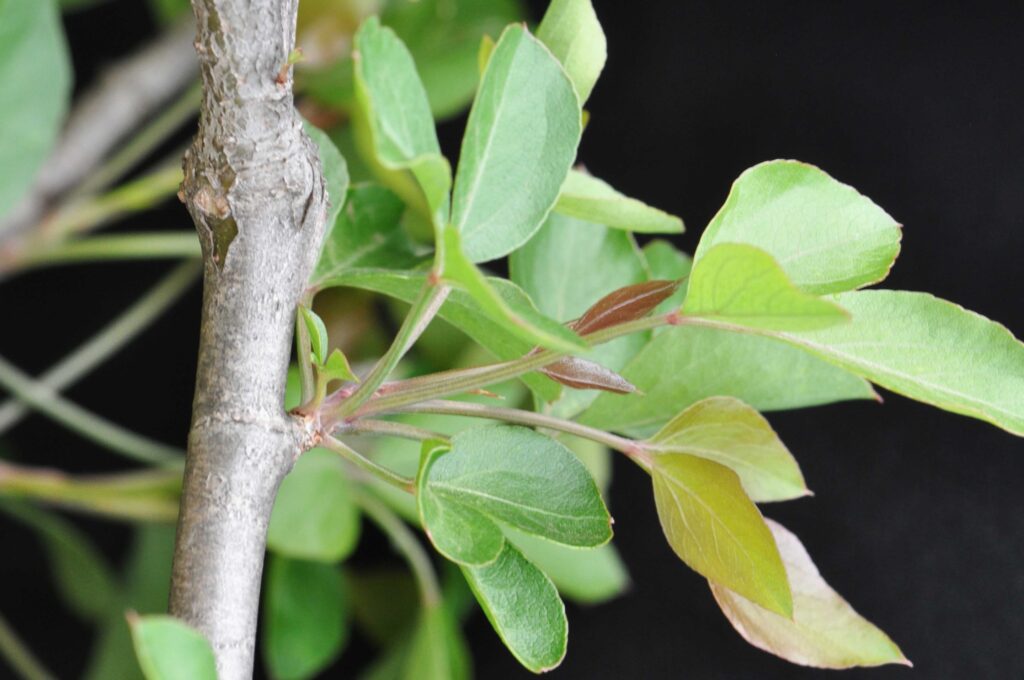
- 578. 2015/09/22. Walter Sisulu NBG. Photo: David Becking.
-
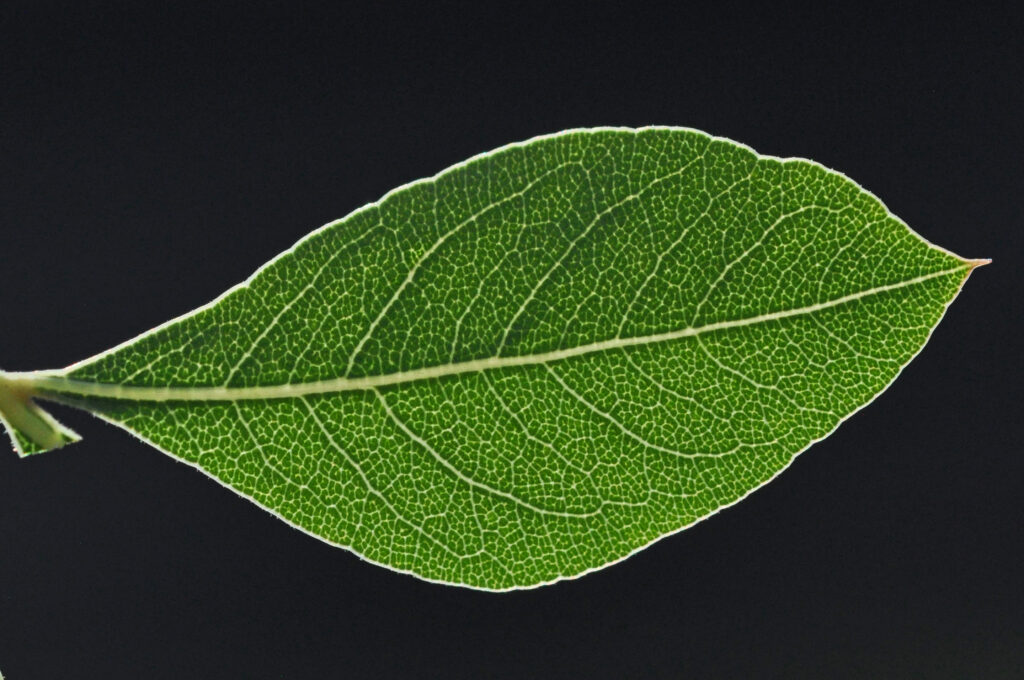
- 595. 2019/09/18. Walter Sisulu NBG. Photo: David Becking.
-
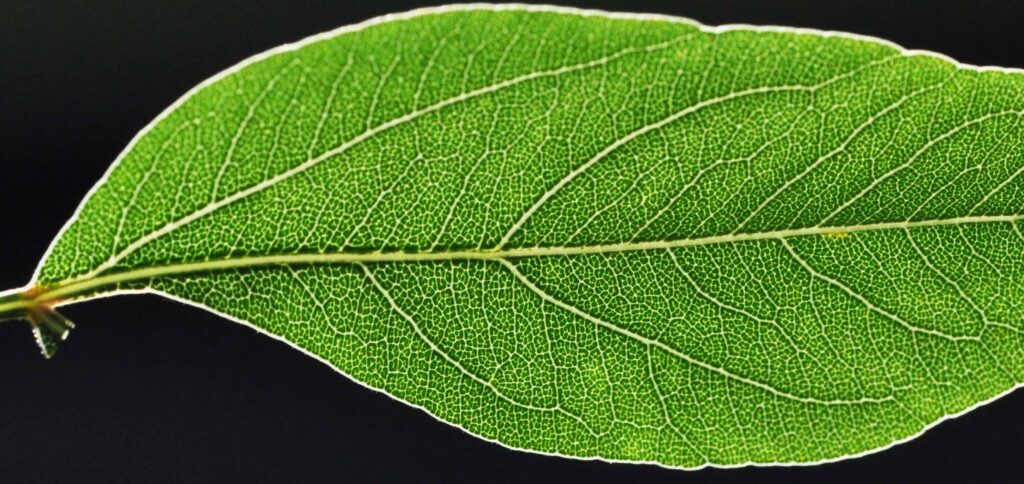
- 593. 2019/09/18. Walter Sisulu NBG. Photo: David Becking.
Flowers
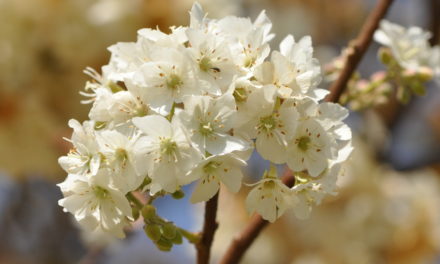
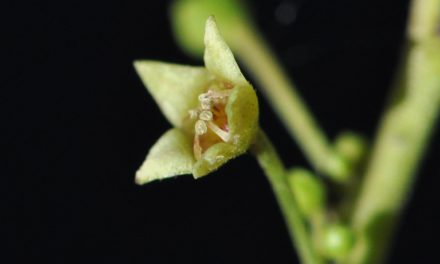
The small, greenish white or yellowish, strong-smelling Flowers develop in dense round heads at the ends of branches in compound Umbels (inflorescence in which flower stalks arise from a common point photo 248). Here they appear at branch ends, well above the leaves in summer, together with and just above the new leaves. The bisexual flowers are actinomorphic (Regular, symmetrical. Flowers are vertically divisible into similar halves by more than 1 plane passing through the axis). Flower heads are bracteate (photo 248) and 5-merous (having a specific number of parts – here 5). A conical expanded Disc (a more or less fleshy or elevated development of the receptacle) is present. The Calyx has 5 triangular teeth. The 5 free, more or less elliptic Petals are curved inwards (photo 248) and keeled on the inner face. They are inserted on the margin of the disc and are short lasting. The 5 Stamens alternate with the petals, are curved in and extend slightly beyond the petals. The Filaments are initially inflexed in the bud, and each filament ends with 2 Theca (pollen sacs) which open laterally. There is a single Pistil (a unit of the Gynoecium, the female element of the flower, composed of the Ovary, Style and Stigma) with an inferior, bilocular Ovary. Two very short Styles are present. The flowers may be strong smelling. (Nov–Jan).
-
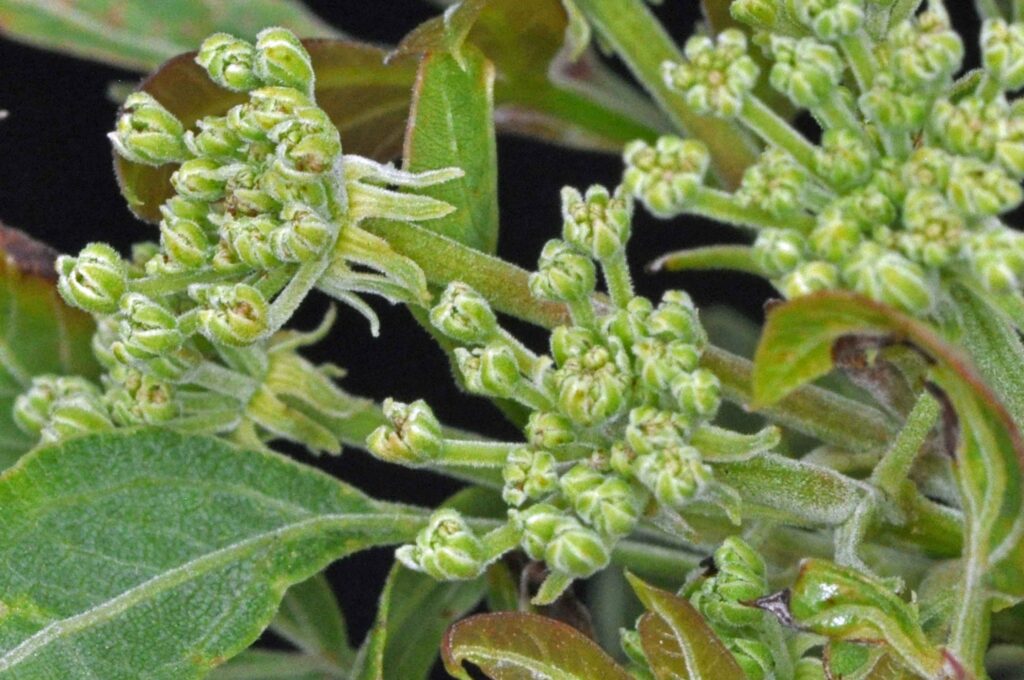
- 248. 2015/12/12. Walter Sisulu NBG. Photo: David Becking.
Fruit
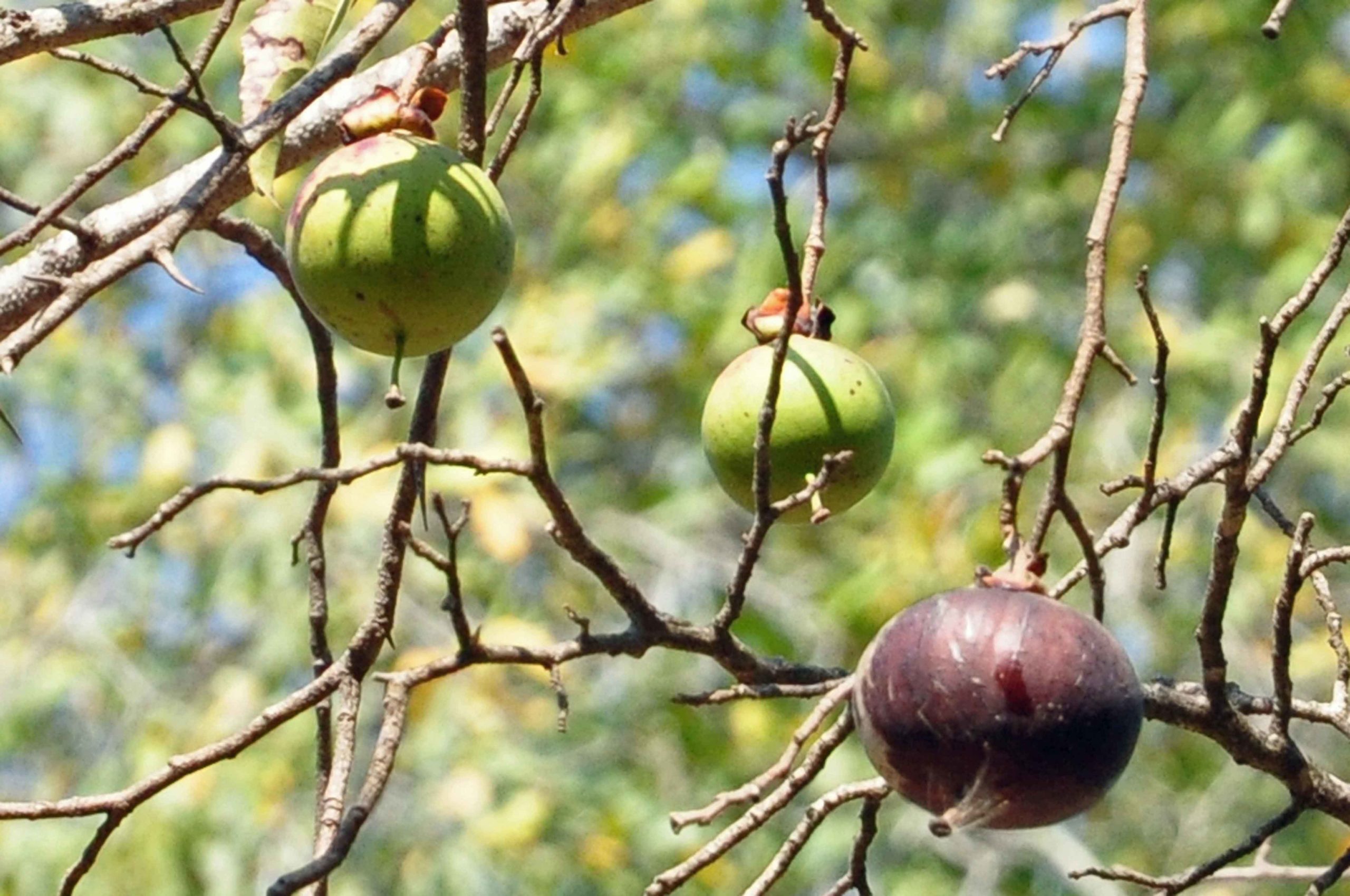
The small – up to 7mm long, elliptic or somewhat pear-shaped Fruit is a light, slightly winged Schizocarp (a dry, dehiscent fruit that splits into one seeded portions called a Mericarps at maturity. Fruits are slightly cordate (heart shaped), laterally flattened with prominent ribs and elevated by a Carpophore (an elongated axis that raises the stem of the pistil above the stamens). The slightly winged fruit is up to 7mm long and becomes light creamy brown when mature. Seeds are subterete (almost circular in cross section) and contain oil glands. (Feb–Aug).
Distribution & Ecology
These Trees are more common at high altitudes – above 700m. They grow in bushveld, grassland, streambeds, on riverbanks, close to woodland, on hill slopes, on mountaintops or grass-veld – almost everywhere from 400m upwards, including dry riverbeds. Trees are drought and frost hardy. They occur in the Eastern Cape, KwaZulu-Natal, Eastern Free State, Gauteng, North West e.g., on southern and eastern slopes of Magaliesberg, Limpopo and Mpumalanga. They also occur in Lesotho, Siswati (Swaziland), Mozambique, Zimbabwe, Northeast Namibia, Malawi, Yemen and Ethiopia.
Ethnobotany
Crushed Leaves smell of parsley and Fruits contain unstable oils. The Tree has non-invasive roots, and musical bows of the Xhosas are made from the soft Wood. This wood is too soft for use in buildings. It is planted in Lesotho villages to keep people loyal to their chiefs. Root extracts are active against gram-positive bacteria and for inhibiting fungal growth. Local medicine makes of the roots bark and leaves. Propagation from seed is rapid – up to 2m per year. Local medicine makes much use of the bark, leaves and roots.
-
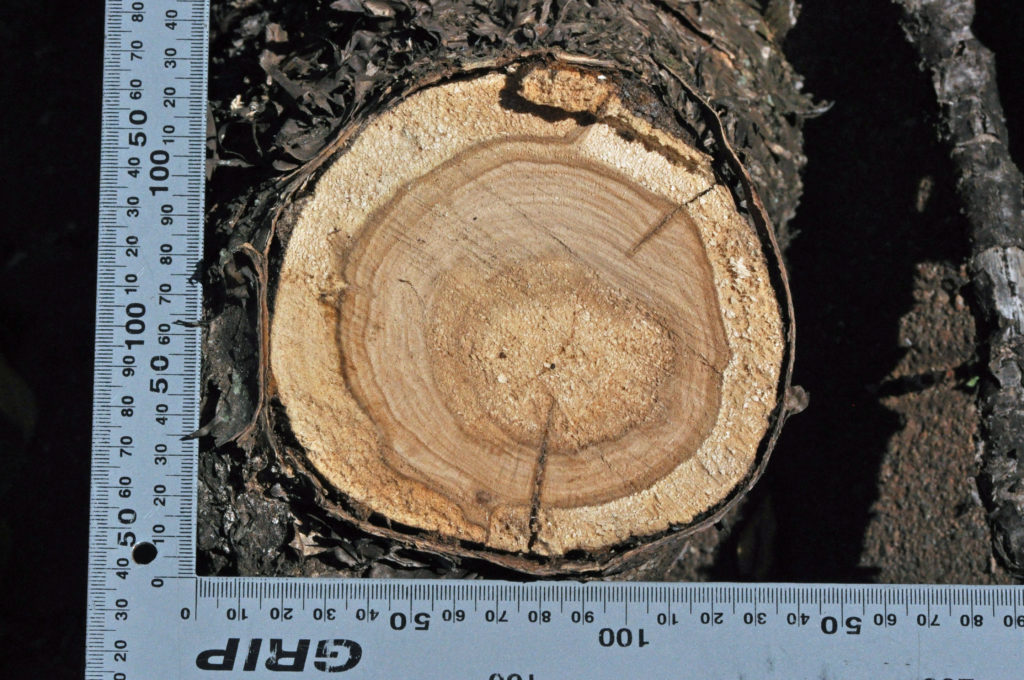
- 564. 2017/01/24. Walter Sisulu NBG. Photo: David Becking.
References
Boon, R. 2010. Pooley’s Trees of eastern South Africa. Flora and Fauna Publications Trust, Durban.
Burrows, J.E., Burrows, S.M., Lotter, M.C. & Schmidt, E. 2018. Trees and Shrubs Mozambique. Publishing Print Matters (Pty) Ltd. Noordhoek, Cape Town.
Coates Palgrave, M. 2002. Keith Coates Palgrave Trees of Southern Africa, edn 3. Struik, Cape Town.
Lawrence, G. H. M, 1951. Taxonomy of Vascular Plants, The Macmillan Company, New York. Tenth Printing 1965.
Palmer, E. & Pitman, N. 1972. Trees of southern Africa, Balkema, Amsterdam, Cape Town.
Schmidt, S. Lotter, M. & McCleland, W. 2002. Trees and Shrubs of Mpumalanga and the Kruger National Park.
van Wyk, B. & van Wyk, P. 1997 Field guide to Trees of Southern Africa, Struik, Cape Town.
Victor, J.E. & Winter, P.J.D. 2005. Heteromorpha arborescens (Spreng.) Cham. & Schltdl. var. abyssinica (Hochst. ex A.Rich.) H.Wolff. National Assessment: Red List of South African Plants version 2024.1. Accessed on 2026/02/18.
http://witkoppenwildflower.co.za/heteromorpha-arborescens/
http://www.plantzafrica.com/planthij/heteromorpharbor.htm
http://www.zimbabweflora.co.zw/speciesdata/species.php?species_id=143100
http://pza.sanbi.org/heteromorpha-arborescens
http://posa.sanbi.org/flora/browse.php?src=SP