Grewia hexamita
General Info – Summary
This deciduous Tree is up to 8m high & has smooth reddish brown/grey bark. Alternate, simple, serrated to entire Leaves: 3-veined from the asymmetric base. Yellow, bisexual, 5-merous, symmetrical and regular Flowers have large bi-coloured sepals & short yellow folded petals. The many male filaments are orange, and the single pistil has a superior ovary and an extended stigma. Fruit is a small, indehiscent drupe.
Description
Previous Names: Grewia schweickerdtii, Grewia messinica.
SA Tree No. 460.
Common names: (Afr) Reuserosyntjie. (Eng) Giant Grewia, Giant raisin, Lowveld Grewia. (isiZulu) Indliwampunzi, Umlalampunzi. (siSwati) Umsipane. (Xitsonga) Nsihana, Nsihani.
Family: Malvaceae. (Wild Pear, Gossypium – cotton, baobab and Hibiscus family). This family has 240+ genera and 4 200+ species. Most species are herbaceous, but a few are trees. Indigenous genera that have trees on this website includes Adansonia (baobab), Cola, Dombeya, Grewia, Hibiscus, Sparrmannia and Sterculia. Stems contain mucous canals. The usually alternate, often compound or palmately veined Leaves of all possess stipules and apart from Adansonia, remain simple. Flowers are regular, bisexual or unisexual and have 5 petals (Sparrmannia africana has 4) with regularly arranged overlapping edges. Petals are absent in Cola and Sterculia. There are 5 to many stamens with filaments often united into a staminal tube. This surrounds the superior Ovary with axile placentation and its simple Style and capitate or lobed Stigma. Fruits are usually nuts, schizocarps or loculicidal capsules.
Name derivation: Grewia – named after the Englishman Nehemiah Grew – (1641- 1712). He was a physiologist and pioneer plant anatomist and was known as the “Father of Plant Anatomy.” hexamita – hexa 6, and mita – a thread. Reasoning unclear. There are 27 species of the genus Grewia in the South Africa.
Conservation: National Status: L C. (Least Concern). Assessed: 2005/06/30 (W. Foden and L. Potter).
Tree
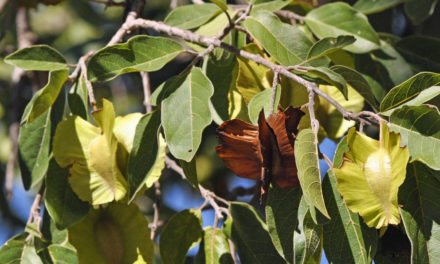
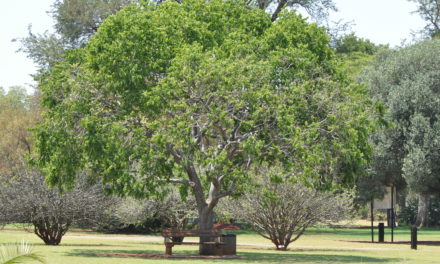
This plant may be a scrambling shrub or a leafy, glossy crowned deciduous Tree up to 5m high. The crooked Stem (plant axis that bears buds and shoots with leaves and, at its basal end, roots) has slightly rough and dark grey Bark (photo 992). The tree is widely branched, and young reddish-brown branches have rusty woolly hairs when young. These hairs are soon lost, exposing the orange to red bark (photo 989 – under Flowers). Here, small, slightly protruding pale Lenticels (usually raised corky, oval or elongated areas on the plant that allows the uncontrolled interchange of gases with the environment) are visible.
Leaves
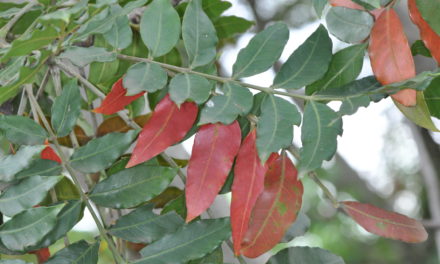
The alternatively arranged, leathery and relatively large Leaves are up to 11 x 7 cm and deciduous (loss of leaves for part of the year). Leaf Shape varies from oval, ovate (egg-shaped) to elliptic or oblong elliptic. Leaves are simple (have a single blade which may have incisions that are not deep enough to divide the blade into leaflets). The slightly, rough and wrinkled Blade is discolorous (having upper and lower surfaces of leaves different colours). The deep glossy green and hairless Upper Surface is a bit rough and shiny (photo 992). Woolly, dense yellowish white hairs cover the paler whitish grey Lower Surface. Here scattered brownish dense hairs are on the up to seven pairs of protruding Lateral Veins and help generate the overall grey-white colour. Veins are more conspicuous below. Leaves are 3-veined from the markedly asymmetric (not equal to the opposite side) Base (photo 992) which may be Cordate (heart shaped. deep indents where the leaf meets the midrib, making it look like the top of a heart). The Apex usually tapers or is rounded to flat. The Margins are slightly rolled under and are slightly or deeply serrated (saw-toothed margin with teeth pointing forward – photo 992). The hairy Petioles (leaf stalks) are short: up to 6mm long (often less). Stipules (basal appendages of the petiole) are present.
-
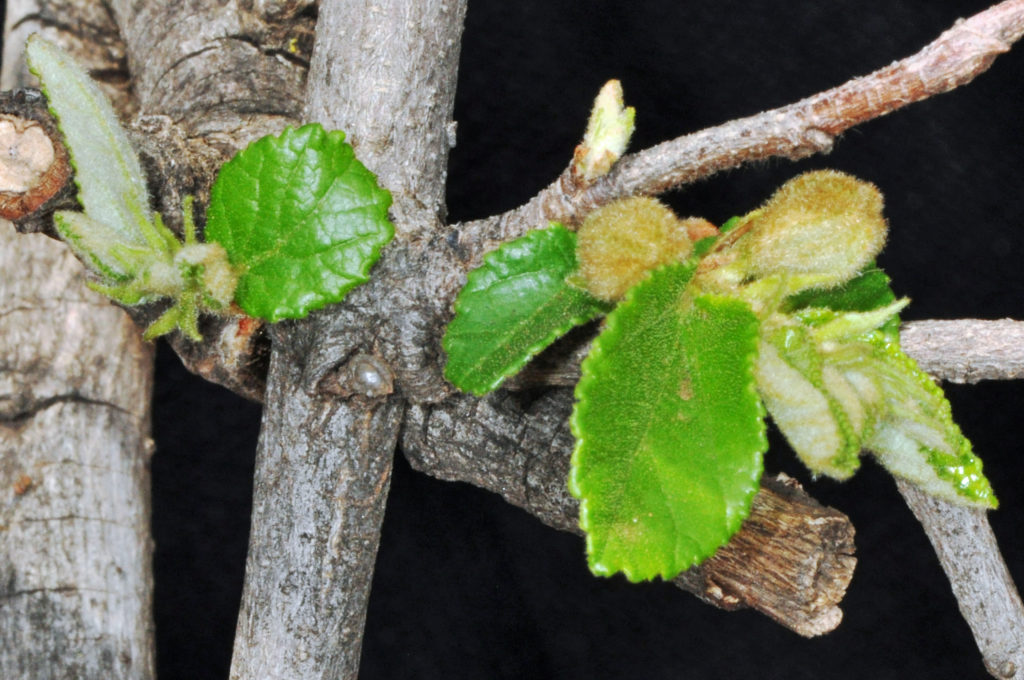
- 992. 2016/10/18. Pretoria NBG. Photo: David Becking.
Flowers
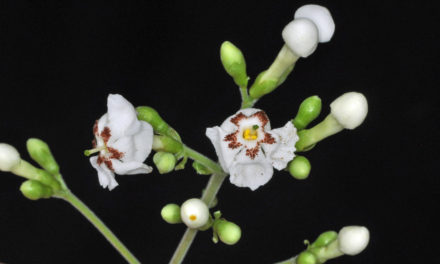
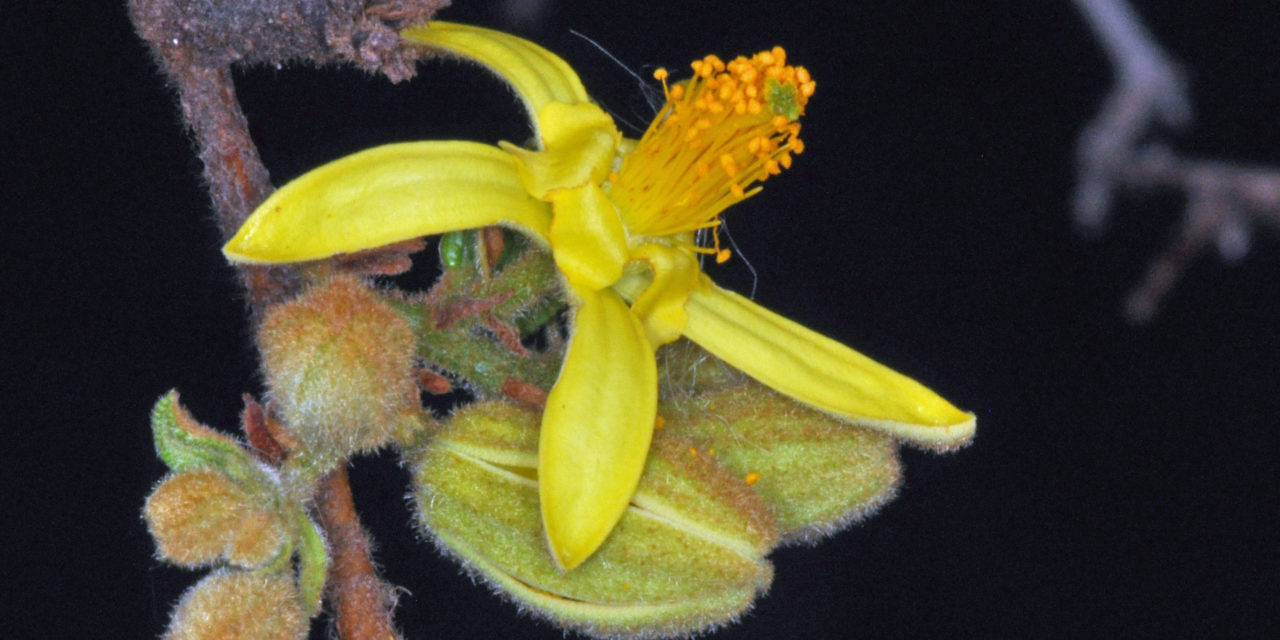
The golden yellow, bisexual and showy 5-merous Flowers are up to 3cm long and 5cm in diameter (photo 984) and may occur in profusion. From 1-4 attractive flowers, develop together at the ends of branches and in leaf axils (the angle between the upper side of a leaf and the stem from which it grows. Flowers are actinomorphic (Regular, symmetrical. These flowers are vertically divisible into similar halves by more than 1 plane passing through the axis). Each Pedicel (stalk of single flower – photo 988) is up to 1,5cm long. The honey-scented flowers develop from hairy buds that are green or reddish (photo 984). Before opening, they become elongated (photo 988). Flowers appear singly, or up to 4 and are arranged in small Cymes (broad, more or less flat-topped, determinate flower cluster, with central flowers opening first). The outer yellow (unusual!) Calyx (is the outer whorl of floral envelopes and consists of leaf-like structures called sepals at the base of a flower that protect the bud during development). It has Sepals that are much longer than the folded over Petals (also unusual!) in the Corolla (the second whorl of the floral envelopes – photo 988). Externally the greenish red sepals (buds in photo 989) are smooth with soft stellate hairs. Internally the sepals are hairless, bright yellow and, from this vantage point (photo 988), they strongly resemble petals. Sepals are up to 2,6cm long and are much larger than the petals. The 5 yellow, folded over Petals are much smaller and less visible than sepals (photo 988). Each petal is up to 7mm long. There are numerous free Stamens, with orange Filaments (the usually long slender stalk that supports the anther -photo 988). Stamens arise from an extended Receptacle (is that expanded tip of the flower stalk from which the floral parts develop). There is a single Pistil (a unit of the Gynoecium, the female element of the flower, composed of the superior Ovary, Style and Stigma). The single Style is longer than the ovary, extends just beyond the stamens and ends in a green-lobed Stigma (the part of the pistil that receives the pollen – photo 988). (Sep-Dec).
-
- 989. 2016/10/18. Pretoria NBG. Photo: David Becking.
-
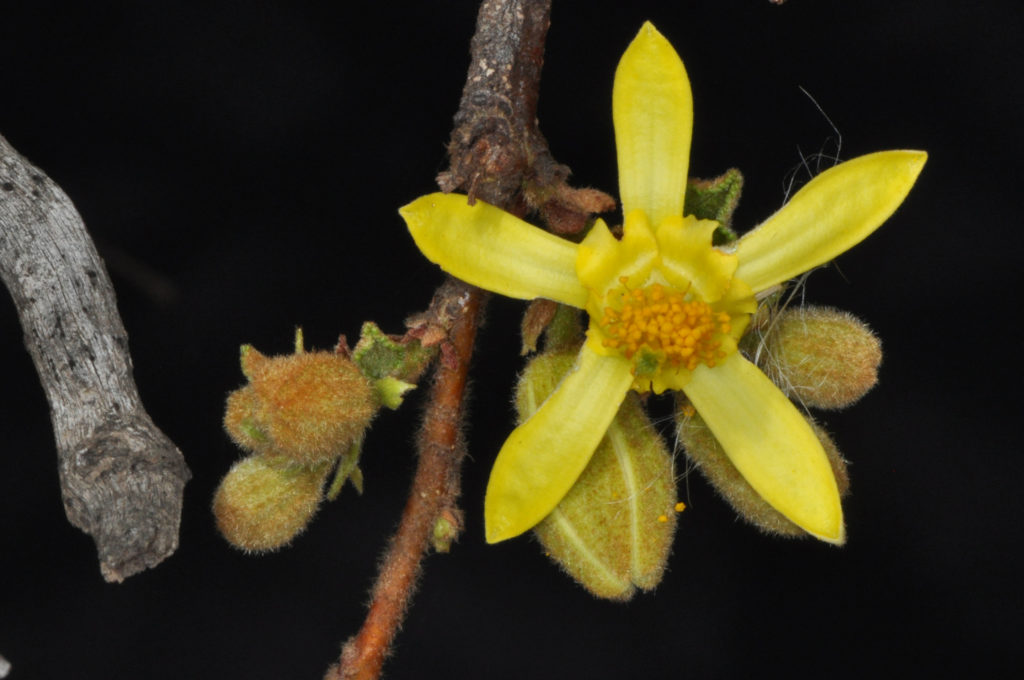
- 984. 2016/10/18. Pretoria NBG. Photo: David Becking.
-
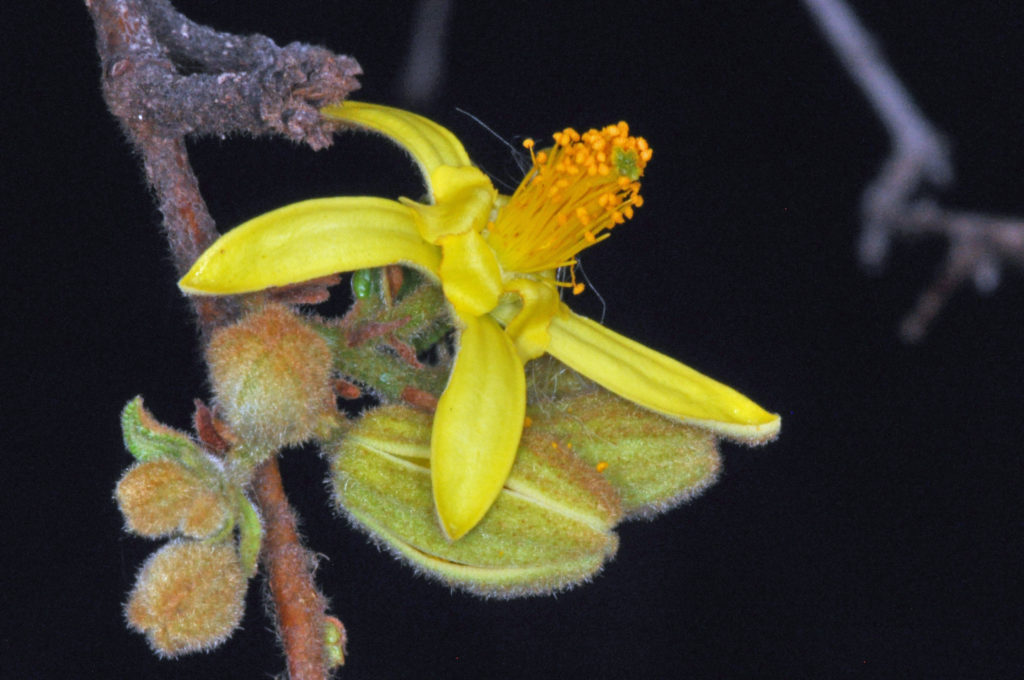
- 988. 2016/10/18. Pretoria NBG. Photo: David Becking.
Fruit
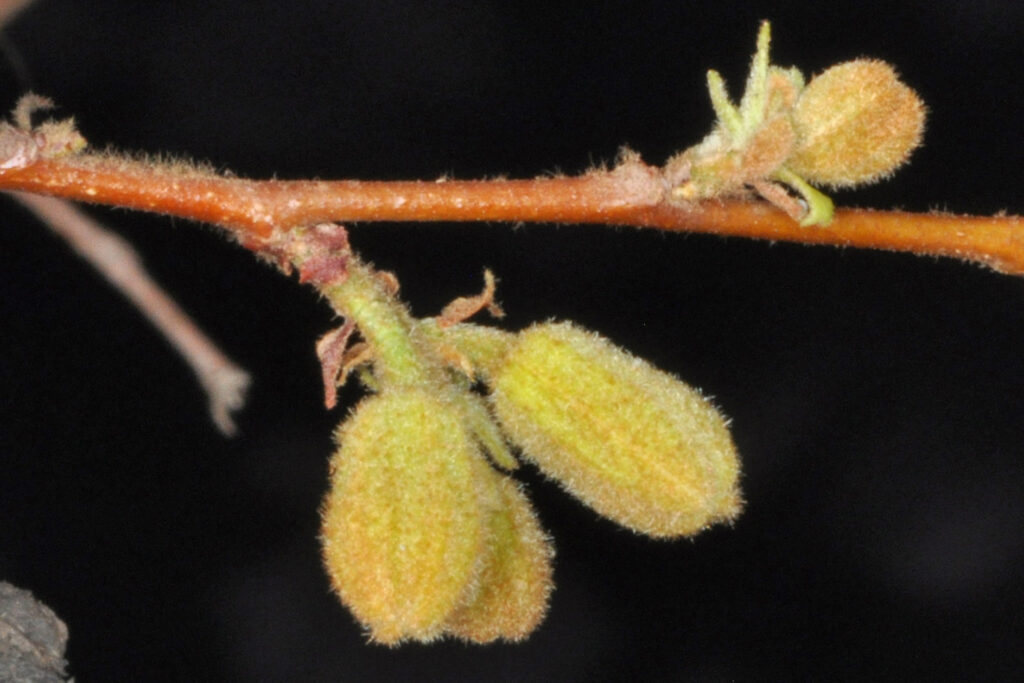
The initially green Fruit matures into a two 2cm wide), hairy, yellowish or reddish small single Drupe (a fleshy, 1-seeded indehiscent fruit with the seed enclosed in a stony endocarp; stone fruit e.g., peach – photo 991). Here the mature drupe is up to 2cm wide (photo 994). Two drupes together may appear paired (photo 994). Each contains a Pyrene (nutlet in a drupe – like a peach pip). The fruit may become reddish and shiny. The Seeds are animal Dispersed. (Dec-Mar).
-
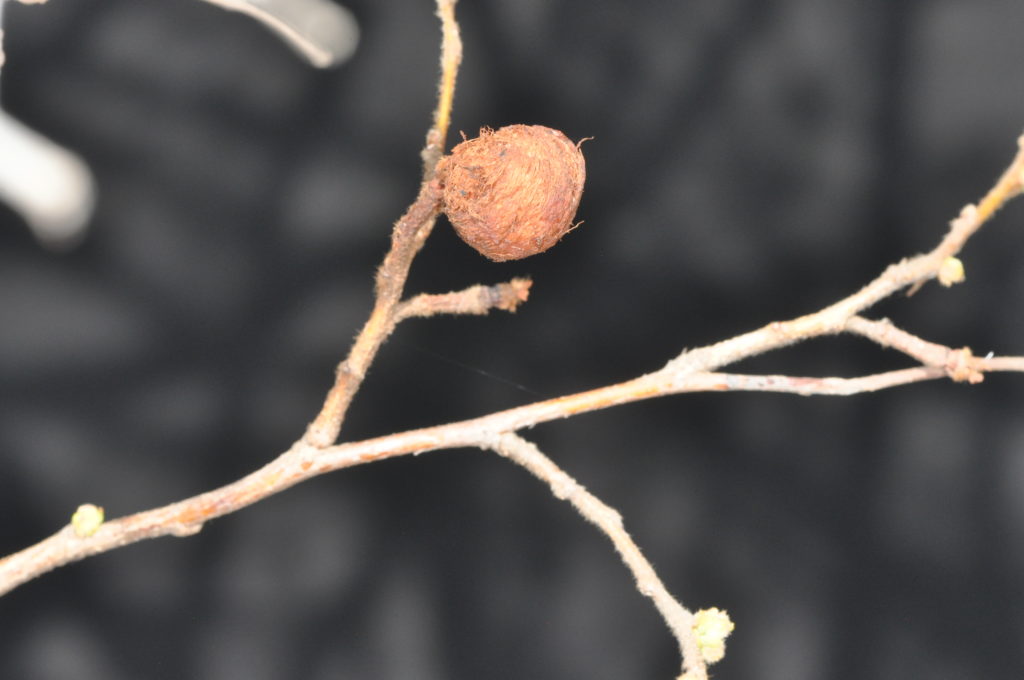
- 991. 2016/10/18. Pretoria NBG. Photo: David Becking.
-
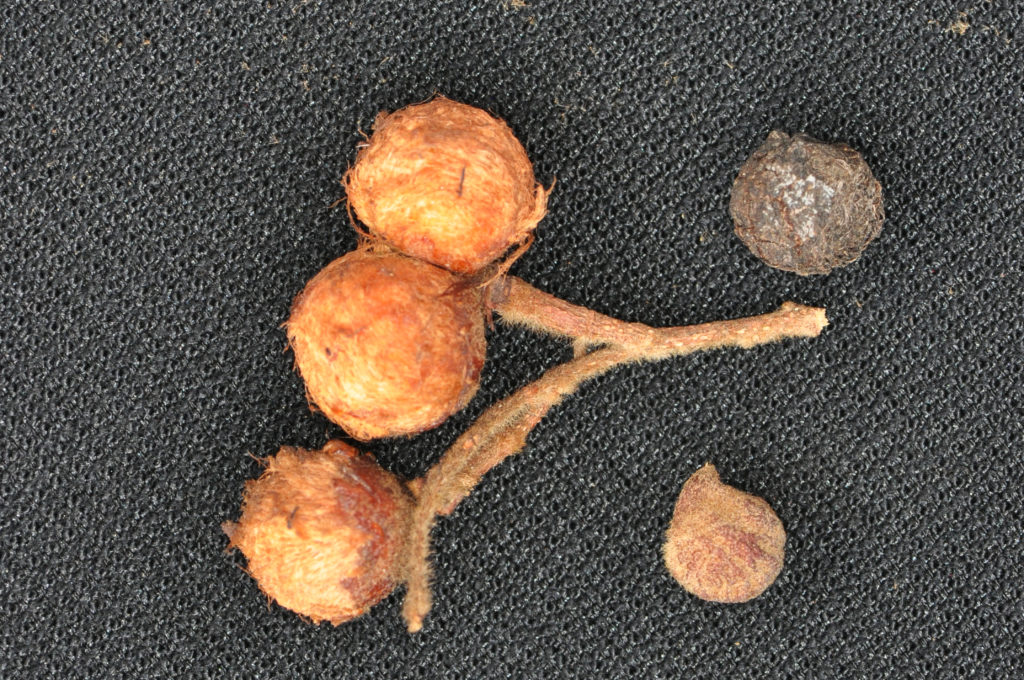
- 994. 2016/10/18. Pretoria NBG. Photo: David Becking.
Distribution & Ecology
These plants occur naturally in northern KwaZulu-Natal, Northern Gauteng, Limpopo, Mpumalanga, Swaziland, southern Mozambique, and from Zimbabwe to Tanzania. The trees occur in deciduous woodland and in valleys at low altitudes. They are common on termite mounds and close to rivers. A number are visible in Limpopo and Komati River valleys. The plant is frost and drought resistant and grows in both sandy and clay soils. Bigger birds like Franklins and Guineafowl consume the Fruit. Other animals that eat the fruit include Baboons, Elephant (favourite food), Giraffe, Kudu, Monkeys and Warthogs.
Ethnobotany
Leaves are browsed by game and stock. The shallow fleshy layer of the Fruit is edible but here the fleshy layer is thin. Flowers are very attractive. The grey-brown Wood is relatively dense, hard, and durable. The heartwood is like ebony. This plant is a good garden prospect for temperate climates and summer rainfall areas. Seeds that have passed through animals tend to germinate more easily. Branches used for propagation are Truncheons (stem cutting from a selected plant that are used to produce genetically identical new plants. Impressive Flowers and Fruit develop after about 2 years.
References
Boon, R. 2010. Pooley’s Trees of eastern South Africa. Flora and Fauna Publications Trust, Durban.
Burrows, J.E., Burrows, S.M., Lotter, M.C. & Schmidt, E. 2018. Trees and Shrubs Mozambique. Publishing Print Matters (Pty) Ltd. Noordhoek, Cape Town.
Coates Palgrave, M. 2002. Keith Coates Palgrave Trees of Southern Africa. edn 3. Struik, Cape Town.
Foden, W. & Potter, L. 2005. Grewia hexamita Burret. National Assessment: Red List of South African Plants version 2024.1. Accessed on 2026/03/23.
Lawrence, G. H. M, 1951. Taxonomy of Vascular Plants. The Macmillan Company, New York. Tenth Printing 1965.
Palmer, E. & Pitman, N. 1972. Trees of southern Africa. Balkema, Amsterdam, Cape Town.
Schmidt, S. Lotter, M. & McCleland, W. 2002. Trees and Shrubs of Mpumalanga and the Kruger National Park. Jacana, Johannesburg.
van Wyk, B. & van Wyk, P. 1997 Field guide to Trees of Southern Africa. Struik, Cape Town.
http://redlist.sanbi.org/species.php?species=933-16
http://pza.sanbi.org/grewia-hexamita
http://www.zimbabweflora.co.zw/speciesdata/species.php?species_id=138480
http://iscantree.co.za/grewia-hexamita-reuse-rosyntjie-giant-raisin/
http://www.ispotnature.org/species-dictionaries/sanbi/Grewia%20hexamita
http://posa.sanbi.org/flora/browse.php?src=SP
https://www.britannica.com/plant/Melianthaceae
https://en.wikipedia.org/wiki/Melianthaceae