Grewia flavescens
General Info – Summary
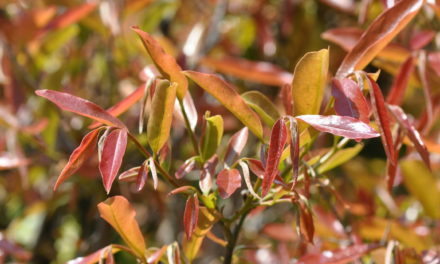
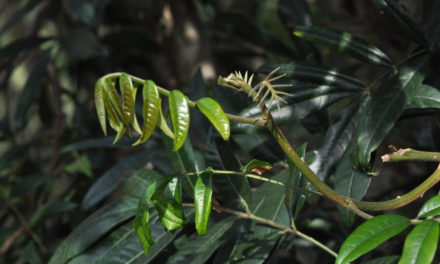
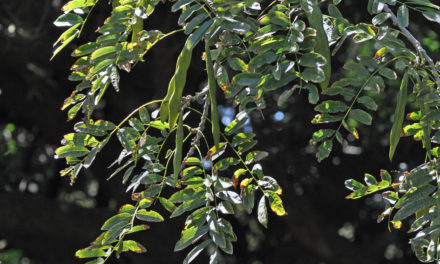
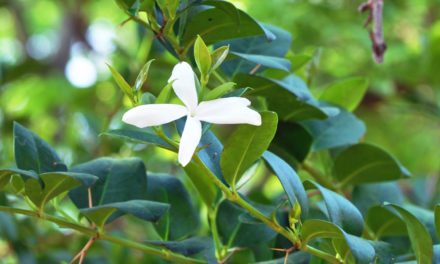
This deciduous, often multi-stemmed shrub, may be a Tree up to 6m high, with 4-angled/grooved branches. Alternate, simple, variously shaped, light green Leaves with unevenly serrated margins are 3-veined from the base. Rough hairs are present. The yellow, bisexual, regular, 5-merous, stalked Flowers have many exserted stamens with yellow filaments and a single pistil. The small, edible Fruit a drupe.
Description
Previous Names: Grewia flavescens var. longipedunculata.
SA Tree No. 459.2.
Common names: (Afr) Kruisbessie, Skurweblaarrosyntjie, Skurwerosyntjie. (Eng) Donkey Berry, Donkyeberry, Rough-leaved Raisin, Sandpaper Raisin. (IsiNdebele) Ubhuzu, Umnaba, Umtewa. (isiZulu) Ilalanyathi, Iklolo. (siSwati) liklolo. (Xitsonga) Mparachwene, Nsihana.
Family: Malvaceae. (Wild Pear, Gossypium – cotton, baobab and Hibiscus family). This family has 240+ genera and 4 200+ species. Most species are herbaceous, but a few are trees. Indigenous genera that have trees on this website includes Adansonia (baobab), Cola, Dombeya, Grewia, Hibiscus, Sparrmannia and Sterculia. Stems contain mucous canals. The usually alternate, often compound or palmately veined Leaves of all possess stipules and apart from Adansonia, remain simple. Flowers are regular, bisexual or unisexual and have 5 petals (Sparrmannia africana has 4) with regularly arranged overlapping edges. Petals are absent in Cola and Sterculia. There are 5 to many stamens with filaments often united into a staminal tube. This surrounds the superior Ovary with axile placentation and its simple Style and capitate or lobed Stigma. Fruits are usually nuts, schizocarps or loculicidal capsules.
Name derivation: Grewia: named after an English pioneer plant anatomist and physiologist: Nehemiah Grew (1641–1712). flavescens – yellowish or becoming yellow – referring to the flower colour. The type specimen came from India. There are 27 species of Grewia in southern Africa.
Conservation: National Status: L C. (Least Concern). Assessment Date: 2005/06/30 (W. Foden and L. Potter).
Tree
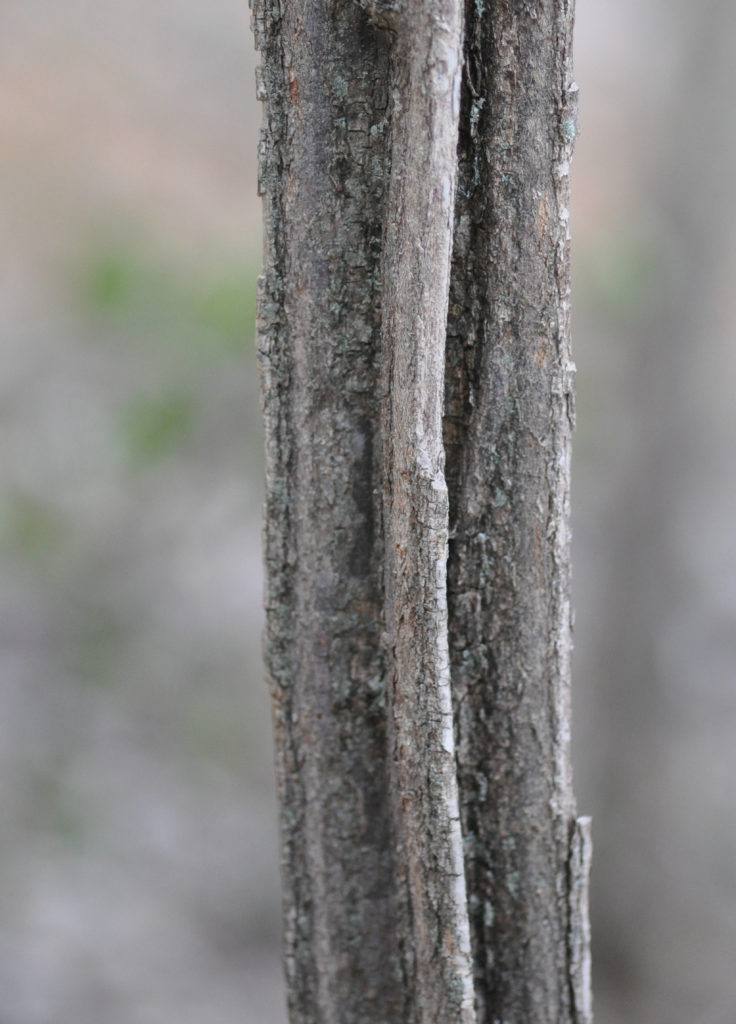
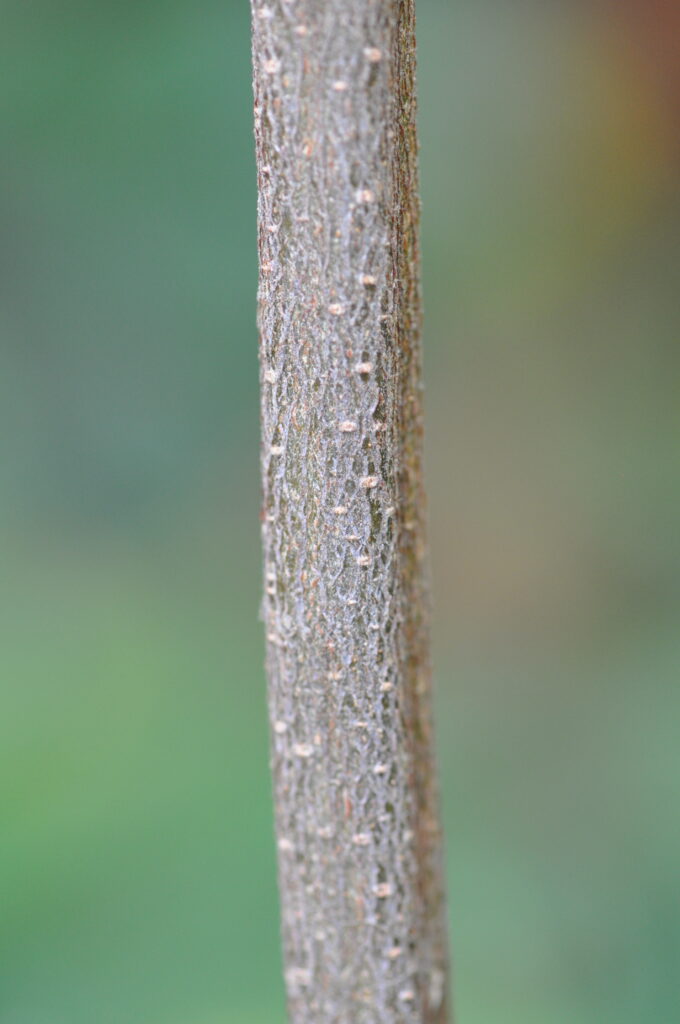
This Tree may reach 6m high, but it is often a shorter, multi stemmed, scrambling shrub. Bark is a dark grey-brown. The vertical, older Trunk (photo 114) and large branches are often clearly 4-angled and fluted, grooved or furrowed. Young green Branches have rough, cream-coloured hairs, which are soon lost. They turn brown with age. Visible light Lenticels (a usually raised corky oval or elongated area on the plant that allows the uncontrolled interchange of gases with the environment – photo 609) are present. Grewia retinervis is similar but does not have 4-angled older stems.
-

- 626. 2018/01/30. Pretoria NBG. Photo: David Becking.
-
- 114. 2014/02/17. Marakele NP Photo: David Becking.
-
- 609. 2018/01/30. Pretoria NBG. Photo: David Becking.
Leaves
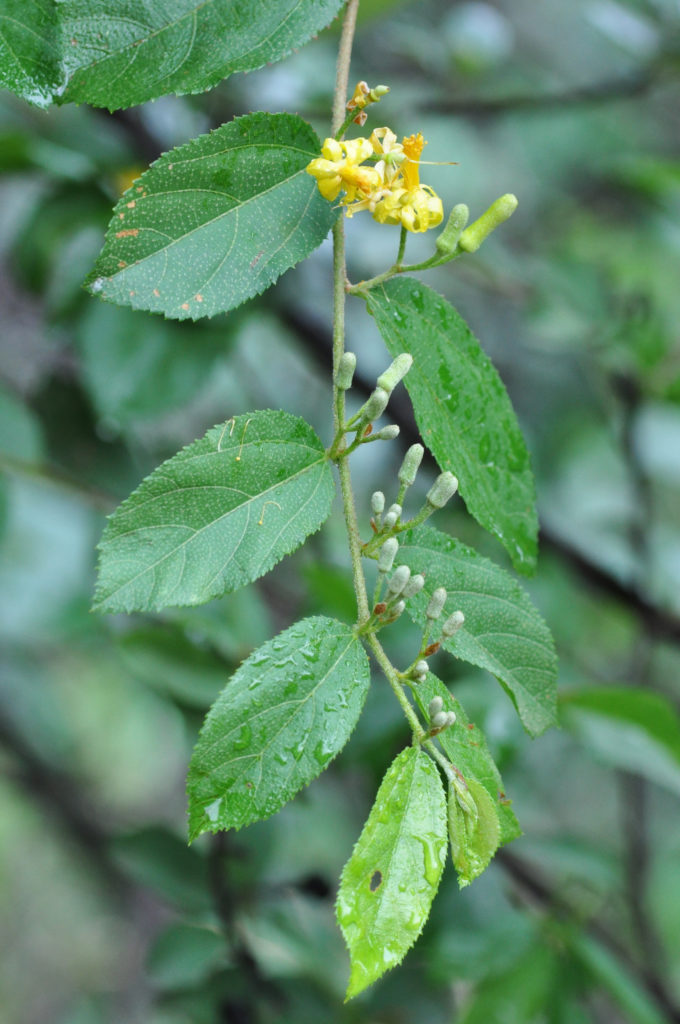
On this deciduous (loss of leaves for part of the year). The process is abscission. tree, the Leaves are light green above and slightly paler below. Leaves are simple (has a single blade which may have incisions that are not deep enough to divide the blade into leaflets). The leaf size is up to 12 x 9cm – usually less. Leaves have distinctly rough hairs – especially below – hence the common name Sandpaper Raisin. The leaf shape is ovate (egg-shaped), obovate (with the narrower end at the base), oblong or oblanceolate (the reverse of lanceolate, the leaf is broader at the apical third than at the middle and tapers towards the base) obovate. The alternate leaves (photo 610) are up to 12 x 9cm. The Apex just tapers to a point or may end with a drip-tip. The veins are more clearly visible on the lower side (photos 606). Here the 3-veined Base (round, lobed or square) is visible (photo 606) and is slightly asymmetric (not equal to the opposite side – photo 604). In this photo the hairy Margin is irregularly serrate (with saw-toothed margin with teeth pointing forward. The longhaired but short Petiole (leaf stalk – photo 604) is usually up to 9mm long. Laterally appearing Stipules (basal appendages of the petiole) are hairy; up to 1cm long and caducous (easily detached and shed at an early stage – photo 604).
-
- 610. 2018/01/30. Pretoria NBG. Photo: David Becking.
-
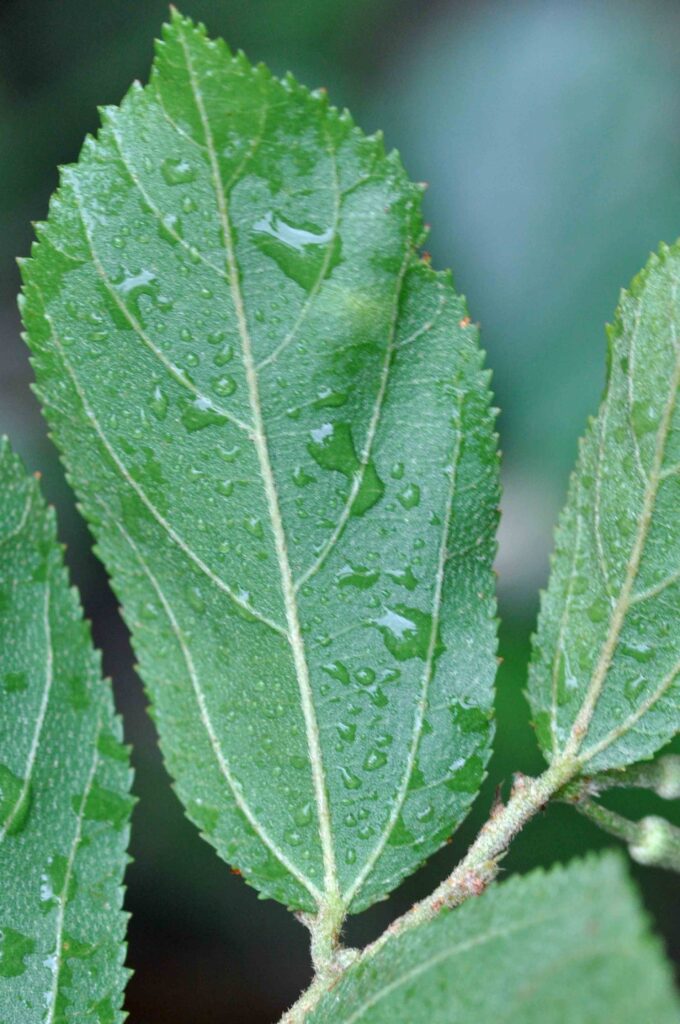
- 606. 2018/01/30. Pretoria NBG. Photo: David Becking.
-
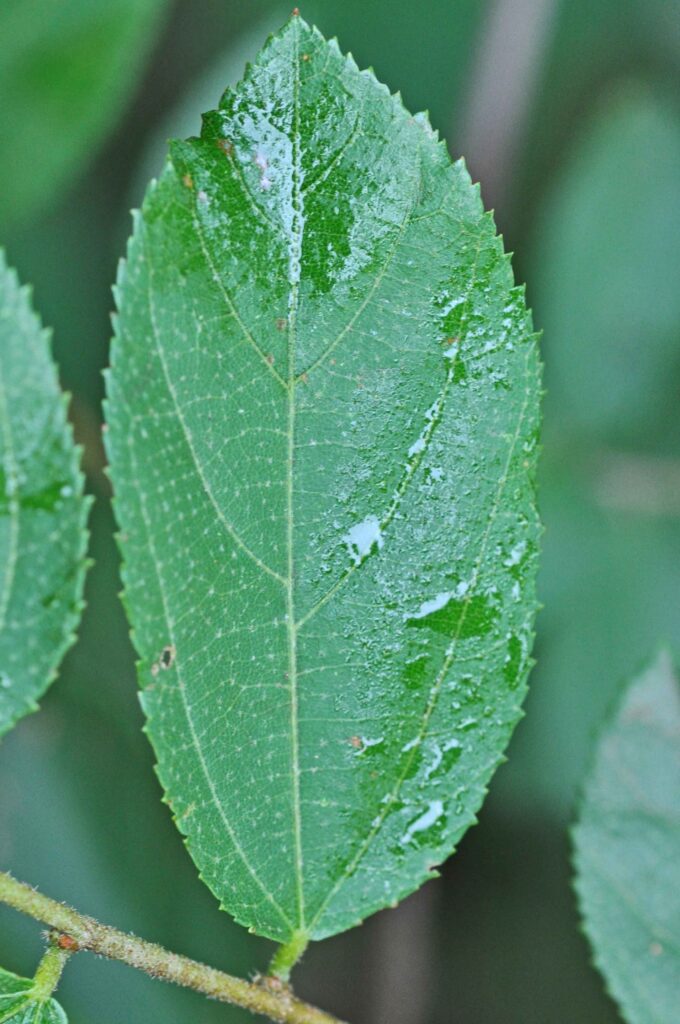
- 604. 2018/01/30. Pretoria NBG. Photo: David Becking.
Flowers
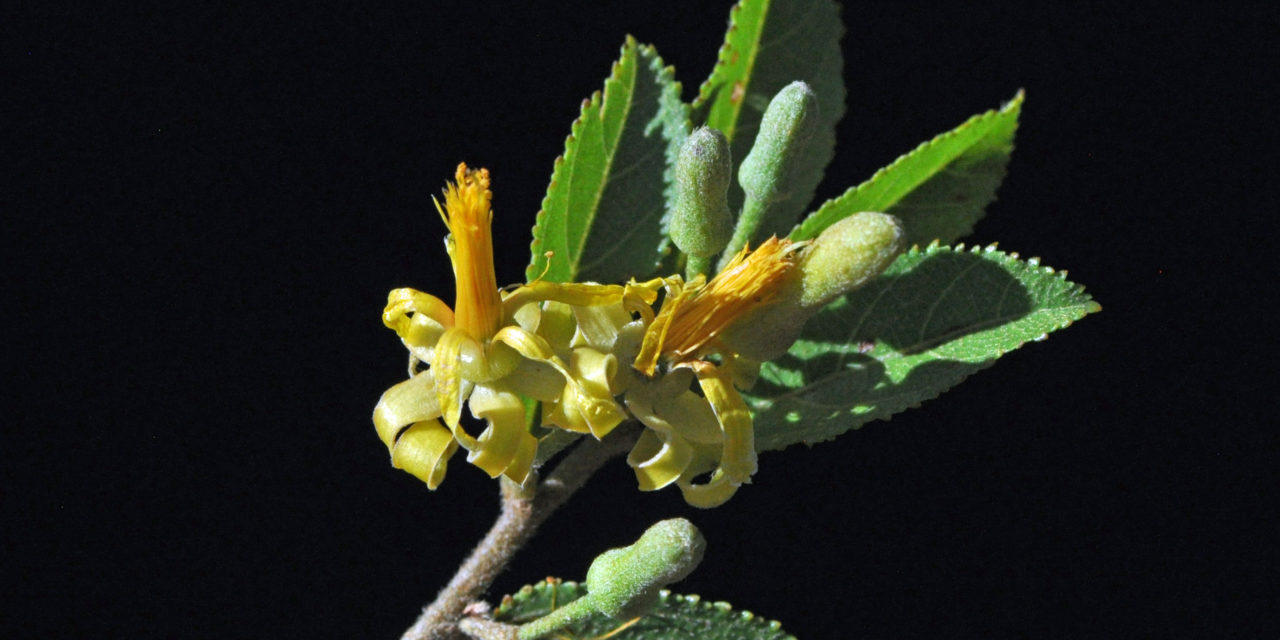
The yellow to golden and possibly fragrant Flowers arise towards the ends of branches from small, oblong buds situated in 2’s or 3’s on each leaf axil (the upper angle between the leaf petiole and the stem – photo 610 – under Leaves). In this photo, the youngest buds are visible closest to the stem apex. Each flower rests on a hairy green Pedicel (stalk of a single flower) that is up to 11mm long (photo 621) and each flower has a diameter up to 3cm and is slightly longer than this. Flowers are bisexual and actinomorphic (Regular, symmetrical. Flowers are vertically divisible into similar halves by more than 1 plane passing through the axis). The Calyx (is the outer whorl of floral envelopes and consists of leaf-like structures called sepals at the base of a flower that protect the bud during development. The 5 free strap-shaped Sepals are up to 3cm long. They are greenish yellow, externally hairy and may become strongly recurved (photo 621). Internally they are distinctively yellowish green and petal-like. The Corolla (the second whorl of the floral envelopes) has 5 thinly yellow or golden Petals that are shorter than the sepals (photo 621). A central mass of free Stamens (pollen producers) with initially yellow filaments (the usually long slender stalk that supports the anther – photos 621 & 623) is present on an extended Receptacle (more or less enlarged or elongated end of the stem or flower axis on which all or some of the flower parts are borne). These numerous stamens surround the single Pistil (a unit of the Gynoecium, the female element of the flower, composed of the Ovary, Style and Stigma). Here the Ovary is superior. There is a single Style, which extends slightly beyond the stamens (photo 621). In this photo, the end of the style, and the lobed green Stigma (the part of the pistil that receives the pollen) is visible. (Nov-Mar).
-
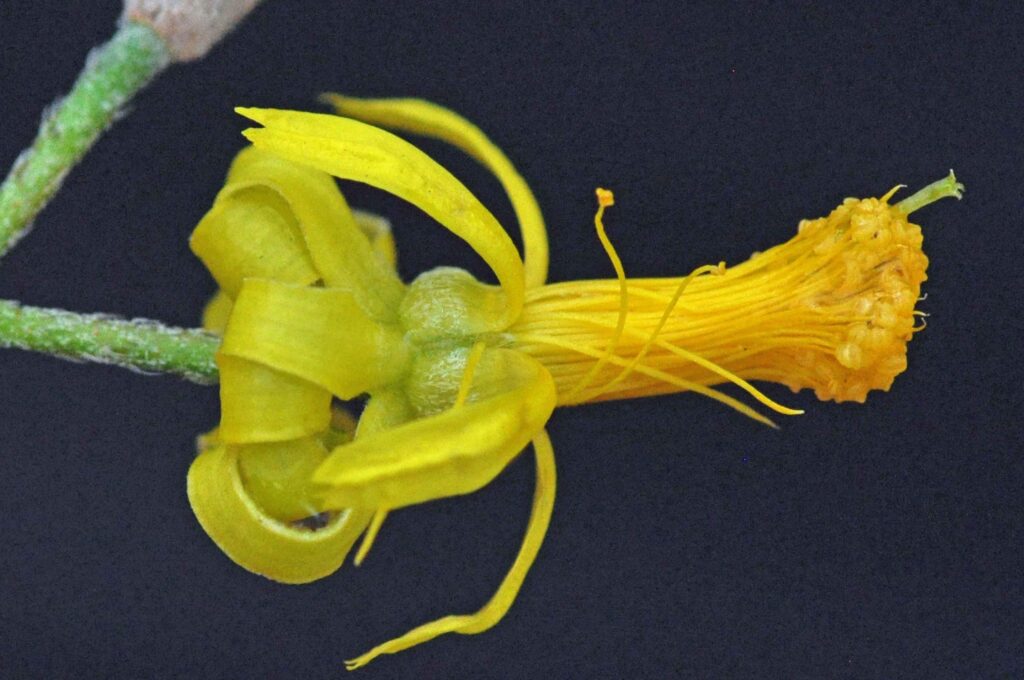
- 621. 2018/01/30. Pretoria NBG. Photo: David Becking.
-
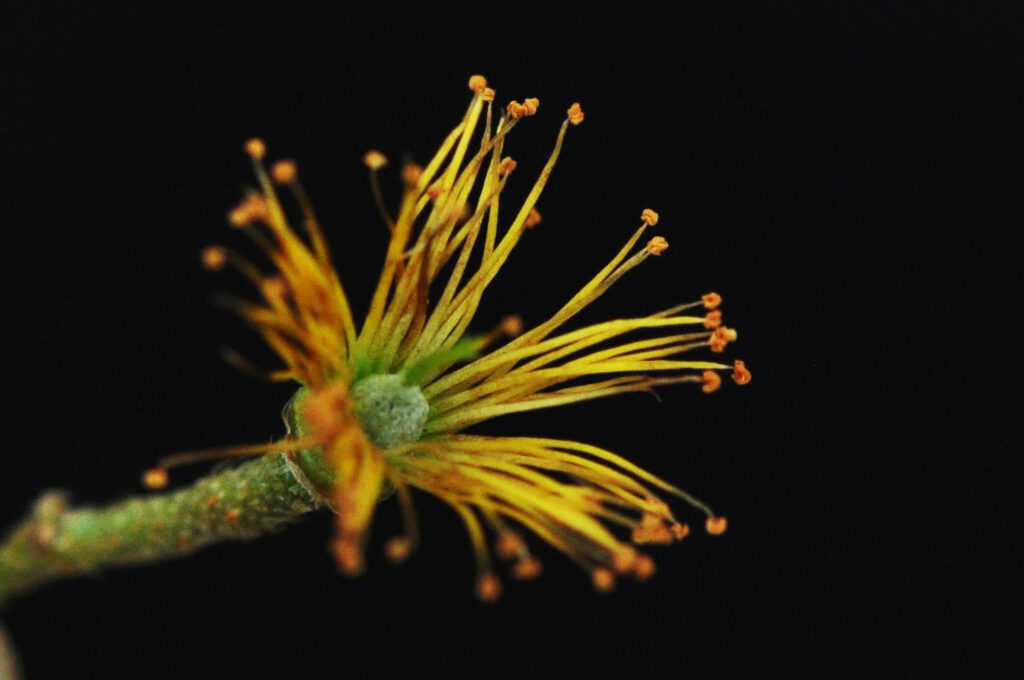
- 623. 2018/08/30. Pretoria NBG. Photo: David Becking.
Fruit
Young green developing fruit (photo 623 under Flowers) is in the centre of the now leaning over the still yellow filaments with the now red anthers. In this photo, the green style is still visible. The small, shiny and hairy Fruit is a Drupe (a fleshy, 1-seeded indehiscent fruit with the Seed enclosed in a stony endocarp; stone fruit e.g. peach) is up to 15mm in diameter. The fruit is usually slightly 2-4 lobed (photo 27) or almost spherical (photo 754). The fruit rests on a hairy Pedicel (here the old, stalk of a single flower) that is up to 2cm long (photo 27). A persistent Style may be visible (photo 900) on the shiny fruit. The fruit contains Pyrenes (nutlets in a drupe similar to peach pips). Each green shiny fruit shrinks and becomes reddish brown when mature (photo 27). At this stage a few long white hairs may be visible. (Mar-Jun).
-
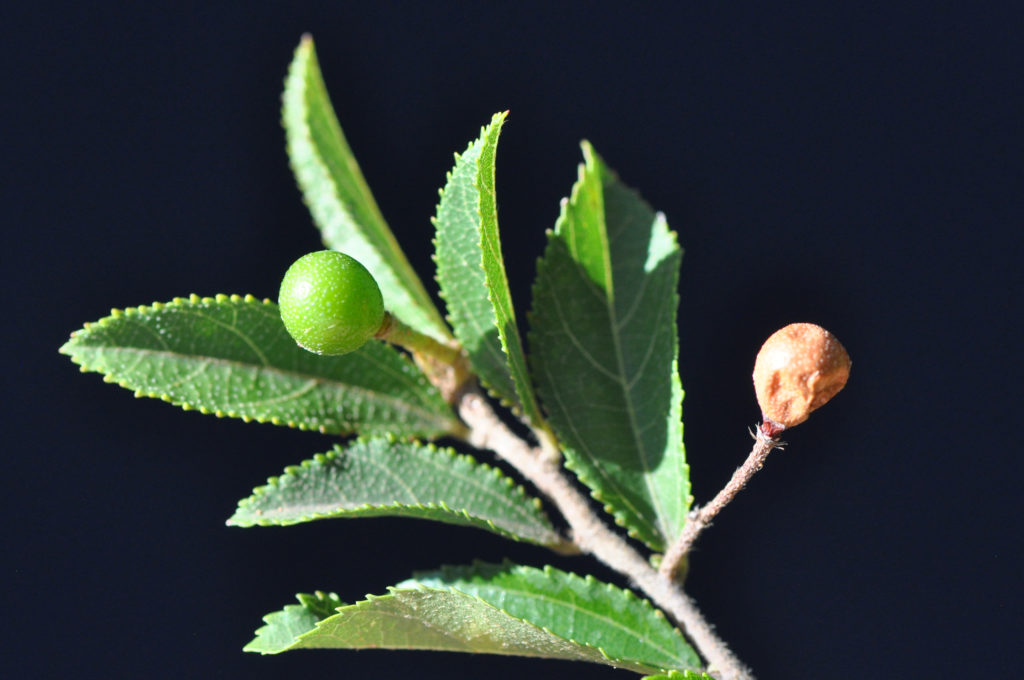
- 754. 2018/02/12. Pretoria NBG. Photo: David Becking.
-
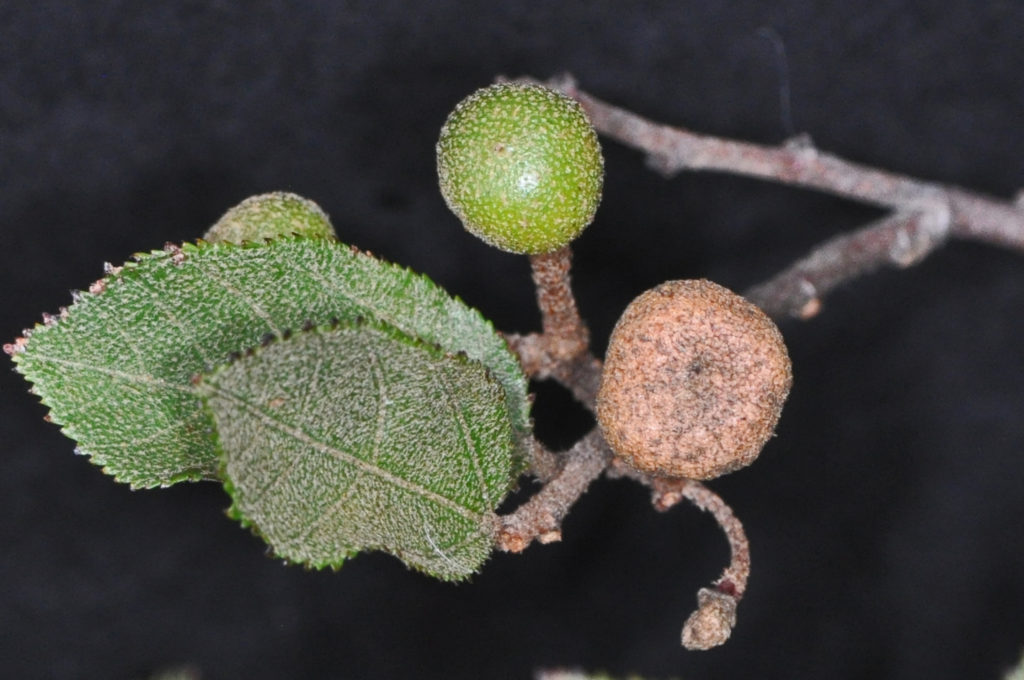
- 27. 2015/04/24. Witkoppen Nursery. Photo: David Becking.
-
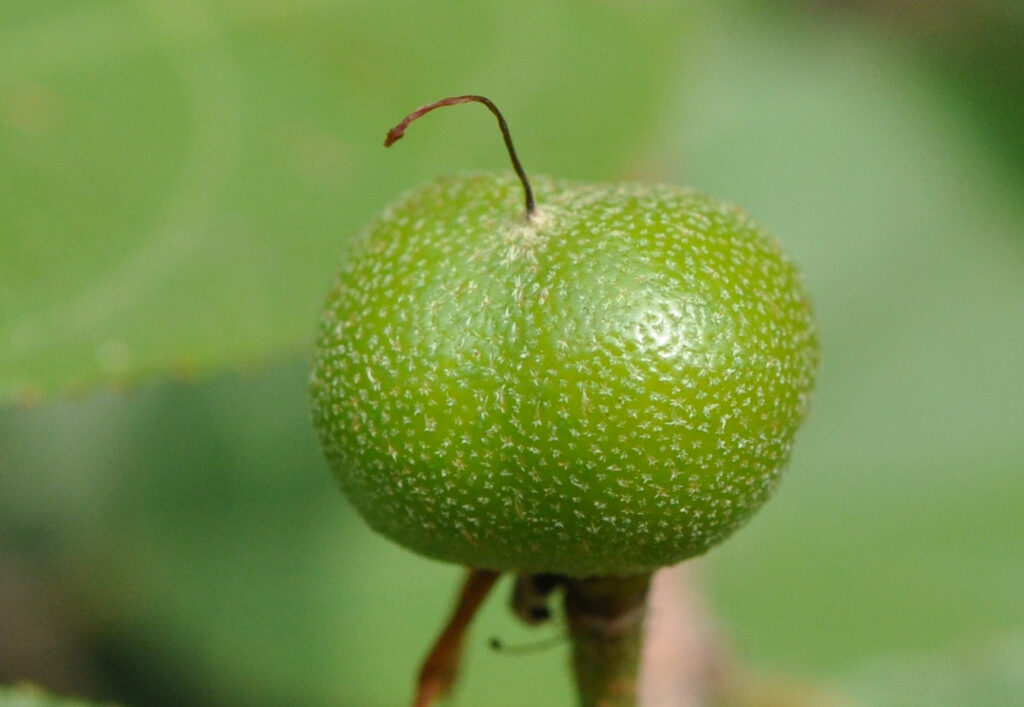
- 900. 2018/03/01. Pretoria NBG. Photo: David Becking.
Distribution & Ecology
These Plants are common below an altitude of 1 550m on rocky slopes, in bushveld (a sub-tropical woodland ecoregion of southern Africa), on termite mounds, riverine thickets and in soils rich in lime. They are also found in fertile alluvial soil where they may form dense thickets. Plants may be scandent (climbing without the aid of tendrils) and may grow in light shady areas. These plants are common in areas of low to medium rainfall. This widely distributed plant is located from central to northern Kwazulu-Natal, Gauteng, Mpumalanga e.g., northern Kruger, Limpopo (largest location in SA), and North West. Beyond South Africa they occur in Eswatini (Swaziland), Mozambique, Botswana, Zimbabwe, Zambia, Malawi, Tanzania, northern and north-eastern Namibia, Arabian Peninsula (including Saudi Arabia, Yemen, Oman, United Arab Emirates (UAE), Qatar, Bahrain, and Kuwait) and India. The Fruit attracts many birds. Monkeys, baboons, warthogs, and buck e.g., klipspringers and impalas, consume the fruit. Game, including the klipspringer and impala, browse the Leaves. They are also the food plants for the larvae of diurnal moth-like Skipper butterflies (named because of their quick, darting flight habits) in the family Hesperiidae with 3 000+ species occur worldwide. They serve as important pollinators and provide a good support for the ecosystem.
Ethnobotany
Stock and game browse the Leaves. The edible Fruit should have the dry skin rubbed off before consumption and the amount left is relatively small. Propagation is through cuttings (most successful) or from seeds that germinate best if they collected from dung. Plant seeds in a sunny place and expect to wait 2 years before flowering. This tree is hardy and can survive in almost any type of soil. In addition, it is frost and drought resistant. This is an attractive addition to a garden and may be used as a screen. Bows, sticks and knobkerries are made from the Wood. Young Branches are used for weaving baskets. This is a good plant for attracting birds. Local medicine makes use of this plant. Aids to identification include very rough leaves and square stems.
References
Boon, R. 2010. Pooley’s Trees of eastern South Africa. Flora and Fauna Publications Trust, Durban.
Burrows, J.E., Burrows, S.M., Lotter, M.C. & Schmidt, E. 2018. Trees and Shrubs Mozambique. Publishing Print Matters (Pty) Ltd. Noordhoek, Cape Town.
Coates Palgrave, M. 2002. Keith Coates Palgrave Trees of Southern Africa, edn 3. Struik, Cape Town.
Foden, W. & Potter, L. 2005. Grewia flavescens Juss. National Assessment: Red List of South African Plants version 2020.1. Accessed on 2023/06/30.
Lawrence, G. H. M, 1951. Taxonomy of Vascular Plants. The Macmillan Company, New York. Tenth Printing 1965.
Palmer, E. & Pitman, N. 1972. Trees of southern Africa. Balkema, Amsterdam, Cape Town.
Schmidt, S. Lotter, M. & McCleland, W. 2002. Trees and Shrubs of Mpumalanga and the Kruger National Park. Jacana, Johannesburg.
van Wyk, B. & van Wyk, P. 1997 Field guide to Trees of Southern Africa. Struik, Cape Town.
Robert H. Archer – help with ID.
http://pza.sanbi.org/grewia-flavescens
http://www.zimbabweflora.co.zw/speciesdata/species.php?species_id=138440
http://posa.sanbi.org/flora/browse.php?src=SP