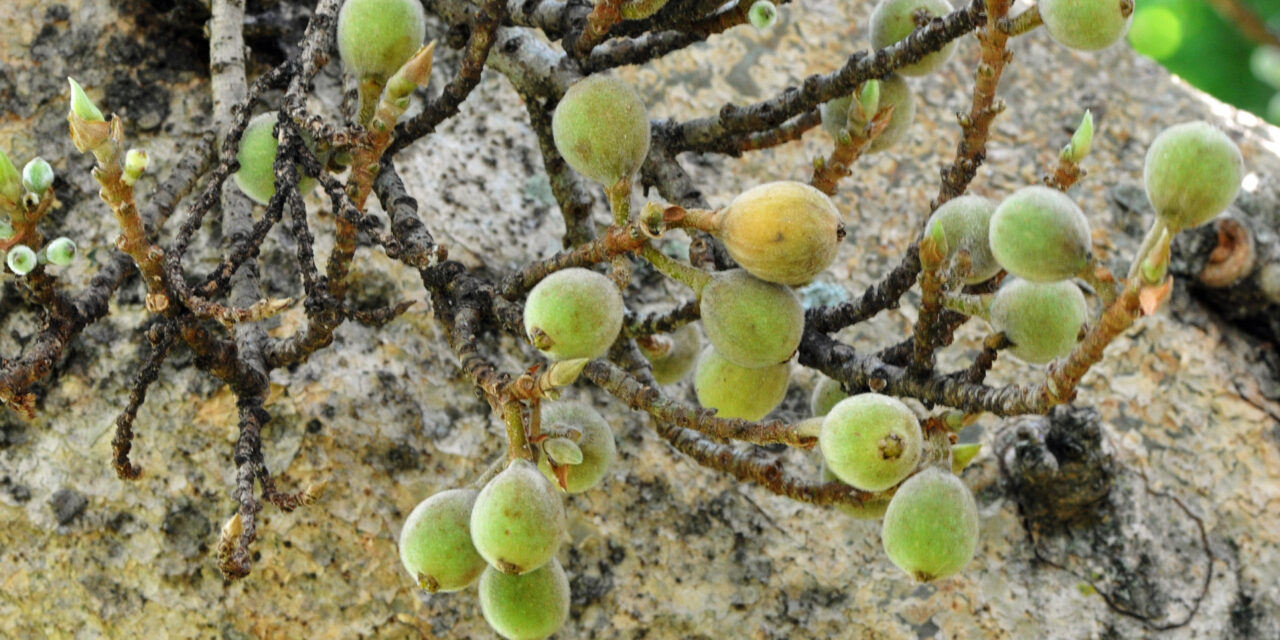
Ficus sycomorus subsp. sycomorus
General Info – summary
This historical and noble Tree is widely distributed throughout Africa. It has a wide trunk and is up to 12m high in SA. Non-toxic milky latex is present. The simple, alternate & entire Leaves are 3-veined from the base on this usually evergreen tree. Stipules are caducous. Flowers are in a syconium. A specific female wasp does the pollination in a mutualistic relationship. Fruit is a hairy fig – on leafless branches or the trunk.
Description
Ficus sycomorus subsp. sycomorus
Previous names: Ficus chanas, Ficus cocculifolia, Ficus gnaphalocarpa, Ficus damarensis, Ficus integrifolia, Ficus scabra, Sycomorus antiquorum.
SA Tree No. 66.
Common names: (Afr) Geel-riviervy, Geelriviervy, Geelstam-vy, Gewone Trosvy, Sycomorus-vy, Sycomorusvy, Trosvy, Wildevy, Wildevye, Wildevyeboom. (Eng) Common Cluster Fig, Sycamore, Sycamore Fig Tree, Sycomore Fig, Tree Killer. (IsiNdebele) Umkhiwa. (isiZulu) Isikhukhuboya, Umkhiwane, Umncongo. (Northern Sotho) Mogo, Mogoboya, Mohlole. (siSwati) Umkhiwane, Umkhiwubovana. (Xitsonga) Nkuwa. (Setswana) Mochaba, Motshaba. (Tshivenda) Muhuvhoya, Muhuyu, Muhuyu-lukuse, Mukuyu-vhukuse, Mutole, Muvhuyu-vhutwa.
Family: Moraceae (fig or mulberry family). Trees are evergreen and have milky or watery latex present. The simple Leaves are alternate or opposite and 3-veined from near the possibly lobed base. Margins are usually entire, and all leaves have stipules. Plants are monoecious or dioecious and flowers are unisexual. The Perianth of indigenous species contains sepals but no petals. Male flowers have up to 6 stamens. Female flowers are inconspicuous and lack staminodes. The superior or inferior Ovary has 1 locule with 1 ovule, and 2 styles are often present. The compound usually fleshy Fruit contains various Seeds. The family has 37 genera and about 1 100 species.
Name derivation: Ficus – Latin for fig. sycomorus – Greek: syka means fig and morus refers to the mulberry – in the same family. The genus Ficus has 36+ species in southern Africa and 25 in South Africa. The yellow bark and rough leaves help with identification. A different tree, known as the sycamore tree (Acer pseudoplatanus in the family Sapindaceae) grows in Europe and Western Asia. In the USA it is known as the sycamore maple.
Tree
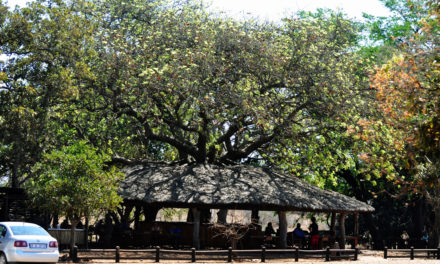
Aerial roots are lacking in this large, non-strangler Tree. It is one of the most striking and colourful of our trees (photo 515). The trunk or stem is the main axis of the plant. It is usually up to 12m high in South Africa and up to 25m in the forests further north. Its huge, rounded, spreading crown (photo 515) may reach 30m wide – especially in the open. The relatively short spreading Trunk (photos 514 & 538) can reach a circumference close to 4m. In large species the base is often buttressed (photo 515). Red or orange mottling may be present on the trunk, which is initially smooth but ages to a slightly rougher surface. The outer bark is powdery, usually yellowish, occasionally whitish, and often peels off in small papery flakes (photo 538). The inner bark is yellow. The tree is often fluted (grooved, funnelled, channelled) in forest specimens. Twigs (1-year-old current branch segments) are initially finely hairy. Damaged parts yield non-toxic Milky Sap.
-
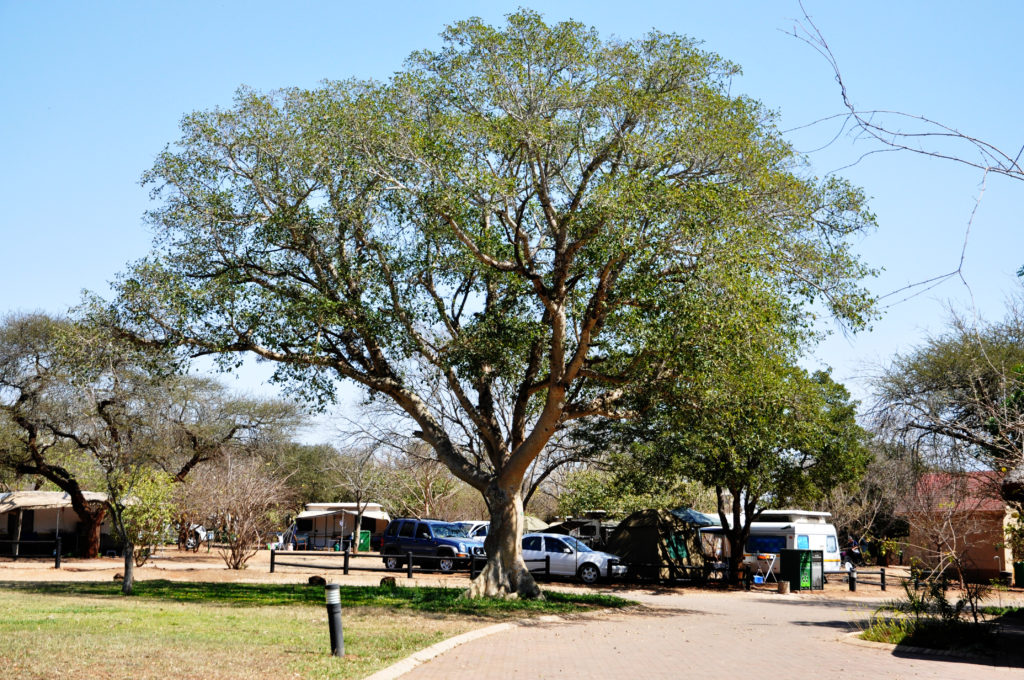
- 515. 2014/09/14. Lower Sabi KNP. Photo: David Becking.
-
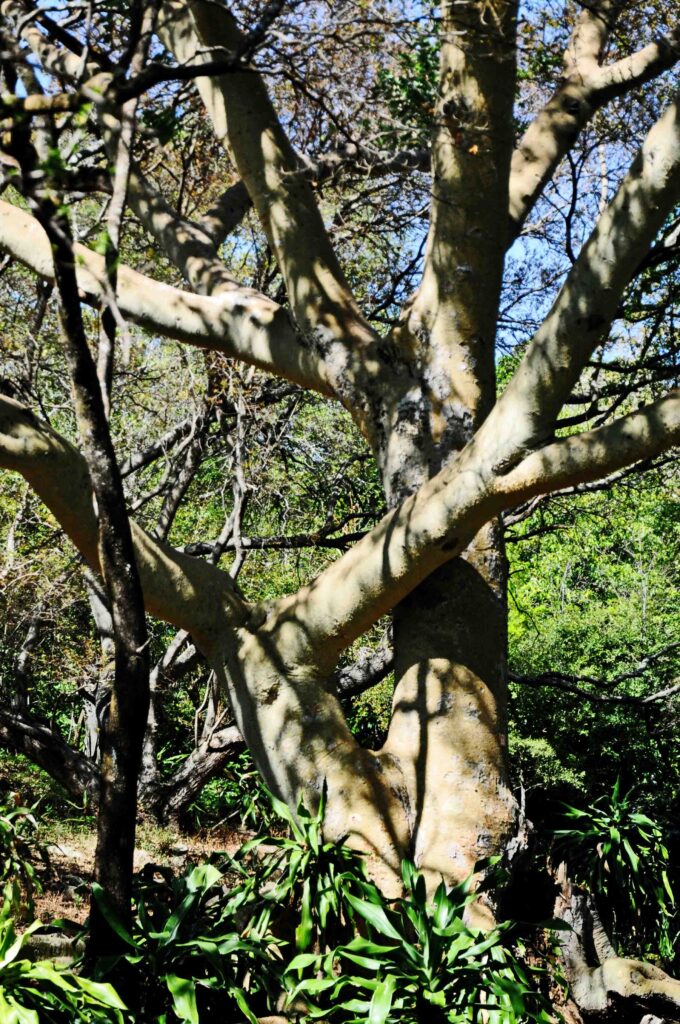
- 799. 2014/09/15. Lowveld NBG. Photo: David Becking.
-
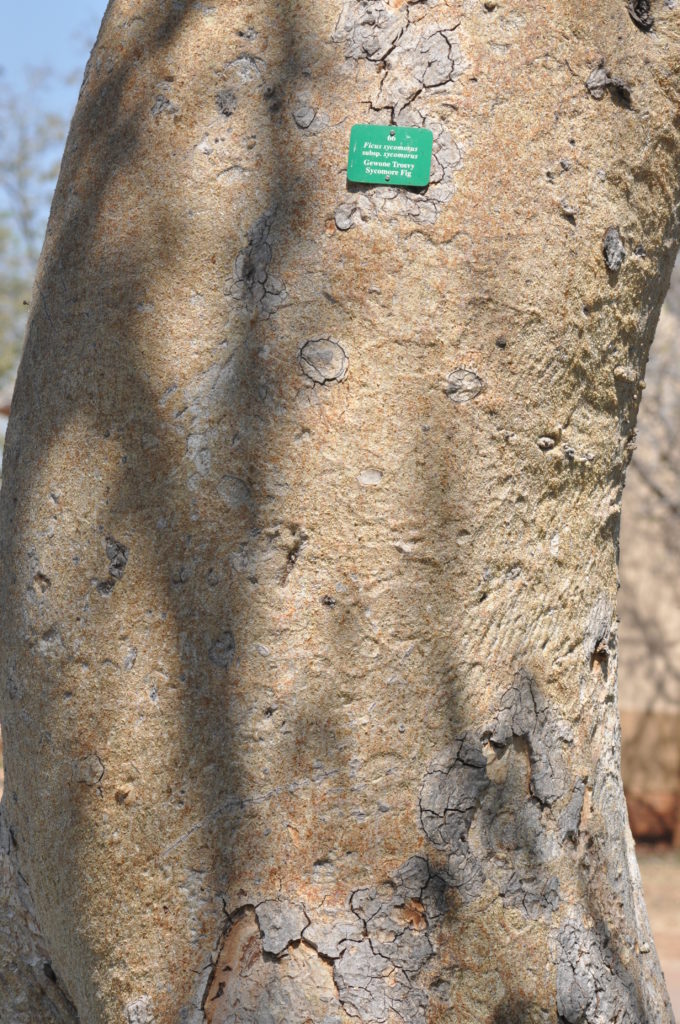
- 514. 2014/09/08. Lower Sabi KNP. Photo: David Becking.
-
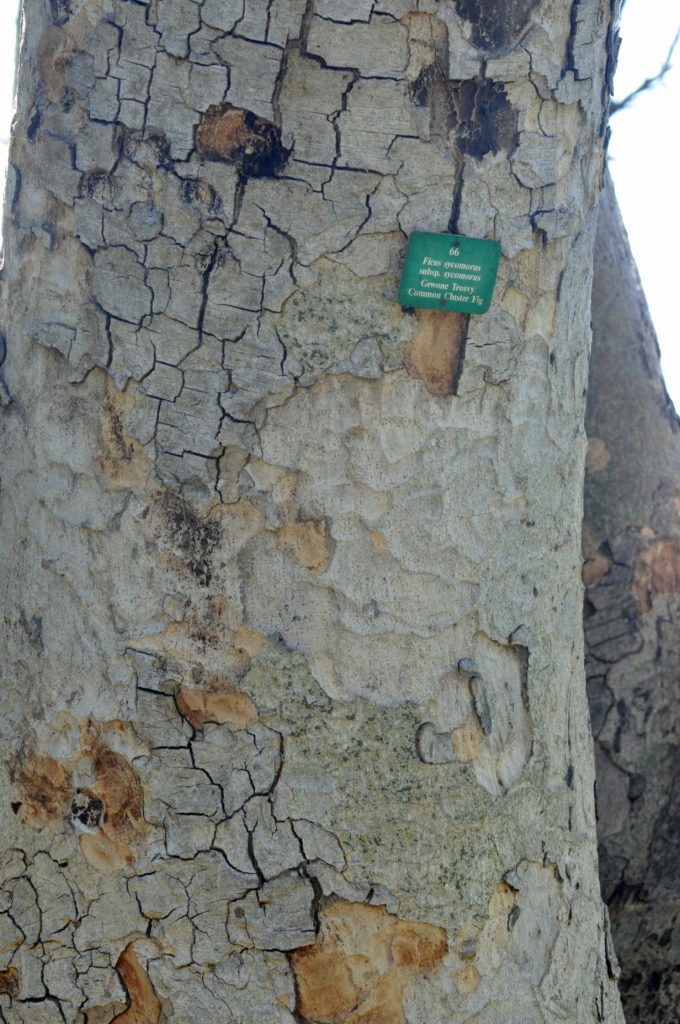
- 538. 2014/09/08. Lower Sabi KNP. Photo: David Becking.
Leaves
These tough trees are usually evergreen but may be briefly deciduous. The youngish leaves are folded along the midrib (photo 800). The attractive, shiny (photo 800) and variably shaped Leaves, may be oval, ovate (egg-shaped), obovate (upside down egg shaped), elliptic or almost circular. The usually stiff leaves are simple (have a single blade which may have incisions that are not deep enough to divide the blade into leaflets). The leaves are usually alternate or opposite. This tree has leaves that may reach 15 x 11cm but are usually smaller. The Apex is bluntly pointed or roundish. The Base is rounded, notched or shallowly cordate (heart shaped – photo 734). The hairy Margins (photo 734) may be wavy and entire (with a continuous margin, not in any way indented), indented or toothed. They may be slightly irregular. The upper surface of the Blade is dark green and may be smooth or sandpapery or roughish – (more so than in Ficus sur). The lower surface is lighter and has a little more hair. Leaves are yellowish and distinctly 3-veined from the base (photo 734). There are usually up to 7 additional lateral veins present on either side of the midrib. The basal pair are prominent. On the lower surface, waxy spots may be located in axils of the basal secondary veins or at the base of the midrib. The initially hairy red Petiole (leaf stalk – photo 734) loses hair and becomes smooth and up to 6cm long (photo 734). Pointed Stipules (basal appendages of the petiole – photo 734) envelope the terminal bud and are caducous (an organ or part of which is easily detached and shed early).
-
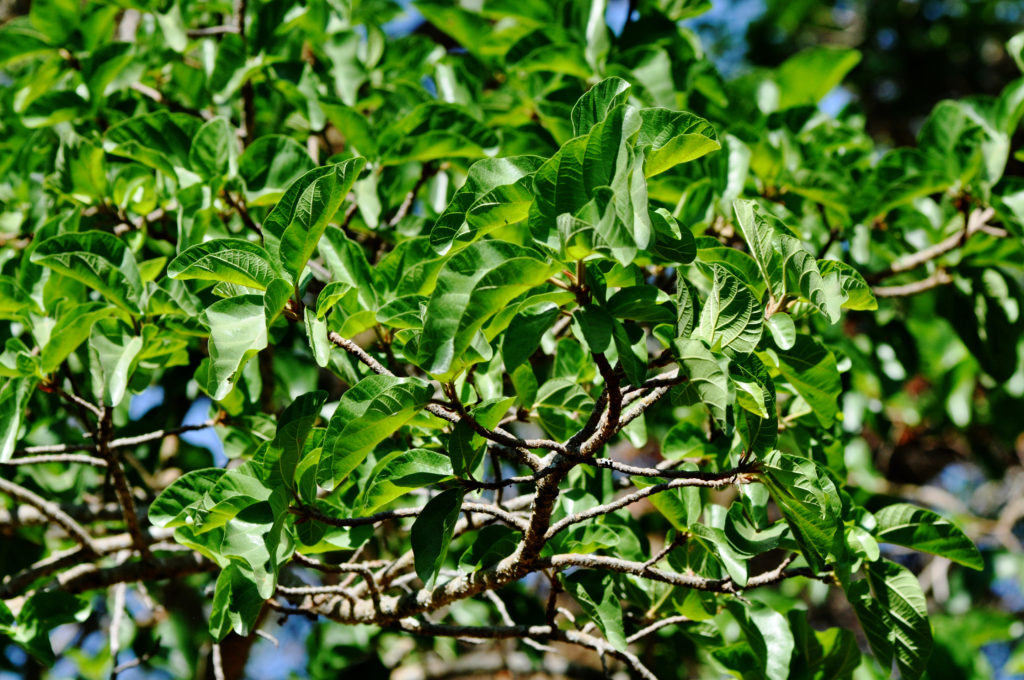
- 800. 2014/09/15. Lowveld NBG. Photo: David Becking.
-
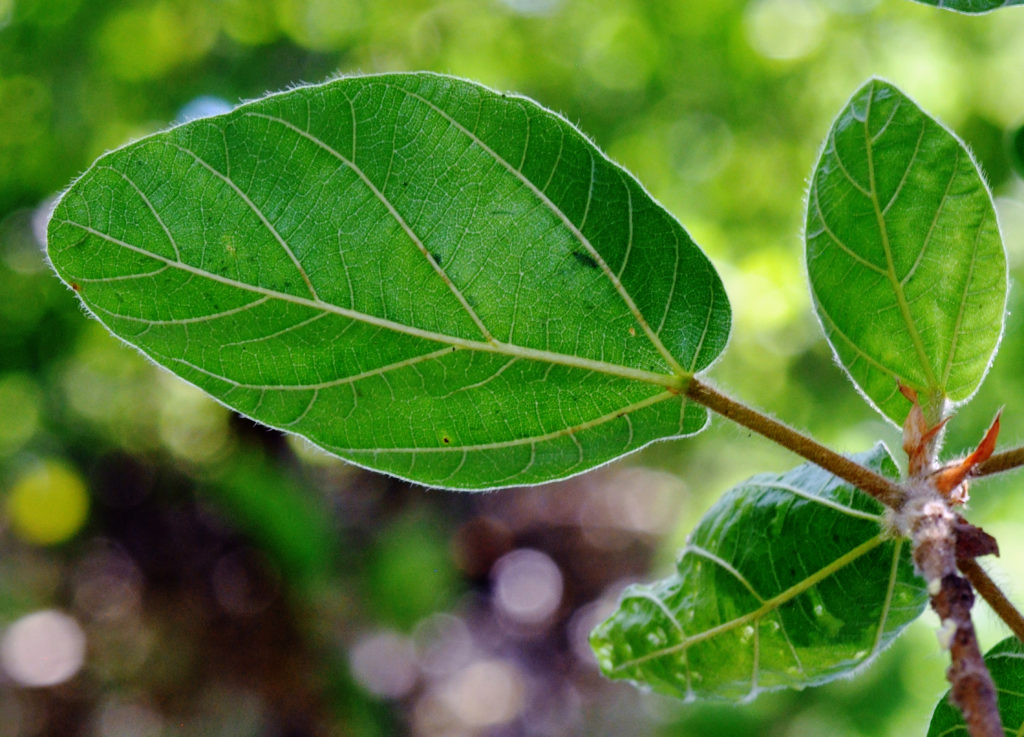
- 734. 2014/09/14. Lowveld NBG. Photo: David Becking.
Flowers
This Tree is monoecious (having both male and female reproductive organs on the same plant). Figs possess a remarkably arranged flower head called a Syconium. Essentially this consists of a Receptacle (is that expanded tip of the flower stalk from which the floral parts develop). This receptacle is greatly expanded in both the Asteraceae and in Ficus. In Ficus, the receptacle perimeter considerably increases in size, folding over to form the fig shape. In this tree, figs occur in dense clusters on the main branches or singly in leaf axes. Two or more crops ripen annually. The hollow fig ends with a tiny opening called an Ostiole (photo 729), which is covered with scales making exit impossible and entrance difficult for wasps. Only the Female pollinating wasp (specific for each species – in this case Ceratosolen arabicus) attempts to do so and usually injures herself in the process. She consumes the inside seeds. Around the inner boundary of the hollow receptacle, a large collection of extremely small flowers develops. These flowers are either male or female. In the Male flowers, up to 6 overlapping perianth (the 2 floral envelopes considered together; a collective term for the calyx – has sepals and corolla – has petals) lobes and one or 2 stamens are present. The ovary is absent or vestigial (imperfectly developed, non-functional relic from the past). In the Female flowers, there are no stamens and usually fewer perianth lobes. The Ovary is free and usually has 2 Styles.
The Female wasp enters the fig with her pollen sacks laden with unintentionally collected pollen and pollinates those female fig flowers with longish styles. These long styles prevent the wasp from reaching the fig Ovaries and thus from laying eggs in it. The wasp targets the flowers with short styles and lays a single egg in each one. These female flowers react to this egg, producing a gall, which nourishes the developing wasp larvae. They eventually pupate and become adult wasps. The robust Male wasps develop first, fertilize the young Female wasps and then burrow through the wall of the fig, allowing oxygen in. The female wasps, now accidently load pollen from the male fig flowers, escape from the fig through the hole made by the male wasps. Female wasps then make their way to another fig of the same species, to continue the life cycle. This is an excellent example of a mutualistic relationship between the fig tree and the wasp, where both benefit.
-
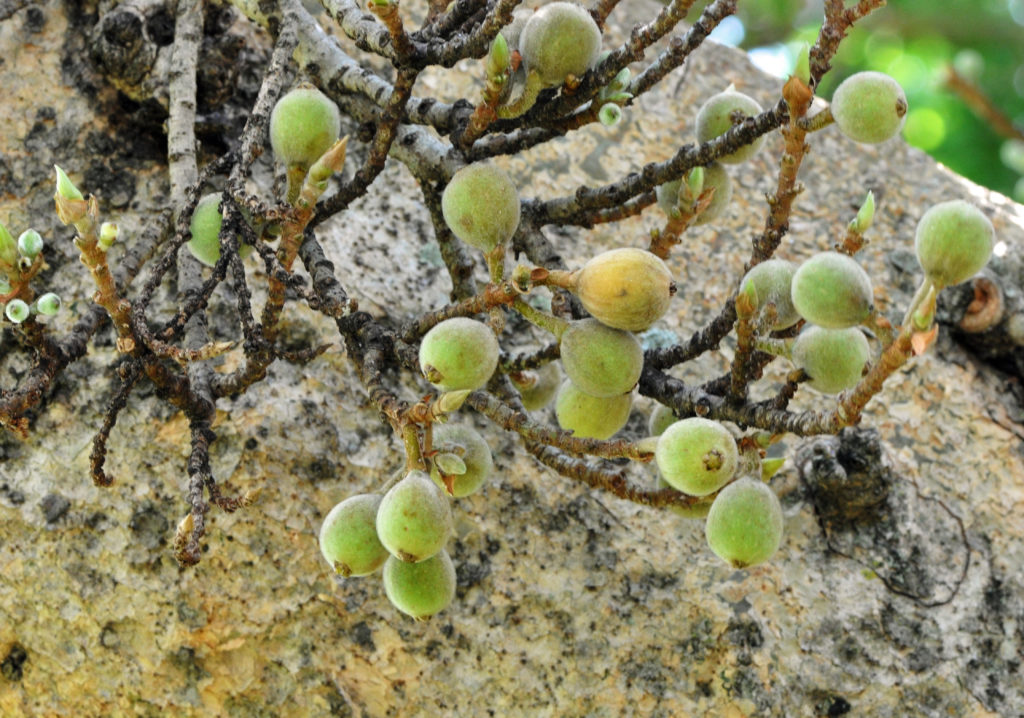
- 729. 2014/09/14. Lowveld NBG. Photo: David Becking.
Fruit
A short stalk (photo 729 below Flower) below each flower supports the usually finely hairy multiply Fruit that develops on specialised leafless major separate branchlets or from on the trunk. These branchlets may reach 3cm wide and are slightly flattened. Nearly a week after the young wasps have left, the initially green figs, with their fertilized seeds, ripen and develop into an orange/red to brown, multiple inverted fruit when mature. The Shape is almost spherical or slightly flattened. The Ostiole is slightly raised (photo 516) and star shaped. The colour change is due to the oxygen induced ethylene production. This oxygen enters where the male wasps have burrowed through the fig. Ethylene (C2 H4) is produced in nearly all parts of plants. It is a small hydrocarbon gas that is odourless and tasteless. This gas is involved in the ripening of the fruit including causing the fig to change colour, texture and softens. It is used commercially to ripen fruits like tomatoes, bananas and pears. Seed dispersal agents include birds and bats (through their droppings). Fruit develops mainly from the inflorescence wall and may be present most of the year but are usually evident from July to December in Southern Africa. The fruit may fall before it is completely ripe, in which case ripens on the ground. In South Africa, usually 1 or 2 crops are produced annually but further north 4 crops are often produced. In Ficus sycomorus subsp. gnephalcarpa the fruit is larger and develops in leaf axils.
-
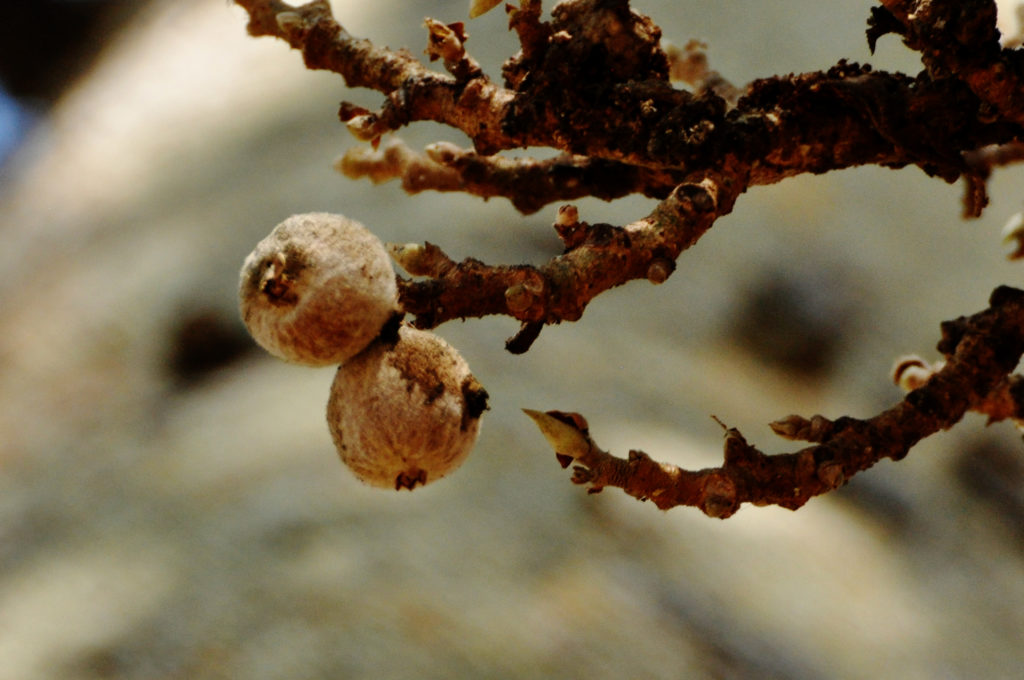
- 516. 2014/09/08. Lower Sabi KNP. Photo: David Becking.
-
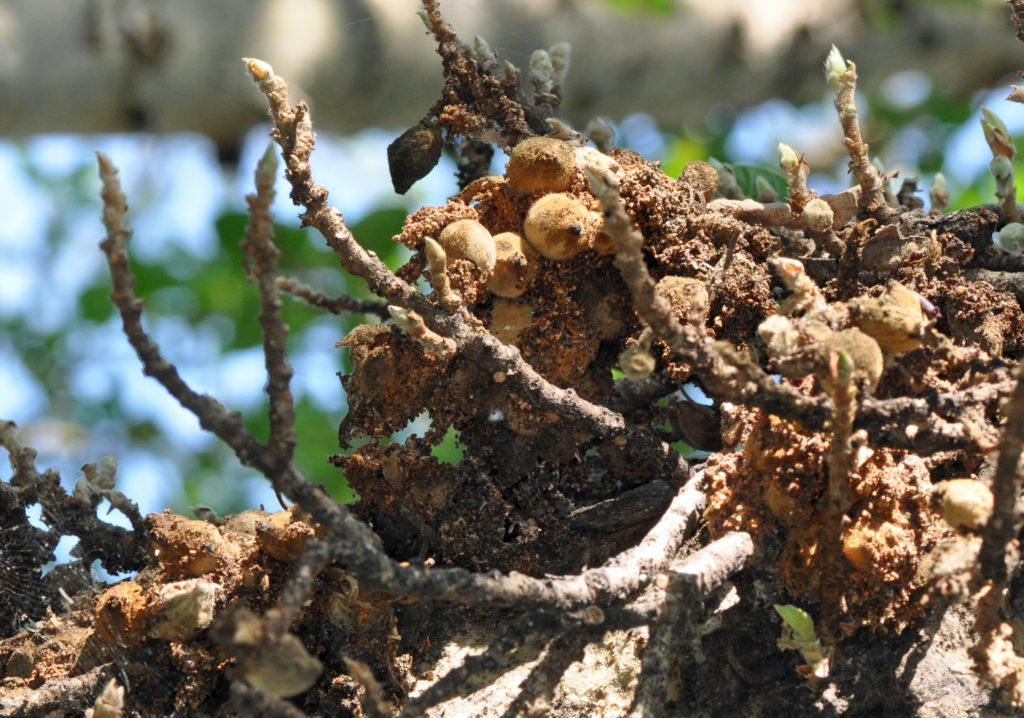
- 731. 2014/09/14. Lowveld NBG. Photo: David Becking.
Distribution & Ecology
The Trees usually occur below 1 200m, adjacent to a water supply – including lowveld rivers, low-lying areas, swamps, open woodland and with termite mounds. Trees often appear in groves and may also be wide spreading in savanna (is a rolling grassland scattered with shrubs and isolated trees, which can be found between a tropical rainforest and desert biome) areas. These plants are associated with high water tables. They are found for example along the narrow Lebombo Mountains (about 800km long from Hluhluwe in KwaZulu-Natal to Punda Maria in the Kruger National Park). This tree is also located in Swaziland (Eswatini), Limpopo, Mpumalanga, Mozambique, Zimbabwe – including the eastern highlands, Comores, Madagascar, Botswana, Namibia e.g., in the Brandberg (NW of Windhoek) and northwards to Egypt, Saudi Arabia and West Africa. Directly or indirectly this tree gives life to many animals. Black rhino eat the leaves. White rhino consume both the bark and leaves and baboons eat the young leaves and use the tree for shade. The Fruit on the tree and fallen fruit is eaten by monkeys, bushpigs, warthogs, rhino and buck. Fish eat fruit that falls into water. Many Birds including the predominately green, Green Pigeon are forest dwellers feeding on fruit like figs and wild plums, Hornbills, White-eared Barbets (mainly a fruit eater) and the relatively quiet Brown-headed Parrot (green with a brown head and big beak and nest in dead wood) consume the fig fruit. White-eared Barbets nest in the dead Wood and feed extensively on wild figs. The medium to large raptor: the African Harrier Hawk or Banded Gymnogene, search for insects in the Bark which becomes cracked and somewhat hollow as it ages.
Ethnobotany
This is the Biblical Sycamore tree. This is the tree that the short Zacchias (the chief tax collector), climbed in order to see Jesus (Luke 19). The Fruit is edible raw or when stewed or dried and can be fermented to make alcohol. The dry fruit can be stored and tastes like sultanas. In dry times it can be cooked in water to make soup. Figs have a good flavour, and more than one crop can be harvested each year. For human consumption it is best collected prior to ripening – to prevent an insect invasion. In times of need, people eat the nutritious young Leaves. Wood is also used for fuel and for making charcoal, carpentry and for building. Together with the fever tree Acacia xanthophloea now Vachellia xanthophloea, their branches are used to make fishing fences. In central Africa, the Tree is grown as a shade protector for coffee plantations. Parts of the tree, including the milky sap, are used in local medicine. In a suitable large environment, this would make a good shade tree. This tree is frost sensitive and requires a lot of water but produces a lot of shade in very large gardens (the crown may reach 30m wide). The yellowish bark and harsh, rough nutrient rich leaves are distinctive for this species. This is good pot plant material. The rough bark and the yellowish bark help in identification.
References
Boon, R. 2010. Pooley’s Trees of eastern South Africa. Flora and Fauna Publications Trust, Durban.
Burrows, J.E., Burrows, S.M., Lotter, M.C. & Schmidt, E. 2018. Trees and Shrubs Mozambique. Publishing Print Matters (Pty) Ltd. Noordhoek, Cape Town.
Burrows, J.E. & Victor, J.E. 2005. Ficus sycomorus L. subsp. sycomorus. National Assessment: Red List of South African Plants version 2024.1. Accessed on 2026/04/16.
Coates Palgrave, M. 2002. Keith Coates Palgrave Trees of Southern Africa, edn 3. Struik, Cape Town.
Ginn, P. J, McIlleron, W.G, & Mimstein, P. le S. 1991. The Complete Book of South African Birds. Struik, Cape Town/Singapore.
Lawrence, G. H. M, 1951. Taxonomy of Vascular Plants, The Macmillan Company, New York. Tenth Printing 1965.
Palmer, E. & Pitman, N. 1972. Trees of southern Africa, Balkema, Amsterdam, Cape Town.
Schmidt, S. Lotter, M. & McCleland, W. 2002. Trees and Shrubs of Mpumalanga and the Kruger National Park.
van Wyk, B. & van Wyk, P. 1997 Field guide to Trees of Southern Africa, Struik, Cape Town.
https://en.wikipedia.org/wiki/Ficus_sycomorus
http://www.worldagroforestry.org/treedb/AFTPDFS/Ficus_sycomorus.PDF
http://posa.sanbi.org/flora/browse.php?src=SP