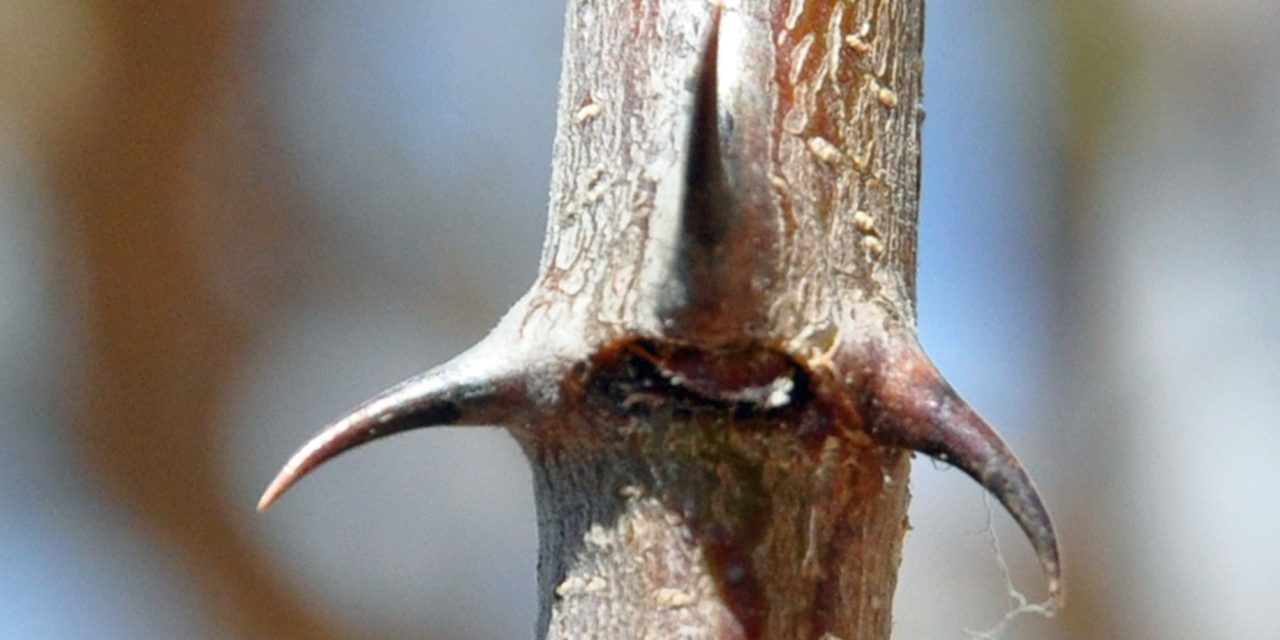
Senegalia senegal var. leiorhachis
General Info – Summary
This slender, single stemmed Tree is up to 8m tall + distinctive, vicious 3-hooked spines. Orange/brown bark peals in slightly papery strips. Small bipinnate Leaves with non-spinescent stipules have well-spaced leaflets + a smooth rachis. Small creamy-white Flowers in hanging spikes. Exserted stamens give cream colour. Superior ovary + elongating style. Fruit: straight, broad, flat, papery pod with a rounded apex.
Description
Previous Names: Acacia circummarginata, Acacia Senegal var. leiorhachis.
SA Tree No. 185.
Common names for (var. leiorachis): (Afr) Diehaakdoring, Driehaakdoring, Geelhaak, Lang-geelhaak, Plat-geelhaak, Platkroon-geelhaak, Slapdoring, Slaploot. (Eng) Bushy Three-hook Thorn, Three-hook Thorn, Slender Three-hook Thorn, Three-thorned Acacia. (IsiNdebele) Umhlahlalinye. (isiZulu) Isikhambophane, Omhloshana, Umkhaya, Umkhayikhayi. (Northern Sotho) Mungana Todwa. (siSwati) Sibambamphala. (Tshivenda) Muunga-thuda. (Tswana) Moloto, Morutlhatshana.
Family: Fabaceae, or Leguminosae (Pea, bean or legume family). After the Orchidaceae and the Asteraceae, the Fabaceae is the third largest Angiosperm (flowering plants) family with 700+ genera and close to 20 000 species. Local Tree genera on this website include Acacia (Vauchellia, Senegalia), Albizia, Bauhinia, Bolusanthus, Burkea, Calpurnia, Colophospermum, Cordyla, Cyclopia, Dichrostachys, Erythrina, Erythrophleum, Faidherbia, Indigofera, Mundulea, Peltophorum, Philenoptera, Piliostigma, Schotia and Xanthocercis. The Fabaceae are recognisable by their fruit and their pinnately compound Leaves. Leaves may also be simple – even bilobed and usually have stipules – some of which may be spinescent. Leaflets are usually entire. Flowers are bisexual and bracteate. Regular flowers usually have 4-5 sepals and the same number of petals. Irregular flowers have 4-5 sepals and 5 or less petals. Stamens have anthers that have 2 pollen sacs and there are usually at least twice the number of stamens as petals – often 10. The superior Ovary has 1 locule containing 1 or more ovules. The Stigma and Style are simple. The single carpel develops into the Fruit, which is usually a pod. The mature pods may dehisce or break into segments. Seeds vary.
Name derivation. Species of the genus Vachellia and Senegalia were considered members of the genus Acacia until 2005. New Names. The genus Vachellia was named after George H. Vachell (1789 – 1839), chaplain and plant collector in China. Here the inflorescence is capitate (head like) and spinescent stipules are present. Plants in the genus Senegalia – (first collected in Senegal) usually do not have spinescent stipules and the inflorescence is usually a spike. leiorachis has a smooth rachis (leaf axis).
Senegalia senegal var. leiorhachis. This usually single stemmed tree is taller (often 5-8m) high and more spindly with current branches away from base. Leaves usually longer – to 5,5cm. Flowers in yellowish white spikes. Floral axis is hairy. Pod usually longer and narrower – up to 9 x 2cm and lacks a beaked tip ending. var. leiorachis only occurs in South Africa. In Senegalia senegal var. rostrate the usually shorter Tree or shrub is less spindly. Branches occur near the base. Leaves usually shorter – up to to 3,5cm. Flowers are in white spikes, and the floral axis is hairy. Here the Pods are usually shorter and wider – up to 7 x 3cm and each pod ends with a beaked tip.
Conservation Status: L C. (Least Concern). Assessment: 2005/06/30. (W. Foden and L. Potter).
Tree
This single stemmed, upright, usually slender and spindly Tree varies from 5 and 8+m high. It has a few erect, initially ascending branches and often stands well above the surrounding vegetation. The vicious 3 hooked Thorns occur at the nodes and are in 3’s. Here the 2 outer ones pointing towards the branch end (photo 237). The corky Bark is orange-brown and has a tendency to peel slightly in papery strips. This may expose an orange to brown Underbark (photo 240). Younger stems have visible Lenticels (a usually raised corky, oval or elongated area on the plant that allows the uncontrolled interchange of gases with the environment – photo 237 & 242 under Leaves). In Senegalia senegal var. rostrata the flat-topped tree is low spreading, less than 4m high and branches arise at ground level and have a greyish flaky trunk.
-
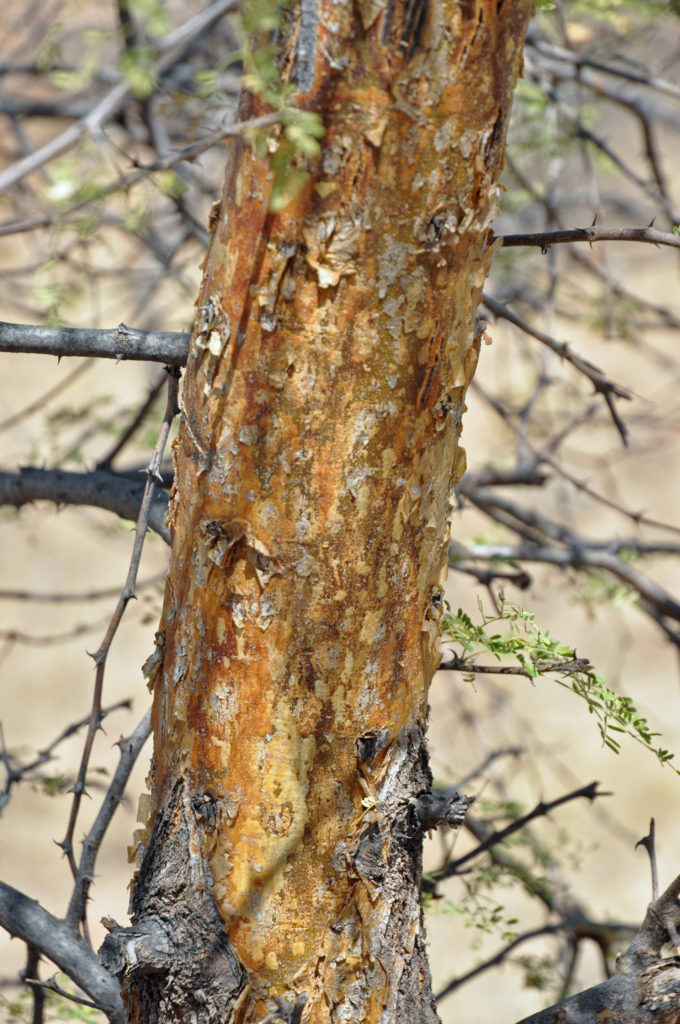
- 240. 2014/09/01. Mapungubwe NP. Photo: David Becking.
-
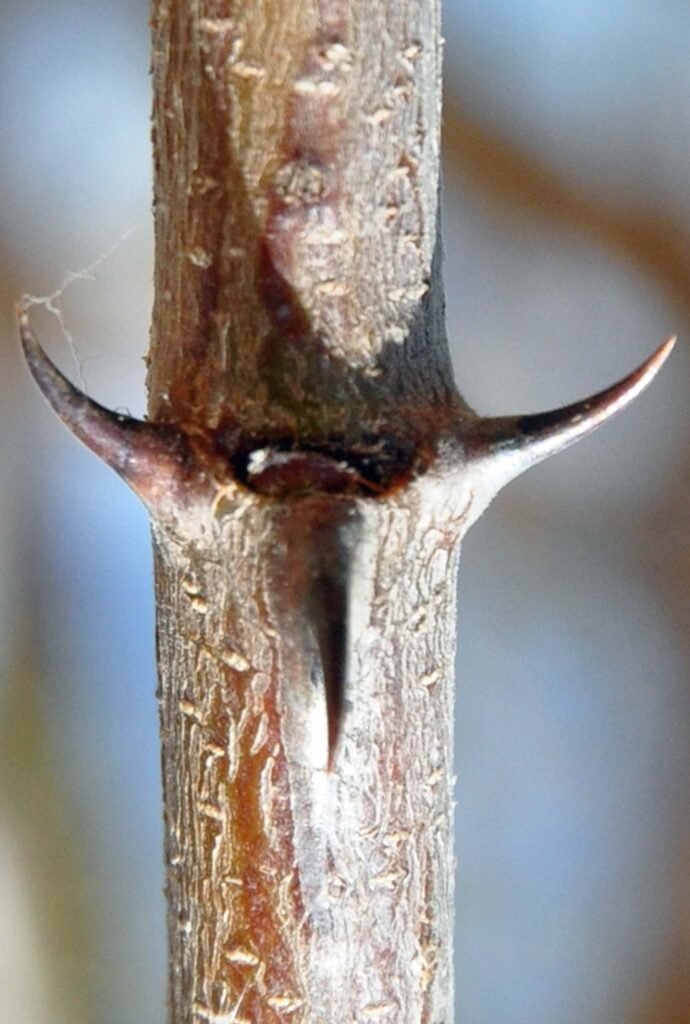
- 237. 2014/09/01. Mapungubwe NP. Photo: David Becking.
Leaves
This deciduous and sparsely leaved tree (photo 73) has very small Leaves that are up to 6cm long. They are bipinnate (compound: twice-pinnate leaves. The rachis – central axis, has lateral pinnae “side branches” not leaflets and the pinnules “leaflets” are on these “side branches”). Each whole Leaf may be solitary – occurring at nodes or there may be up 4 on a woody cushion (photo 73). There are up to 8 pairs of pinnae supporting up to 15 pairs of leaflets which are clearly separated from each other (photo 242). The pale green pinnules are small – up to 7 x 2mm. The hairy Petiole (stalk that attaches the leaf blade to the stem) may have a gland present. Stipules (basal appendage of the petiole) are not spinescent (having or becoming spiny). The Rachis (extension of the petiole of a compound leaf that eventually bears the leaflets) is smooth and up to 7cm long. In Senegalia senegal var. rostrate the rachis is hairy.
-
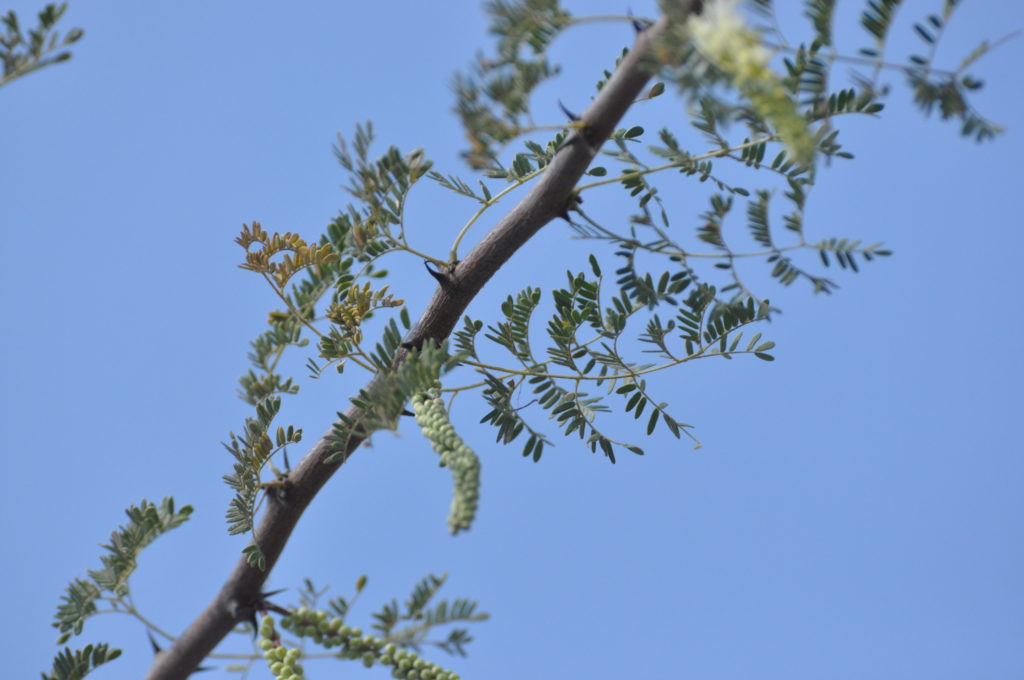
- 73. 2014/09/02. Mapungubwe NP. Photo: David Becking.
-
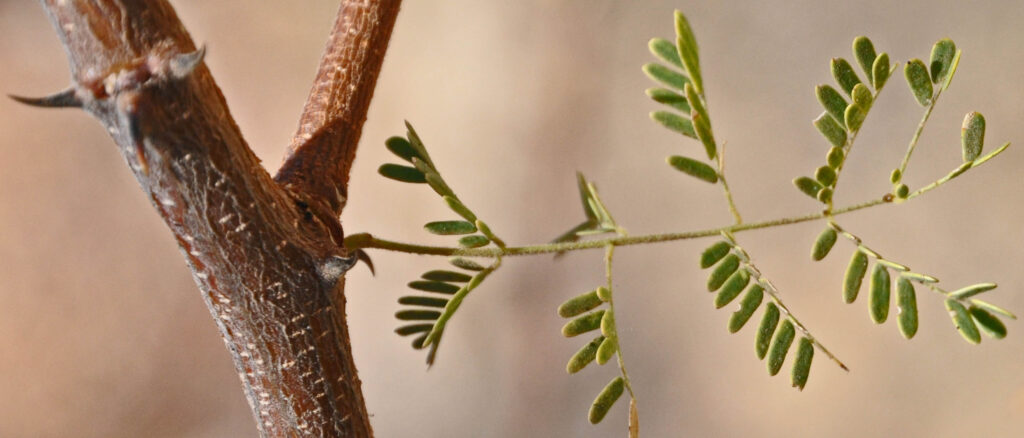
- 242. 2014/09/01. Mapungubwe NP. Photo: David Becking.
Flowers
The very small fragrant, bisexual Flowers are contained in hairless hanging cylindrical Spikes (simple indeterminate inflorescence with sessile flowers on a single unbranched axis opening in succession towards the apex – photo 238). The spikes are up to 8 x 2cm and occur singly or are in pairs at nodes (photo 72). The individual light-yellow flower buds are almost spherical (photo 72). On opening, a mass of exserted stamens protrudes through the yellow calyx. Each free Stamen has a white Filament. This, together with the yellow Anthers, makes the flowers appear creamy-white (photo 72). Present is a single Pistil (the female element of the flower composed of the ovary, style and stigma). After dispersal of the flowers own pollen the thin, single Style eventually elongates and extends beyond the anthers and the small, single concave Stigma becomes receptive to pollen. This procedure enhances cross-pollination. Bees and other insects Pollinate the tree. (May-Oct).
-
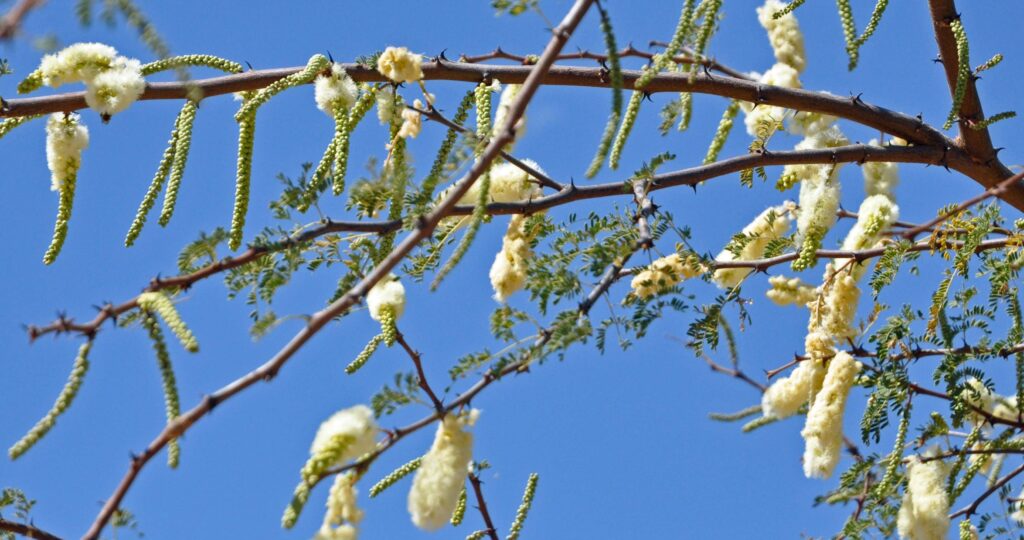
- 239. 2014/09/02. Mapungubwe NP. Photo: David Becking.
-
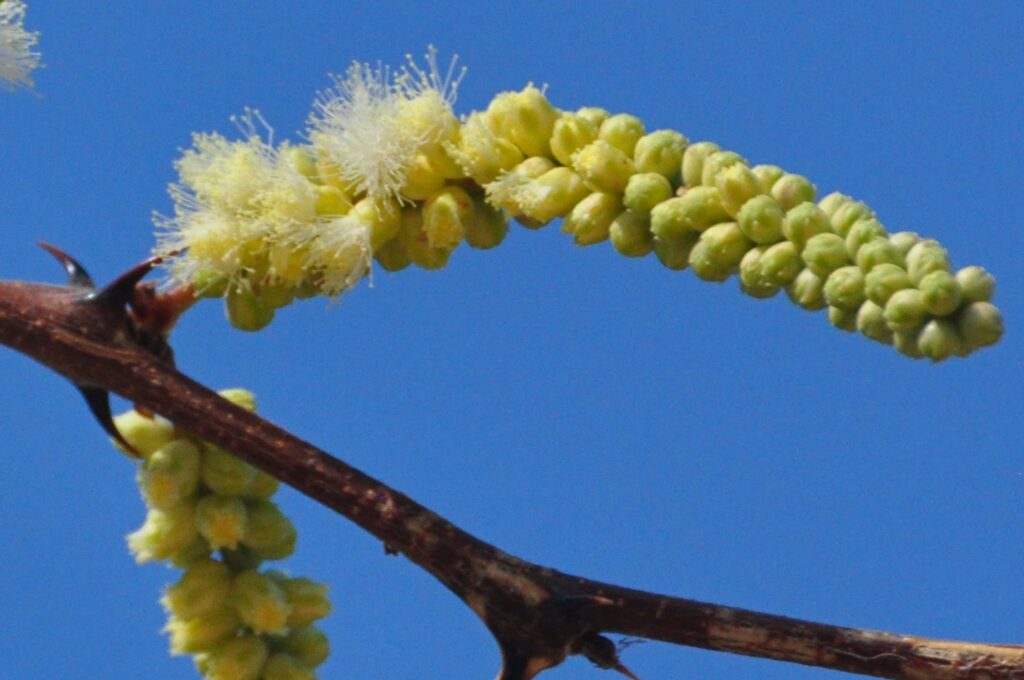
- 72. 2014/09/02. Mapungubwe NP. Photo: David Becking. 72. 2014/09/02. Mapungubwe NP. Photo: David Becking.
Fruit
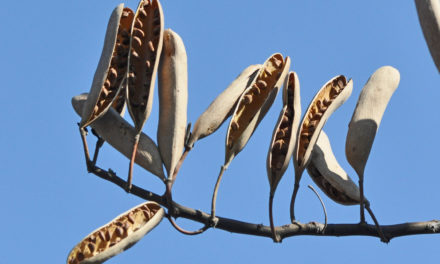
The straight, yellowish-brown, light brown or khaki Fruit is a flattish, papery Pod that is up to 9 x 3cm. It is connected to the stem with a short stalk. Pods are initially green and hairy but become broad, smooth and pale brown with a round apex (lacking a beak) when mature. In variety rostrate, the narrow pods usually have a beaked apex. Dehiscence normally occurs from January to July).
Distribution & Ecology
These plants are located in KwaZulu-Natal – north of the Tugela River, Mpumalanga, Limpopo, North West, Zimbabwe, Botswana, Mozambique and extending northwards to Ethiopia. This tree is a survivor and can withstand droughts and high temperatures, sandstorms and dry winds but is frost sensitive. The tree is a nesting ground for Crested and Pied Barbets. It is found in low altitude bushveld, often associated with alluvial or calcareous soil and is often is taller than the surrounding vegetation. The best conditions for optimal growth include a pH of 5-8, coarse textured soils with between 30-40cm rainfall per year and an altitude range of 100-1 700m. Black rhino consume Leaves. Trees live for about 26 years. Like other “Acacias” (Senegalia and Vachellia), its roots have atmospheric nitrogen fixing bacteria in a mutualistic relationship. The surrounding vegetation also eventually benefits from this relationship. This tree, in particular, is regarded as an excellent contributor to soil fertility and as a means of increasing crop production.
Ethnobotany
This tree, reportedly, produces the best Gum Arabic (a water-soluble sugary polysaccharide that is exuded to seal wounds and prevent infection by bacteria and fungi. They also prevent trees from freezing). This clear gum is a good quality and has been toxicologically shown to be a safe food additive. Gum Arabic contains a high level of dietary fibre. It is also an ingredient in many snack foods and candies, like gumdrops and marshmallows and may help to reduce cholesterol. After germination, the plant can produce gum after about 4 years. When bark extracted gum is mixed with water, it can be used to produce ink. The gum is used in the human and animal Medicine industry as a stabiliser for emulsions. Over 1 000 tons are exported to the UK each year. Harvesting occurs after the leaves fall and before winter set in. Cooked dry Seeds serve as a source of protein. It is a poor shade tree and allows grass to grow close to the trunk.
References
Boon, R. 2010. Pooley’s Trees of eastern South Africa. Flora and Fauna Publications Trust, Durban.
Burrows, J.E., Burrows, S.M., Lotter, M.C. & Schmidt, E. 2018. Trees and Shrubs Mozambique. Publishing Print Matters (Pty) Ltd. Noordhoek, Cape Town.
Coates Palgrave, M. 2002. Keith Coates Palgrave Trees of Southern Africa, edn 3. Struik, Cape Town.
Foden, W. & Potter, L. 2005. Senegalia senegal (L.) Britton var. leiorhachis (Brenan) Kyal. & Boatwr. National Assessment: Red List of South African Plants version 2020.1. Accessed on 2024/01/07.
Lawrence, G. H. M, 1951. Taxonomy of Vascular Plants, The Macmillan Company, New York. Tenth Printing 1965.
Palmer, E. & Pitman, N. 1972. Trees of southern Africa, Balkema, Amsterdam, Cape Town.
Schmidt, S. Lotter, M. & McCleland, W. 2002. Trees and Shrubs of Mpumalanga and the Kruger National Park.
South African Journal of Botany. Volume 119, November 2018. Pages 362-368.
van Wyk, B. & van Wyk, P. 1997 Field guide to Trees of Southern Africa, Struik, Cape Town.
http://www.kew.org/science-conservation/plants-fungi/acacia-senegal-gum-arabic
http://tropical.theferns.info/viewtropical.php?id=Senegalia+senegal
http://posa.sanbi.org/flora/browse.php?src=SP
https://www.sciencedirect.com.