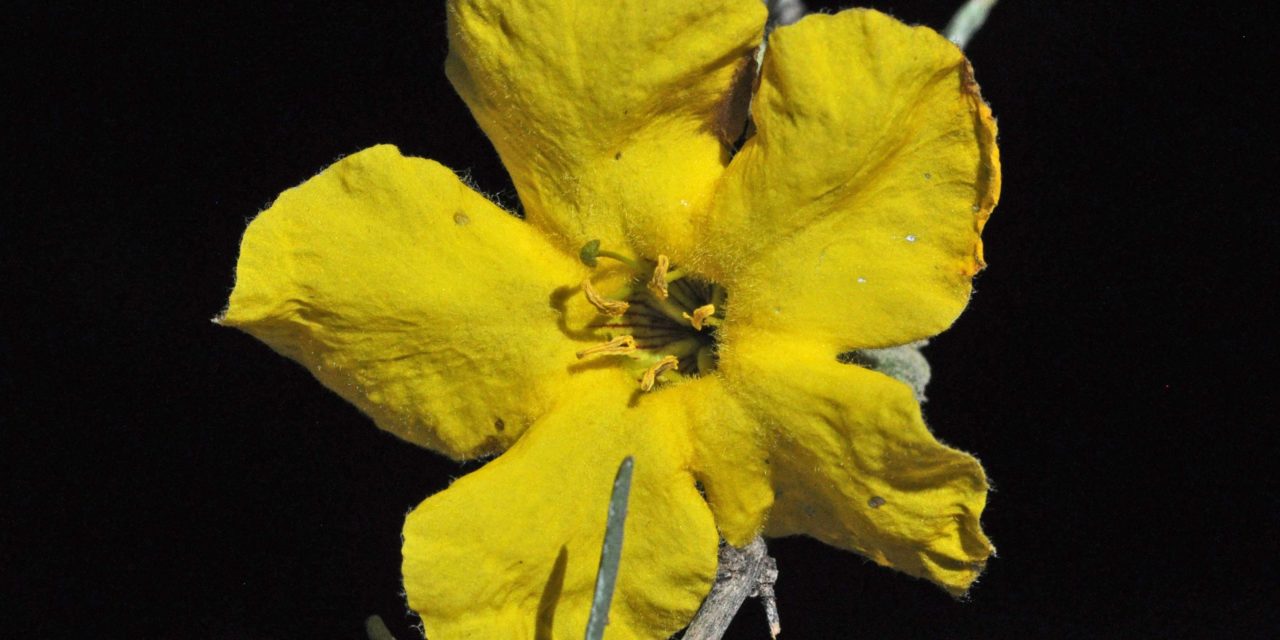
Rhigozum brevispinosum
General Info – summary
This multi-stemmed shrub may also be a small Tree up to 4m high. Leathery, hairy and narrow deciduous Leaves are usually simple with entire margins. Bisexual 5-merous Flowers are up to 4cm wide. Attractive, yellow horizontal petal lobes have slightly extending stamens. The green/brown Fruit is a capsule with a persistent calyx. Here the petals have fallen. The light brown seeds have papery wings.
Description
Previous Names: Rhigozum binifolium, Rhigozum linifolium, Rhigozum spinosum.
SA Tree No. 674
Common names: (Afr) Kortdoringgranaat. (Eng) Simple-leaved Rhigozum, Short-thorn Pomegranate. (Setswana) Mohurukwana.
Family Bignoniaceae (Jacaranda family). In this mainly tropical family, there are about 83 genera and 810+ species. In South Africa, there are 6 genera + 2 naturalised with a total of 13 species. The indigenous genera with trees on this website include Bignonia, Kigelia, Markhamia, Rhigozum, and Tecomaria. Most species are woody. Leaves are usually compound, opposite and lack stipules. The usually large and brightly coloured Flowers are bisexual and irregular. They usually occur in panicles or racemes or are solitary. The Calyx has 5 partly united sepals which are shorter than the usually 5 joined Petals producing a conspicuous tube. The petals are often 2-lipped with the upper lip having 3 lobes and the lower lip with 2 lobes. There are occasionally 2 but usually 4 didynamous Stamens (2 long and 2 short) which arise from the corolla tube. A single staminode may be present. The Anthers have 2 pollen sacs which dehisce longitudinally. There is a superior Ovary with 2 united carpels. Many ovules are present. The simple Style terminates in a Stigma with 2 flattened lobes. The Fruit is usually a bivalved capsule. Seeds are usually flat and usually have a glassy, translucent wing.
Name derivation: Rhigozum – rigid branches. brevispinosum – with short spines. This plant was first collected and named by William John Burchell (1781-1863). He was an English explorer, naturalist artist and author. He spent 4 years travelling in South Africa from 1811. His 7 000km trip was an amazing accomplishment at the time. There are 4 widespread species of Rhigozum in southern Africa.
Conservation Status: L C (Least Concern). Assessed: 2017.09.05 (L. von Staden).
Tree
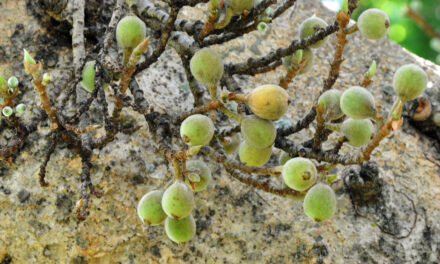
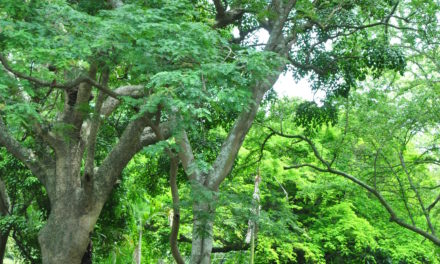
This plant is a shrub or a small Tree (photo 108) up to 4m high and is often multi-stemmed. The grey-brown Bark is finely striated (Photo 88). Paired short straight Spines are up to 10mm long and usually develop just above the leaves. Spines develop at right angles to the many rigid Branches. These slender grey-brown branches are quadrangular (photo 104 under Fruit), twisted and finely striated (Photo 88).
-
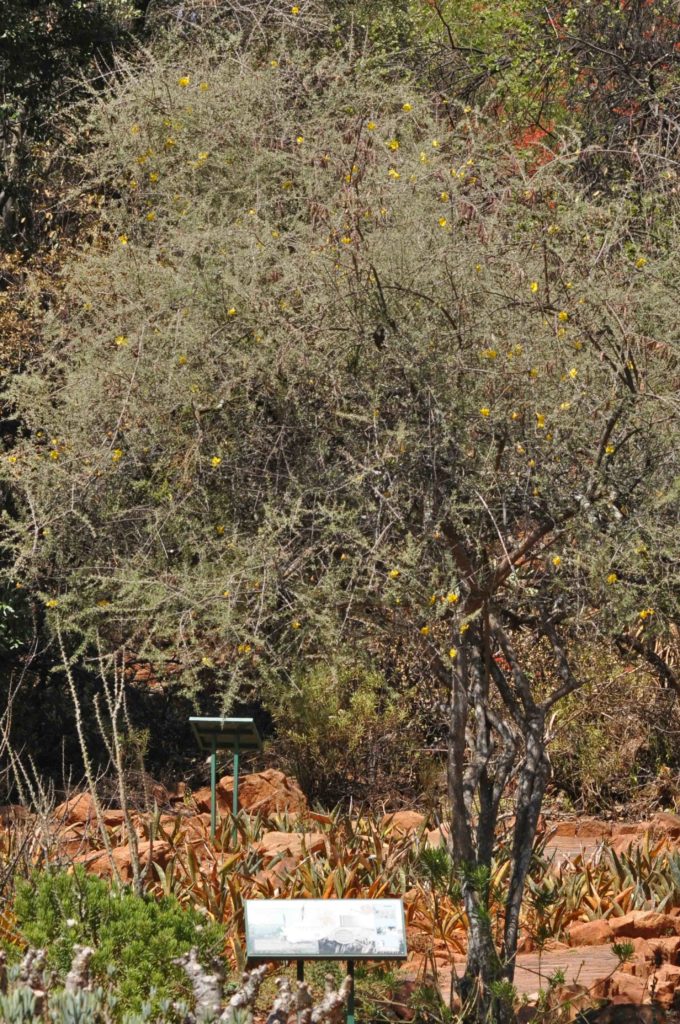
- 108. 2019/09/27. Pretoria NBG. Photo David Becking.
-
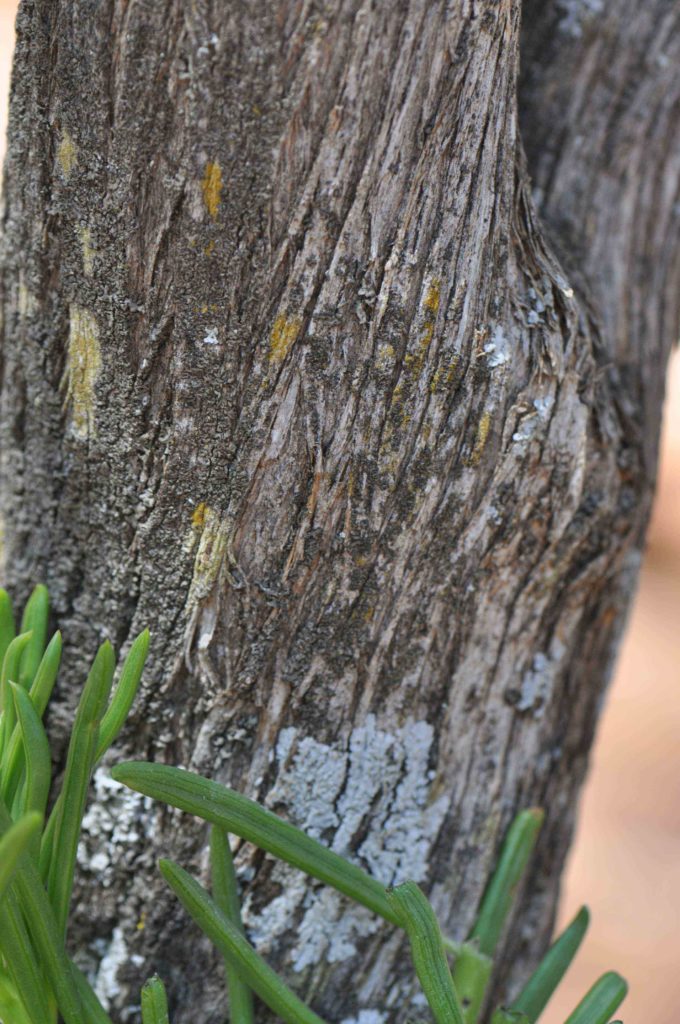
- 88. 2019/09/27. Pretoria NBG. Photo David Becking.
Leaves
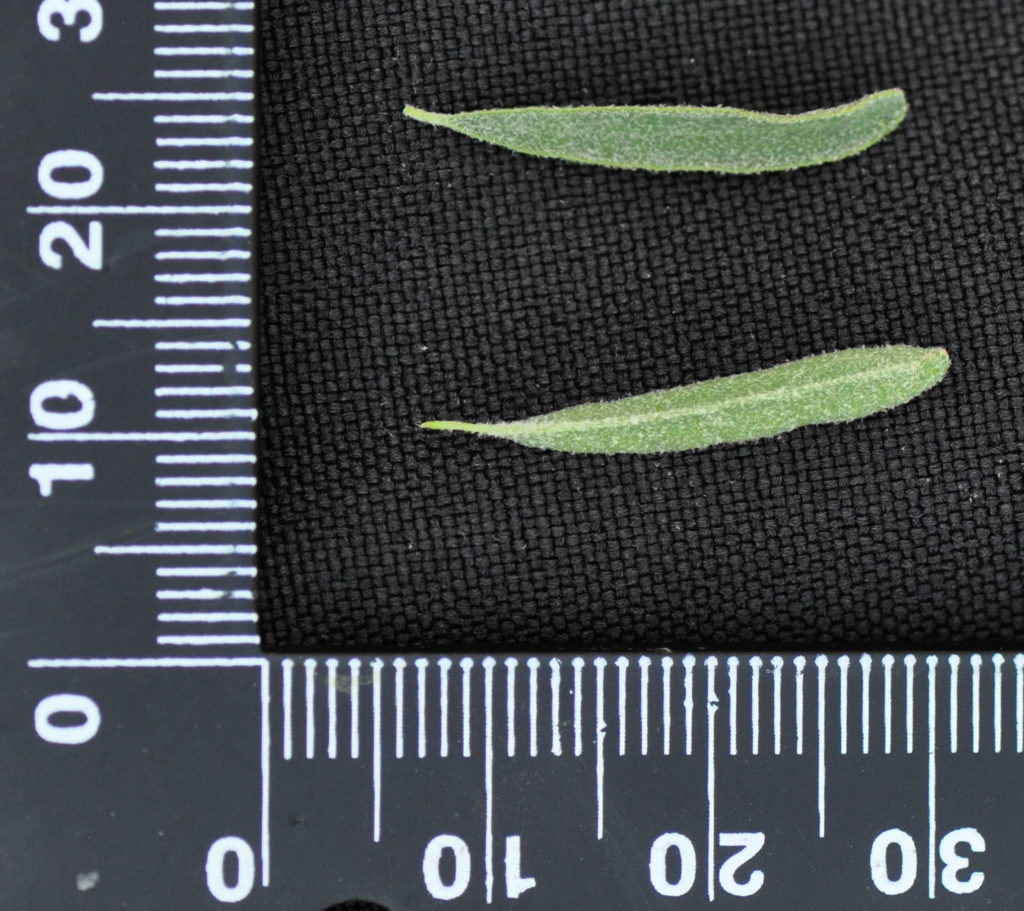
Leaves grow in tufts on velvety cushions (photo 100). The deciduous, thinly leathery Leaves are slender and elliptic or oblanceolate (the reverse of lanceolate, the leaf is broader at the apical third than at the middle and tapers towards the base – photo 102). The lower surface is a slightly lighter green. Leaves are occasionally trifoliate but usually simple (have a single blade which may have incisions that are not deep enough to divide the leaf into leaflets). Each leaf may reach 25 x 4mm (photo 102). The 3-5 leaves initially occur in alternate clusters on woolly cushions (photo 100) and may appear just below the short spines. Margins are entire (with a continuous margin, not in any way indented). Veins are indistinct and leaves are covered with short soft white to grey Hairs (photo 100). Here the protruding Midrib is more visible on the lower side (photo 102). The Apex is rounded photo 100) or notched. The Base tapers and is decurrent (leaf blades that partly wrap or have wings around the stem or petiole). As a result, the Petiole (leaf stalk) is short or absent.
-
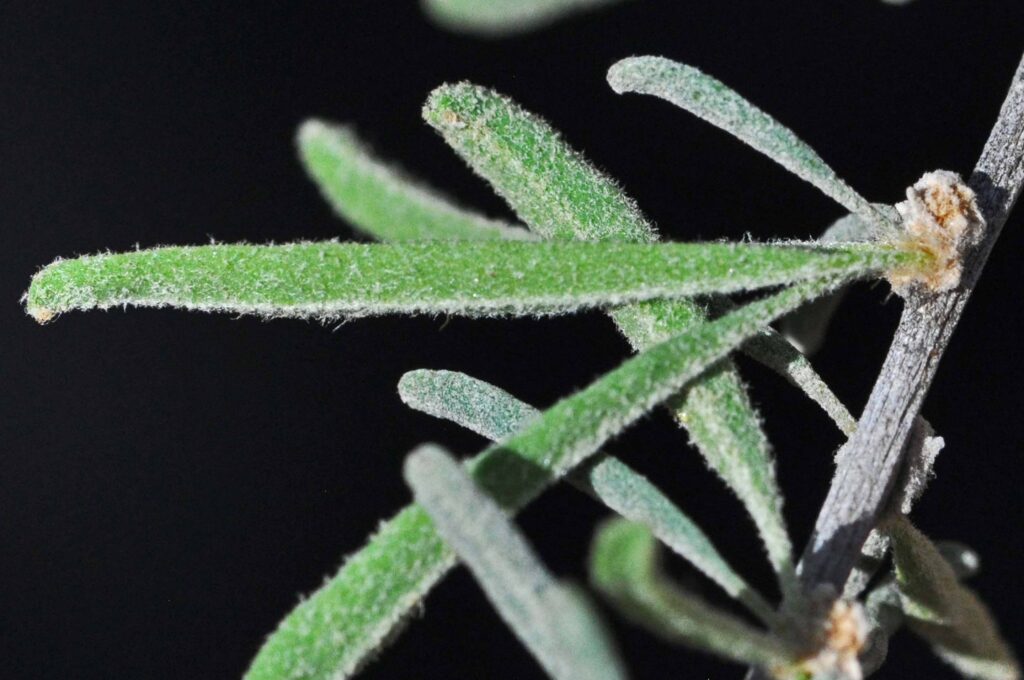
- 100. 2019/09/27. Pretoria NBG. Photo David Becking.
-
- 102. 2019/09/27. Pretoria NBG. Photo David Becking.
Flowers
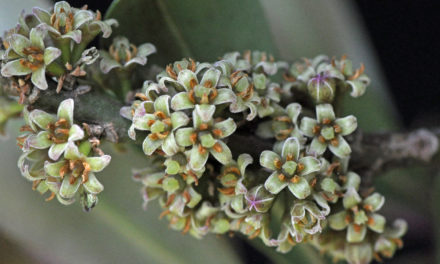
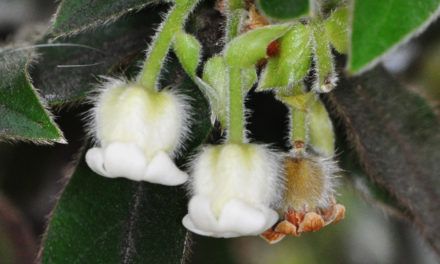
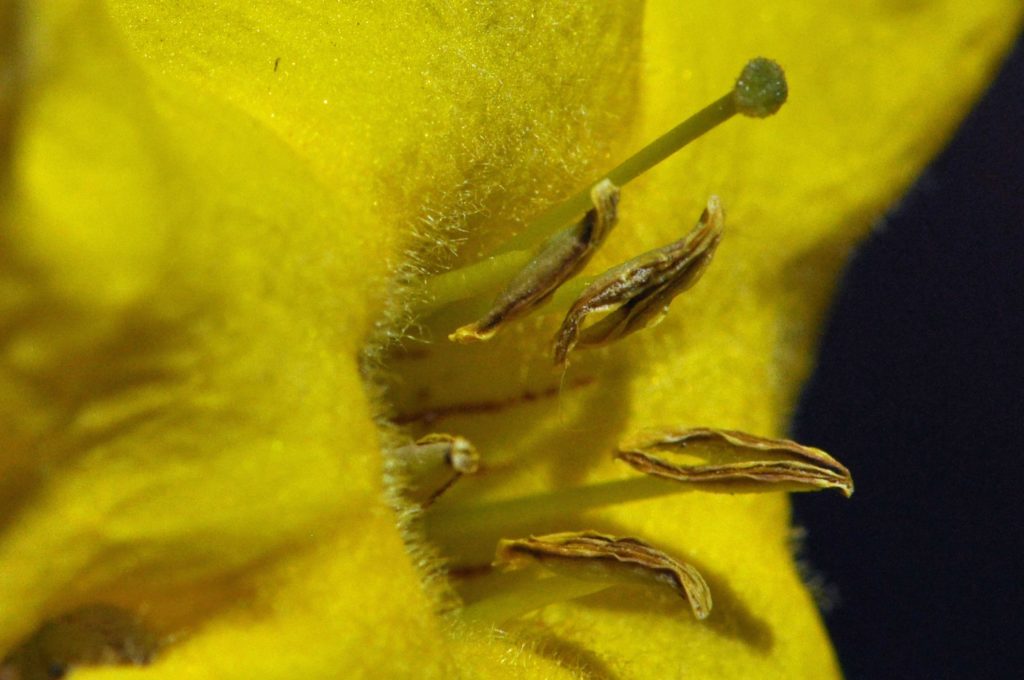
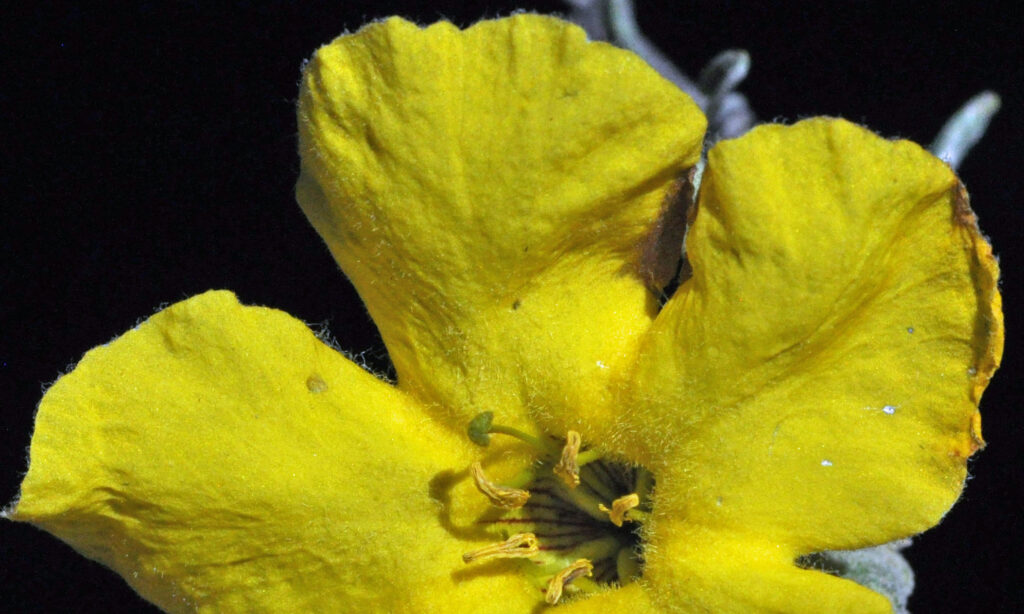
The attractive golden yellow bisexual and 5-merous Flowers are large – up to 4cm wide. They occur singly (usually) or in clumps. These flowers develop all along the branches sharing cushions with the leaves. The hairy Pedicels (stalks of single flowers) are up to 10mm long (photo 104 – under Fruit). The hairy bell-shaped Calyx (photo 104 under Fruit) is cylindrical near the base and campanulate (bell-shaped) higher up. It ends in 5 lobes. The bright yellow Corolla has spreading, obovate (like an upside-down egg, with the narrower end at the base) Petal Lobes. These lobes are distinctly crinkled, and wavy around the edges (photo 90). The, up to 2cm long, nearly cylindrical corolla tube, is visibly hairy near the mouth (photo 94). Reddish streaks may be visible in the throat (photo 90). Slightly exerted Stamens (male reproductive part of a flower) arise from the inside of the tube. Each Filament (the anther bearing the stalk of a stamen) is circular in cross section and hairy at the base. The 5 Anthers eventually produce the pollen grains). The anthers are oblong, up to 5mm long and dehisce longitudinally (photo 94). The ovoid bilocular Ovary contains many ovules. The green terete (circular in cross-section) Style extends slightly beyond the corolla mouth and ends in a capitate (shaped like a head) Stigma (the part that receives the pollen – photo 94). (Sep-Dec).
-
- 94. 2019/09/27. Pretoria NBG. Photo David Becking.
-
- 90. 2019/09/27. Pretoria NBG. Photo David Becking.
Fruit
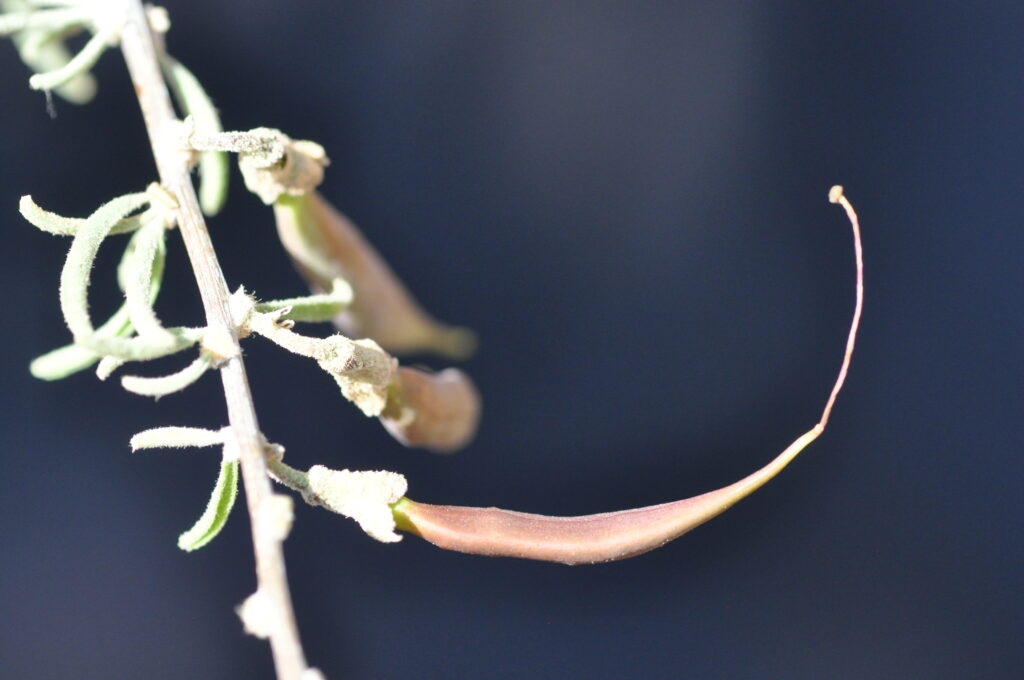
The young fruit Apex ends in a sharply pointed tip arising from the long style (photo 105). In this photo the remains of the stigma are still present. The smooth, light green to pale brown flattened and thin-walled pod-like Fruit is a compressed beaked Capsule (a dry fruit resulting from the maturing of a compound ovary that usually opens at maturity by one or more lines of dehiscence – photo 99R). Here the mature dehiscent capsules are up to 7 x 1,5 cm. In order to release seeds, the mature capsule splits perpendicularly down the centre (photo 105) into two valves that become loose. In this photo (and photo 104) the persistent calyx is visible at the Base. As the fruit matures the remains of the style falls and the fruit expands with its developing Seeds (photo 104). The light brown paper winged seeds are about 2 x 2cm – including the paper wings. Old brown empty capsules may remain on the plant for months. (Dec-May).
-
- 105. 2019/09/27. Pretoria NBG. Photo David Becking.
-
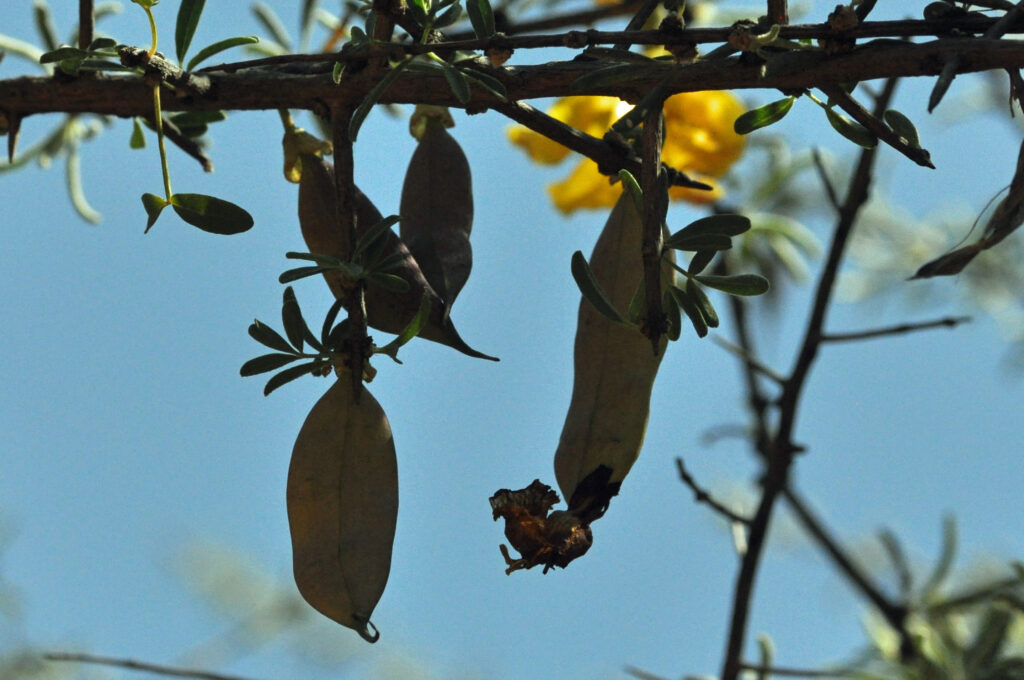
- 099R. 2019/09/27. Pretoria NBG. Photo David Becking.
-
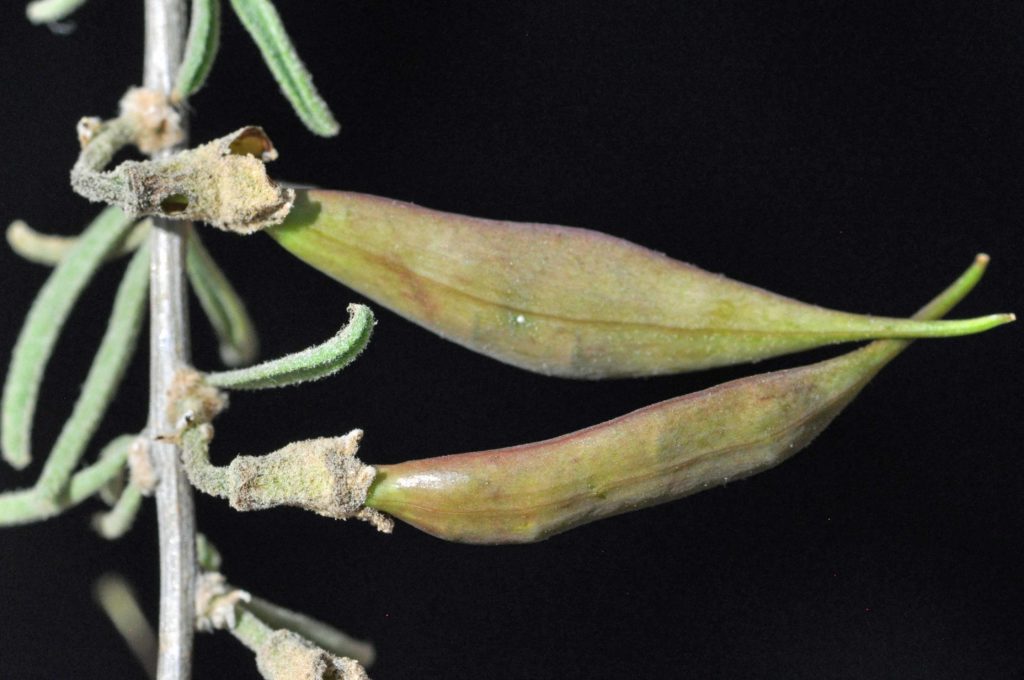
- 104. 2019/09/27. Pretoria NBG. Photo David Becking.
Distribution & Ecology
This plant Occurs in hot dry arid bushveld, open woodland, semi desert vegetation and dense low thornveld in river valleys. It may occur in rocky areas like the sides of koppies (koppie – a small, natural stony hill remaining up from the flattish African veld). It also occurs with limestone outcrops and even in sandy soils. Because the fruits and leaves are edible and located in dry areas, local animals take their toll. The altitude range is 700-1 250m. These trees occur in Northern Cape, Gauteng, North West, Mpumalanga, Limpopo, south-western Zimbabwe, Botswana, Angola, and are widespread in Namibia. Catopsilia florella (African Vagrant or Migrant) is a species of Butterfly whose larvae feed on the leaves of this plant and legumes e.g., Bauhinia galpinii as well as other plants. The males tend to be mainly white and the females mainly white or yellow.
Ethnobotany
The strong Wood is used to make digging sticks instead of spades and they work well. In places it is also used for fences. This Tree is browsed by stock. Some believe that plant parts have magical uses.
References
Coates Palgrave, M. 2002. Keith Coates Palgrave Trees of Southern Africa, edn 3. Struik, Cape Town.
Palmer, E. & Pitman, N. 1972. Trees of southern Africa. Balkema, Amsterdam, Cape Town.
Schmidt, S. Lotter, M. & McCleland, W. 2002. Trees and Shrubs of Mpumalanga and the Kruger National Park. Jacana, Johannesburg.
van Wyk, B. & van Wyk, P. 1997 Field guide to Trees of Southern Africa, Struik, Cape Town.
von Staden, L. 2017. Rhigozum brevispinosum Kuntze. National Assessment: Red List of South African Plants version 2020.1. Accessed on 2023/11/12.
Woodhall, S. 2020. Field Guide to Butterflies of South Africa, edn 2. Donnelley, RR, China.
https://www.zimbabweflora.co.zw/speciesdata/species.php?species_id=152350
http://www.samj.org.za/index.php/samj/article/view/5093/4021
https://plants.jstor.org/compilation/Rhigozum.brevispinosum
https://lizzieharper.co.uk/2019/02/flower-shapes-terminology/
https://www.madeirabirds.com/african-migrant-catopsilia-florella