
Found 303 Results
Page 26 of 51
Page 26 of 51
Galpinia transvaalica
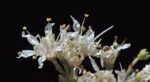
Galpinia transvaalica General Info – Summary This many stemmed shrub or small Tree has squarish young branches. Simple, leathery, shiny Leaves are entire, opposite and decussate with an apical midrib gland. The small white, usually 6-merous, bisexual, regular Flowers have crinkled petals and attract insects. They occur in terminal or axillary panicles. Fruit is a small […]
Freylinia tropica
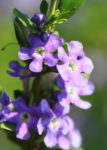
Freylinia tropica General Info – Summary This small attractive Tree may reach 7m high but is often a shrub up to 3m. Spreading branches are loose. The hairless, shiny and glabrous Leaves are simple with a lightly serrated the upper margin. Small, regular, bisexual Flowers with a 5 lobed perianth, didynamous stamens, a superior ovary, […]
Filicium decipiens

General Info – summary This attractive, dioecious and thornless Tree may reach 25m high and develops an almost spherical crown. Mature bark may have orange underbark. Paripinnate Leaves with widely spaced leaflets are fern-like. The midrib & petiole have leaf-like wings. Tiny, white, 5-merous, functionally unisexual Flowers are in terminal or axillary panicles. The Fruit is a […]
Ficus trichopoda

Ficus trichopoda General Info – Summary This monoecious, non-strangler fig Tree is up to 21m high & trunk + a unique horizontally spreading crown with descending prop roots. All damaged parts exude non-toxic milky latex. Large, simple Leaves are distinctly 3-veined at the base. The inflorescence is a syconium with a mutualistic relationship between the […]
Ficus sycomorus
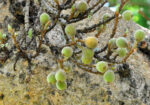
Ficus sycomorus subsp. sycomorus General Info – summary This historical and noble Tree is widely distributed throughout Africa. It has a wide trunk and is up to 12m high in SA. Non-toxic milky latex is present. The simple, alternate & entire Leaves are 3-veined from the base on this usually evergreen tree. Stipules are caducous. Flowers are […]
Ficus sur
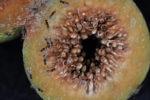
Ficus sur General Info – summary This non-strangler fig Tree is up to 12+m high with a light, smoothish bark and wide spreading roots. Damaged parts leak non-toxic milky latex. Simple, stipule-lacking Leaves are 3-veined from the base; the margin may have small teeth. The tiny monoecious Flowers occur in a syconium and are specific […]